
Lecture
The problem of thought in the afterlife occupies a unique position at the intersection of philosophy of mind, cognitive science and religious anthropology. Despite the absence of empirical data, the concept of postmortem thought continues to stimulate debate about the nature of consciousness, its dependence on a biological substrate and the possibility of existence outside the bodily shell.
The question of whether thought is possible after the death of the body remains a subject of speculative reflection in philosophy of mind, neuroscience, theology and cultural anthropology. The present article offers an analytical review of theoretical models that allow for the existence of cognitive activity in the afterlife, and examines the epistemological and ontological premises of such a hypothesis.
Thought has traditionally been regarded as a function of the brain, sustained by neural activity. However, in a number of philosophical and religious teachings consciousness is interpreted as an entity capable of autonomous existence outside the physical body. In the context of the afterlife, thought acquires the status of a transcendent phenomenon, unconstrained by material substrates.
The aim of this article is to systematize the existing theoretical approaches to thought in the afterlife, to identify the key epistemological and ontological premises, and to propose a model of hypothetical cognition outside the biological body.
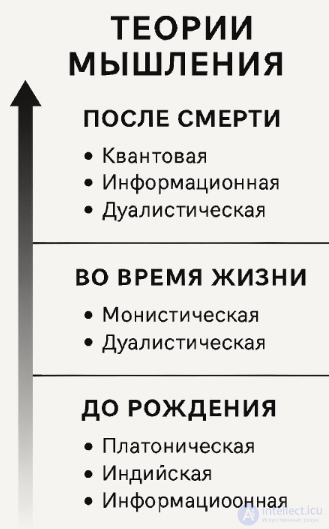
René Descartes, in his Meditations on First Philosophy, argued that thought is an attribute of the soul, independent of the body. In the dualist model, consciousness can persist after death, continuing to perform cognitive acts in an immaterial form.
Classical Cartesian dualism posits the existence of a thinking substance independent of the body. Within this paradigm, thought in the afterlife is possible as a continuation of the activity of the soul — res cogitans — after the body — res extensa — ceases to function.
Husserlian phenomenology allows for the existence of a transcendent I that can retain intentionality outside empirical experience. This opens up the possibility of thought as a pure act of consciousness, untethered to sensory perception.
Contemporary panpsychist theories (Galen Strawson, Philip Goff) suggest that consciousness is a fundamental property of matter. In this context, thought may be reorganized into another form of existence that does not depend on neural architecture.
Roger Penrose and Stuart Hameroff proposed the Orch-OR model, according to which consciousness arises from quantum processes in the microtubules of neurons. If consciousness is indeed linked to quantum coherence, then in theory it could persist in the form of a quantum field after the death of the body.
However, some theories, such as Penrose and Hameroff's theory of orchestrated objective reduction (Orch-OR), suggest that consciousness may be a quantum phenomenon potentially capable of existing outside the brain.
Some researchers (Tononi, Tegmark) regard consciousness as a form of organized information. In that case thought could be reconstructed or preserved as an informational pattern, potentially compatible with an immaterial medium.
| Theoretical model | Possibility of thought after death | Rationale |
|---|---|---|
| Dualism | Yes | Independence of the soul from the body |
| Materialism | No | Consciousness is a product of the brain |
| Quantum model | Possible | Cognition as a quantum field |
| Informational model | Theoretically possible | Consciousness as structured information |
The Book of the Dead (both the Egyptian and the Tibetan) describes states of consciousness after death, including the capacity for reflection, choice and even learning. These texts interpret thought as continuing in an altered form, often in the context of moral evaluation and transformation.
Christian doctrine asserts the preservation of personality and consciousness in the afterlife, which implies the presence of thought, memory and will.
A model is proposed in which thought after death may be represented as:
An emergent informational field preserving cognitive patterns
An emergent structure based on quantum superposition
A cognitive simulation in an immaterial medium
A simulated reality in which consciousness continues to function in a virtualized form
A quantum-integrated structure of consciousness that does not depend on biological carriers
It must be acknowledged that any claims about thought after death are speculative, since verifiable data are lacking. Nevertheless, their analysis helps to expand the boundaries of cognitive theory and stimulates the development of new models of consciousness.
The question of the existence of thought before birth goes beyond empirical science and touches on fundamental aspects of the philosophy of mind, the ontology of personhood and the theory of time. Unlike postmortem models, the hypothesis of prenatal thought presupposes the presence of cognitive activity before the formation of the biological brain, which requires a revision of basic conceptions of the nature of consciousness and its temporal boundaries.
In the dialogue Meno, Plato argues that the soul possesses knowledge acquired before birth, and that the process of learning is merely recollection (ἀνάμνησις). This conception presupposes the presence of thought in a pre-empirical state, outside the bodily shell.
In Vedantic and Buddhist teachings, consciousness is regarded as a continuous stream passing from one life to another. According to these models, thought may exist before birth in the form of karmic impulses, mental traces (Sanskrit vāsanā) that shape the future personality.
If consciousness is interpreted as an immaterial informational structure, then its temporal frame may be independent of biological onset. In that case, thought before birth may be represented as latent cognitive activity existing in potential form.
Some interpretations of the quantum theory of consciousness allow for the existence of cognitive states outside linear time. In this context, thought before birth may be part of a nonlocal quantum field in which information is not tied to chronological points.
| Model | Possibility of thought before birth | Rationale |
|---|---|---|
| Platonic | Yes | The soul possesses knowledge before incarnation |
| Indian | Yes | Consciousness as a continuous stream |
| Materialist | No | Thought begins with the development of the brain |
| Informational | Theoretically possible | Consciousness as an extra-biological structure |
| Quantum | Possible | Nonlocality and timelessness of cognition |
Modern research shows that the fetus is able to respond to sounds, light and the mother's emotional states as early as the late stages of pregnancy. Although this does not confirm thought before conception, it expands the boundaries of the cognitive onset.
In a number of cases (for example, in transpersonal psychology) subjective descriptions of "before birth" states are recorded. Although they cannot be scientifically verified, their existence stimulates philosophical reflection on the nature of consciousness.
As with thought after death, the hypothesis of prenatal thought faces a lack of objective data. Nevertheless, its theoretical consideration makes it possible to broaden the horizons of cognitive science and the philosophy of personhood.
The hypothesis of children's thought after death rests on the notion that consciousness does not depend on the degree of brain maturity but is an autonomous entity. A number of religious and philosophical systems (for example, Christian eschatology and the Tibetan Book of the Dead) assert that a child's soul retains the capacity for perception, learning and spiritual development after death.
The main question here is: will they acquire the thinking of an adult (communication, memory, etc.) after death? since during life it had not yet had time to develop (for example at the age of a few months)
Characteristics: an incomplete cognitive structure, but a potential capacity for development in the afterlife environment.
Models: eschatological pedagogy (the possibility of learning after death), the theory of latent consciousness.
Some theories allow that after death consciousness may be preserved not in full, but in a fragmentary or limited form.
This may be connected with:
Incomplete integration of the personality (for example, in the case of sudden death or a lack of spiritual preparation).
The preservation of separate cognitive modules — memory, emotions, intuition — without an integral "I".
Such models are found in transpersonal psychology and some esoteric teachings, where postmortem thought may be "split" or "clouded".
The main question here is: will they acquire full, objective, all-round, comprehensive, absolute thought after death?
Examples: fragmentary thought, limited reflection, cyclical repetition of mental patterns.
The question of whether animals have thought after death is bound up with the broader discussion of the nature of animal consciousness. If we allow that animals possess an elementary form of consciousness (experiences, instincts, emotions), then it may be supposed that these aspects can be preserved in an afterlife form.
Philosophical foundations: panpsychism, biocentrism, animism.
Models: the preservation of emotional patterns, instinctive reactions, attachments.
Some religious systems (for example, Jainism, Hinduism) allow for the reincarnation of animals and for their having a soul capable of postmortem existence.
The main question here is: will they acquire full, objective, all-round comprehensive, absolute thought (communication, memory) comparable to human thought after death?
4. on the basis of the questions proposed above a general question can be posed.
suppose that the afterlife exists, and that all three groups have attained absolute thought (enlightenment)
What prevents a healthy person (with limited thinking), a very small child and an animal from possessing absolute thought during life?
The paradox: despite the maturity of the brain, a person may possess limited thinking — fragmentary, reactive, unreflective.
The main obstacles:
Neural specialization: the brain is adapted to survival, not to enlightenment. Evolutionarily it is optimized for processing sensory information, decision-making and social adaptation, not for metaphysical self-knowledge.
Cognitive filters: beliefs, cultural norms and linguistic structures limit the perception and interpretation of reality.
Psychological inertia: habitual patterns of thought, emotional reactions and defense mechanisms prevent one from going beyond egocentric consciousness.
The temporality of thought: thought is bound up with linear time, which limits access to timeless forms of awareness.
Conclusion: absolute thought requires the deconstruction of the ego, the transcendence of neural patterns and going beyond biological adaptation — something that is very rarely achieved during life.
The paradox: a child is not corrupted by social constructions, but its thinking is immature and unstructured.
The main obstacles:
Immaturity of the neural networks: cognitive functions (abstraction, reflection, metacognition) are not yet formed.
The absence of a linguistic model: without language it is impossible to form complex concepts, including the idea of the "I" and of the "absolute".
Limited memory and experience: a child's thinking is based on immediate perception, without the capacity for deep integration and generalization.
Conclusion: a child may be closer to "pure consciousness", but does not possess the instruments to comprehend or express it.
The paradox: animals demonstrate emotional sensitivity, intuition and even elements of self-awareness, but do not attain abstract thought.
The main obstacles:
The absence of symbolic thought: animals do not operate with signs, language and logic in the human sense.
The dominance of instinct: animal behavior is determined by biological programs rather than by free reflection.
Limited neural architecture: although complex cognitive acts are observed in some species (for example, dolphins, elephants, crows), they do not reach the level of metaphysical reflection.
Conclusion: animals can experience, feel and even respond intuitively, but they do not possess the structure of thought necessary for absolute awareness.
Thought in the afterlife remains a speculative but methodologically fruitful topic — a concept situated at the junction of philosophy, neuroscience and cultural studies.
Its study makes it possible to expand the boundaries of our understanding of consciousness, stimulates the development of theories outside the materialist paradigm and fosters interdisciplinary dialogue between philosophy, neuroscience and cultural studies.
Despite the absence of empirical confirmation, its theoretical consideration makes it possible to rethink the nature of consciousness, its possible forms and the boundaries of its existence.
Absolute thought is not merely expanded consciousness but a qualitatively different form of cognition that goes beyond biological realization. During life it is limited by:
the biological architecture of the brain,
social and cultural filters,
the immaturity of cognitive structures,
the absence of abstract instruments in animals.
In the afterlife model, where these limitations are removed, it is possible to allow for the realization of thought as pure, non-structural, timeless awareness — what in philosophy is called enlightenment or gnosis.
Author Zu Han 2025

Comments