
Lecture
memory palace ( loci from the Latin - for “places”) is a memory enhancement strategy that uses visualisation of familiar spatial environments in order to improve the recall of information. The method of loci is also known as memory journey , the method of places, the method of loci , mind palace, spatial mnemonic . This method is a mnemonic device adopted in ancient Roman and Greek rhetorical treatises (in the anonymous Rhetorica ad Herennium , Cicero’s De Oratore and Quintilian’sInstitutio Oratoria ). Many champions of memory competitions use this technique to memorise faces, digits and word lists.
This term is most often encountered in specialised works on psychology, neuroscience and memory, although it was used in the same general way at least as early as the first half of the nineteenth century in works on rhetoric, logic and philosophy. John O’Keefe and Lynn Nadel refer to:
the “method of loci”, an imaginal technique known to the ancient Greeks and Romans and described by Yates (1966) in her book “The Art of Memory”, as well as by Luria (1969). In this technique the subject memorises the layout of some building, or the arrangement of shops on a street, or any geographical unit that consists of a number of discrete locations. Wishing to remember a set of items, the subject “walks” through these loci in his imagination and commits an item to each of them, forming an image between the item and any distinguishing feature of that locus. Retrieval of the items is achieved by “walking” through the loci, allowing the latter to activate the desired items. The effectiveness of this method is well established (Ross and Lawrence 1968, Crovitz 1969, 1971, Briggs, Hawkins and Crovitz 1970, Lea 1975), as is the minimal interference observed with its use.
The items to be remembered in this mnemonic system are mentally associated with specific physical locations. The method relies on memorised spatial relationships to establish order and to recall memorial content. It is also known as the “journey method”, used for storing lists of related items, or the “Roman room” method, which is most effective for storing unrelated information.
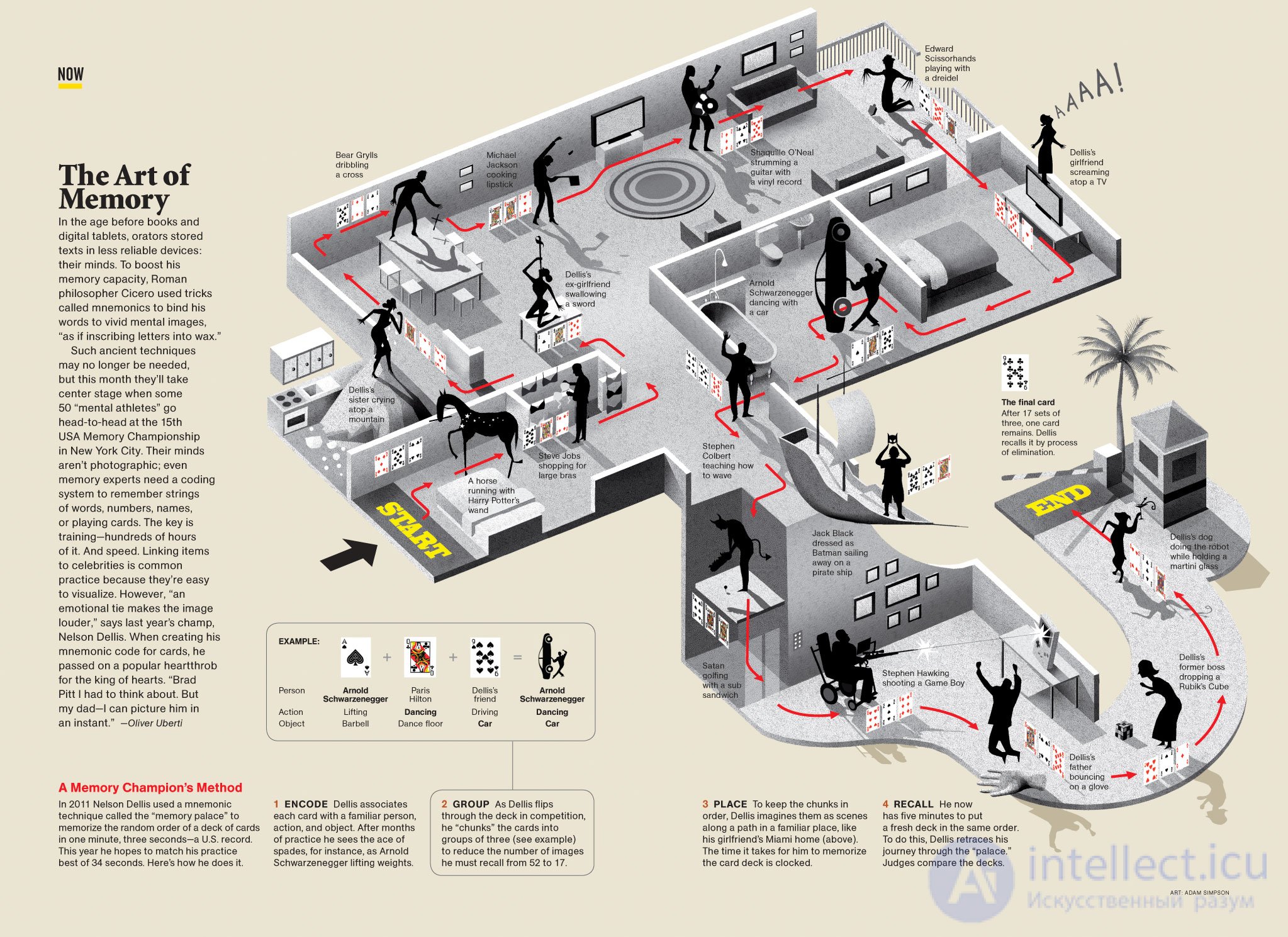
Many effective memorisers today resort to the “method of loci” to one degree or another. Modern memory competitions, in particular the World Memory Championship, were initiated in 1991, and the first United States championship was held in 1997. Part of the competition requires the memorisation and recall of a sequence of digits, two-digit numbers, letters of the alphabet or playing cards. Put simply, participants, using various strategies long before the competition, store in long-term memory a unique vivid image associated with each item. They have also memorised a familiar route with firmly established stopping points, or loci. Then, in the competition, they need only place the image they have associated with each item at the loci. To recall, they retrace the route, “stop” at each locus and “observe” the image. Then they translate this back into the associated item. For example, Ed Cooke, a Grand Master of Memory, describes to Joshua Foer in his book “ Moonwalking with Einstein”.how he uses the method of loci. First, he describes a very familiar place where he can clearly recall many different small locations, such as the sink in his childhood home or his dog’s bed. Cooke also advises that the more outlandish and vulgar the symbol used to memorise the material, the more likely it is to stick.
Memory champions refine this by combining images. This technique is used by eight-time World Memory Champion Dominic O’Brien. The 2006 World Memory Champion Clemens Mayer used a 300-point journey through his home to set a world record in the “numbers half-marathon”, memorising 1040 random digits in half an hour. Gary Shang used the method of loci to memorise pi to more than 65,536 (2 16 ) digits.
This technique is taught as a metacognitive technique in learning-to-learn courses. It is usually applied to encoding the key ideas of a subject. There are two approaches:
The method of loci has also been shown to help people suffering from depression to recall positive, self-affirming memories.
A study conducted at the University of Maryland assessed participants’ ability to accurately recall two sets of familiar faces using a traditional desktop display and a head-mounted display. The study was designed to use the method of loci with virtual environments resembling memory palaces. The study found an 8.8% improvement in recall in favour of the head-mounted display, in part because participants were able to use their vestibular and proprioceptive senses. [10]
Rhetorica ad Herennium and most other sources recommend that the method of loci should be integrated with other forms of elaborative encoding (i.e. the addition of visual, auditory or other data) to strengthen memory. [11] [12] However, because of the power of spatial memory, simply mentally placing objects in real or imagined locations without further elaboration can be effective for simple associations.
A variant of the “method of loci” involves creating imaginary places (houses, palaces, roads and cities) to which the same procedure is applied. It is generally accepted that the initial setup requires considerable effort, but after that performance matches that of the standard method of loci. The presumed advantage lies in creating towns and settlements, each of which represents a topic or field of study, which provides efficient storage of information and an easy route for the regular review needed for long-term retention in memory. [13] [14]
Something that is probably a reference to the “method of loci” technique survives to this day in the common English phrases “in the first place”, “in the second place” and so on. [15] [16]
This method is also used for learning second-language vocabulary, as described by the polyglot Timothy Doner in his 2014 TED talk. [17]
The designation is not used entirely consistently. In some cases it refers broadly to the so-called art of memory, whose origins, according to tradition, are linked to the story of Simonides of Ceos and the collapsing banquet hall. [18] For example, after telling the story of how Simonides relied on the memorised seating plan to bring to mind the faces of the recently deceased guests, Stephen M. Kosslyn notes: “[t]his insight led to the development of a technique the Greeks called the method of loci, which is a systematic way of improving memory by using imagery”. [19] Skoyles and Sagan point out that “an ancient memorisation technique called the method of loci, by which memories are directly correlated with spatial maps”, arose from the story of Simonides. [20] Referring to mnemonic methods, Verlee Williams mentions: “One such strategy is the ‘loci’ method, developed by Simonides, a Greek poet of the fifth and sixth centuries BC”. [21] Loftus cites the founding story of Simonides (taken more or less from Frances Yates) and describes some of the most basic aspects of the use of space in the art of memory. She states: “This particular mnemonic technique came to be called the ‘method of loci’”. [22]Although place or position certainly occupied a prominent role in ancient mnemonic techniques, no designation equivalent to “method of loci” was used exclusively to denote mnemonic schemes based on space for organisation. [23]
In other cases the designation is generally consistent but more specific: “The method of loci is a mnemonic device involving the creation of a visual map of one’s house”. [24]
This term can be misleading: the ancient principles and techniques of the art of memory, hastily glossed over in some of the works mentioned above, depended equally on imagery and on places. The designation “method of loci” does not convey the equal importance of both elements. The teaching of the art or craft of memory in general, as attested in classical antiquity, was far more comprehensive and encompassing in its treatment of this subject.
Brain scans of “superior memorisers”, 90% of whom use the method of loci, have shown that it involves activation of brain regions involved in spatial perception, such as the medial parietal cortex, the retrosplenial cortex and the right posterior hippocampus. . [25] [26]The medial parietal cortex is most associated with the encoding and retrieval of information. Patients with damage to the medial parietal cortex find it difficult to associate landmarks with particular places; many of these patients are unable to give or follow directions and often get lost. The retrosplenial cortex is also associated with memory and navigation. In one study of the effects of selective granular lesions of the retrosplenial cortex in rats, the researcher found that damage to the retrosplenial cortex leads to impairment of the capacity for spatial learning. Rats with damage to this area could not remember which areas of the maze they had already visited, rarely explored different parts of the maze, almost never recalled the maze in future trials, and needed more time to reach the end of the maze compared with rats with a fully functioning retrosplenial cortex.
In a classic study in cognitive neuroscience, O’Keefe and Nadel proposed that “the hippocampus is the core of a neural memory system providing an objective spatial framework within which the items and events of an organism’s experience are located and interrelated”. This theory provoked considerable debate and further experiments. It has been noted that “the hippocampus underlies our ability to navigate, to form and recollect memories, and to imagine future experience. How the activity of millions of hippocampal neurons supports these functions is a fundamental question in neuroscience, wherein the size, sparsity and organisation of the hippocampal neural code are debated”. [27]
In a later study, memory champions showed no specific regional brain differences during rest periods, but did show distributed functional changes in brain network connectivity compared with control subjects. When volunteers were trained in the use of the method of loci over six weeks, the training-induced changes in brain connectivity were similar to the brain network organisation that distinguished memory champions from the control group. [28]

Comments