
Lecture
Cognitive schemas are structures consisting of a set of basic and often unconscious assumptions about who I really am, what the world around me is like, and what I can expect from it. They concern the domains of performance, acceptance (self-acceptance) and power, which represents an excessive need to control oneself and the events around one (competence and autonomy). They are created under the influence of early childhood experience and may remain latent for varying periods of time. Cognitive schemas are usually activated under the influence of one or another triggering situation, and this can lead to distressing experiences that may also have occurred in the person's past.
The schema was first used as a basic concept by the British psychologist Frederic Bartlett as part of his theory of learning. The theory assumed that our understanding of the world is shaped by a network of abstract mental structures. The first to introduce the term "schema", however, was the Swiss psychologist Jean Piaget. According to his theory of cognitive development, children pass through several stages of intellectual growth, and a schema refers both to a category of knowledge and to the process of acquiring that knowledge. He believed that people, as they receive new information and learn something, are in a state of constant adaptation to the surrounding world. As newly acquired knowledge and experience emerge, new constructs are developed or old ones are modified. By making extensive use of this term in his own works, Piaget gave an unprecedented impetus to its popularization.
Psychology of the 1920s-1930s. 1948 - Edward Tolman, in the work "Cognitive Maps in Rats and Men", proposed the notion of a "cognitive map" in the sense of a "scheme of neural connections of the CNS (Central nervous system), in accordance with which the behavior of the organism is carried out".
Frederic Bartlett proposed a notion close to the modern one.
"Schema" in the sense of "a specially organized form of knowledge derived from past experience". On the basis of this knowledge we interpret current events and carry out our actual behavior.
Serial experiments. The participants of the experiment (7-10 people) had to listen to a text and then retell it to the next participant in the chain.
or
One person retells the text after various intervals of time (from several hours to several months).
Results of the experiment - In retelling, the text undergoes transformations.
Abbreviations. Titles, names, background details, and conclusions that fit poorly with the overall logic are gradually discarded.
Rationalizations - the narrator's introduction of his own judgments into the account.
filling in missing content;
introduction of details that clarify the content)
Bartlett suggested that these changes are constructive in nature.
The logic of the constructive processes on which reproduction is based is precisely the cognitive schema.
Bartlett's schema. The relations between the various components of a text should be reproduced consistently in the process of recalling the content of the text and summarizing it, while destroying the original structure of the text should reduce these possibilities.
An interesting observation: two texts about the same thing that have different structures are remembered better than two texts about different things that have the same structure.
In the 1970s-1980s the concept of the cognitive schema became firmly established in cognitive psychology and cognitive science.
Both followers of Bartlett and his critics appeared.
Criticism of Bartlett's approach to the cognitive schema. A number of scholars (Robertson, Anderson and others) believe that the results described indicate that in the process of understanding a text a reconstruction of the cause-and-effect relations between the components of the text takes place, rather than the storage in memory of certain formalized representations.
T. Trabasso's causal analysis of texts.
It is assumed that in the process of understanding textual information a reconstruction takes place of the causal chain linking the various components of the schema. The success of remembering one or another structural component of the text in this case depends on two factors:
its role in the structure of the schema;
the number of causal links of this component with others.
The modern view of cognitive schemas.
The assumption that memory contains a canonical structure of a text, including such components as orientation, complication, resolution, and theme. Each of these components may contain various substructures, which in turn are divided into smaller substructures. Thus, for example, the complication may consist of various episodes, and each episode of a subgoal, an attempt, and an outcome. In this way a segmented multilevel model of the text arises.
R. Schank. Scripts.
The processing of textual information is carried out first of all by drawing on background knowledge about the world - knowledge about habitual kinds of human activity, such as, for example, visiting a restaurant, renovating an apartment, the journey to work, and so on. This knowledge, it is assumed, is recorded in memory in the form of structures called scripts.
Difference from frames: scripts, unlike frames, describe a situation in its development; they usually consist of two or more scenes, include a specification of roles and a description of possible ways in which the scenes may develop.
The study of the nature of mental images. R. Shepard
The conclusion that mental images, i.e. internal representations, are more or less exact copies of objects. In any case they have the same spatial structure and organization as the objects themselves, although the exact metric relations within this structure may change.
Interpretation of the experiments. Two approaches to explaining the same experimental facts:
The analog approach came to be called the radical theory of images. The best-known proponent of this theory of images is the American psychologist S. Kosslyn.
The discrete approach is connected with the development of the ideas of neo-associationism and came to be called the propositional theory of images. Here one should mention first of all the works of the American psychologists Z. Pylyshyn and J. Anderson.
Further development
The following also grew out of cognitive maps and schemas:
PEST analysis
SWOT analysis
It can also be put this way: a cognitive schema is something like a set of instructions containing four points:
Cognitive schemas can be described as short propositions. For example, the attitude "all men are jerks" is an excellent example of a cognitive schema.
We are surrounded by a veritable chaos of information. In order to make some sense of it, we rely on cognitive schemas. This is convenient, since it reduces the organism's expenditure on the work of perception, but for this economy we pay with blindness.
Put more simply, we are more likely to notice what fits into our schemas.
Here is a typical experiment on this subject. Participants in the experiment were asked to watch a short video recording of a birthday party for a certain young woman. Half of the participants were told that she was a waitress. The other half were led to believe that the woman was a librarian.
As you will appreciate, "waitress" or "librarian" is already a cognitive schema (in plain terms - a label or a stereotype).
And when the experimenters activated these cognitive schemas, a miracle happened. The subjects who knew they were looking at a "waitress" remembered that she drank beer and stared at the TV. Whereas those who thought of the woman as a librarian remembered her glasses and her love of classical music.
Of course, in the clip the woman did both.
Cognitive schemas direct perception in such a way that people notice only what corresponds to the cognitive schema.
Suppose a husband is convinced that his wife - I quote - "doesn't respect him". What will he notice? Only what corresponds to this cognitive schema of his.
Those instances in which the wife did show him respect (whatever that may mean) the man will simply let pass by his consciousness. And he will suffer because of his wife's "disrespect" (although what he ought to be suffering over is the cognitive schema).
The same kinds of situations can occur with a woman, but let us not dwell on that. I think the point is clear.
A schema is a general representation laid down within us, a cognitive structure that performs the function of organizing and interpreting information. Schemas are useful because they allow us to find and use the shortest path for interpreting the enormous volume of messages from the surrounding world.
However, sometimes these mental constructs cause us to ignore important information and focus our attention on those things that confirm ideas and beliefs we already hold. In this way they contribute to the formation of stereotypes and hinder the assimilation of new knowledge that does not correspond to our already established worldview.
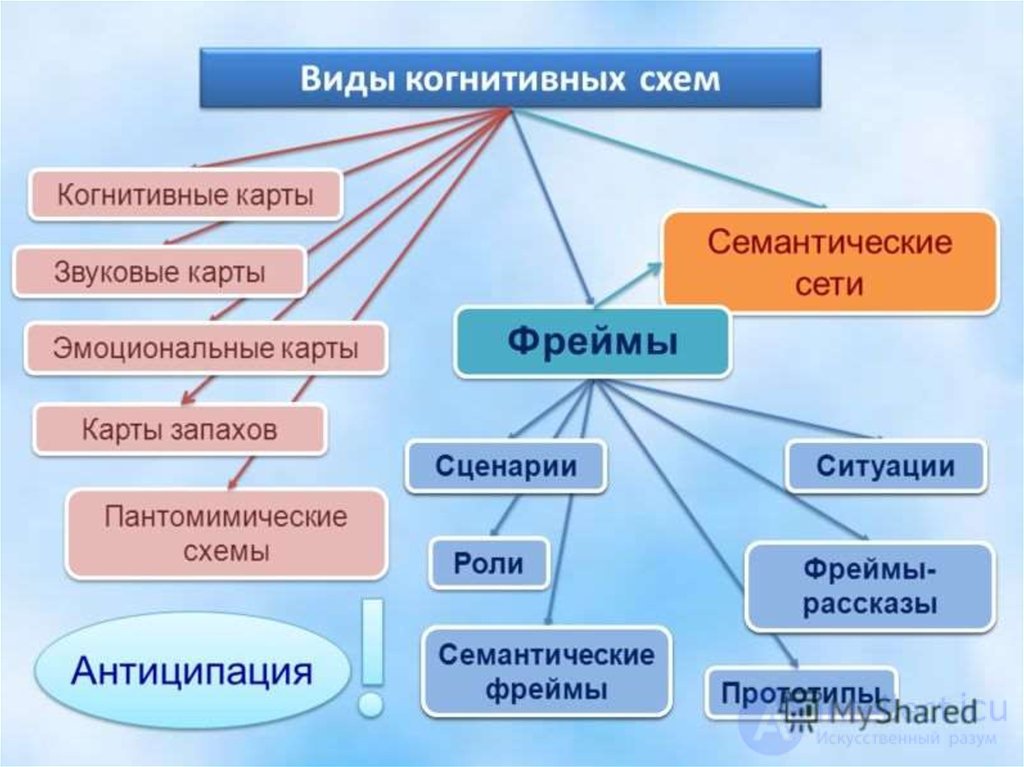
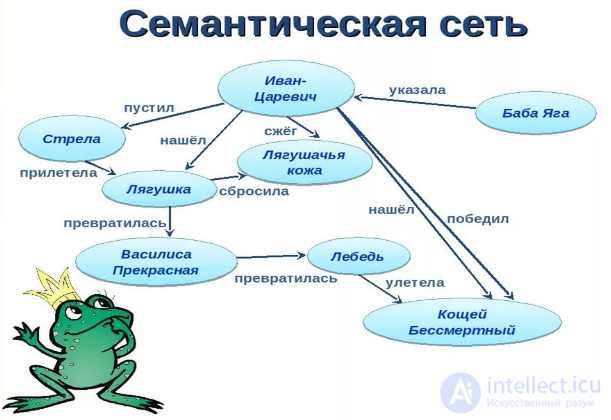
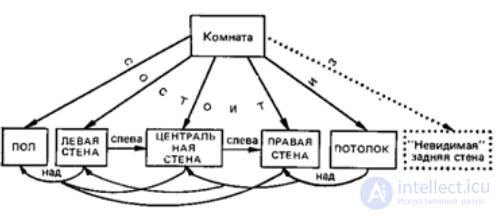
A semantic network is an information model of a subject domain that takes the form of a directed graph whose nodes correspond to objects
of the subject domain, while the arcs (edges) specify the relations between them. The objects may be concepts, events, properties, or processes.
A frame is an abstract image for representing a certain stereotype of information.
In psychology: anticipation, foreseeing, a representation of an object or event that arises before the act of perceiving it, the expectation of the occurrence
of an event. A representation of the outcome of one or another process that arises before it is actually achieved and serves as a means of feedback in the construction of an action.
In linguistics: the influence of a subsequent linguistic form on a form preceding it in a sequence.
A prototype is a cognitive schema that incorporates various signs, traits and features that we associate with people of a particular type, as well as with things, objects, and even with situations and circumstances.

The social stereotype is yet another variety of cognitive schema. These schemas are formed in relation to members of some social group:
ethnic, gender, age. A stereotype differs from a prototype both in the way it is formed and in the way it functions. Whereas
a prototype is, as a rule, based on individual experience and knowledge, a stereotype is based on social, public, group representations that the individual adopts from those around them as early as childhood.

A child, initially developing a schema for a horse, knows that it is big, that it has four legs and a tail. And when a little boy encounters a cow for the first time, he may easily identify it as a horse. After all, it does fit his construct of the characteristics of a horse - it is a large animal, it has four legs and a tail. As soon as he is told that this is a different animal, a cow, he modifies the existing schema of the horse and creates a new one, for the cow. Now let us imagine that this boy encounters a miniature horse for the first time and mistakenly identifies it as a dog. His parents explain to him that the animal before him is a very small type of horse and that, consequently, the child needs to modify his existing construct regarding it. Now he understands that although some horses are large, there are also very small ones. Thanks to new experience, already existing schemas are modified and new information is learned.
Despite the fact that Piaget focused on the stages of development in childhood, all people possess schemas. They continue to form and change throughout our entire lives. For example, with regard to objects. This is the type of construct that focuses on what an inanimate object is and how it works. Most people from industrially developed countries have a schema for what a car is. It includes many subcategories for different types of car, such as the station wagon, the sedan or the pickup truck. And over time, under the influence of the external world, this schema is constantly changed and updated.
What other types of schemas are there that people possess:
A reasonable question arises - is it possible to change anything?
The processes by which changes or corrections in schemas take place are known as assimilation and accommodation. In assimilation, new information is incorporated into already pre-existing constructs. In accommodation, as we learn new information and gain experience, we transform or form new schemas. Changes generally come about more easily in childhood, and as we grow up they become more difficult to bring about. And they often persist even when a person is presented with facts that fundamentally contradict their beliefs. However, under the influence of a continuous stream of evidence signaling and pointing to the need for change, we gradually change. Through such processes as adaptation and accommodation we create, modify and expand our schemas, providing a basis for understanding the surrounding world.
Cognitive schemas cannot be restructured. If you have once in your life formed such a schema in some way, it lives in your brain always, always. Always, always.
However, it is possible to create a new cognitive schema. It will not replace the old one but will be, as it were, on top of it. If you consolidate it well, it will work for you.
But the old schema will break through - in moments of illness, fatigue, hunger and similar states.
It is all like hanging wallpaper in a village house. There new wallpaper is usually pasted over the old. And if you scrape hard enough with a knife, you can find a copy of the newspaper Pravda from before the revolution.
In other words, we carry everything of our own with us. And sometimes it goes off.
Can this be lived through? Yes, and without any particular effort. It is enough simply to say to yourself: right, an old cognitive schema has surfaced, it happens. And it will all pass.
Schemas play a considerable role in the learning process. Let us give some examples:
In most cases the use of schemas in learning occurs automatically or with minimal effort, but difficulties may also arise in the process of mastering new knowledge. One of the most striking examples of this is prejudice, which prevents a person from seeing the world as it is. By maintaining certain beliefs regarding, for example, a specific group of people, this schema leads to the misinterpretation of various situations. When an event occurs that challenges these existing beliefs, the person tends to offer an alternative explanation, maintaining the current schema instead of adjusting or changing it.
A similar phenomenon can be clearly traced in gender expectations. In different cultures every person has a schema regarding what is considered masculine and what is considered feminine. And such schemas may possibly give rise to a stereotype about how men and women will behave in a given situation and what role characteristic of them they will display.
In one study, children were shown a series of pictures that corresponded to gender expectations (a man driving a car, a woman washing dishes). Other images were inconsistent with gender stereotypes (a man washing dishes and a woman driving a car). Later, when they were asked to recall what they had seen, children with fairly rigid views on matters of gender frequently misidentified the sex of the people in the gender-inconsistent images. That is, in most cases they confused the woman driving a car with a man.
Cognitive modeling is the determination, including by means of a computer, of the most effective management decisions and/or scenarios for the development of events on the basis of identifying notions (concepts, factors) that quantitatively and qualitatively characterize the emerging situation, as well as of assessing the mutual influence of the factors.
As a rule, cognitive modeling is carried out by a team of people (executives, managers, experts) responsible for the development
of some institutional structure.
A model for representing an expert's knowledge in the form of a signed digraph (a cognitive map) (F, W), where F is the set of factors of the situation and W is the set of cause-and-effect relations between the factors of the situation; methods of situation analysis.
Thus, cognitive schemas are the real masters of our consciousness. They govern almost all of our life. If we want to live happily, it makes sense to build ourselves working cognitive schemas.
A cognitive schema is a generalized and stereotyped form of storing past experience relating to a strictly defined subject domain (a familiar object, a known situation, a habitual sequence of events, etc.).
Cognitive schemas are responsible for the reception, gathering and transformation of information in accordance with the requirement of reproducing stable, normal, typical characteristics of what is happening (including prototypes, anticipatory schemas, cognitive maps, frames, scripts, etc.).

Comments