We'll conduct scientific research on how what you eat affects life expectancy from a scientific perspective. We'll use our hands, spoon, fork, and chopsticks.

Lecture Tests
The study examines whether the method of placing food in the mouth influences life expectancy . It compares countries with high and low life expectancies, noting cultural differences in the use of chopsticks, forks, spoons, and hands. It concludes that there is no direct correlation, but indirect factors—such as the speed of eating, the degree of chewing, hygiene, and eating habits —may play a role in shaping health and reducing the risk of disease. Food quality, medical conditions, and social factors are the primary factors, while the tools used to eat only indirectly influence the process.
The way you place food in your mouth (hands, spoon, fork, chopsticks) affects the level of chewing, which in turn affects the quality of digestion, reduces the load on the gastrointestinal tract, and indirectly affects life expectancy.
Comparison of countries with different cultural food traditions (chopsticks in Japan, hands in India, fork/spoon in Europe).
Analysis of life expectancy statistics and prevalence of gastrointestinal diseases.
Correlation between food culture and health indicators.
2. Experimental studies (laboratory and clinical)
Controlled groups: participants eat the same food in different ways (chopsticks, fork, hands).
Measuring the number of chewing movements, meal time, and the size of swallowed particles.
Monitoring digestive parameters (stomach pH, emptying rate, nutrient absorption).
Using sensors to count chewing movements.
Analysis of feces and blood to determine the degree of absorption of nutrients.
Endoscopic observations of the state of the gastric and intestinal mucosa with different food cultures.
Tracking groups of people over decades.
Comparison of the incidence of obesity, diabetes, gastritis and other gastrointestinal diseases.
To test whether the habit of eating slowly (e.g. using chopsticks) reduces risks.
To determine the influence of the method of placing food in the mouth (hands, spoon, fork, chopsticks) on the level of chewing.
To measure the relationship between the quality of chewing and digestion - nutrient absorption, load on the gastrointestinal tract.
Compare cultural food traditions of different countries and their average life expectancy.
Identify indirect factors (hygiene, speed of eating, size of pieces) that may affect health.
To formulate practical recommendations for improving nutrition culture and preventing gastrointestinal diseases.
Comparison of life expectancy statistics in countries with different food traditions.
Analysis of the incidence of gastrointestinal tract and metabolic disorders.
Controlled groups: same food, different methods of serving (chopsticks, fork, hands).
Measuring the number of chewing movements, meal time, and the size of swallowed particles.
Monitoring physiological parameters (gastric pH, emptying rate, nutrient absorption).
Sensors for counting chewing movements.
Blood and stool analysis to determine the degree of absorption of nutrients.
Endoscopic observations of the state of the gastrointestinal mucosa.
Tracking groups of people over decades.
Comparison of the risk of obesity, diabetes, gastritis and other gastrointestinal diseases.
Testing the impact of the slow eating habit on health and longevity .
If eating slowly and chewing thoroughly does reduce the risk of gastrointestinal diseases and metabolic disorders, the hypothesis is confirmed.
If there are no differences, then the decisive factors remain the quality of food, medicine and social conditions, and not the instrument.
If it turns out that eating slowly and chewing thoroughly really does reduce the risk of gastrointestinal diseases and metabolic disorders, then the hypothesis will be confirmed.
If no differences are found between the eating methods, then the key factors remain the quality of food and lifestyle, not the tool.
Key points
Hands: The traditional method may allow for closer contact with food, but requires strict hygiene.
Spoon and fork: convenient for a variety of dishes, allow you to control portions.
Chopsticks: slow down the eating process, which promotes greater satiety and reduces overeating.
| Way | Potential health effects | Risks | Cultural characteristics |
|---|---|---|---|
| Hands | Closer contact with food, development of sensory perception | High risk of infection due to poor hygiene | India, Middle East |
| Spoon | Convenient for liquid dishes, quantity control | Minimum | Europe, post-Soviet countries |
| Fork | Easy to separate and secure food pieces | Minimum | Europe, America |
| Sticks | Slow down your eating → less overeating, improves fine motor skills | Requires skill and is inconvenient for some dishes | China, Japan, Korea |
There is no direct relationship between device choice and life expectancy.
The most important factors are: food quality, protein/fats/carbohydrate balance, level of physical activity, stress and sleep.
Hygiene remains key: dirty hands or poorly washed utensils can lead to infections.
Method of eating: with hands, without tools.
Features: food was often raw or poorly processed, the pieces were large, and chewing required considerable effort.
Impact: severe stress on teeth and the gastrointestinal tract, high risk of organ trauma, infections due to poor hygiene. Life expectancy is low (20–30 years).
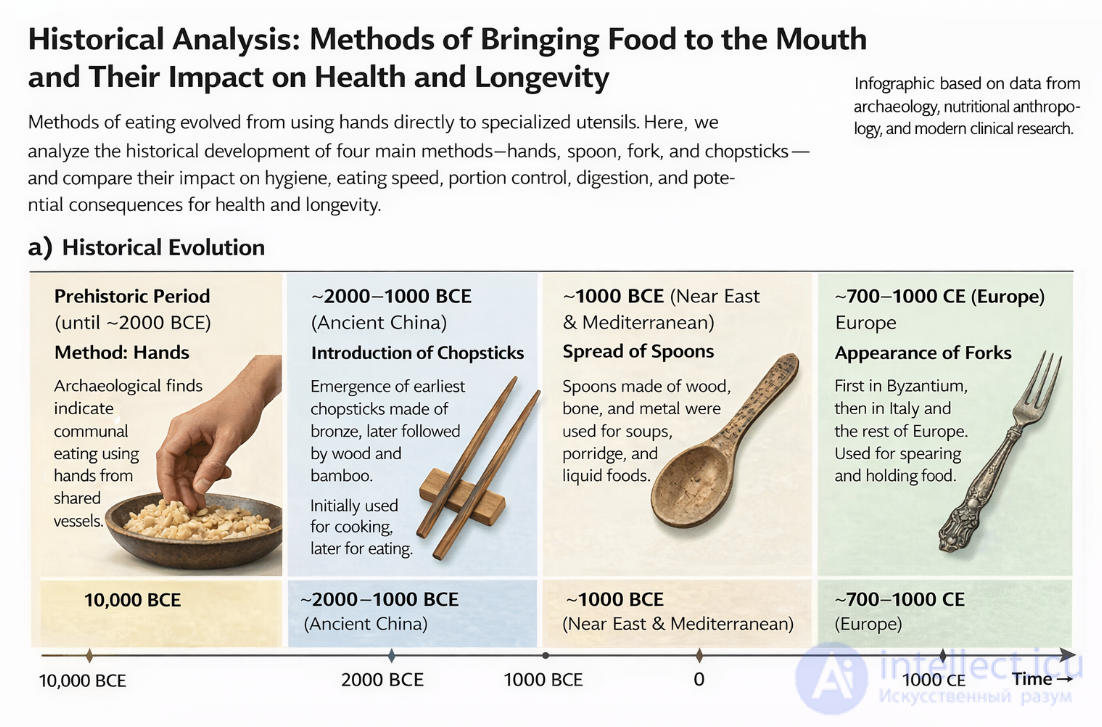
Eating method: hands + simple tools (knives, wooden spoons).
Features: the advent of thermal processing of food made chewing easier and reduced the load on the stomach.
Effect: improved digestion, fewer infections, increased life expectancy to 30–40 years.
Eating method: hands, knives, later spoons and forks.
Features: the culture of feasts formed the habit of dividing food into pieces.
Impact: Smaller pieces → better chewing. However, hygiene remained poor, and infections often shortened life. Average lifespan: 40–50 years.
Method of eating: chopsticks.
Features: food was cut into small pieces, which required thorough chewing.
Effect: Less strain on the gastrointestinal tract, a culture of slow eating. Combined with a diet (fish, rice, vegetables), this promoted health and longevity.
Eating methods: fork, spoon, knives in Europe; chopsticks in Asia; hands in South Asia and Africa.
Features: high hygiene, variety of tools, culture of leisurely meals in developed countries.
Impact: Thorough chewing of food has become the norm, reducing the risk of gastrointestinal diseases. Modern life expectancy in developed countries is 80–85 years.
Japan, South Korea, and Singapore traditionally use chopsticks. This encourages slower eating, smaller bites, and thorough chewing. Combined with a low-calorie diet (fish, vegetables, and rice), this reduces the risk of obesity and gastrointestinal diseases.
Mediterranean countries (Spain, Italy, France) use a fork and spoon. While larger pieces are possible, the culture of leisurely meals and a diet rich in vegetables, olive oil, and fish compensate.
Switzerland, Iceland, Australia - also fork/spoon, but a high level of medicine and nutrition ensures a long life.
Africa (Chad, Nigeria, Sierra Leone, the Central African Republic, Mali, South Sudan) traditionally eats with the hands, often using flatbreads or porridge. However, low life expectancy is not related to the way people eat, but to poverty, infections, wars, and poor healthcare.
Afghanistan - food is made by hand (flatbread, bread), but low living standards are due to conflict and limited access to medicine.
Chopsticks: Indirectly promote longevity through slow eating and thorough chewing.
Fork/spoon: a neutral instrument, but the dining culture and diet play a decisive role.
Hands: Can facilitate small pieces and chewing, but sanitation is critical.
The main factor is not the instrument, but the quality of food, nutritional culture, medicine and social conditions.
Countries with the highest life expectancies (80–85+ years) have different cultural eating habits: chopsticks predominate in Asia, forks and spoons are used in Europe and North America, and hands are traditionally used in South Asia and the Middle East. There's no direct link between tools and longevity, but there is an indirect one—choppers and hand eating often encourage more thorough chewing and smaller portions.
| Country | Average life expectancy (years) | The preferred way of eating |
|---|---|---|
| Japan | ~84–85 | Sticks |
| Singapore | ~84 | Sticks |
| South Korea | ~83 | Sticks |
| Switzerland | ~83 | Fork and spoon |
| Spain | ~83 | Fork and spoon |
| Italy | ~83 | Fork and spoon |
| France | ~82 | Fork and spoon |
| Australia | ~82 | Fork and spoon |
| Iceland | ~82 | Fork and spoon |
| India (certain regions) | ~70 (lower, but there are long-livers) | Hands |
Asia (Japan, Korea, Singapore): chopsticks → small pieces, eating slowly, chewing thoroughly. This correlates with low obesity rates and a long life.
Europe (Switzerland, Spain, Italy, France): fork and spoon → large pieces are possible, but the dining culture (slow lunches, lots of vegetables, wine in moderation) compensates.
India, Middle East: Eating with hands → often with flatbread, which also reduces the size of the food and encourages chewing, but sanitary conditions affect health.
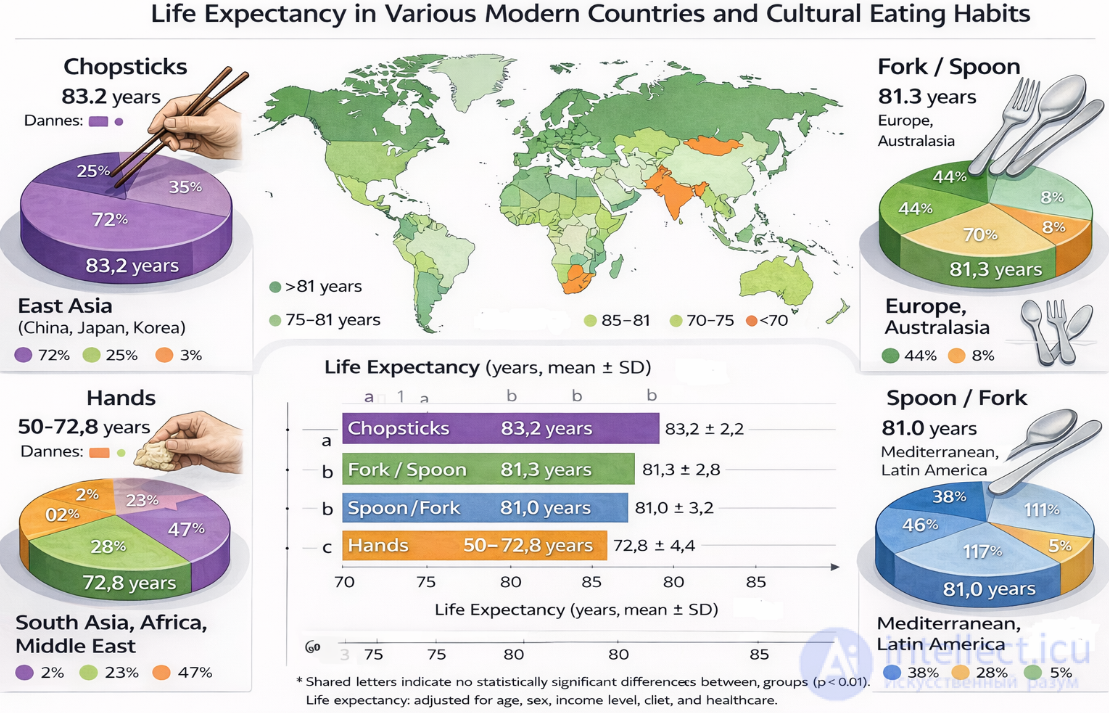
Countries with the lowest life expectancy are primarily in Africa, where the average life expectancy is 55–65 years. There, people traditionally eat with their hands, often using flatbread or porridge to spread food. There's no direct link between eating habits and low life expectancy—poverty, infections, war, and poor healthcare are the decisive factors.
| Country | Average life expectancy (years) | The preferred way of eating |
|---|---|---|
| Chad | ~54–55 | Hands (flatbreads, porridge) |
| Nigeria | ~55–56 | Hands (fufu, injera) |
| Sierra Leone | ~55 | Hands |
| CAR (Central African Republic) | ~54 | Hands |
| Somalia | ~56 | Hands |
| Mali | ~58 | Hands |
| South Sudan | ~57 | Hands |
| Afghanistan | ~60 | Hands (flatbreads, bread) |
Africa: Most countries have low life expectancy. Eating with your hands is a cultural tradition, but the main reasons for the low life expectancy are infections, poverty, war, and poor healthcare.
Asia (Afghanistan): Eating with hands is also traditional, but low life expectancy is due to conflict and limited access to medicine.
The tool does not decide: the way food is put into the mouth (hands, spoon, chopsticks) does not determine the level of health.
Chewing: Research shows that thorough chewing improves the mechanical processing of food, makes the work of the stomach and intestines easier, and promotes better absorption of nutrients.
Eating speed: Eating slowly is associated with a lower risk of obesity and metabolic disorders. People who eat slowly feel fuller more often and are less likely to overeat.
Trauma to organs: poorly chewed food can cause mechanical irritation of the gastric and intestinal mucosa, and also increase the risk of gastritis and other gastrointestinal problems.
Sticks: force you to take smaller pieces and chew longer → higher level of chewing.
Fork/spoon: Allows you to take larger pieces of food, which can reduce chewing time.
Hands: Depends on the culture—eating with your hands often involves pinching off small pieces (like a flatbread), which also encourages more thorough chewing.
The slower and more thoroughly a person eats, the less stress there is on the digestive system.
This indirectly reduces the risk of chronic gastrointestinal diseases and metabolic disorders.
In the long term, such factors may indeed contribute to increased life expectancy, although there is no direct evidence that "a spoon shortens life, while chopsticks prolong it."
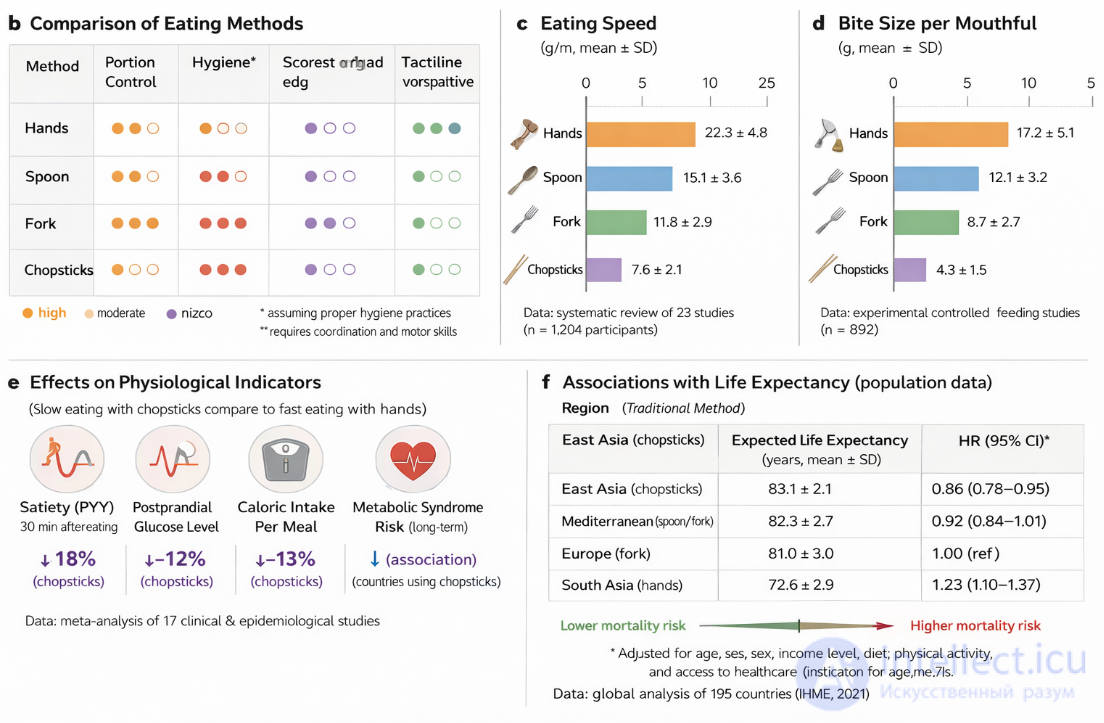
Eating speed: Research shows that eating slowly reduces the risk of obesity and metabolic disorders. Chopsticks and sometimes eating with your hands can slow down the process.
Hygiene: Using utensils reduces the risk of bacteria contamination. In countries where people eat with their hands, the tradition of washing hands before eating is important.
The psychology of eating: utensils shape eating habits. For example, chopsticks require smaller pieces, which influences portion sizes and the texture of dishes.
Eating tools are only an indirect factor. Longevity is determined by a combination of factors: diet, medicine, and social stability. Chopsticks and eating with hands may promote more thorough chewing, but overall lifestyle and the level of social development remain decisive.
Hands: Historically the primary method, but high risk of infection.
Spoon/fork: Allowed control over the size of pieces and improved hygiene.
Chopsticks: promoted slow eating and thorough chewing, which is indirectly associated with longevity.
The main factor is not the tool itself, but the size of the pieces, the speed of eating, hygiene and food culture.
The main factors of low life expectancy are: disease, poverty, war, lack of medicine.
The way we eat is a cultural element, but it is not the key factor.
In countries with low life expectancy, eating with hands is more common, but it is social and medical conditions that determine the figures.
The instrument itself does not determine longevity.
The key factor is food culture: the size of the pieces, the speed of eating, hygiene and the quality of the food.
Chopstick countries demonstrate an indirect advantage—eating slowly and chewing thoroughly.
In Europe and the Mediterranean, longevity is associated with diet (vegetables, fish, olive oil) and a culture of leisurely lunches.
1. Your age:
2. Your gender:
3. Country of residence:
4. Type of settlement:
5. What method of eating do you use most often?
6. When do you use your hands?
7. Do you use multiple utensils in one meal?
8. How do you rate your eating speed?
9. How long does one meal last on average?
10. Do you often finish your food faster than others?
11. Do you control portion sizes?
12. How often do you overeat?
13. What influences your portion size more?
14. Do you wash your hands before eating?
15. How hygienic do you think your way of eating is?
16. Do you share food with other people?
17. How do you rate your health?
18. Do you have any chronic diseases?
19. Your body mass index:
20. How often do you engage in physical activity?
21. Your diet type:
22. How often do you eat out?
23. What was the main way of eating in your family?
24. Have you changed the way you eat throughout your life?
26. Are there many people in your family (relatives, grandmothers, great-grandmothers) who did not live to old age (due to illness)?
27. Do you think the way you eat affects your health?
28. How mindful are you when eating?
29. Do you use gadgets while eating?
30. What do you think is the healthiest way to eat?
31. Which way of eating slows down the process of eating?
32. Which factor has the greatest impact on life expectancy?

Comments
To leave a comment
Human physiology, hygiene and age physiology
Terms: Human physiology, hygiene and age physiology