
Lecture
Microeconomics (Ancient Greek: μικρός — small; οἶκος — house; νόμος — law) — a branch of economic theory that studies the behavior of individual economic agents in the course of their production, distribution, consumption and exchange activities.
Microeconomics studies how and why economic decisions are made at the individual level: how consumers make purchasing decisions given the prices of goods and services and their income levels; how firms plan production given the level of technology and the prices of resources and finished goods and services; how workers decide where and how much they need to work, and how, as a result of individual decisions, an overall market equilibrium emerges that determines the price level, etc.
Microeconomics studies the models that are most basic to the economy as a whole. In-depth analysis of the behavior of economic agents is carried out within specialized fields, such as, for example, Contract Theory or Industrial Organization. Microeconomic models form the foundation on which macroeconomics is built. In modern macroeconomics, all the relationships between aggregate variables (GDP, inflation, unemployment, etc.) are obtained as the result of a multitude of individual decisions by economic agents.
This topic begins the study of the most important branch of general economic theory — microeconomics. It examines questions important for understanding the structure and content of the microeconomics course and the methods of microeconomic analysis.
Thus, a definition of the subject of microeconomics is given, and the content of the problem of choice in the economy is revealed through identifying the main problems of the economic organization of society.
The most important principles of economic analysis are examined — economic atomism, economic rationalism, and the equilibrium approach — and the main methods and techniques of microeconomic analysis are revealed.
Special attention is paid to the role of functional and marginal analysis and the modeling of economic phenomena and processes in microeconomic research.
The main branches of modern economic theory are microeconomics, macroeconomics and international economics.
Microeconomics studies the activity of individual firms, households and the government interacting in the markets for consumer goods and productive resources. Microeconomics assumes that the optimal equilibrium of the entire economic system (general economic equilibrium) emerges from the equilibrium of individual consumers (households), producers (firms), and the markets for consumer goods and resources. It reveals the mechanisms for the efficient allocation of scarce resources and the distribution of income, and serves as the basis for developing microeconomic policy.
Macroeconomics as a science studies the national economy as a single whole, treating as its objects of analysis the behavior of aggregated economic agents (the aggregate consumer, the aggregate producer, the government) interacting in the aggregated markets for labor, goods and services, and money. It assumes that the equilibrium conditions of individual economic agents and markets do not yet determine the optimal equilibrium of the entire economic system. Macroeconomics studies the mechanisms behind the development of various forms of macroeconomic instability (economic downturns, inflation, unemployment, external economic imbalance) and serves as the basis for developing macroeconomic policy.
Micro- and macroeconomics are closely interrelated. Microeconomic analysis serves as the basis for analyzing many macroeconomic processes. At the same time, the behavior of economic units is influenced by macroeconomic factors: aggregate demand, aggregate supply, the money supply in circulation, the level of employment, etc.
Microeconomics as a science studies the behavior of individual economic agents with the aim of identifying the conditions and mechanisms for the efficient use of scarce productive resources to satisfy unlimited human needs.
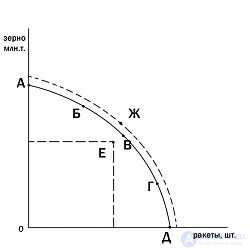
The scarcity, or limitedness, of resources lies in their insufficiency at any given moment in time to achieve different goals. Using a resource to produce one good rules out the possibility of using that same resource to produce another good. This determines the existence of the problem of choice, which consists in determining how to use scarce resources so as to best achieve the goals set. In choosing one of the alternatives, one must forgo the other (alternative) options. Therefore, choice is always associated with certain sacrifices, which are called opportunity costs. They reflect the price of choosing one or another course of action.
The problem of choice in the economy is made concrete by three problems of economic organization that face any society:
what to produce (which goods and in what quantities are needed by society)?
how to produce (which resources and in what combinations should be used in producing this or that output)?
for whom to produce (how should the output produced be distributed)?
The proposition about the mechanisms for the efficient allocation and use of productive resources for the maximum possible satisfaction of unlimited human needs, as the subject matter of microeconomics, was first put forward by Lionel Robbins.
In the article «The Subject-Matter of Economic Science» he wrote that «economic science is the science which studies human behaviour as a relationship between ends and scarce means which have alternative uses». From the economist's point of view, the conditions of human existence are characterized by the following four fundamental propositions: man pursues various ends; the time and means at his disposal are limited; they can be directed toward the achievement of alternative ends; at any given moment different ends possess different degrees of importance. Therefore it is necessary to find the optimal ways of applying the limited productive resources available to society.
The analysis of the behavior of households and firms is based on a number of principles that serve as assumptions (premises). One of the basic ones is the principle of economic atomism. According to it, economic agents are assumed to possess economic sovereignty and to make decisions independently of one another, with economic regularities emerging as the aggregate result of these decisions.
Another crucially important assumption about economic behavior is the principle of economic rationalism. Its essence lies in the fact that economic agents strive to maximize their net gain as the difference between costs and benefits: consumers maximize their total utility, and producers maximize their total profit.
The striving to maximize the results of all types of economic activity (for the consumer — maximizing utility; for the producer — maximizing profit) within certain constraints is regarded by microeconomic theory as the fundamental premise of economic behavior, which is defined as rational economic behavior. It is characterized by the systematic and purposeful nature of actions aimed at making results exceed costs.
A distinction is drawn between full, bounded, and organic rationality.
Full rationality is a theoretical assumption of a situation in which a person, possessing complete and reliable information, makes a decision that allows him to obtain the maximum benefit at minimum cost.
Bounded rationality reflects the impossibility of achieving full rationality due to the fact that a person strives for the best result but does not have sufficient information at his disposal (there are difficulties in gathering and analyzing it), and his cognitive abilities are also limited.
Organic rationality is characterized by the fact that interaction among people is rationalized by both formal and informal (for example, moral, ethical, religious) rules of behavior.
In real life, many economic agents do not always act rationally, which is determined by the following reasons:
real life is far more complex than theories, and a person making a decision is only able to absorb a limited part of the incoming information;
the decisions of individual people are not always determined by purely economic arguments — they can be influenced by psychological, moral and other factors.
Rational behavior on the part of economic agents is possible under a system of prices that are freely formed in the markets.
One of the remarkable properties of the price mechanism is the fact that prices, which convey information about the state of the market, simultaneously provide both the incentive and the means to react to this information. In this way, the stimulating (sometimes called the regulating, or sanitizing) function of the price mechanism is realized.
If consumers want to buy more of some good, its price will rise. This will be a signal to the producers (sellers) of that good that output (sales) should be increased. Those agents who correctly read market signals and act accordingly will receive additional income. Those who sell a good nobody needs, or produce it in a less-than-efficient way, will earn a lower income or incur losses, go bankrupt, and leave the market. In this way, economic agents receive incentives in the form of profits and losses to engage in economic activity that is most expedient and useful from the point of view of society.
Market prices provide communication (a link) between separate producers and consumers, giving them the opportunity to act in a coordinated way even when they never think about each other's existence. For example, the mayor of Paris does not have to «rack» his brains over how to supply the city's residents with the necessary quantity of the goods they need. The price mechanism solves this problem very successfully. Hundreds of thousands, millions of different items flow in daily from every corner of the world into the French capital. If someone wanted to regulate this process, the results of such activity would very soon provoke mass protests from the city's population. Although in conditions of some kind of emergency (floods, earthquakes, wars, etc.) the importance of the regulating role of the state in supplying its citizens with the necessary goods and services increases.
Prices also perform a distributive function. The income received by households (individuals) represents payment for the productive resources belonging to them — labor, capital, land, entrepreneurial ability. People's incomes depend both on the quantity and quality of these resources and on the prices established in the markets for factors of production.
The success of the functioning of the economy is largely determined by how effectively theory and economic practice are interconnected. The development of microeconomics, like that of other sciences, reflects real practice, and in this sense theory is secondary, dependent on practice, determined by its regularities, and intended to contribute to its improvement. Correspondence or lack of correspondence with practice, and the ability to explain and predict its development, is the ultimate criterion of the truth of a theory.
However, theory, while being conditioned by practice, exerts a substantial influence on the development of practice. Acting as guidelines and motivating impulses for practical action, theoretical concepts and forecasts, if they prove true, can contribute to the improvement of economic practice.
In the most general terms, economic policy can be defined as a set of measures aimed at regulating the behavior of economic agents (consumers and producers), or the consequences of their activity, in order to effectively achieve the economic goals that have been set.
The connection between the facts of economic life, theory, and economic policy is manifested in the fact that economic policy is based on theories, which are formulated on the basis of systematizing and generalizing facts. Defining microeconomic policy, at the first stage, involves above all the gathering, comprehension, classification, and interpretation of facts, events, and processes. At the second stage, the general principles of the economic behavior of microeconomic agents are identified, which serve as the basis for solving the task of the third stage: working out microeconomic policy, i.e., measures or decisions that ensure the correction or elimination of the problem under consideration.
The transition from the first and second stages of formulating economic policy to the third stage is a transition from positive microeconomics to normative microeconomics.
«Positive science, — wrote John Neville Keynes — may be defined as a body of systematized knowledge concerning what is; a normative or regulative science — as a body of systematized knowledge relating to what ought to be, and therefore concerned with the ideal as distinguished from the actual…».
Positive microeconomics is independent of normative judgments; its task is to create a system of generalizations that can be used to make correct predictions about the consequences that will follow from any change in circumstances.
At the same time, normative microeconomic science is not independent of positive science — any policy conclusion necessarily rests on a prediction of the consequences of one or another course of action, a prediction that must rely — explicitly or implicitly — on positive theory.
Economic theory, as a system of knowledge that explains economic phenomena and gives a holistic picture of the most essential relationships between economic variables, is based on the application of an integral system of techniques, methods and principles of analysis.
Research in the field of economic theory makes use of general-logical methods of cognition (abstraction, analysis and synthesis, induction and deduction, analogy), techniques and methods of empirical and specific-economic analysis (observation, description, measurement, comparison, grouping, modeling, expert assessment), principles of theoretical-economic research (economic atomism, economic rationalism, «other things being equal», the equilibrium approach), and methods of theoretical research (the systems approach, ascent from the abstract to the concrete, a combination of the historical and the logical). And this list is not exhaustive.
An important technique of economic analysis is abstraction. It consists in disregarding, in the process of cognition, the inessential aspects and in singling out the stable and characteristic features of the object under study. With the help of the method of abstraction, scientific concepts (categories) are formulated that express the essential aspects of the objects being studied.
Analysis and synthesis, induction and deduction are extremely significant general-logical techniques of economic analysis. A comprehensive study of an economic object requires, on the one hand, breaking it down into its separate constituent parts, and, on the other hand, — building up a coherent picture of it as a whole. This is achieved through analysis and synthesis. Through analysis, an economic phenomenon is broken down into its constituent parts, and each of these parts is examined separately. Through synthesis, economic theory reconstructs a single coherent picture by combining the separate parts into a unified whole.
Induction and deduction are also widely used. Induction (generalizing from observation) provides the transition from studying individual facts (from the particular, the specific) to general propositions and conclusions.
Deduction (inference) makes it possible to move from the most general conclusions to relatively particular ones.
It is impossible to apply analysis or synthesis, induction or deduction, one-sidedly; these methods of cognition must be applied together.
Analogy — is a technique of cognition based on transferring one or several properties from a known phenomenon to an unknown one. It plays an important role in the birth of new ideas and hypotheses. Many discoveries in economic theory have been made by analogy. François Quesnay, for example, proposed a fruitful analogy between blood circulation in the human body and the movement of flows of goods and money in the social organism. This allowed him to construct the first macroeconomic model of the circular flow of goods and money.
Many of the erroneous conclusions that people draw are due precisely to the fact that in their reasoning they fail to observe the rule according to which the consideration of each individual process should be carried out under the assumption of «other things being equal».
This requirement is the most important methodological principle of every science, but of microeconomics — especially so. The principle of «other things being equal» assumes that, in order to establish the influence of the chosen independent variable, an assumption is made that all other variables of the model remain unchanged except for the variable under study. For example, the magnitude of demand for a good is influenced by a great many factors: the price of that good, the prices of other goods, consumers' expectations regarding future price changes, the level of the population's income, etc. In order to find out how each of the factors listed affects the quantity demanded of a given good, it is necessary to assume that all the other factors remain unchanged.
The principle of the equilibrium approach means that economic phenomena are analyzed under conditions in which they are found to be in equilibrium, that is, in such a state in which economic agents have no internal motive to change the situation that has developed. This does not mean that economic theory ignores the possibility of change. It only means that, in its analysis, it relies on the study of states in which there exist forces that automatically offset deviations and tend to return a situation that has changed under the influence of external forces to its original state. It is assumed here that even substantial changes in a phenomenon are nothing other than a transition of the phenomenon from one equilibrium state to another equilibrium state.
The methods of theoretical research are widely used in microeconomics (the systemic approach, ascent from the abstract to the concrete, the combination of the historical and the logical).
Movement from the concrete to the abstract is characteristic of the first stages of cognition of any object. The concrete in this case serves as the starting point of cognition. Ascent from the abstract to the concrete makes it possible to reproduce the whole complex and diverse structure of the economy in a system of economic categories and laws. Economic laws are usually understood as stable, recurring, causally conditioned connections and interrelations of economic phenomena.
The principle of combining the historical and the logical states that the logic of presenting the subject of study broadly reflects the history of its formation and development. The historical — is a way of revealing the conditions for the development of phenomena in their historical sequence. The logical, unlike the historical, reproduces the whole that has taken shape as a system, revealing the role played by its individual elements. At the same time, the logical — is the same historical, but freed from contingencies.
The most important method of theoretical-economic analysis, widely used by economic theory, is the modeling of economic phenomena and processes, i.e., the study of the objects of cognition not directly but indirectly, through the analysis of certain auxiliary objects, which are called models. The task of modeling is to investigate the influence of certain factors on a phenomenon, to predict the consequences of changes in these factors, and to give a theoretical grounding for the observed dependencies.
Graphical models possess explanatory power to a greater degree. That is why they are widely used for teaching purposes. In this textbook, graphical models are one of the main ways of presenting material. Their advantage — lies in the compactness and easy visibility of all the relationships between variables. But they also have a drawback. Easily readable graphical models are two-dimensional, while three-dimensional ones are already not so easy to read, and multidimensional ones do not exist at all. This limits the explanatory power of graphical models.
Concepts of a marginal nature are widely used in economic models — marginal utility, marginal product, marginal costs, marginal revenue, and so on. Marginal (marginalist) analysis is based on the study of quantitative changes arising from an infinitesimally small change in some economic variable affecting the given phenomenon. For example, an increase in output by one additional unit of product will change the firm's gross income and gross costs — the magnitudes of these changes will constitute marginal revenue and marginal cost. Marginal analysis is a tool for forecasting the behavior of economic agents. It makes it possible to answer the questions: how will consumers spend their income; which goods, in what quantities, and with what resources will firms produce?
Functional analysis is the most important method for studying economic phenomena. It makes it possible to investigate the patterns of change in one economic quantity as a function of another and to establish the way these quantities are related.
It should be kept in mind that the presence of a functional relationship indicates only an existing correlation, not a cause-and-effect relationship between them. However, this does not diminish the value of functional analysis. The relationships uncovered make it possible to establish interconnections between economic phenomena, as well as to identify the factors affecting them and the conditions for reaching equilibrium.
Economic models include two types of variables — exogenous and endogenous. Economic variables whose parameters are set outside the model are called exogenous (external) economic variables. Economic variables whose parameters are determined within the model are called endogenous (internal) economic variables.
Depending on the extent to which the time factor is taken into account in the study of economic processes, a distinction is made between short-run (to a certain extent — static) and long-run (dynamic) analysis. All the parameters of short-run models relate to one and the same period of time. In such models it is assumed that endogenous variables respond instantaneously to changes in exogenous parameters. Long-run models contain variables relating to different periods of time, so these models reveal the movement from the initial state to the final one (for example, models of economic growth).
According to the way they are measured over time, a distinction is made between economic flow variables and stock variables.
Flow variables are measured by the quantity of something per unit of time (for example, investment expenditure over some interval of time).
Stock variables represent a quantity fixed at some point in time (for example, the amount of fixed capital in the national economy at the end of the year).
Macroeconomic models reflect various types of functional relationships between endogenous and exogenous economic variables: technological, behavioral, institutional.
An example of a technological functional relationship can be the production function, which reveals the technological dependence of a firm's output on the quantity and combination of the production resources it uses: Y = F (K, L), where K and L — are, respectively, the quantities of capital and labor used.
Behavioral functional relationships reflect the established preferences of economic agents. For example, the dependence of private firms' investment on the real interest rate (I = I(r)) characterizes the investment behavior of producers of economic goods.
Institutional functional relationships express the interconnections between economic variables and the state institutions that regulate economic activity.
Microeconomics studies economic relations connected with the efficient use of limited resources. Within microeconomic models it is assumed that agents choose the option for using limited resources that is best from the standpoint of some criterion. Microeconomics proceeds from the premise of rationality or bounded rationality in the behavior of economic agents. Irrational choice is studied within behavioral economics.
Microeconomics includes the following branches:
There are specialized branches of economics which, building on the basic ideas of microeconomics, study particular aspects of the behavior of economic agents in greater depth.
Microeconomics uses general and specific methods. General methods include: abstraction, analogy, induction, deduction, analysis, synthesis. Specific methods include:
0. Classical political economy: within the research of the classics of political economy — Adam Smith, David Ricardo, Jean-Baptiste Say, Thomas Malthus — the consideration of microeconomic aspects of the national economy's activity was an integral part of general economic reasoning about the causes of the formation of wealth.
I. «before 1871» no well-known scholarly work appeared proposing a new system of economic thought to replace the classical one. However, works did appear that proposed individual approaches which later became part of the toolkit of economic theory. Thus, in 1826 the German Johann von Thünen was the first to use differential calculus in economic science and proposed his own version of differential rent in spatial economics. The Frenchman Augustin Cournot in 1838 proposed a version of the analysis of firm behavior in the market (the «Cournot model»). In 1854 Hermann Gossen studied the psychological factor in the economic behavior of agents and formulated the laws of the satiation of human needs.
II. The 1871−1880s. The «marginalist revolution» of 1871—1874 (the use of marginal quantities in analysis and the abandonment of the labor theory of value by the Austrian Carl Menger, the Englishman William Stanley Jevons, and the Swiss Léon Walras) led to the formation of a new discipline, called in English «economics» («economic theory»).
The Austrian school — Carl Menger, Eugen von Böhm-Bawerk, Friedrich von Wieser — discovered the principles of marginal utility and proposed an ordinal (ordinalist) approach to its definition. By modernizing the theory of marginal utility, the American John Bates Clark created the theory of the marginal productivity of the factors of production. The mathematical school of William Stanley Jevons and the Lausanne school of Léon Walras used the apparatus of differential calculus to analyze the behavior of both the consumer and the producer under perfect competition. At the same time, Léon Walras, for the first time since François Quesnay's «Tableau économique», proposed a mathematical model of the general economic equilibrium in the economy.
III. The 1890−1920s. In 1890 the English economist Alfred Marshall published his monograph, which became the main textbook on microeconomics for the first half of the 20th century. He proposed a compromise version of the determination of market value by marginal utility and the costs of production, and formulated the Law of Supply and Demand. Arthur Pigou continued Marshall's research, analyzing the situation of monopoly markets and options for government regulation of the resulting market imperfections by means of taxes.
Representatives of the mathematical school (Vilfredo Pareto, Francis Edgeworth), using mathematics as a tool of economic research, proposed a cardinal (cardinalist) approach to the definition of marginal utility and provided the grounding for the theory of general economic equilibrium.
IV. The 1930−1960s. Microeconomics is enriched with new discoveries. Publications of the 1930s saw the start of active research into situations of monopolistic competition and oligopoly (Joan Robinson (1933), Edward Chamberlin (1933), Heinrich von Stackelberg (1934)).
In the 1930−1940s there was active study of various microeconomic models. Within the study of the influence of prices on consumer behavior, John Hicks distinguished the income and substitution effects (the earlier work of Eugen Slutsky went unnoticed by English-language authors).
In connection with the appearance in 1936 of J. M. Keynes's treatise «The General Theory of Employment, Interest and Money», economic theory split into two large blocks — microeconomics and macroeconomics (later international economics also became a separate field). At the same time, from the early 1930s the development of econometrics began.
The appearance in 1944 of the work «Theory of Games and Economic Behavior» by John von Neumann and Oskar Morgenstern marked the emergence of a new theoretical approach for analyzing economic behavior within microeconomics — game theory. However, it was only after the works of John Nash in the early 1950s that the new toolkit began to enter the practice of theoretical economists.
Economic needs — internal motives that drive economic activity.
Primary — satisfy a person's vital needs (sleep, food, clothing). Primary needs cannot be replaced one by another.
Secondary — all other needs (leisure, etc.)
Economic goods — means of satisfying economic needs (things, services). Among economic goods it is necessary to distinguish interchangeable goods — substitutes (tea, coffee, train or plane), and mutually complementary goods — complementary goods (paper — pen, car — gasoline). Economic goods are divided into — present and future, direct (consumer) and indirect (production).
Durable — reusable.
Nondurable — disappearing as a result of a single use.
The demand function — a function that determines demand depending on the factors affecting it.
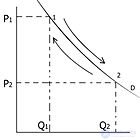
The law of demand refers to the inverse relationship between price and the quantity demanded.
The demand curve shows what quantity of economic goods buyers are willing to purchase at various prices at a given moment in time.
If the price factor has an effect, the quantity demanded changes. (Movement down and up along the curve {\displaystyle D} ). {\displaystyle Q_{D}=f(P)}
Factors affecting demand (non-price)
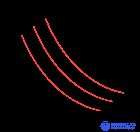
Under the influence of non-price factors, demand changes. The curve {\displaystyle D} shifts to position {\displaystyle D_{1}} when demand increases, and to {\displaystyle D_{2}}
 when it decreases.
The supply function — determines supply depending on the factors affecting it.
The law of supply refers to the increase in the quantity of a good supplied as its price rises.
The supply curve — shows what quantity of an economic good producers are willing to sell at various prices at a given moment in time.
If the price factor has an effect, the quantity supplied changes (movement up or down along the curve).
Factors affecting supply (non-price)
1. Prices of the factors (resources) of production
2. Production technology
3. Price and shortage expectations of producers
4. The amount of taxes and subsidies
5. The number of producers
Under the influence of non-price factors, supply changes (-> S1 when supply increases, and -> S2 when supply decreases).
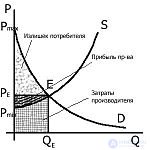
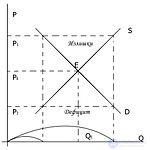
The equilibrium price — is the price that balances demand and supply as a result of the action of competitive forces. {\displaystyle P_{E}=P_—=P_{S}} , {\displaystyle Q_{E}=Q_—=Q_{S}}
 .
.
Since the equilibrium price is usually lower than the maximum price consumers are willing to offer, the amount of the surplus can be represented graphically by the figure {\displaystyle P_{E}P_{\text{max}}E} . In turn, the equilibrium price is usually higher than the minimum price producers are willing to offer ({\displaystyle P_{\text{min}}EP_{E}}
 ).
).
Total revenue — {\displaystyle T_{R}=P_{E}\times Q_{E}} . The difference between total revenue and the producer's costs ({\displaystyle OP_{\text{min}}EQ_{E}}
 ) constitutes the producer's surplus (profit).
The cobweb model — is the simplest dynamic model, showing damped oscillations as a result of which equilibrium is formed.
It reflects the formation of equilibrium in an industry with a fixed production cycle, when producers, having made a decision based on prices that existed in previous years, can no longer change the volume of production. For example, in agriculture, when producers base their decisions on the previous year's harvest without taking natural disasters into account.

Comments