
Lecture
The depth and forms of state intervention in industrial development
can vary. The state's industrial policy is carried out
using various methods, with differing degrees of direct involvement
of the state in economic decision-making. The following types of
industrial policy are distinguished (Table 4).
Table 4
Types of State Industrial Policy
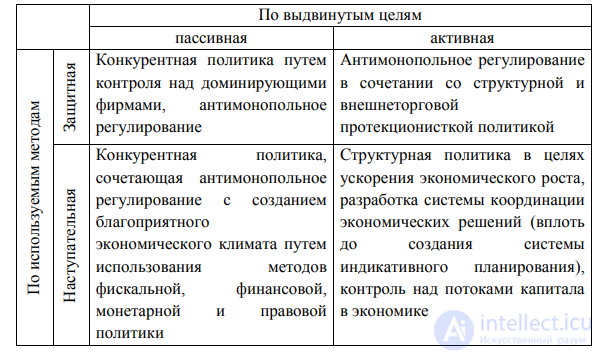
An offensive passive industrial policy involves
restricting and combating monopoly power, and supporting specific
types of economic activity. For example, tax and financial
incentives for small and medium-sized enterprises do not fall within the scope
of antitrust regulation as such, but they undoubtedly contribute
to the development of competition. The passivity of this type of industrial policy
consists in the fact that it only improves the conditions under which enterprises
make decisions, but does not aim to influence specific decisions.
This model of economic policy is closest to governments
that reject active intervention in the economy.
A passive defensive industrial policy has as its main goal
the fight against monopolies whose activity leads to an inefficient
allocation of resources and creates losses of social welfare.
An active defensive industrial policy uses measures
that have a specific focus, aimed at preventing certain
decisions by firms.
An active offensive industrial policy is characterized
by a combination of specific, along with general, positive goals and
targeted action by the state on the decisions of economic agents.
Among the goals of state antitrust policy, one can distinguish the following:
1. ensuring the efficiency of production and resource allocation in the economy;
2. preventing or eliminating undesirable market structures and undesirable behavior by economic agents – that is, situations
that are regarded as violating social welfare;
3. helping some groups of economic agents at the expense of others (for example, assisting small firms in their competition with large ones, regardless of their efficiency).
Each goal is important from the standpoint of the economy as a whole, but
individual countries place different degrees of importance on these goals in their antitrust
legislation, which reflects the particular preferences of countries in
promoting competition.
According to traditional antitrust policy, the behavior of firms
is considered illegal if the following actions by firms are observed:
1) fixing of sale prices, secretly or openly, such that the prices set by the firm fall outside the influence of the market;
2) purchase restrictions: prohibiting customers from buying a given good elsewhere, from another seller, at a different price, or in a different quantity than
established by the selling firm;
3) sale restrictions: prohibiting suppliers from selling goods to another customer, in another place, at a different price, or in a different quantity than
provided for in the contract with the buying firm;
4) tied sales: selling one product to a customer on condition that they also purchase some other (previously specified in the contract) product
of the given firm;
5) unfair advertising: emphasis in advertising messages on qualities
of the product that the product in fact does not possess, or the highlighting of the shortcomings of a competing firm's
goods;
6) unfair labeling of goods: designing the external appearance of a product in a way that does not correspond to its purpose, or indicating
internal characteristics that are not actually present in the product;
7) vertical or horizontal restrictions of competition: pressure on suppliers (consumers) of a product or on other firms,
producing the given product, with the aim of strengthening the firm's own influence on the market by forcibly imposing its rules of
conduct on its partners.
In practice, the implementation of antitrust policy encounters
certain difficulties, among which the following can be identified:
1) there are no unambiguous interpretations of the consequences of a firm's behavior.
For example, the merger of two firms can lead, on the one hand, to an increase in the selling price of a good (a negative consequence of an imperfect
market structure), while on the other hand, such interaction between two firms may result in the introduction of a new product or in an improvement
in the quality of an existing product (a positive consequence of monopoly);
2) uncertainty as to who bears the damage from an imperfect market structure.
Thus, in implementing antitrust policy, a balance
must be struck between the consequences, both negative and positive.
1. Russia's FAS issued an order to PJSC “SUEK”, which is engaged in the extraction, processing, and sale of coal, requiring it to pre-agree standard forms of coal supply contracts with the federal antitrust authority and to use them for concluding contracts with
specific customers. For what purpose was this order issued? What could have happened in the absence of such an order?
2. Does competition in a market depend – and if so, how – on the strength of guarantees of property rights to industrial assets and land?
3. Can Federal Law No. 38-FZ of 13.03.2006 “On Advertising” be classified as a legislative act of competition-support policy?
Justify your point of view.

Comments