
Lecture
Capital market (market of capital) — the part of the financial market where long money circulates, that is, funds with a circulation period of more than a year. In the capital market, free capital is redistributed and invested in various income-generating financial assets.
The forms of circulation of funds (financial resources) in the capital market can vary:
Modern capital markets are almost always hosted on computerized electronic trading platforms; most of them can only be accessed by financial-sector entities or the treasury departments of governments and corporations, but some may be directly accessible to the public. For example, in the United States any US citizen with an Internet connection can create an account with TreasuryDirect and use it to purchase bonds on the primary market, although sales to individuals make up only a tiny share of the total volume of bonds sold. Various private companies provide browser-based platforms that allow individuals to purchase stocks and sometimes even bonds on secondary markets. There are many thousands of such systems, most of which serve only a small part of the overall capital markets. The organizations hosting these systems include stock exchanges, investment banks and government agencies. Physically, the systems are located all over the world, although, as a rule, they are concentrated in financial centers such as London, New York and Hong Kong.
In the economic system there exist relations of exchange of economic goods using money as an intermediary asset, called the financial market, where the mobilization of capital, the extension of credit, the execution of monetary exchange operations, and the allocation of financial resources in production take place.
Financial market – a general financial category comprising the aggregate of the money market and the capital market.
The money market is the system of economic relations concerning the provision of funds as a loan (for a loan term of less than a year). A loan for a longer term may be accompanied by the issuance of additional securities, in which case it passes into the capital market.
Capital market (market of capital)– the part of the financial market where funds with a circulation period of more than a year circulate. In the capital market, free capital is redistributed and invested in various income-generating financial assets.
Three main segments of the capital market are distinguished:
1) the market for capital goods, where production assets are bought and sold;
2) the market for capital services, where these assets may be rented out for a fee;
3) the market for loanable funds, or loan capital. This last segment is the principal one in the interpretation of the capital market.
Each factor of production, as noted, generates income for its owner. The income generated by loan capital is called interest
. In economic theory there are various approaches to defining the essence of interest:
1) the neoclassical – real theory of interest;
2) the Keynesian – monetary theory of interest.
According to the neoclassical theory, the economic nature of interest is a higher valuation of present goods compared with future goods. This feature of economic behavior is called time preference. Interest is the difference between the value of present and future goods. It is, in a sense, a payment for time.
Thus, interest is payment for the capital owner's abstaining from current consumption. Therefore, the longer the borrowing period, the higher the interest paid. In Keynesian theory, interest is a reward for parting with money as liquidity for a given period. At present, the general theory of the interest rate, which takes both of the above approaches into account, has become widespread.
Within this theory, four main factors influencing the formation of the interest rate are distinguished:
In determining the level of the interest rate, the risk factor also plays an important role (the American economist I. Fisher proposed additionally taking the risk factor into account in the formation of the interest rate.) . The owner of capital, in investing it, always takes a risk, which requires a reward. The higher the risk, the higher the interest rate should be.
As indicated above, the demand for factors of production is presented by the production firm. The firm's demand for capital is a function of the marginal productivity of capital (MRPk). The demand curve has a negative slope, since it reflects the law of diminishing marginal productivity. As capital increases, the firm receives diminishing returns, and therefore pays a lower interest rate for capital.
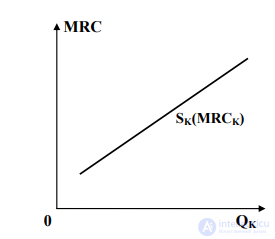
Fig. 7.6.
The supply curve in the capital market. The slope of the capital supply curve depends on the marginal opportunity cost of capital. Thus, by offering funds to a firm, the owner of capital forgoes a wide range of opportunities: buying land and earning rental income, starting his own business and earning income, consumption and obtaining utility, etc.
Consequently, the more funds the owner offers as a loan, the greater their opportunity cost. Therefore, the capital supply curve has a positive slope (fig. 7.6.). Under the influence of non-price factors, the supply curve shifts in parallel to the right or to the left (fig. 7.7.).
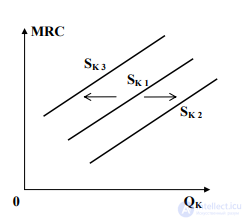
Fig. 7.7. Shift of the supply curve
Among the main non-price factors affecting the shift of the supply curve, the following should be highlighted:
1) inflation;
2) the phase of business activity the economy is in (recession, upturn);
3) the state's tax and monetary policy.
According to the neoclassical theory, equilibrium in the capital market is achieved when the marginal productivity of capital (MRPk) equals the marginal cost to the owners of capital (MRCk) associated with foregoing the use of capital at the present time. The interest rate determined by the intersection of the MRP and MRC lines is called the equilibrium interest rate (fig. 7.8).
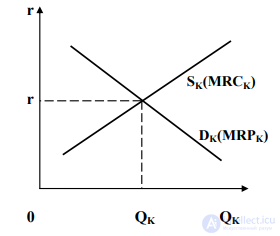
Fig. 7.8. Equilibrium in the capital market
In a state of equilibrium, the maximization of the return on invested capital at the scale of society is ensured, since capital is invested only to the extent necessary to obtain a return greater than the benefits of immediate use of the capital. Capital is a resource of long-term use, and therefore, when considering the theory of capital, we encounter the factor of time.
Capital – is produced goods that are used to increase the production of future goods. Creating additional goods in the future requires certain costs in the present. This gives rise to the need to make intertemporal comparisons of current costs and future income.
The interest rate (rate of interest, rate of return) is the ratio of the income on capital lent out to the amount of the capital lent itself, expressed as a percentage.
For example, if the owner of capital invested 1000 rubles and received an annual income of 100 rubles, the interest rate will be:
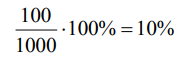
The market interest rate has a significant influence on decisions to invest capital. The owner of capital always compares the expected level of income on capital with the current market interest rate. For example, if investing 1,000,000 rubles yields an income of 200,000 rubles after a year, the interest rate will be:
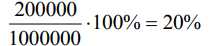
But at a market interest rate of 25%, such an investment cannot be considered profitable. Consequently, capital should be invested if the expected level of income is higher than or equal to the market interest rate. Another way of evaluating the effectiveness of a capital investment is the discounting procedure. Future money is always cheaper than present money. This is due not only to inflation, but also to the possibility of earning income from the invested capital.
Discounting – is the procedure of bringing future income to the present moment, taking into account the opportunity cost. This procedure is used to determine the present value of money that will be received in the future.
Indeed, 1000 rubles to be received in a year will today have a different value, since it is necessary to take into account alternative ways of using the capital, for example a deposit in a bank. Consequently, 1000 rubles in a year at a market rate of 15% is equivalent to depositing 869.56 rubles in a bank today and receiving the deposit amount with interest of 1000 rubles after a year. Thus, the present value of the future 1000 rubles is 869.56 rubles. The discounting formula has the following form:
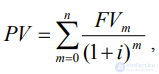
where PV – present value;
FV – future value;
i- the interest rate, as a fraction;
m- the number of years.
For example, if 5 million rubles is invested today, over 10 years the annual income will be 600 thousand rubles. If the interest rate is 2%,
then the present value of the annual payments will be:

Thus, the value of the future income is higher today than the costs, since 5 million rubles < 5.34 million rubles.
Consequently, at a market interest rate of 2%, the capital investment is profitable. Another tool for evaluating the feasibility of a capital investment is net present value.
Net present value (NPV – net present value) – is the discounted value of all future income less the discounted value of all costs (capital investments).
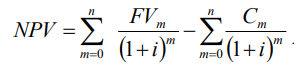
If the rate of return on the invested capital is greater than the cost of investment in the form of loan interest, the NPV value will be positive. If the rate of return is lower, the NPV value is negative. Thus, a positive NPV value indicates that it is advisable to invest the capital, while with a negative NPV value the capital investment should be rejected. A zero NPV value indicates that the total income from the capital investment equals the costs. The rate of return at which NPV equals zero is called the internal rate of return (IRR – internal rate of return).

Comments