
Lecture
Это окончание невероятной информации про метакогнитивные процессы.
...
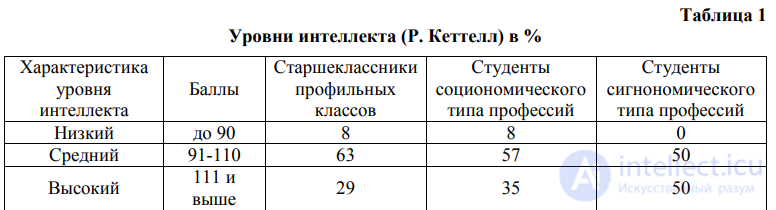
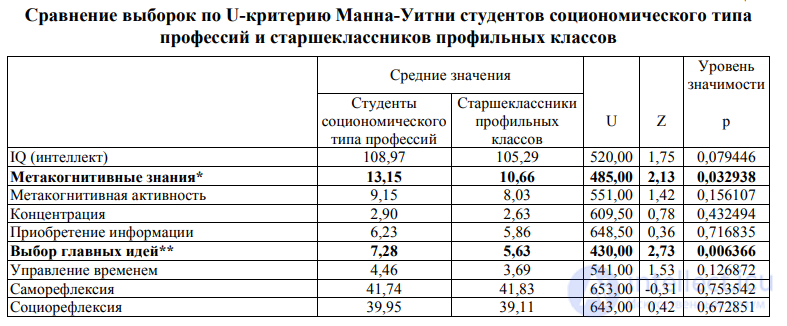
analysed the level of intelligence (using R. Cattell’s Culture Fair Intelligence Test), we see that, although there are some differences between the various groups in percentage terms and, at first glance, the percentage of students with high intelligence predominates among students in the economics specialty, nevertheless no significant differences were revealed by the Mann-Whitney-Wilcoxon U test (MWW) (Tables 1, 4-6). At the same time, as we showed in our previous publication, even within a single occupational type, for example “person-to-person”, but with a different character of work (managerial and executive) and a different orientation (transformative and exploratory), significant differences in intelligence may exist: among future physicians intelligence is higher (U=319.00, p<0.05) than among management students. These differences are with high probability determined by the career being chosen and by the optimality of the use of intellectual abilities, for example, in the activity of a manager (A.V. Karpov, 2005).
Among students in socionomic occupational types, intelligence is positively related to socioreflection (ρ=0.32, p<0.05), to psycholinguistic indicators of professional thinking: to nouns in the course of the situation (ρ=0.37, p<0.05), to verbs in the aftermath of the situation (ρ=0.35, p<0.05), as well as to M.M. Kashapov’s situational–suprasituational criteria (ρ=0.34, p<0.05) and to E.K. Osipova’s levels of problem solving (ρ=0.34, p<0.05). Taking into account that the main feature of adolescence is the formation of life plans, which manifest themselves — with allowance for the opportunities available at the given moment in time — in the choice of a profession, we have grounds to say that intellectual abilities in students studying for a “person-to-person” type of profession help them to choose professions consciously, in particular medical specialties, and to set the moral goal of helping people. In accordance with this goal, projecting themselves into the future, they manage even at the early stages of professionalisation to see themselves as if “through the eyes of others” and to solve problem situations promptly and correctly, finding non-standard solutions. The latter of the above parameters are directly consistent with the required professional competencies specified in the Federal State Educational Standard 3+ for students of medical orientation, which presuppose the ability to solve non-standard problems and to bear social responsibility for the decisions taken. Thus, according to the data we obtained, some manifestations of the required professional qualities can be partially observed already in the first and second years of study.
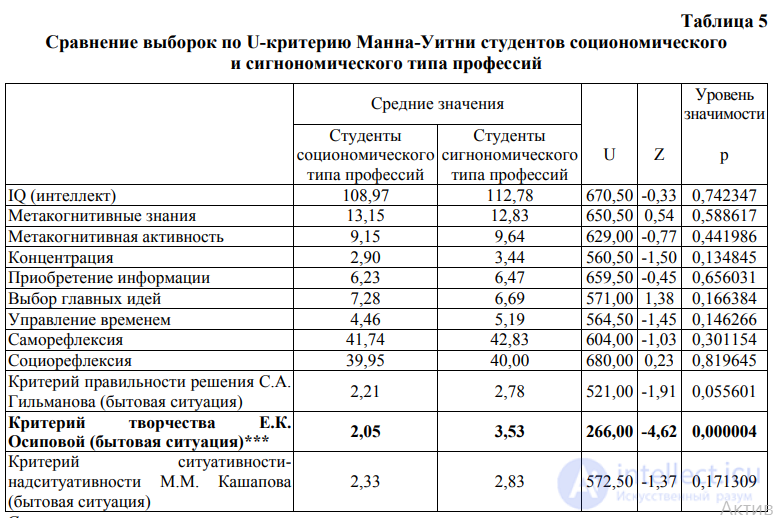
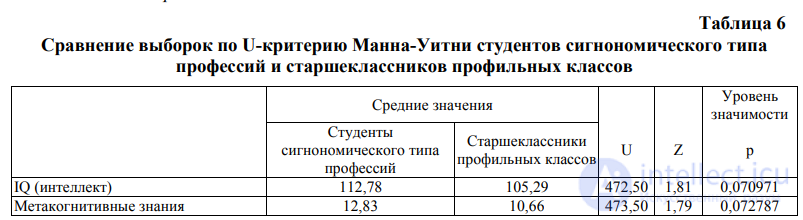
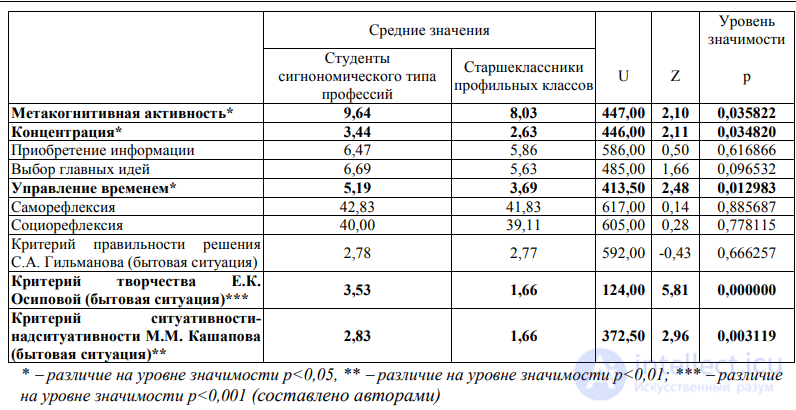
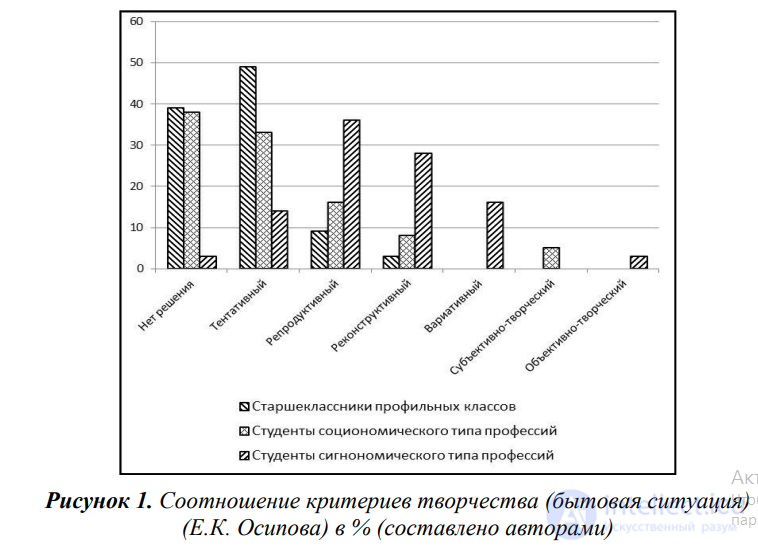
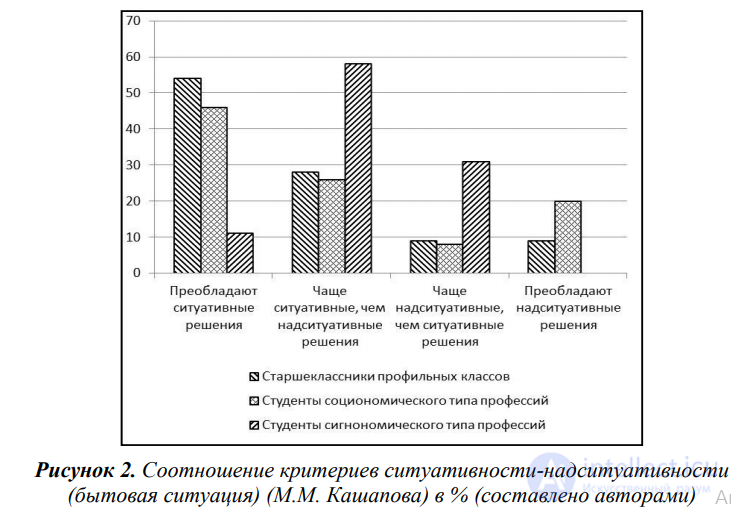
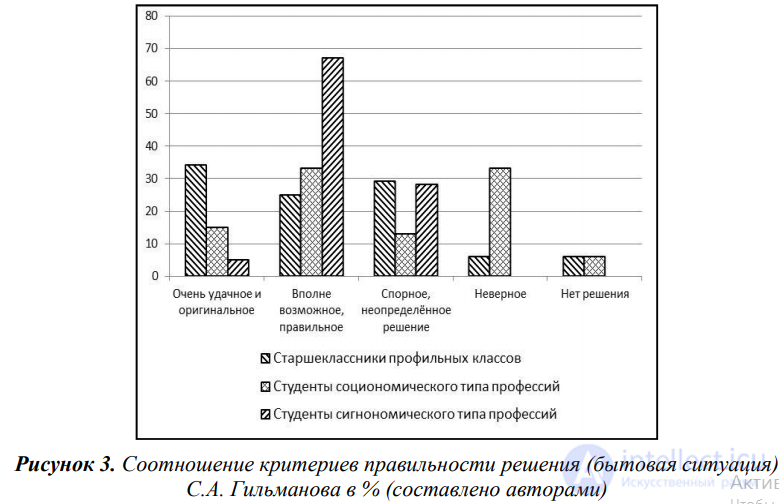
The analysis carried out (Serafimovich I.V., Bazanova G.Yu. I) revealed connections between intelligence and metacognitive processes manifested in the realisation of suprasituational thinking when solving problem situations at such stages of professionalisation as the choice of professional orientation and the initial stages of university study (using the example of socionomic and signonomic types of professions).
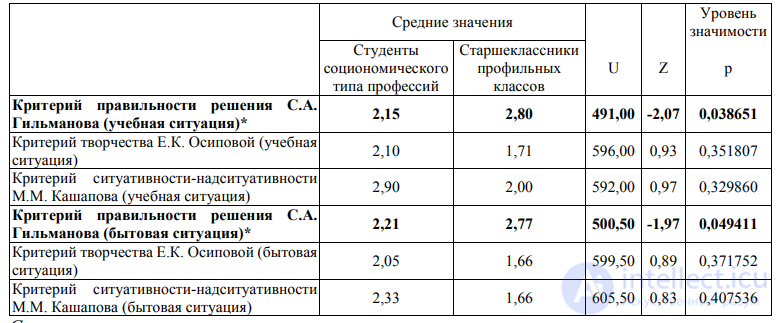
1.1. A comparative analysis of the correlations of intelligence gives grounds to say that, during the choice of professional orientation in senior school students, intelligence contributes to the development of reflection skills and metacognitive abilities, while no influence is found on the practical component of thinking that manifests itself in solving problem situations.
1.2. At the initial stages of university study, in students of socionomic types of professions intellectual abilities are directly related to the suprasituational nature of solutions to problem situations and to socioreflection; in students of signonomic types of professions intelligence is related only to certain aspects of practical thinking and contributes to awareness of one’s own behaviour and emotions in a problem situation, which indirectly influences
an increase in socioreflection.
2. The results of the study show the need for psychological support of the formation of students’ competencies at different stages of study and in different profiles, and for the design and development of such forms of support for the development of professional experience as mentoring, coaching and tutoring. On the basis of the data obtained, it is possible to develop a coaching programme for the formation of suprasituational thinking and metacognitive
changes, through broader use of various qualities of suprasituational thinking and their variable application in resolving a problem situation.
3. A comparative analysis of differences in intelligence, level of thinking and its metacognitive characteristics in senior school students of specialised biology-chemistry and
mathematics classes and in university students pursuing a specialised orientation while studying in medical and economics specialties revealed that there are no significant differences in intelligence and level of reflection between students and pupils of specialised classes.
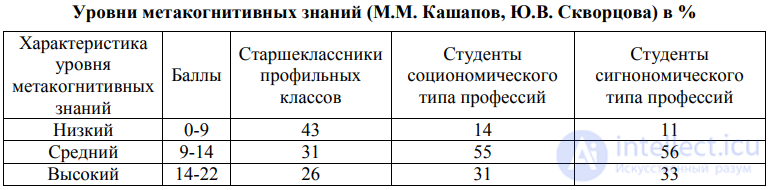
It was noted that when mastering socionomic types of professions the level of metacognitive knowledge increases at the initial stages, while when mastering signonomic types of professions the level of metacognitive activity increases at the initial stages (compared with senior school students). No significant differences were revealed between students at the initial stages of study in socionomic and signonomic types with respect to metacognitive knowledge and metacognitive activity.
Часть 1 Metacognitive processes distortions and therapy, metacognition
Часть 2 - Metacognitive processes distortions and therapy, metacognition

Comments