
Lecture
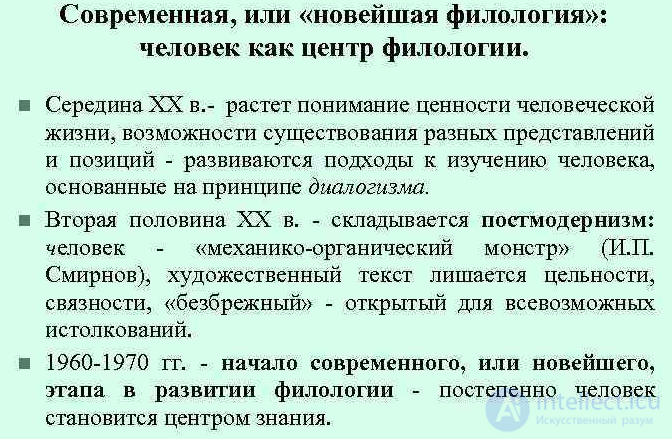
In the mid-20th century, serious changes took place in the development of science. After the Second World War (1939—1945), the world increasingly recognized the value of human life and the possibility of the coexistence of different views and positions. In the humanities, these new tendencies are expressed in the development of approaches to studying the human being based on the principle of dialogism.
In the second half of the 20th century, a new movement took shape in social thought and culture — postmodernism (Eng.
postmodernism, Fr. postmodernisme, Ger. Postmodernismus). In postmodernist works, the human being appears as a «mechanico-organic monster» (I.P. Smirnov). Accordingly, the literary text (like text in general) loses its integrity and often its coherence, becoming «boundless» — open to
all manner of interpretations2
.
Let us give an example of such a text (from the second part of Vl. Sorokin’s novel «The Norm»):
The 1960s—1970s mark the beginning of the modern, or most recent, stage in the development of philology. In philology and the
sciences and scholarly disciplines that make it up, the human being gradually becomes the center of its knowledge. Let us consider the situation in linguistics. Traditionally, its interests are focused on the study of language as a system. Among the subjects of close attention of contemporary linguistics is the phenomenon of communication. Let us consider a fragment of text occurring in the following situation.
A student comes to the dean’s office and addresses the secretary:
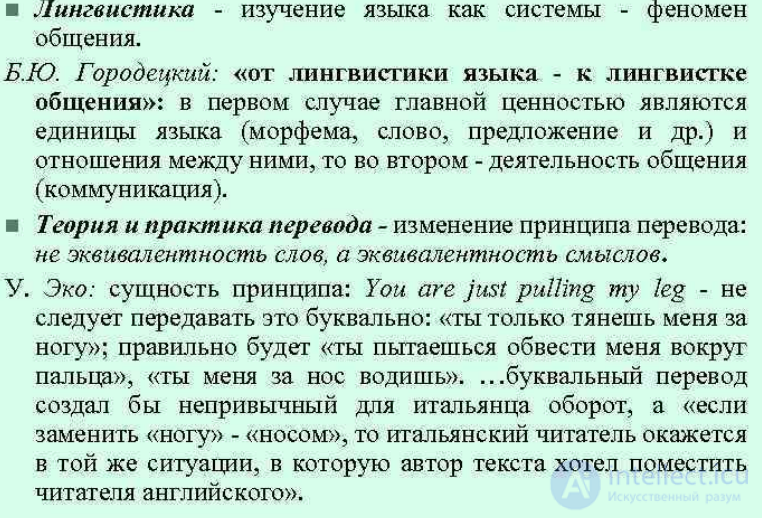
«Anna Ivanovna, may I get a certificate from you?». When language is studied as a system, the analysis will establish, for example, the grammatical type of the sentence (simple, complicated by an address, one-part, impersonal), and the ways and means
of expressing the parts of the sentence; a description of the situation is
in principle not needed for this.
If this same sentence is considered from the point of view of the theory
of communication, the task may be to explain
what makes the speaker choose the given form of address. It is the situation of business communication that compels this: the speaker —
a student, the addressee — a dean’s office employee, the type of relations — official, the subject matter of communication is related to the organization of work,
which is why an official form of address is used. Thus,
if in the first case the main value is the units
of language (morpheme, word, sentence, etc.) and the relations between
them, then in the second it is communicative activity (communication).
This fact is expressed in the formula: «from the linguistics of language to the linguistics of communication». This is precisely how the contemporary
Russian linguist B.Yu. Gorodetsky formulated the main tendency
in the development of philology in our time.
fundamentally different positions. The author of one of them is
F.F. Zelinsky (1859—1944), who acknowledges the existence
of a unified historico-philological science: this is «a science whose
content is the study of the creations of the human spirit in their
sequence, i.e., in their development». Within the composition of this science, philology
is directed toward the study of written monuments,
while history is directed toward the study of the general laws of development. Authorship
of the other position belongs to G.O. Vinokur (1896—1947): the science
of literature and linguistics are «sisters, works of an identically oriented consciousness whose task
is the interpretation of a text».
Let us give an example from the field of translation theory and practice.
Here a change occurs in the principle of translation: not equivalence of words, but equivalence of meanings. The Italian scholar
U. Eco (b. 1932) reveals the essence of this principle: «Suppose that in some American text one character says to another: you are just pulling my leg. The translator should not
render this literally: «you are only pulling me by the leg» or
«yes, you are leading me by the leg»; it would be correct to say «you are trying
to lead me around by the finger» <...> or even better «you are leading me by the
nose» <...>». U. Eco explains that a literal translation
in this case would create a phrase unfamiliar to an Italian,
and «if one replaces «leg» with «nose», then the Italian reader
will find himself in the same situation into which the author of the text wanted to place the English reader»3
.
Let us give an example from the field of literary studies. In M.A. Sholokhov’s short story «The Fate of a Man» (1956—1957), in the mid-
and late 1950s, the features seen above all were those
typified by the writer in the image of the main character, Andrei Sokolov: the national pride and dignity of the Russian person, endurance, spiritual humanity, and so on. A 21st-century author,
N.L. Leiderman4
analyzes Sholokhov’s story through the prism
of the renewal of the socialist-realist conception of personality, discerning in the story a novelty in the return to «simple» and eternal universal human values.
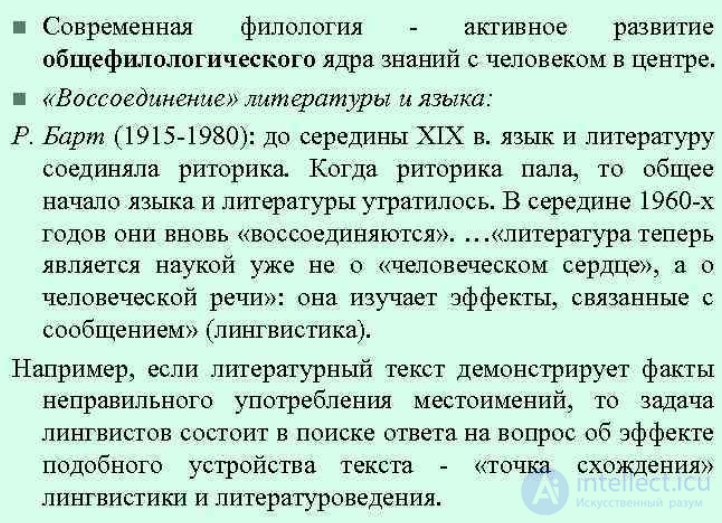
Contemporary philology is distinguished by the active development
of a general philological core of knowledge with the human being at the center. In what
does this manifest itself?
«Reunification» of literature and language. This tendency
was noted in the mid-1960s by the French philosopher
and philologist R. Barthes (1915—1980). Examining the relations
between language and literature in the West, the scholar noted in a 1970 article that until the mid-19th century language and literature were joined by
rhetoric. When rhetoric fell, the common origin of language and
literature was lost. In the mid-1960s they once again
«reunite». This is because, as Barthes observed,
«literature is now a science no longer of the «human
heart», but of human speech»: it studies effects related to the message5
(the message is traditionally «under the jurisdiction» of linguistics!).
Let us give an example. In A. Christie’s novel «The Mirror Crack’d from Side to Side», a complication connected with investigating the causes
of Marina Gregg’s death, «a fading but still charming
film star», arises because the maid Gladys
Dixon «had shaky grammar». The theme of «shaky grammar»
recurs periodically in the novel. Here is one of the fragments of text in which this theme develops. Miss Marple recounts an episode from the past: «She (the Lauristons’ maid. This is the very
figure from the past. — A.Ch.), of course, had to go to
the telephone and answer calls, but I can’t say she managed it very well. She would be given a message, and she would grasp the general sense,
but she would write it all down in such a way that sometimes complete nonsense came out. She must have had shaky grammar. There were positively
real mishaps. A certain Mr. Burrows, if I’m not mistaken, called and said that he was meeting Mr. Elvaston about
a broken fence, but repairing the fence was not his
business at all. The fence is on the other side of the property, and he wants to clarify whether this is really so, and only then decide how to proceed further, since it depends on this whether he takes the matter on or not,
and before turning to lawyers, he needs a clear plan
of the property. You see for yourself what confusion resulted. The picture was not
clarified, only made murkier» (Agatha Christie. Works: in 3 vols.
M., 1992, p. 534). (I ask readers to pay attention to
which nouns in the text are replaced by personal
pronouns.)
If a literary text demonstrates instances of the incorrect use of pronouns, the linguist’s task consists
in seeking an answer to the question of the effect of such a textual device. This is how a «point of convergence» between linguistics and literary studies is created.
In contemporary philology, «points of convergence» are multiplying. See, for instance, the fragment cited above from Vl. Sorokin’s novel: whereas a classical literary text consists of sentences, in Sorokin’s text a sentence is hard to discern
(in fact impossible). This is how the problem of mutual
Let us give an example from the field of translation theory and practice.
Here a change occurs in the principle of translation: not equivalence of words, but equivalence of meanings. The Italian scholar
U. Eco (b. 1932) reveals the essence of this principle: «Suppose that in some American text one character says to another: you are just pulling my leg. The translator should not
render this literally: «you are only pulling me by the leg» or
«yes, you are leading me by the leg»; it would be correct to say «you are trying
to lead me around by the finger» <...> or even better «you are leading me by the
nose» <...>». U. Eco explains that a literal translation
in this case would create a phrase unfamiliar to an Italian,
and «if one replaces «leg» with «nose», then the Italian reader
will find himself in the same situation into which the author of the text wanted to place the English reader»3
.
Let us give an example from the field of literary studies. In M.A. Sholokhov’s short story «The Fate of a Man» (1956—1957), in the mid-
and late 1950s, the features seen above all were those
typified by the writer in the image of the main character, Andrei Sokolov: the national pride and dignity of the Russian person, endurance, spiritual humanity, and so on. A 21st-century author,
N.L. Leiderman4
analyzes Sholokhov’s story through the prism
of the renewal of the socialist-realist conception of personality, discerning in the story a novelty in the return to «simple» and eternal universal human values.
Contemporary philology is distinguished by the active development
of a general philological core of knowledge with the human being at the center. In what
does this manifest itself?
«Reunification» of literature and language. This tendency
was noted in the mid-1960s by the French philosopher
and philologist R. Barthes (1915—1980). Examining the relations
between language and literature in the West, the scholar noted in a 1970 article that until the mid-19th century language and literature were joined by
rhetoric. When rhetoric fell, the common origin of language and
literature was lost. In the mid-1960s they once again
«reunite». This is because, as Barthes observed,
«literature is now a science no longer of the «human
heart», but of human speech»: it studies effects related to the message5
(the message is traditionally «under the jurisdiction» of linguistics!).
Let us give an example. In A. Christie’s novel «The Mirror Crack’d from Side to Side», a complication connected with investigating the causes
of Marina Gregg’s death, «a fading but still charming
film star», arises because the maid Gladys
Dixon «had shaky grammar». The theme of «shaky grammar»
recurs periodically in the novel. Here is one of the fragments of text in which this theme develops. Miss Marple recounts an episode from the past: «She (the Lauristons’ maid. This is the very
figure from the past. — A.Ch.), of course, had to go to
the telephone and answer calls, but I can’t say she managed it very well. She would be given a message, and she would grasp the general sense,
but she would write it all down in such a way that sometimes complete nonsense came out. She must have had shaky grammar. There were positively
real mishaps. A certain Mr. Burrows, if I’m not mistaken, called and said that he was meeting Mr. Elvaston about
a broken fence, but repairing the fence was not his
business at all. The fence is on the other side of the property, and he wants to clarify whether this is really so, and only then decide how to proceed further, since it depends on this whether he takes the matter on or not,
and before turning to lawyers, he needs a clear plan
of the property. You see for yourself what confusion resulted. The picture was not
clarified, only made murkier» (Agatha Christie. Works: in 3 vols.
M., 1992, p. 534). (I ask readers to pay attention to
which nouns in the text are replaced by personal
pronouns.)
If a literary text demonstrates instances of the incorrect use of pronouns, the linguist’s task consists
in seeking an answer to the question of the effect of such a textual device. This is how a «point of convergence» between linguistics and literary studies is created.
In contemporary philology, «points of convergence» are multiplying. See, for instance, the fragment cited above from Vl. Sorokin’s novel: whereas a classical literary text consists of sentences, in Sorokin’s text a sentence is hard to discern
(in fact impossible). This is how the problem of mutual
influence of language and literature, of linguistics and literary studies, arises.
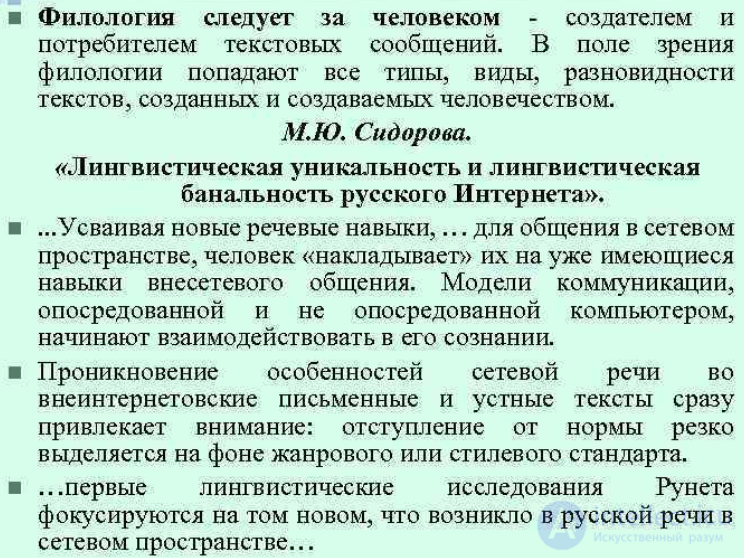
Philology follows the human being — the creator and consumer of textual messages. This following is manifested in the fact that,
within philology’s field of vision fall all types, kinds, and varieties of texts created and being created by humanity. This
makes the problem of understanding topical within the science. See, for example, the contemporary joke: «Gone to the blogs, don’t wait for me for lunch». In this
message (in the genre of a note), the problem of understanding may arise because the listener/reader does not know the English word blog. See:
blog
1. n.; comp.; from weblog
1) blog, weblog (a periodically updated feed of messages
on various topics, each of which may be commented on by readers; a collective discussion board)
2) an online diary, a «LiveJournal», LJ (a frequently updated personal site on which the
author publishes comments on various topics)
Syn: Live Journal, LJ
2. to blog; to engage in blogging
One more example from a joke:
— Friend, you owe a ruble.
He looked around.
— Where?
In this case the problem is no longer a matter of not knowing words, but of assessing
the situation of the conversation.
In the course of resolving the problem of understanding, answers are sought to the questions: owing to what is a person able to understand / why is a person unable to understand another? how does the process of interpreting
the meaning of a text (message) proceed? what is needed to achieve understanding? and so on. (See, in the reading materials given below,
fragments of an article by M.Yu. Sidorova devoted to Internet communication.)
In the contemporary world, speech is once again gaining power (this paraphrases a judgment of Tz. Todorov). Among the causes of this phenomenon we may name the development of democratic tendencies in social life, above all in the countries of Europe and North America
(and later in others), the growing significance of mass communication,
the need to influence one’s interlocutor, one’s audience by means of the word rather than by violence. Owing to this,
rhetoric has again become in demand. (On the subject of contemporary rhetoric, see the excerpt from A.K. Mikhalskaya’s book given in
the reading materials.) Thanks to rhetoric, the problematics of speech influence has become topical in all philological
sciences, in philology as a whole. How does the word gain power over
a person? how can this power of the word be made to benefit the person? society? — these are the main questions arising
here.
On the basis of the interaction of linguistics and literary studies, new integral fields of
research and teaching are being revived and arising. Let us name two of the most important.
First, general philology. Its revival took place
in the works of Yu.V. Rozhdestvensky (1926—1999), S.I. Gindin
(b. 1945), and other Russian scholars. Thus, Yu.V. Rozhdestvensky substantiated the position that general philology studies
the ways and forms of the use of language in social-linguistic
practice. Whereas a particular (Russian, Tatar, Spanish, etc.)
philology describes the composition of texts in a given language,
their interpretation in the past, and their current state, general
philology generalizes the data of particular philologies and provides «an initial orientation in the ocean of texts and an orientation in
the principles of their study»6
. Thus, the «main character» of general
philology, according to Rozhdestvensky, is the text, regardless of the sphere of its existence (literary, business, political,
legal, scholarly, everyday, etc.).
Second, the theory of literary art. In its revival, a large
role was played by the works of a number of Russian philologists — A.I. Gorshkov (b. 1923), Yu.I. Mineralov (b. 1948), T.D. Venediktova
(b. 1952), and others. A.I. Gorshkov, for example, notes that the theory of literary art studies the content of a work of literary art and
the methods of the linguistic expression of this content.
.
Against this background, the specialization of knowledge in philology and the differentiation of scholarly disciplines continue. In our time
the intensive formation of applied philology has begun.
Unlike theoretical philology, it studies the ways of
solving practical problems arising in the linguistic, literary, and communicative life of the individual and society. These
problems are connected with analytical-expert activity, the philological support of contemporary types of communication —
political, legal, advertising, intercultural, Internet communication, and so on.
The self-knowledge of philology. At present, differences are noticeable in the understanding of philology as a branch of humanities knowledge. These differences occur in different countries, in different scholarly disciplines, and scholarly schools. They are well reflected
in terminological and other dictionaries. Let us compare, for example,
the definitions of the term philology in at least a few dictionaries: «Philology <...> this word usually denotes the study
of literature in general, but in a more specific sense <...> the study of written monuments and the form of language with which
they acquaint us, and in an even more specialized sense — the study
of texts and their transmission, excluding the study of language, which is the concern of linguistics <...>» ; «...the concept (of philology. — A.Ch.) usually conveys the commonality of two sciences — literary studies and linguistics, and in
a narrower sense it denotes textology and textual criticism»11.
In the development of the processes of philology’s self-knowledge at the most recent stage of its existence, a fundamental role is played
by G.O. Vinokur’s work «Introduction to the Study of Philological
Sciences», based on a course of the same name that he first delivered (in the war years!)
to students. The book was written more than 50 years ago and was first
published in 1981 (reprinted in 2000). In the scholar’s book, philology
is examined from various angles — as the study of
language, the processing of text, the history of national culture, a «moment» in scholarly work, and so on. G.O. Vinokur’s ideas were further developed in the writings of a number of contemporary Russian authors
(S.I. Gindin, A.A. Chuvakin, and others).
Thus, within contemporary philology as a body of humanities and scholarly disciplines studying natural language,
text, and homo loquens, there exists an interdisciplinary (i.e., general-philological) core of knowledge. This is how a second basis arises
for recognizing philology as an independent branch within the system
of the humanities.
of philology studies the content of a work of verbal art and
the ways in which this content is linguistically expressed
.
Against this background the specialization of knowledge in philology and the differentiation of scholarly disciplines continues. In our time
the intensive formation of applied philology has begun.
Unlike theoretical philology, it studies the ways of
solving practical problems that arise in the linguistic, literary, and communicative life of the individual and society. These
tasks are connected with analytical-expert activity, with the philological support of modern types of communication —
political, legal, advertising, intercultural, Internet communication, etc.
The self-knowledge of philology. At present, differences are noticeable in how philology is understood as a branch of the humanities. These differences occur across different countries, different scholarly disciplines, and different scholarly schools. They are well reflected
in terminological and other dictionaries. Let us compare, for example,
the definitions of the term philology in at least some of these dictionaries: «Philology <...> this word usually denotes the study of
literature in general, but more specifically <...> — the study of written monuments and the form of language with which
they acquaint us, and in an even more specialized sense — the study
of texts and their transmission, with the exception of the study of language, which is the concern of linguistics <...>»
of language, esp. its history and development (Philology — the study of language, especially its history and development .
Thus, in contemporary philology as a body of humanities disciplines studying natural language,
text, and homo loquens, there exists an interdisciplinary (= general-philological) core of knowledge. This is the second ground
for recognizing philology as an independent branch within the system of
the humanities.
Tatar, Buryat, Yakut, English, Bulgarian, and others.
<...> we have in mind the word, that is, language in its concrete and living totality, and not language as the specific object of linguistics <...>.
Dialogic relations <...> are extralinguistic. But at the same time they cannot be separated from the sphere of the word, that is, from language as a
concrete, integral phenomenon. Language lives only in the dialogic communication of those who use it. Dialogic communication is the genuine
sphere of the life of language. The entire life of language, in any sphere of its use (everyday, business, scholarly, artistic, etc.), is permeated with dialogic relations. But linguistics studies «language» itself, with its
specific logic in its generality, as that which makes dialogic communication possible, while it consistently abstracts from the dialogic relations themselves. These relations lie in the sphere of
the word, since the word is by its very nature dialogic, and therefore must
be studied by metalinguistics, which goes beyond the bounds of linguistics and has its own independent subject and tasks.
Dialogic relations cannot be reduced to logical and subject-semantic relations, which in themselves lack the dialogic moment. They must be clothed in the word, become utterances, become positions of different subjects expressed in the word, so that dialogic relations may arise between them.
«Life is good.» «Life is not good.» Before us are two judgments, possessing a definite logical form and definite
subject-semantic content (philosophical judgments about the value of life). Between these judgments there is a definite logical relation: one is the negation of the other. But between them
there is not and cannot be any dialogic relation; they do not argue with each other at all (although they may provide the subject matter and
logical basis for an argument). Both of these judgments must be embodied for a dialogic relation to arise between them or toward them.
Thus, both of these judgments may, as thesis and antithesis, be united in a single utterance of a single subject, expressing his unified dialectical position on the given question. In this case no dialogic relations arise. But if these two judgments are
divided between two different utterances of two different subjects, then dialogic relations will arise between them.
«Life is good.» «Life is good.» Here are two entirely identical judgments, essentially, therefore, one single judgment, written (or spoken) by us twice, but this «two»
pertains only to the verbal embodiment, not to the judgment itself.
True, we may also speak here of the logical relation of identity between the two judgments. But if this judgment is expressed
in two utterances of two different subjects, then dialogic relations (of agreement, confirmation) will arise between these utterances.
Dialogic relations are entirely impossible without logical and subject-semantic relations, but they are not reducible to them; they
have their own specific character.
Logical and subject-semantic relations, in order to become dialogic, as we have already said, must be embodied, that is, must enter another sphere of being: become a word, that is, an utterance,
and acquire an author, that is, a creator of the given utterance, whose position it expresses. Every utterance in this sense has its author, whom we hear in the utterance itself as its creator. About the real author, as he exists outside the utterance, we can know
almost nothing. And the forms of this real authorship can be very diverse. A given work may be the product of collective labor, may be created by the successive labor of a series of generations, and so on —
in any case we hear in it a unified creative will, a definite position, to which one can react dialogically. The dialogic
reaction personifies every utterance to which it reacts. Dialogic relations are possible not only between whole (relatively speaking) utterances, but a dialogic approach is also possible with respect to
any significant part of an utterance, even to a single word, if it is perceived not as an impersonal word of language but as a sign of someone else's
semantic position, as the representative of someone else's utterance, that is, if we hear in it another's voice. Therefore dialogic relations
can penetrate into the interior of an utterance, even into the interior of a single word, if two voices dialogically collide within it (a microdialogue, of which we have already had occasion to speak).
On the other hand, dialogic relations are also possible between linguistic styles, social dialects, and so on, provided they
are perceived as certain semantic positions, as a kind of linguistic worldview, that is, no longer under linguistic consideration as such.
Finally, dialogic relations are possible even toward one's own utterance as a whole, toward its individual parts, and toward an individual word within it, if we somehow separate ourselves from them, speak with an inner reservation, take a distance in relation to them, as it were
limiting or splitting our own authorship.
In conclusion let us note that, under a broad consideration of dialogic relations, they are possible also between other meaningful
phenomena, provided only that these phenomena are expressed in some sign material. For example, dialogic relations are possible between
the images of other arts. But these relations lie beyond the bounds of metalinguistics.
The principal subject of our consideration, one may say, its principal hero, will be the double-voiced word, which inevitably arises under conditions of
dialogic communication, that is, under conditions of the genuine life of the word. <...>
Cited from: Bakhtin M.M. Problems of Dostoevsky's Poetics / / Bakhtin M.M. Problems of Dostoevsky's Creative Work. Kiev, 1994. P. 395, 397–399.
A.K. Mikhalskaya. Fundamentals of Rhetoric.
<...> § 14. We now have some grounds on which
to attempt to find a definition of contemporary rhetoric.
Rhetoric is the theory and craft of purposeful, effective, harmonizing speech.
Let us analyze our definition so that it becomes fully
clear.
We speak of rhetoric both as a theory and as a craft, since
rhetorical theory arose in antiquity and continues to develop to this day
precisely as a generalization of the craft of eloquence in the broad sense of the word, that is, as a reflection on rhetorical practice.
Few disciplines so clearly embody the classical
antique unity of craft and art, of skill and science.
The purposefulness of speech is its correspondence to the goal of the speaker (orator), or, to put it in the language of modern science, to his speech
intention. Purposefulness is understood as the fundamental requirement for
a rhetorical work, as the basic law of successful speech ever
since the time of Aristotle.
Equally indispensable a property of good speech is the power
of its effect on the addressee. Rhetorically competent speech
will never leave anyone indifferent — it will awaken mind and feeling, ratio and intuition, incline the listener first to listen, favorably and with interest, and then compel him with his whole soul to accept the
picture of the world that the speaker offers him. Such speech is capable not only of inducing agreement or wringing out tears, but also of moving people to active deeds, and sometimes even of forcing a complete change in their way of life and worldview.
Both the purposefulness of speech and its capacity to affect the listener are determined by the ability to construct and conduct speech according to
the laws of the addressee, in keeping with the characteristics of the audience,
with the laws of perception. Rhetoric, both ancient and modern alike,
treats the addressee with constant, close attention. Rhetorically competent (purposeful, effective) speech must
be tailored to the addressee's measure, like a garment to the customer's measure, otherwise
it will not succeed. This means that of the two main participants in communication
(speaker and listener), the determining role, paradoxical as it may seem, belongs to the second. Everyone understands that with a first-grader
and with the minister of education one must speak differently about problems
of education, yet in practice we often see otherwise. Nowadays we
rarely find orators who could even relatively accurately assess
their audience in order to influence it effectively, and equally few
know how to conduct themselves correctly in conversation, guided by a correct understanding of the interlocutor, understanding his particularities and needs,
and orienting themselves toward him. In fact the connection between the speaker and those
to whom the speech is addressed has been lost.
Purposeful and effective speech is effective speech. It is clear that for our definition of rhetoric it is important to understand
what the effectiveness of speech and speech communication is.
Until recently, drawing on information theory and communication
theory, specialists in speech communication tended
to consider communication effective (successful) when the loss of information in the process of its transmission from speaker to listener is minimal. Let us return to the assessment of the effectiveness of speech communication (50%
without special training): this assessment was made precisely on the basis of the informational approach. Thus it follows that the fewer the interferences and losses in the transmission of information, the more successful the communication, the higher the
effectiveness of the speech. To take into account that a person nonetheless differs
in some way from a computer, that he has feelings and emotions, that he always
evaluates reality, three types of information transmitted by speech came to be distinguished:
conceptual-logical, evaluative
(+ or –), emotional. It follows that if the listener has correctly
«decoded» the information of all three types present in the speaker's message, then communication between them is successful (effective),
and speech, correspondingly, is effective insofar as it ensures correct decoding.
Let us consider, however, the following situation, which, despite its
age, is easily recognizable even today.
A young man of about twenty-three or twenty-four, thin, pale,
with fair hair and in a rather narrow black tailcoat, appeared on the scene timidly and in confusion.
«Good day, most esteemed sir! — said the general, smiling
benevolently and not rising from his seat. — My doctor speaks very well of you; I hope we shall be pleased with one another. Hey, Vaska! (at
this he whistled). Why don't you bring a chair? You think, tutor,
that none is needed... I humbly beg your pardon. I have, most esteemed sir, a son; a good
boy, with abilities, I wish to prepare him for military school. I will tell you frankly, I have no need for my son to become a master
or a philosopher; however, most esteemed sir, thank God though I am, I shall not pay two thousand
five hundred rubles for nothing...» The young man remained
silent all this time, blushed, fingered his handkerchief, and was about to
say something... he felt that his [the general's] whole speech together produced a sensation resembling that of running one's hand over walrus hide against
the grain (Herzen A.I. Who Is to Blame?).
In this speech situation, all the information conveyed by the speaker to the addressee was decoded by the latter completely — both the conceptual,
the evaluative, and the emotional. Yet the overall impression left by this speech
on the listener — the tutor — gives no grounds whatsoever for calling the outcome of the communication successful, or the speech itself effective; rather the opposite.
Contemporary rhetoric, reflecting the most pressing problem of
speech communication in the modern world — the problem of ensuring the best possible mutual understanding between people, a constructive resolution of the conflicts that arise,
above all addresses the task of uniting the participants in communication. That is why, as an indispensable requirement for successful speech, one more condition is introduced today — the harmonization of relations
between the speaker and the addressee. Harmonizing speech is, perhaps, the speech of the future; at present it represents more of an ideal,
one to be striven for, but an ideal that is fully conscious and genuinely
significant. That is why we include in our definition of rhetoric this
notion so vital for all of us today — the notion of harmony. It is especially important that harmonizing speech is a rhetorical ideal
that took shape in the history of our national culture, characteristic of
the Russian speech tradition (this will be discussed in more detail below).
Thus, contemporary rhetoric is the theory and craft of effective (purposeful, influential, harmonizing) speech.
Cited from: Mikhalskaya A.K. Introduction / / Mikhalskaya A.K. Fundamentals of Rhetoric: Thought and Word. M., 1996. P. 32—34.
M.Yu. Sidorova. The Linguistic Uniqueness
and Linguistic Banality of the Russian Internet
<...> No one arrives on the Internet at two months of age and
submerges into the virtual world so completely as to entirely lose
the need for the real world and contact with this surrounding world (we
are not speaking of isolated pathological cases, which are not the subject of our science). In acquiring the new speech skills necessary
for communication in the network space, a person «overlays» them onto the
skills of offline communication he already has. Models of communication, mediated and not mediated by computer, begin to interact in his mind. The penetration of features of network speech into
non-Internet written and oral texts (for example, the use of emoticons in school compositions, which teachers
complain about) immediately attracts attention because this penetration
is sporadic: a separate foreign element, a deviation from the norm,
stands out sharply against the background of the genre or stylistic standard. It is precisely
for this reason that the first linguistic studies of the Runet focus
on what is new, what has arisen in Russian speech in the network space. The reverse influence — the reflection in computer-mediated communication of linguistic phenomena that existed and continue to exist before and apart from the Internet — is far more extensive, is taken for granted, and as a result
is less well described. And indeed, even the reason for the wide spread of such
genres of interpersonal communication as forums and chats lies not
only in the convenience of the electronic form of communication, but also in the rootedness
of these genres in pre-network linguistic consciousness, in the presence among Russian speakers of a need for diverse forms of free, informal
discussion, conversation, chatting, and in the existence in the Russian language of a wide range of means
that support these genres (various means
of authorization and addressing, expression of evaluation, argumentation,
exhortation, apology, and so on).
From this the ideology of Internet Russian studies must follow. In attending
to what is new, what has appeared in Russian interpersonal, political, business, and scholarly communication, in our contemporary literature with the development of computer networks, we must always remember that
the Russian language on the Internet is only one of the forms of existence of the Russian language, which has a thousand-year history reaching back into the depths of centuries, a
written and literary tradition, and a language system and system of textual genres that took shape over the centuries. It is precisely for this reason that
scholarly study of this sphere of Russian speech is possible: because we have an understanding of linguistic norms, of the stylistic characteristics of linguistic
units, and of the general properties of each level of the Russian language system.
There is no special «language of the Internet» as some form of realization of the Russian language system, a variety of Russian obligatory
for use on the world network. In some zones and genres of the Internet
literary, codified speech predominates; in others — non-literary speech (jargon, colloquialisms, anti-orthography, etc.); in some communication follows the laws of written speech, in others — the
laws of oral speech, but «conveyed in writing.» In some Internet texts the features of bookish speech prevail, in others — the linguistic markers
of colloquial speech; some are oriented toward spontaneity, others toward the polishing of the text. For the use of certain genres and communication in
certain territories of the network, command of the entire stylistic range of the Russian language is assumed (high — neutral — low
style); in order to feel at home in other genres and corners of the Runet, the user needs only linguistic means of a lowered stylistic coloring, in which elements of the neutral style are submerged.
In the World Wide Web there is both monologue and dialogue. Finally, on the Internet
all the traditionally distinguished functional styles are represented. And
all the features listed: literariness (codification) /
non-literariness, orality / literacy, monologic / dialogic character, stylistic restrictedness / stylistic neutrality, polish / spontaneity, and so on — are modified by the network
form in which speech activity and the existence of linguistic material (texts) are realized. That is why the term «computer-mediated
communication» arose in the West, reflecting the essence of the phenomenon far better than the notorious «language of the Internet.» Over a very large expanse of the Runet, a native speaker of Russian can perfectly well exist and
solve his communicative tasks without going beyond the boundaries of the written literary language in its traditional form, without resorting
to any of the specific sign resources of the Internet (neither to network
jargon, nor to emoticons and other graphic elements, nor to word abbreviations, etc.). It is another matter if a native speaker ventures into
a territory of communication that is knowingly alien to the norms of literary speech and
professes a different attitude toward language (an orientation toward the unimportance of spelling, the priority of network traditions and rules over general-language ones,
simplification of communication and verbal expression). But here too the issue is
not the use of some other, special Internet language, but simply
The virtual space in which network communication takes place was created by man for himself, on a human scale, bounded
by the limits of human imagination and possibility. This means there is no deep contradiction between the technical innovations of the «post-Gutenberg era» and the features of language and communication that
took shape before it.
Today we know more about post-Gutenberg man than we did at the
end of the last century, but still not enough. The instability
of interdisciplinary connections (above all between linguistics and
psychology) is one reason for this. We know even less about the Russian
post-Gutenberg man: most of the information that
can be gleaned from the works of domestic researchers of the Internet who are
not linguists is a projection onto the Runet of data obtained by foreign colleagues in studying the English-language network, and of conclusions drawn on the basis of these data. Such linguistic «particulars,» which thereby drop out of view,
as the distinction in Russian between the forms
«ty» and «Vy» when addressing a second person, the gender opposition
expressed by the endings of past-tense verbs and adjectives, or, for example, the traditional special marking of
obscene, unprintable words, must not simply, as we shall show below, be taken into account when transferring interpretations of the English-language Internet to the Runet, but in some cases compel us to limit
and substantially revise these interpretations.
One obvious illustration. It is a commonplace in the arguments
of specialists in Internet communication to postulate
the anonymity of communication on the Internet as a source of unlimited
possibilities for constructing a virtual image of the communicant:
«The anonymity of communication on the Internet enriches the possibilities of a person's self-presentation, giving him the opportunity not merely to create
an impression of himself of his own choosing, but also to be whomever he wishes,
that is, the peculiarities of communication on the Internet allow a person to construct his identity as he chooses» (A.E. Zhichkina.
Socio-Psychological Aspects of Communication on the Internet, 1999).
Indeed, for an Internet communicant who wishes, in the virtual
space, to live under the mask of the opposite sex from his /
her real sex, whatever language he / she writes in, there are available
linguistic means that allow the construction of a virtual image corresponding to this or that gender stereotype. But these means
vary from language to language. For a native speaker of English it is much
easier to carry out gender swap (a virtual change of sex), if only
because he has the possibility of constructing texts in the past
tense without worrying about the «telltale» verb endings
that often give away inattentive Russian-speaking Internet communicants; of writing about himself without paying attention to the form of the adjective. On the soil of Russian, however, far greater possibilities open up for elaborate gender mystifications. There are even known
attempts to make entries in an Internet diary «in the neuter gender»:
ya bylo rado, ya potianulos', ya snosilo eto gordo i terpelivo, and so on <...>
Cited from: Philology and Man. 2006. No. 1. P. 76—79.
L.V. Shcherba. Essays in the Linguistic Interpretation
of Poems / 1 /
II. Lermontov's «The Pine» in comparison with its German
prototype / 2 /
The aim of this essay in the interpretation of poems is likewise to show
those linguistic means by which the ideational and its associated emotional content of literary works is expressed. That linguists must be able to bring all
these means to conscious awareness admits of no doubt whatsoever. But this must
also be something literary scholars are able to do, since they cannot content themselves with intuition and reason about ideas that they may
have incorrectly read out of the text. It goes without saying that a purely
linguistic education alone is insufficient for understanding literary works: these latter arise in a particular
social environment, in a particular historical situation, and have
their own contemporaries and predecessors, in whose light alone they can, of course,
be understood. But that linguist is also poor who has no grasp of these questions. <...>
In what follows, by means of a detailed linguistic analysis, I shall attempt to show that Lermontov's poem, though a
beautiful piece, is a wholly independent one, quite far removed
from its quasi-original.
Ein Fichtenbaum steht einsam In the wild north there stands alone
Im Norden auf kahler Höh! On a bare summit a pine
Ihn schläfert, mit weisser Decke And it dozes, swaying, and with loose falling snow
Umhüllen ihn Eis und Schnee. Clothed, as in a vestment, it is.
Er träumt von einer Palme, And it dreams of all that in the distant desert,
Die fern im Morgenland In that land where the sun rises,
Einsam und schweigend trauert Alone and sorrowful on a burning cliff
Auf brennender Felsenwand. A beautiful palm grows.
Fichtenbaum, which means «fir,» Lermontov rendered with the word pine.
There is nothing surprising in this, since in the Russian-German lexicographic tradition Fichte is still translated as pine to this day, just as
is the word Kiefer, and conversely — pikhta and sosna are translated as Fichte,
Fichtenbaum (cf. the «Russian Dictionary with German and French Translations»
by Nordstet, 1780–82).
In Germany itself the word Fichte is used in many localities in the sense of «pine,» and, in all likelihood, Heine by Fichtenbaum
meant precisely «pine.» For the image created by Lermontov, a pine, as we shall see further on, does not quite fit, whereas for
Heine the botanical species of the tree is wholly unimportant, as is proven, incidentally, by the fact that other Russian translators rendered Fichtenbaum as cedar (Tyutchev, Fet, Maikov), and others even as oak
(Weinberg). Yet it is entirely evident already from these translations that
the masculine gender (Fichtenbaum, not Fichte) is not accidental / 3 / and that in its
opposition to the feminine gender Palme it creates an image of a man's
unsatisfied love for a distant, and therefore unattainable, woman. Lermontov, by making the pine feminine, deprived the image of all its amorous
striving and transformed a strong masculine love into fine-souled reveries. Connected with this are also almost all the other deviations
of the Russian translation.
In German, the psychological and grammatical subject is Fichtenbaum, standing in first place, which is thus
the hero of the piece. In Russian, sosna [the pine] is made the psychological predicate and, standing at the end of the phrase, as it were answers the question: «Who stands
alone?» The answer is not very informative, since it explains nothing to
us / 4 / ; but this is unimportant for us right now — what matters is only to emphasize
that in Lermontov the pine is deprived of that active individuality
which it possesses in the German original as subject. <...>
From the linguistic analysis carried out it follows quite
unambiguously that the essence of Heine's poem comes down to the fact
that a certain man, bound hand and foot by external circumstances, strives toward a woman inaccessible to him and likewise found in
grievous confinement, while the essence of Lermontov's poem
— comes down to the fact that a certain lonely being benevolently dreams of some
distant, beautiful, and likewise lonely being. <...>
…in the world there is only one miracle — language.
G. Genette
Natural human language has always been at the center of philology's attention. In the 20th century it is recognized as an object of philology.
Characteristic is the position of F. de Saussure (1857—1913) — one
of the greatest linguists of the 20th century, who formulated the significance of language for philology in its traditional understanding. Examining the relations between philology and linguistics,
the scholar declares that philology is sharply distinct from linguistics: «Language is not the sole object of philology:
it sets itself above all the task of establishing, interpreting, and
commenting on texts. This basic task also leads it
to occupy itself with the history of literature, of everyday life, of social institutions,
and so on ...its interests lie almost exclusively in the sphere of Greek and Roman antiquities». Language is called upon by philology
in order «to compare texts of different eras, to determine
the language proper to a given author, to decipher and explain inscriptions in archaic or poorly known languages».
In linguistics, on the other hand, «language represents an entity
in itself...»1
.
The recognition of language as an object of philology (more precisely, as one of its
objects) Saussure links to the tasks that face philology as a science of antiquities, that is, philology
in the traditional sense.
Let us turn to contemporary philology. At the present stage of the development of philology, the task of studying ancient

Comments