
Lecture
The study of text in philology encompasses a great many aspects, since text in this context is regarded not simply as a combination of words but as a complex object with its own structural, linguistic, and cultural features.
In the philological sciences, text is studied both as an object of philology as a whole and separately by each individual philological science.
In studying text as an object, philology considers in it whatever is common and significant for all the philological sciences. This is the functional nature of the text, its most important features, its place in the world of texts, and its capacity to interact with them. The philological discipline that studies text has come to be known as text theory.
Together with humanistic semiotics, text theory ensures the unity of linguistics and literary studies as philological sciences and serves, in contemporary philology, as an integrating principle. Each of the philological sciences has its own tasks in studying text. Linguistics studies text as a linguistic object.
The main aspects of textual analysis in the philological sciences include the following areas:
Traditionally, linguistics places text within syntax: text is regarded as a unit of a higher level than the sentence, and it closes off a series of syntactic units: phrase— simple sentence— complex sentence— text. In the 1960s—1970s, a separate field emerged within the language sciences as a whole devoted to the study of text — text linguistics. Its main task is to reveal the essence of the text in its relation to other linguistic units, to establish the features of text as a linguistic object, and the rules for creating a text and understanding its meaning. Linguistics studies all types, kinds, and varieties of texts.
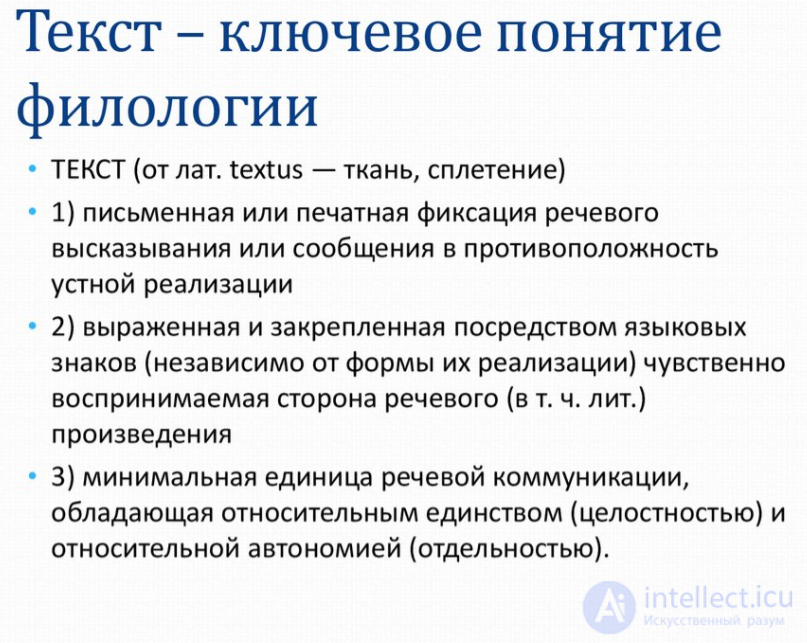
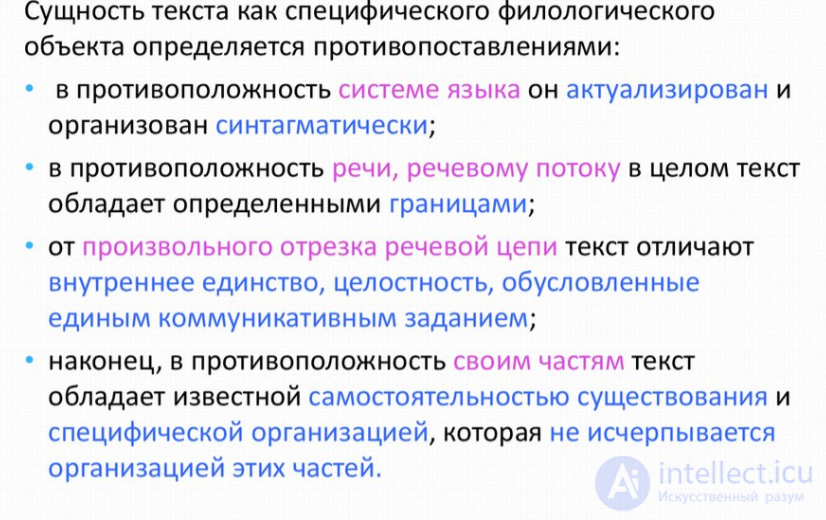
In literary studies, text is significant as an aspect of a literary work. Here text, according to the definition of the British philosopher and literary scholar Terry Eagleton, whom N.N. Mikhailov cites approvingly, is «a speech work detached from any specific speech situation, and therefore open to the most varied interpretations by different readers». The «detachment» of a literary work from a specific speech situation is quite understandable: the text is created by means of the language of imaginative literature — a sign system of a special kind.
Thus, the lyric poem by A.S. Pushkin «To I.I. Pushchin», begun the day after Pushchin's visit to the disgraced poet, is perceived as a message to all friends:
My first friend, my priceless friend!
And I blessed my fate,
When my secluded courtyard,
Covered with mournful snow,
Your little bell rang out. <...>
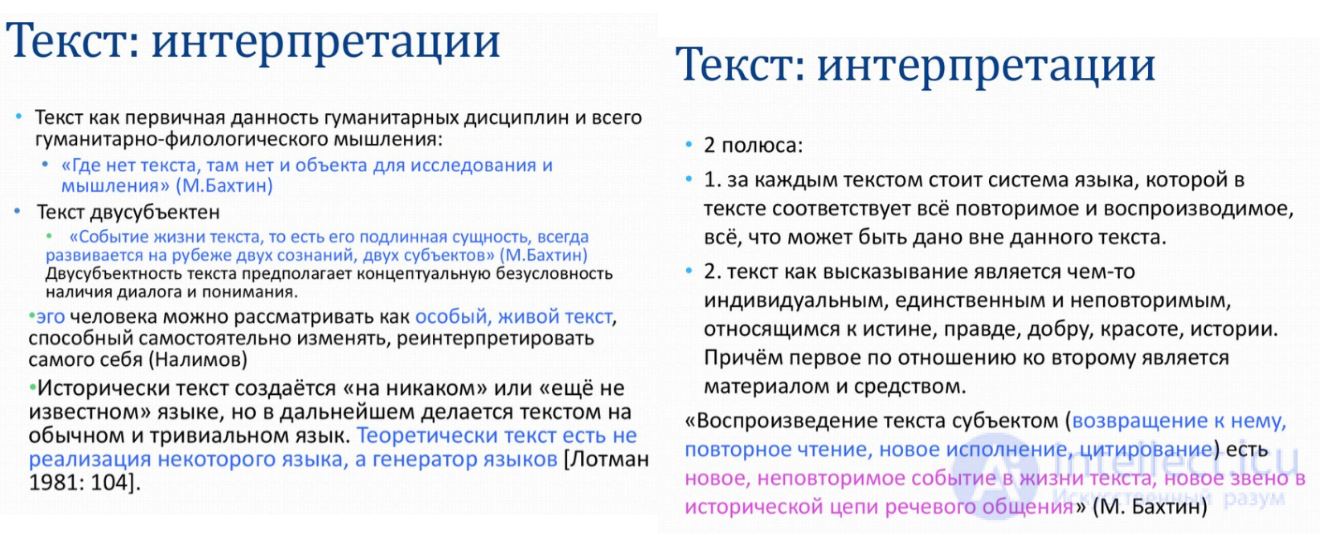
Both linguistics and literary studies have their own specialized scholarly disciplines that study different facets of the text. Thus, in linguistics, for example, text stylistics stands out; in literary studies, textology plays a major role. Text is also significant for the humanities as a whole. This thesis was already put forward by M.M. Bakhtin. Discussing research in the humanities, he observed: «Whatever the goals of research may be, the only possible starting point is the text».
R. Barthes. From Work to Text
<...>
In contrast to the work (a traditional concept which has long been, and still is, conceived in a Newtonian manner, so to speak), there arises a need for a new object, obtained as a result of a shift or transformation of the earlier categories. That object is the Text. I understand that this word is currently in fashion (I myself am rather inclined to use it fairly often), and thereby arouses some distrust; that is precisely why I would like to formulate for myself, as a reminder, the basic propositions at whose intersection, in my view, the Text is situated. The word «proposition», «sentence», should be understood here in a grammatical rather than a logical sense; these are not proofs but simply statements, a kind of «trial», attempts at an approach to the subject, in which a degree of metaphoricity is admitted.
<...>
***
1. The Text should not be understood as something calculable. Every attempt to physically demarcate works and texts is futile. In particular, it would be rash to assert: «the work is the classics, the text is the avant-garde»; the point is not at all to hastily draw up a list of «contemporary laureates» and to arrange some literary compositions as in1 and others as out2 by chronological criterion; Inside (Eng.). — Translator's note. 2 Outside (Eng.). — Translator's note. in fact «something of the Text» may be found even in a very ancient work, whereas many creations of contemporary literature are not texts at all. The difference lies here: the work is a material fragment occupying a certain portion of book-space (for example, in a library), while the Text is a field of methodological operations (un champ méthodologique). This opposition partly recalls (but by no means duplicates) the distinction proposed by Lacan: «reality» is shown, while the «real» is demonstrated; similarly, the work is visible, tangible (in a bookshop, in a library catalogue, on an examination syllabus), whereas the text is demonstrated, articulated according to certain rules (or against known rules). The work can fit in one's hand, the text is situated in language, exists only in discourse (or rather, it is a Text only insofar as it is aware of being so). The Text is not the product of the work's decomposition; on the contrary, the work is the imaginary train trailing behind the Text. Or to put it differently: the Text is felt only in the process of work, of production. It follows that the Text cannot remain motionless (say, on a bookshelf); by its nature it must move through something — for example, through a work, through a series of works.
***
2. In the same way, the Text is not confined within the bounds of respectable literature, does not lend itself to inclusion in a genre hierarchy, or even in an ordinary classification. What is decisive for it is, on the contrary, precisely its ability to break through the old categories. <...> <...> one may say that the Text is always, in the literal sense, paradoxical.
***
3. The Text is known, is grasped, through its relation to the sign. The work is closed, reducible to a determinate signified.(In the original, the reflexive verbs se démontrer, se montrer, se parler are played upon; a literal translation: «“reality” is shown, and the “real” is revealed..., the text is revealed, is spoken...» — Editor's note.) To this signified two kinds of value may be ascribed: either we take it to be explicit, and then the work becomes the object of a science of literal meanings (philology), or we consider this signified to be secret, deep-seated, something to be sought, and then the work falls under the purview of hermeneutics, of interpretation (Marxist, psychoanalytic, thematic, etc.). It follows that the work as a whole functions as a sign; it is fitting that it should constitute one of the foundational categories of the civilization of the Sign. In the Text, by contrast, the signified is endlessly deferred; the Text is evasive, it operates in the realm of the signifier. The signifier should not be conceived as the «visible part of meaning», not as its material antechamber, but on the contrary, as its secondary product (aprèscoup). Likewise, the infinity of the signifier does not imply unnameability (a signified that resists naming) but play; the generation of the signifier within the field of the Text (or rather, the Text itself is its field) occurs perpetually, as in a perpetual calendar — not organically, through maturation, and not hermeneutically, through a deepening into meaning, but through multiple displacement, superimposition, and variation of elements. The logic governing the Text rests not on understanding (elucidating «what the work means») but on metonymy; in the working-out of associations, interconnections, and transfers, symbolic energy finds an outlet; without such an outlet man would die. The work, at best, is only slightly symbolic; its symbolism quickly fades, that is, freezes into immobility; the Text, by contrast, is thoroughly symbolic; the work, understood, perceived, and accepted in the full plenitude of its symbolic nature, is precisely the text. Thereby the Text returns to the bosom of language: as in language, it has structure but no unifying center, no closure. (Structuralism is sometimes treated with disdain, as a «fashion»; yet the exceptional epistemological status now accorded to language is due precisely to the fact that we have uncovered in it the paradoxical nature of structure — a system without purpose and without a center.)
***
4. The Text is characterized by plurality. This means not simply that it has several meanings, but that in it plurality of meaning as such is realized — an irreducible plurality, not merely an admissible one. In the Text there is no peaceful coexistence of meanings — the Text crosses them, moves through them; therefore it does not lend itself even to a pluralistic reading, for in it an explosion, a scattering of meaning takes place. Indeed, the plurality of the Text arises not from the ambiguity of the elements of its content but, so to speak, from the spatial multilinearity of the signifiers of which it is woven (etymologically, «text» means «fabric»). The reader of the Text may be likened to an idle person who has shed within himself all the tensions produced by the imaginary and is burdened by nothing internally; he strolls (as once happened to the author of these lines, and it was then that he vividly pictured to himself what the Text is) along the slope of a ravine through which a drying river flows (the mention that the river is drying is meant to convey the unfamiliarity of the setting). His perceptions are multiple, irreducible to any unity, heterogeneous in origin — glints of light, patches of color, plants, heat, fresh air, clapping sounds coming from somewhere, the sharp cries of birds, children's voices on the other slope of the ravine, passers-by, their gestures, the garments of the local inhabitants in the distance or quite nearby; all these random details are half-recognizable — they refer to familiar codes, but their combination is unique and fills the walk with dissimilarities that can be repeated only as new dissimilarities. So it is with the Text — it can be itself only in its dissimilarities (which, however, says nothing about any individuality of its own); the reading of the Text is a one-time act (which is why any inductive-deductive science of texts is illusory — the text has no «grammar»), and at the same time it is woven entirely of quotations, references, echoes; these are all the languages of culture (and what language is not?), old and new, which pass through the text and create a powerful stereophony. Every text is an inter-text in relation to some other text, but this intertextuality should not be understood as meaning that the text has some origin; all searches for «sources» and «influences» correspond to the myth of the filiation of works, whereas the text is formed out of anonymous, untraceable, and at the same time already-read quotations — quotations without quotation marks. The work does not contradict any philosophy of monism (even though some of these are, as is well known, irreconcilable enemies); for such a philosophy, plurality is the world's Evil. The Text, by contrast, in opposition to the work, might choose as its motto the words of the one possessed by demons (Gospel of Mark, 5, 9): «My name is Legion, for we are many». The Text stands opposed to the work through its plural, demonic texture, which is capable of bringing about profound changes in reading, precisely in those very areas where monologism constitutes a kind of supreme commandment: certain «texts» of Scripture, traditionally surrendered to theological monism (historical or anagogical), can be read with an eye to the diffraction of meanings, that is, in the final analysis, materialistically, whereas the Marxist interpretation of works, hitherto strictly monistic, could through plurality attain an even greater degree of materialism (provided, of course, that the Marxist «official institutions» allow it).
***
7. Given this, one more, final, approach to the Text may be considered (proposed) — through pleasure. <...> Of course, the work (some works) also gives pleasure: I can read and reread Proust, Flaubert, Balzac, and even — why not? — Alexandre Dumas with rapture. But such pleasure, for all its intensity, even when entirely free of any prejudices, still remains in part a consumerist pleasure (except that one must make extraordinary efforts to criticize it): for although I can read these authors, I also know that I cannot re-write them (that it is no longer possible to write «that way» today); the mere awareness of this rather sad fact separates me from creating such works, and this very separation is the guarantee of my modernity (does being a modern person not mean knowing thoroughly that which can no longer be begun anew?). As for the Text, it is bound up with enjoyment, that is, with pleasure free of any sense of separation. The Text realizes a kind of social utopia in the realm of the signifier; ahead of History (unless History chooses barbarism), it renders transparent, if not social relations, then at least linguistic ones; in its space no language has precedence over another, they circulate freely (bearing in mind the «circular» meaning of that word).
<...> Quoted from: Barthes R. Selected Works: Semiotics. Poetics. Moscow, 1994. Pp. 413—423. I.T. Kasavin. Text. Discourse. Context
The study of text in philology thus involves a multilevel, interdisciplinary approach that makes it possible to understand it at a deeper level and in various aspects — from structure and style to cultural and philosophical significance.

Comments