
Lecture
"Homo loquens" (a Latin term translated as "speaking man") refers to a concept expressing a specific characteristic of the human being as a creature capable of language and communication. This concept emphasizes the uniqueness and significance of language in human nature and culture. The term homo loquens, in a narrow sense, denotes «the person speaking» (writing), listening (reading), and in a broad sense, a person participating in speech communication.
The study of homo loquens (the speaking human) in philology presupposes a comprehensive approach to studying the human being through his linguistic activity and communication. The philological sciences examine homo loquens from the standpoint of several aspects:
Cognitive and psychological aspects. Homo loquens is studied from the standpoint of the cognitive processes underlying the creation and comprehension of language. It examines how language reflects thought, how concepts are formed, and how a person structures information. Psycholinguistics investigates the interaction between thought and language, the processes of speech production and speech perception.
Sociocultural aspects. Homo loquens is examined in the context of cultural norms, traditions, social roles, and interpersonal interactions. This aspect is studied by sociolinguistics and cultural studies, which investigate how language influences social structures and, conversely, how social changes are reflected in language. Researchers study linguistic norms, dialects, accents, social linguistic differences, and language as a bearer of a cultural code.
Communicative aspects. Homo loquens is manifested through various types of speech activity (speaking, writing, reading, listening). Communicative linguistics studies the functions of language in communication, the structure and styles of speech, as well as the mechanisms of meaning transmission in the process of communication. Within this direction, researchers study the principles of constructing speech acts, rhetoric, pragmatics, nonverbal communication, and much more.
Historical and evolutionary aspects. This aspect of studying homo loquens includes an analysis of the historical development of languages, the evolution of language systems, and changes in speech behavior. Historical linguistics and comparative-historical studies analyze how language has changed over time, and how homo loquens has adapted language to changing conditions of existence and knowledge.
Ethnolinguistic and anthropological aspects. Homo loquens is examined in ethnolinguistics and anthropological linguistics, which investigate the influence of language on the formation of ethnic and cultural identity. Researchers study the ways of expressing mentality, mythology, rituals, and rites through language, as well as the role of language in preserving ethnic uniqueness and intercultural communication.
Technological aspects. With the development of technology, homo loquens acquires a new dimension in the digital space. Issues of digital linguistics, computational linguistics, automatic speech analysis and synthesis, and the influence of virtual communication on language are becoming relevant. Researchers study changes in the structure of language, the influence of social networks and the Internet on language, abbreviations, emoji, and other innovative forms of communication.
Philosophical and metaphysical aspects. The study of homo loquens is also connected with the philosophy of language, which investigates the nature of language, its influence on worldview and consciousness, as well as questions of sense, meaning, and truth in linguistic expressions.
Language is one of the fundamental distinguishing features of the human being. A person has the ability to create and use complex systems of signs and symbols to convey thoughts, ideas, emotions, and information to other people. Language allows us to express our thoughts, exchange information, build communities, and develop culture.
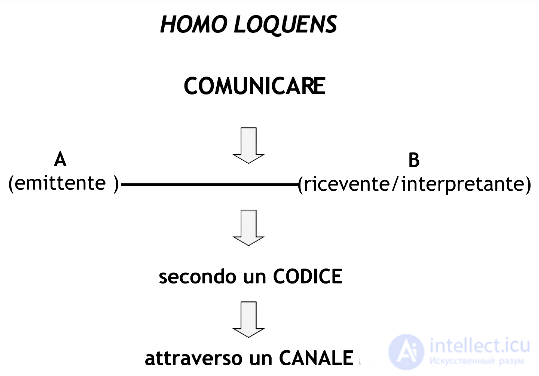
The speaking human also possesses the ability for linguistic diversity and creativity. We can create new words, form grammatical constructions, and use language to express abstract and complex ideas. Language allows us to communicate and pass knowledge and experience on from generation to generation.
The concept of "homo loquens" emphasizes that the capacity for language is a fundamental trait of human nature, one that plays an important role in our thinking, social organization, and cultural development.
In contemporary philology, no unified philological scholarly discipline has yet taken shape whose subject of study is homo loquens as an object of philology. (Compare: for example, text as an object of philology is studied by the theory of text; language and literature — by humanities semiotics.) The study of homo loquens as an object of philology is carried out within a number of scholarly disciplines that are linked with linguistics and literary studies.
Let us name two such disciplines:
1. philological hermeneutics, which studies the processes of understanding a text.
«Understanding,» writes G.I. Bogin, «leads to mastering «the essence of the matter»». The scholar asserts that «the ultimate social goal of philological hermeneutics is to help people communicate <…>, to overcome the failure of one person to understand another» (Bogin G.I. Attaining the Capacity to Understand. An Introduction to Hermeneutics.).
2. discourse analysis (cf.: English discourse — to orate; to discourse; to set forth in the form of speech, and French discours — speech) — a scholarly direction studying, in the words of N.D. Arutyunova, speech «immersed in life».
If, traditionally, a text is studied in abstraction from the speaker (writer) and the listener (reader), from the situation in which the creation and perception of the text takes place, i.e. is studied «in itself,» then discourse analysis presupposes examining the text in relation to the situation of its creation and perception, to the speaker (writer) and the listener (reader), to the goals and tasks of communication, to other texts, to the «world,» and, of course, to language. Thus, of primary importance are the participants in the act of communication, their capacities for speaking (writing) / listening (reading), their psychological and social
characteristics, activity, etc. Taking into account the entire set of these factors, a text can be interpreted adequately.
The generalizing scholarly direction studying homo loquens as an object of philology is the philological theory of communication. Let us define its area of interest against the background of the general theory of communication. The theory of communication, as a humanities discipline, studies the processes of information transmission in
society, carried out by means of any sign systems (natural language, optical, auditory, tactile signs, the languages of dance, theater, cinema, etc.) of human interaction. The interests of the philological theory of communication are focused on human communicative activity by means of a text in a natural language.
Philological hermeneutics, discourse analysis, and the philological theory of communication, together with humanities semiotics and the theory of text, serve to integrate the philological sciences and disciplines in their connections with other humanities sciences and disciplines.
Linguistics studies homo loquens as the «principal subject of communication». What knowledge and conceptions does a person have as a subject of communication; how does he «make use» of them in the processes of communication? — these are the main questions of linguistics as it studies «its own» aspects of homo loquens. It is understood that this body of knowledge includes knowledge of language and the rules of language use, knowledge of communication and the rules of speech communication, knowledge of the world, and so on.
Literary studies is interested in homo loquens as a subject of artistic investigation, in the first place, and as a subject of literary-artistic communication (author — reader), in the second. What do the two have in common? Literature is interested in the human being at moments of psychic tension.
A person performs the functions of author and reader in exactly the same way, at moments of his own psychic tension. Otherwise, the work created will not be artistic, and the reader will retell the artistic work as an ordinary everyday story, in no way connected with the sphere of aesthetic perception.
Accordingly, contemporary linguistics and literary studies turn out to be closely connected with psychology, sociology, and the cognitive (Lat. cognitio — knowledge, cognition) and communicative sciences.
Joseph Brodsky. Nobel Lecture <...> A person takes up the writing of a poem for various reasons: to win the heart of a beloved, to express his attitude toward the reality surrounding him, be it a landscape or a state, to capture the state of mind in which he finds himself at a given moment, to leave — as he thinks at that moment — a trace on earth. He resorts to this form — to the poem — for reasons that are, most likely, unconsciously mimetic: a black vertical mass of words in the middle of a white sheet of paper apparently reminds a person of his own position in the world, of the proportion of space to his body. But regardless of the reasons for which he takes up the pen, and regardless of the effect produced by what comes from under his pen on his audience, however large or small it may be — the immediate consequence of this undertaking is a sense of entering into direct contact with language, or more precisely — a sense of immediately falling into dependence on it, on everything that has already been expressed, written, realized in it.
This dependence is absolute, despotic, but it also liberates. For, being always older than the writer, language possesses a colossal centrifugal energy imparted to it by its temporal potential — that is, by all the time lying ahead. And this potential is determined not so much by the numerical size of the nation that speaks it, although that too plays a role, as by the quality of the poem being composed in it. It suffices to recall the authors of Greek or Roman antiquity, it suffices to recall Dante. What is created today in Russian or in English, for example, guarantees the existence
of these languages for the next millennium. The poet, I repeat, is a means for the existence of language. Or, as the great Auden said, he is the one through whom language lives. I who write these lines will be gone, you who read them will be gone, but the language in which they are written and in which you read them will remain, not only because language outlives man, but also because it is better adapted to mutation.
The person writing a poem, however, does not write it because he counts on posthumous fame, though he often does hope that his poem will outlive him, if only briefly. The person writing a poem writes it because language prompts him, or simply dictates to him, the next line. On beginning a poem, the poet, as a rule, does not know how it will end, and is sometimes very surprised by what comes out, for it often comes out better than he supposed, often his thought
goes further than he had reckoned. This is precisely the moment when the future of language intervenes in its present. There exist, as we know, three methods of cognition: the analytical, the intuitive, and the method used by the biblical prophets — through revelation. The distinction of poetry from other forms of literature is that it makes use of all three at once (leaning predominantly toward the second and third), for all three are given in language; and sometimes, with the help of a single word, a single rhyme, the person writing a poem manages to find himself where no one has been before him — and further, perhaps, than he himself would have wished. The person writing
a poem writes it above all because a poem is a colossal accelerator of consciousness, of thinking, of the sense of being. Having experienced this acceleration once, a person is no longer able to refuse to repeat this experience; he falls into dependence on this process, just as one falls into dependence on drugs or alcohol. A person who finds himself in such dependence on language is, I believe, precisely what is called
a poet.
Everyone immediately understands what kind of question is being posed here and where it originates from. Well then — is the art of conversation disappearing? Do we not observe, in the life of society in our era, a gradual monologization of human behavior? Is this a universal phenomenon, connected with the scientific-technical thinking inherent in our civilization? Or is it that some particular experiences of loneliness, of alienation from oneself, constrain the lips of younger people? Or perhaps this reflects a resolute departure from the very desire to come to an understanding with one another, an embittered protest against the appearance of mutual understanding
in social life, over which some lament, seeing in it people's inability to converse? These are the questions that come to everyone's mind on hearing what topic we have just named. And yet the ability to hold a conversation is a natural attribute of the human being. Aristotle called man a creature endowed with language, and language exists only in conversation. Language can be codified, fixed to some degree in dictionaries, grammars, and literature, and yet, as language lives, becomes obsolete, is renewed, coarsens, and grows refined, attaining the high stylistic forms of literature as art, all of this is alive thanks to the active exchange of speech among people conversing with one another. Language exists only in conversation.
But how varied the role of conversation can be! Once I happened to observe, in a Berlin hotel, a military delegation from Finland — the officers sat at a round table in silence, absorbed in themselves:
those sitting next to one another were divided by a boundless tundra, by their inner landscape, by an unbridgeable distance. Who, coming from the North, has not marveled at the ceaseless surf — the noisy, resounding waves of conversation in the squares and markets of southern countries, Spain or Italy! But it is quite possible that we should not regard the one — as an unwillingness to enter into conversation, and the other — as a special gift for conducting conversation. Because it is quite likely that conversation is something other than the constantly shifting dynamic of the everyday style of companionable life. And there can be no doubt that complaints about an inability to converse implied not
this style, but conversation in a more serious sense of the word.
The advantage of this understanding is that discourse, disrupting intuitive or linguistic approaches to its definition, is not confined to the framework of a specific linguistic utterance, i.e. to the framework of a text or the dialogue itself. Conversation analysis confirms this with particular clarity: the speaker and the listener, their personal and social characteristics, other aspects of the social situation, undoubtedly pertain to this event. In this sense a conversation, a meeting, a hearing of a case in court, a lesson in class — all of these may be called complex communicative events. Such events can be further broken down into smaller communicative acts, such as a story told in conversation, a lawyer's plea in court, a teacher's explanation of a lesson in class. Some of these phenomena, for example narratives or discussions, may exhibit qualities characteristic of communicative acts and discourses in other social settings. In written or printed types of discourse this interactional nature of the phenomenon is less apparent: the writer, the text, the reader are not in such close interaction within a single situation localized in space and time. But even in this case it would be worth analyzing texts from the point of view of the dynamic nature of their production, comprehension, and the action performed with their help. For example, the analysis of the meaning of discourse, which seems to us very important, may up to a certain point be limited to an abstract description of the meaning of the text itself, but empirically it would be more correct to speak of meanings expressed by means of the utterance itself or created by it, or of meanings that arise in the process of the text's publication by the writer, or of meanings that are ascribed to the text or extracted from it by the reader. In this case, in determining the meaning of discourse, one must take into account meanings generally accessible to the participants of communication, knowledge of language, knowledge of the world, other attitudes and conceptions. It should be added that writers create forms and meanings that are presumably intelligible to the reader or that may be explicitly addressed to him, that provoke reactions and that are generally oriented toward the recipient, as happens in conversation. In the case of written communication, writers and readers participate in a process of sociocultural interaction. All these characteristics also pertain to news texts. In the narrow sense of the word we may abstractly investigate the structures of news reports, defined as a special kind of social discourse. And yet (with this we shall become more closely acquainted below) the structures of news under consideration can be adequately understood in only one way: if we analyze them as the result of the cognitive and social activity of journalists in producing texts and their meanings, as the result of the interpretation of texts by newspaper readers and television viewers, produced on the basis of their experience of engaging with the mass media. It would, however, probably be useful to distinguish the cognitive processing of a text, or the social parameters of communication carried out by means of texts, on the one hand, from the structures of the mass-communication texts themselves, on the other. In our study we shall concentrate attention on the structure of news texts and shall only occasionally relate these structures to their cognitive, social, and political contexts; the latter have been described in fairly considerable detail in other works devoted to news and the mass media (Gans, 1979; Tuchman, 1978; Fishman, 1980). (For a further theoretical description of the structure of news and problems of cognitive processing in the production and comprehension of texts, see: van Dijk, 1987e.)
— the formal-demographic and ethnographic;
— the social, psychological, and socio-psychological;
— the cultural-anthropological;
— the philosophical-worldview;
— the cognitive and communicative;
— the linguistic;
— the situational-behavioral.
— philological hermeneutics?
— discourse analysis?
— the philological theory of communication?
These aspects allow us to study homo loquens comprehensively, to understand how language shapes a person's personality, thinking, perception of the surrounding world, and social interactions.

Comments