
Lecture
What is a text? The answer to this question seems simple: it is intuitively clear to every speaker (writer) what a text is. All the more so since the contemporary school offers students an answer to the question posed.
Initially (and most deeply) this term took root in linguistics. For the linguist, a text is an act of the use of natural language possessing a definite complex of properties. It is characterized by coherence and completeness. A text is clearly delimited from everything external to it, from the surrounding speech and non-speech reality. Put simply, it has a clearly expressed beginning and end, constituting a chain (group) of sentences that is the minimal (indivisible) communicative unit
The linguistic understanding of the text is in some cases narrower (text as a «linguistic expression of a particular semantic series»[594]), in others wider. Thus, the scholarly discipline known as text linguistics treats the text as a speech formation (work) with its linguistic «flesh», its construction, and its meaning.
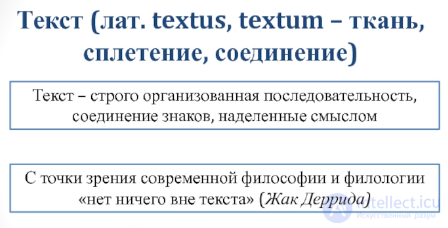
The complexity, however, is connected with the fact that the text belongs to at least two «masters»: language and man. The German scholar
of the mid-twentieth century P. Hartmann writes: «...language becomes visible in the form of a text». This judgment correlates with the words of M.M. Bakhtin cited in the epigraph: «The event of the life of a text,
i.e. its true essence, always develops at the boundary of two consciousnesses, two subjects».
The reader can see that in one statement the text is assessed «from language», and in the other — «from man». Let us examine two
conceptions of the text that exist in contemporary philology. One of them, which arose comparatively long ago, we shall call traditional, and the other, more recent one — contemporary.
The first. A text is several sentences connected in meaning and grammatically — such is the traditional, «school» definition of text.
Contained in this understanding of the text is an idea that corresponds to the meaning of the word text in Latin (Lat. textus —
fabric, weave, connection): the sentences making up the text
are connected in two respects — semantically and grammatically.
Language has developed special means of such connection, for example:
a) repetition of words. See the text of the abstract of a scholarly article (the article is devoted to the question of the dependence of chat speech on subject matter):
l Russian: The aim of the article is to compare youth chat with other kinds, and also to reveal the dependence of chat speech
on the age and profession of the participants. In the course of the research it was
revealed that youth chat is characterized by features
of colloquial speech and depends on the age of the participants;
l English: The aim of this article is to compare the youth chat with others, thus checking the supposition of speech dependents in
the chat on the participants’ age and profession. It has been revealed in the course of the research that the youth chat mostly correlates
with oral speech, and it is characterized by the age of the participants
(Philology and Man. 2008. No. 4. P. 209);
b) incompleteness of a sentence, replacement of a noun by a pronoun, and other means. See the dialogue:
l Russian: — Where is Elena? — At home. Her leg hurts.
l Czech: — Kde je Helena? — Doma. Bolí ji noha.
In applying the traditional definition, certain questions and difficulties arise. Let us give several cases.
Case 1. The text contains only one sentence.
If this is so, then, for example, an abstract
consisting of a single sentence, or the first line of the dialogue given above, is not a text. See further examples:
l a note: Be there at eight in the evening;
l an appeal to readers of an advertising publication: If you have not received the newspaper, call 000-00-00; and others.
Here, too, the text is not «found» owing to the presence of only a single sentence.
Case 2. Between the sentences there is no grammatically expressed connection, for example in the sentences of the second line of the dialogue given above. The second sentences turn out to be connected with the first sentences of the reply not
directly, but through a relation to the sentence of the opening
line: at home = with her = with Elena. (The same holds in the Czech dialogue.)
See also: The wind started up. We hid under the boat. The sentences given have no grammatical connections between them, although the semantic (causal) connection is obvious.
Case 3. Between the sentences of a text grammatical connections do exist, but semantic connections are absent. An interesting piece of material is given by the Russian specialist in text linguistics S.I. Gindin: I went to the cinema. The cinema is on Ostozhenka.
Ostozhenka is one of the oldest streets in Moscow. Moscow is the center of all the railway lines of the country. Railways are
the arteries of the national economy <...>.
The text given above may be created under special conditions, for example in a game. However, according to the traditional
understanding of the text, this material cannot be subsumed under the concept of text — for the reason stated above.
Case 4. In speech there are widespread texts created by means of different semiotic systems. They are often reproduced in fiction. Recall, for example, the final scenes
l from A.S. Pushkin’s tragedy «Boris Godunov»:
Mosalsky. People! Godunov and her son Feodor have poisoned themselves
with poison. We have seen their dead bodies. (The people are silent in horror.)
Why are you silent? Cry out: long live Tsar Dmitry
Ivanovich!»;
l from N.V. Gogol’s comedy «The Government Inspector»:
Gendarme. An official who has arrived from St. Petersburg by personal decree demands you before him this very hour. He has put up at the
inn.
The words spoken strike everyone as if by thunder. A sound of astonishment escapes the ladies’ lips in unison; the whole group, suddenly changing position, remains frozen.
In the situations described in the excerpts given, there
occurs a «mixed» text. It is created by means of different semiotic systems: in Pushkin — by natural language and silence, in Gogol — by natural language and the sound of astonishment
(from the ladies), as well as by the change in the characters’ position in space and by «universal petrification».
Thus, the traditional definition of text embraces only part of the material that is intuitively recognized as
text. These are «correct», predominantly written texts.
The second. A text is a linguistic formation that ensures the communicative interaction of people — such is one
of the contemporary definitions of text.
Under this definition all of the cases considered above can be subsumed. Indeed, from the standpoint of this
definition it is not essential how many sentences the text consists of. What is important is that it is a linguistic formation. This
means that the text, like other linguistic units (for example, the word and the sentence), expresses by its own linguistic means
a certain content. This is how matters stand in cases (1)—(3).
The situation is somewhat different with texts subsumed under case (4). Its peculiarity consists in the fact that the texts are formed
by means of different semiotic systems: the linguistic formation conveys content only in interaction with the means of other sign systems, though the main content of the utterance is nevertheless conveyed precisely by linguistic means.
Thus, this definition takes into account both the connections between the sentences of a text, if it contains more than one, and texts
created by means of different semiotic systems, at the center of which lies natural language.
The second understanding of text characterizes it from a functional point of view: the text ensures the communicative interaction of people. This is its main function.
This function is revealed in examining the text «from the speaker’s side» in its interaction with the «listener». In a certain
situation the text is created by the speaker (writer), and is perceived by the listener (reader) — in the same or a different situation — and
interpreted. If, for example, the speaker wants to please the interlocutor, he may pay him a compliment: You
look wonderful today! Though a compliment may also be made «automatically», without the intention of «pleasing the interlocutor
». The task facing the listener (reader) consists in interpreting the meaning of what was said. Thus, the text given may be interpreted not as a compliment but otherwise, for example: Yesterday you looked bad! What are the grounds for such an interpretation? The listener may be «struck»
by something in the interlocutor’s intonation, in his look; the situation of yesterday’s conversation may be taken into account, the listener may proceed from the opinion that the speaker is not capable, or, owing to complicated relations, cannot pay a compliment, and so on. This example is a simple case of communicative interaction.
Matters are more complex with the communicative interaction of people, for example, in the sphere of aesthetic communication. Here
there are texts that are more complex in structural and semantic terms; their meaning is likewise interpreted in a more complex way. Every
reader knows this from his own experience of studying at school Russian and/or native, foreign literature. (See in the reading materials given below excerpts from the book by Yu.M. Lotman.)
Thus, the functional understanding of text turns out to be communicative in its essence.
From the analysis carried out of the two understandings of text, it follows that both understandings are significant for the philological sciences. They complement one another. Each of them reveals one side of the text: the first — its organization from the standpoint of structure and semantics; the second — its functional nature.
At the same time, the second understanding does not cancel the characteristics contained in the first, it only «removes» their extremes (it is precisely these extremes that are shown in the analysis of the first definition).
Let us name the most important features of text as an object of philology.
Communicativeness is a feature expressing the functional purpose of the text. The text is the highest communicative unit of language, in which the activity of the speaker (writer) in creating the text and the activity of the
reader (listener) in perceiving and understanding the text are «conjoined».
Each of them is represented in the text.
An example. The texts of public speeches by writers, journalists, and public figures at the turn of the twentieth—twenty-first centuries are distinguished by their addressee-orientation. How is the addressee designated? N.P. Volvak
(The Addressee Factor in Public Argumentative Discourse: abstract of Candidate’s dissertation in philology. Vladivostok, 2002) notes
that if the speaker’s opponent is not a specific person but «general opinion», it may be represented, for example, by the formulas «many say» or expressed without indicating
with whom the speaker is arguing: «they say».
See the excerpts of texts:
– «And others harp on: patriotism is a shameful stain, we are incapable of anything of our own, we must without looking back —
adopt everything, everything, everything from the West» (Solzhenitsyn);
– «They say nowadays: «No one is forgotten, nothing is forgotten». Oh, much is forgotten!» (Solzhenitsyn).
If, however, the addressee is a like-minded person of the speaker,
then his opinion is usually conveyed by quotation or in paraphrase. Thus the speaker realizes different possibilities for arguing with an opponent.
Systemic organization is a feature expressing the principle of a text’s structure. A text is a linguistic formation organized as a complex sign or sequence of signs. Like any linguistic sign, it has two sides: the signifier and the signified. Unlike other linguistic signs, a text possesses not only meaning but also sense. Thus, the meaning of an advertising text is usually taken to be an offer of a product (service, etc.). This meaning is expressed by the linguistic and non-linguistic signs by which the text is created. The sense of an advertising text, however, is usually taken to be
an offer of the services of the manufacturing firm, the trading organization, etc. This sense arises from the relations of the given advertising text to others. For the advertiser it is important that not a single product be advertised, but the company, the firm, and so on. The same
is essential for the consumer of advertising. If at least one type of product (service) purchased from a given organization satisfies the consumer in terms of quality, price, and other parameters, then in the future he will turn for services to that same
organization. The consumer always strives to find for himself a reliable (and advantageous) partner.
Yu.M. Lotman (1922—1993) named three functions of text, in which its functional nature is manifested.
The first function: text «packages» meaning. Thus, the theme of love is «packaged», for example, in the following variants (we give the texts):
— I loved you: love still, perhaps,
Has not quite died away within my soul;
But let it not trouble you any longer;
I do not wish to sadden you in any way.
I loved you silently, hopelessly,
Tormented now by shyness, now by jealousy;
I loved you so sincerely, so tenderly,
As God grant you may be loved by another
(A.S. Pushkin);
— I loved you. Love still (perhaps
it’s simply pain) drills into my brains.
Everything has flown to hell in pieces.
I tried to shoot myself, but it’s complicated
with a weapon. And further: temples:
which to strike? It was not trembling that spoiled things, but
pensiveness. Damn it! Everything’s not right!
I loved you so much, hopelessly,
as God grant you by another — but He won’t grant it!
He, being capable of much,
will not create — after Parmenides — twice
this heat in the blood, this broad-boned crunch,
so that fillings in the mouth melt from the yearning
to touch — I cross out «bust» — lips!
(I. Brodsky);
— Fedya + Dasha = love (an inscription on the asphalt opposite one of the windows of a student dormitory).
Between the «packagings» given there are substantial
differences: both in the syntactic construction of the texts, and in the vocabulary, and in the non-linguistic signs used: the meter of the first and second texts (moreover a different one!) and mathematical signs — in the third. Each of the texts is constructed according to the laws of its own genre:
the first and second — as lyric poems; the third — as a declaration of love. This predetermines the possible variants of the
compositional structure of the texts.
The second function: text is a generator (Lat. generator — producer) of meanings. One and the same text may be interpreted differently by different listeners (readers) in different situations
. See, for example, the text: Lightness, merriment, joy.
Dreams, a boundless future. Songs and poems. Sunsets and youth, which is eternal.
Below are given variants of the interpretation of the theme (what is the text about?) and of the idea (what is the main thought of the text?) of the text.
What is the text about? What is the main thought of the text?
About youth. Memory of the eternal.
About being young. Youth is the merriest time in life.
About a carefree life. What is needed for a carefree life.
About a happy future. Everything will be fine forever.
Why do different interpretations turn out to be possible?
Let us take into account the role of the listener (reader), his ability to interpret the meaning of the text. But this alone is not enough to answer the question. Let us turn to the text itself. Every text, including the one given, sends, by its constituent means, by its various facets of structure, different signals to each of those perceiving it in the process of
communication. In the given text, judging by the answers of the subjects, they discerned different signals. In fact the text possesses
a certain semantic potential, which allows the reader to discern in it different meanings: the reader «latches on» to this or that signal. (See: Korzhneva E.A. The Activity of the Experimental Linguist in the Study of Text Structure: Candidate’s dissertation, 2003. P. 101—102, 181—182.)
The third function: text is a condenser (Lat. condensare — to condense) of cultural memory. For example, Yu.M. Lotman writes:
«...«Hamlet» is not only Shakespeare’s text, but also the memory of
all the interpretations of this work and, moreover, the memory
of those historical events lying outside the text with which Shakespeare’s text may evoke associations. We may
forget what Shakespeare and his audience knew, but we cannot forget what we learned after them. And this gives the text new
meanings»
. The meanings accumulated by the text are preserved in the historical and cultural memory of mankind; they exist in
the form of a kind of cloud in which the text lives. The ability to accumulate cultural memory is possessed not only by texts of fiction and folklore, but by all others as well.
Thus, a text is not only stable, as follows from the fact that its meaning is «packaged», but also changeable. It is open to the reader of different times and countries. It presupposes the co-creation of the reader. (See in the reading materials given below excerpts from the book by U. Eco.)

Comments