
Lecture
Topic objective: to examine the main methods of psychodiagnostics, the requirements placed on them, and their advantages and disadvantages.
Topic outline:
3.1 Quantitative and qualitative methods of psychodiagnostics. Requirements for quantitative methods: the concepts of «reliability» and «validity». General characteristics of qualitative methods of psychodiagnostics, their capabilities, areas of application, and limitations.
3.2 Observation as the most important method of socio-psychological research. The specifics of observation as a scientific method, its difference from the everyday process. Goals, categories, and units of observation. Preparing observation protocols. Capabilities and limitations of the method. Observation as a method for assessing the level of professionalism.
3.3 Experiment, testing, survey, the method of studying activity processes and outcomes, and modelling. The specifics of the methods and forms of presentation. Advantages and disadvantages of the methods.
Discussion topic: The capabilities and limitations of the observation method in the practice of a human resources management specialist.
The word «psychodiagnostics» has two main meanings in psychology.
1. A field of scientific psychological knowledge and research,
2. A field of practical application of psychological knowledge.
As a field of science, psychodiagnostics includes the principles, procedures and methods for verifying the scientific validity of various psychodiagnostic methods.
As a field of practice, it is oriented toward professional knowledge and skills related to the practical application of its methods.
In both cases, what is at issue is a set of ways of assessing a person's psychological processes, properties and states. Theoretical psychodiagnostics scientifically justifies how this is best done, while practical psychodiagnostics shows how it should be done correctly and reliably.
Psychodiagnostic methods are distinguished based on qualitative and quantitative analysis of experimental data. In the first case the property being diagnosed is described using established scientific concepts, while in the second case it is described through the relative degree to which it has developed in the given person compared with other people. Sometimes quantitative and qualitative characteristics are combined within the same method, so that the property being studied ultimately receives a dual - quantitative-qualitative - characterization. For example, in the Lichko test, designed to diagnose character accentuations in adolescents, each of the character traits studied has a dual characterization - both quantitative and qualitative at the same time.
Methods that make it possible to obtain quantitative data reflecting the degree of development of the property being studied make it possible to use measures and methods of quantitative processing of psychodiagnostic results. At the same time, such methods make it impossible to distinguish between qualitatively different psychological properties that have identical quantitative indicators.
At present, methods of psychodiagnostics have been created and are being used in practice that cover all the psychological processes, properties and states of a person known to science.
Blank-form methods - those in which the examinee is offered a series of statements or questions to which he or she must respond orally or in writing. The responses obtained from the examinee are, in turn, used to judge the psychology of the person who gave these answers. The wide prevalence of and practical interest in blank-form methods are explained by the fact that they are relatively simple both to develop and to use, as well as to process the results obtained.
Second in frequency of occurrence are survey methods, in the course of which the researcher of a person's psychology asks the examinee oral questions, and notes and processes his or her answers. These methods are good in that they do not require the preparation of special forms and allow the psychodiagnostician to behave quite flexibly toward the examinee. The drawback of survey methods is their subjectivity, which shows up both in the choice of the questions themselves and in the interpretation of the answers to them. In addition, survey methods are difficult to standardize and, consequently, it is difficult to achieve high reliability and comparability of the results obtained.
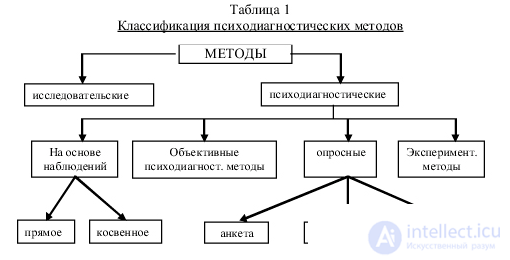
Third in frequency of use are drawing-based psychodiagnostic methods. In these, drawings created by the examinees themselves are used to study their psychology and behaviour; these drawings may have either a set theme or a spontaneous character. Sometimes the technique of having examinees interpret standard, ready-made images is used. Often the content of these images visually presents tasks that the examinee must solve (for example, the Raven matrix test, discussed in one of the following chapters).
The first and third of the types of psychodiagnostic methods described may each have two variants: manual and computer-based. In the manual variant, the method is used from beginning to end without the use of electronic computing equipment to present or process the experimental material. In the computer-based variant, electronic computing equipment is used at one of the stages of psychodiagnostics mentioned. For example, text and drawing material can be presented to examinees via a display screen, and the machine's processor can be used to perform quantitative calculations, as well as to print out the results obtained.
A special place among psychodiagnostic methods is occupied by projective methods, which, in turn, may be blank-form, survey-based, or drawing-based. The frequency of their practical use is also quite high and increases from year to year, for the reason that methods of this group are the most valid and informative.
The next group of methods is object-manipulation methods. In these, the tasks to be solved by examinees are presented to them in the form of real objects with which something must be done: assembled from given materials, made, taken apart, and so on.
In B. G. Ananiev's classification of methods of psychological research, psychodiagnostic methods belong to the group of empirical methods, alongside the methods of observation, experiment, modelling, and other methods of psychology that make it possible to obtain scientific information about the subject being studied.
A method — is a broad class of techniques and procedures united by a kinship of the basic technological approach and common theoretical principles.
The main distinguishing feature of the psychodiagnostic method is its measurement-and-testing orientation, through which a quantitative and qualitative assessment of the phenomenon being studied is achieved. This becomes possible thanks to the standardization of the measuring instrument, which is based on the concept of a norm, since an individual assessment - for example, of how successfully a given task has been performed - can only be obtained by comparison with the results of other examinees. Standardization of the examination procedure is no less essential for the psychodiagnostic method — precise compliance with the instructions, strictly defined ways of presenting the stimulus material, non-interference by the researcher in the activity of the examinee, and so on.
A psychodiagnostic method — is a specific, particular procedure or technique aimed at obtaining information about specific psychological characteristics (the subject of the study) in a specific person or group (the object of the study) in a given situation (or conditions), in order to solve specific tasks.
At present the main technique of psychodiagnostics is psychological testing. Its advantages over other (non-test) ways of obtaining diagnostic information lie in the features of the creation and use of psychological tests (hereafter this term will be used as a synonym for a psychodiagnostic method) — a special class of experimental-psychological methods that provide comparatively fast and low-effort acquisition of reliable, objective, and most often quantitatively expressed psychological data on the individual characteristics of examinees. This is what makes psychological tests dangerous: by expressing the result in a simple quantitative form, they create in amateurs the illusion of ease and simplicity of use, pushing them toward a pseudo-scientific style of working with tests. In the most general sense, a test (in English – a trial, check, or examination) is defined as a standardized psychological measuring instrument.
Several classifications of psychodiagnostic methods can be given on various grounds.
I. By form of administration, methods are divided into group and individual ones. Individual methods are administered only individually with each examinee; administering them to a group is impossible (for example, the Wechsler test). Group methods can be administered simultaneously to a group of examinees (for example, the Amthauer test).
II. By the nature of the stimulus material, and correspondingly the main activity of the examinee, methods are divided into verbal and nonverbal ones. In verbal methods, verbal stimulus material generates verbal activity in the examinee (for example, the Amthauer test). Nonverbal methods have nonverbal (imagery-based or object-action-based) stimulus material, and the operations called for by the task are carried out at the nonverbal level (for example, the Raven test).
III. By the presence or absence of time limits on the examinee's work, methods are divided into speed tests and power (achievement) tests. In power tests the time for completing the test task is not limited; in speed tests, by contrast, the examinee's working time is strictly regulated.
IV. An operational classification, based on distinguishing the diagnostic procedure itself. The psychodiagnostic method is realized in three main diagnostic approaches, which practically cover the entire range of existing diagnostic methods.
1. The «objective» approach — diagnosis is carried out on the basis of indicators of success (effectiveness) and the manner (or characteristics) of performing an activity. This approach is represented mainly by numerous tests of intelligence, tests of general and special abilities, achievement tests, and situational tests.
The main diagnostic indicator in these tests is the objective result or success in completing the proposed task — whether it was solved or not, how much was solved and by what method. These methods presuppose the existence of a correct answer (solution) or an optimal algorithm for completing the task. The introduction of computer-based testing opens up possibilities for studying the procedural side of the activity that the test models, helps identify individual strategies for solving tasks, and helps analyze difficulties
Let us note that the main indicator of an ability for some activity is the success of its performance. Another indicator is the ease of achieving success, or the energy expenditure, which can be objectively measured by instrumental psychophysiological methods, for example, changes during the activity in indicators of breathing, heartbeat, and galvanic skin response. These methods are used in psychodiagnostics as indicators of functional capacities and the dynamics of state, and are conditionally (owing to the problem of interpreting objective indicators) considered part of the objective approach.
2. The «subjective» approach — diagnosis is carried out on the basis of information reported by the person about himself or herself, self-descriptions of personality characteristics, and behaviour in various situations. This approach is represented by numerous questionnaires (open-ended and closed, single-factor and multi-factor, and so on), surveys and scaling techniques built on the model of C. Osgood's semantic differential, W. Stephenson's Q-sort, adjective check lists, and the like. These methods are, in essence, varieties of standardized self-report of personality: the client reports information about himself or herself according to the format offered by the method.
A special place is occupied by the individually oriented techniques of G. Kelly's role construct repertory grid method. Unlike personality questionnaires, here the parameters being assessed are not predetermined but are derived from the individual's own responses. The procedure usually involves discussing the figures making up the person being tested's reference group, or concepts significant to him or her. From the composition of this group (the role repertory) and the characteristics assigned to each member of the group, to oneself, or to the concepts discussed, one can arrive at a system of personal constructs or the psychosemantic components of the personality and its surroundings. By applying repertory diagnostic methods, one can identify the leading constructs and transform them, taking into account the available repertoire and the content of the semantic formations.
Computer capabilities make it possible to promptly apply modern methods of statistical data processing, ensuring the reliability of the information obtained, and to convert the survey into a dialogue (interactive) mode.
Computer-based diagnostics develops the capabilities of semantic methods (semantic differential, repertory grids, and others) aimed at studying the reflexive traits of personality or features of self-awareness that determine a person's behaviour and actions in a specific situation. This promising direction in the development of psychodiagnostics makes it possible to overcome the limitations of personality questionnaires, whose data describe a person and his or her possible behaviour within predetermined parameters («scales»). Often these predetermined parameters fail to capture the main characteristics of the individual, and instead produce a fragmentary, superficial psychological portrait of the personality. The use of the semantic method makes it possible to accurately diagnose mental characteristics that are integral in nature (for example, the level of understanding and personal development, the formation of professional orientation, the content of the need-motivational sphere, features of a person's psychological compatibility with others, and so on).
The procedure of computer-based psychosemantic methods (for example, I. Solomin's method for diagnosing latent motivation, or the «Kelly-98 co-therapeutic system») is as follows. In accordance with the psychosemantic model of individual consciousness, the various subjective attributes that a person uses in assessing and comparing different objects of reality are represented as the coordinate axes of a multidimensional space. The objects themselves — are points in this space, the ratings of objects on subjective attributes — are the coordinates of the points along the corresponding axes, and the subjective differences between objects – are the distances between the points. A person rates objects or concepts (people, events, values, feelings, and so on) using semantic differential techniques, and multivariate statistical analysis makes it possible to graphically depict the semantic space of the personality's self-awareness. As a result, the closeness or dispersion of a person's subjective representations and emotional assessments, the balance of his or her personality structure, and the hierarchy and structure of motives are clearly depicted - that is, those latent (hidden) characteristics that underlie a person's behaviour in a given situation and make it possible to arrive at specific recommendations and corrective action.
3. «Projective» approach — diagnosis is carried out on the basis of analysing the specifics of interaction with externally neutral and ambiguous stimuli, devised and presented in such a way that the person can project onto them his or her individual traits, aspirations, fears and expectations.
The effectiveness of the projective method rests on a long-known psychological fact — the fact that mental reflection, and human consciousness in particular, is inherently biased. Projection is now regarded as a general mechanism of personality perception.
In 1939, L. Frank put forward three basic principles underlying the projective study of personality:
1. It is directed at what is unique in the structure or organization of personality. Unlike traditional psychometric procedures, personality is regarded as a system of interrelated processes rather than a list (set) of abilities or traits.
2. In the projective approach, personality is studied as a relatively stable system of dynamic processes organized on the basis of needs, emotions and individual experience.
3. This system of basic dynamic processes operates constantly and actively throughout the individual's life, «forming, directing, distorting, changing and reshaping every situation into a system of the individual's inner world». Every new action, every emotional manifestation of the individual, his perceptions, feelings, statements, and motor acts bear the imprint of personality. This third and principal theoretical proposition is usually called the «projective hypothesis».
In defining the specifics of the projective approach, L. Frank writes that it is a technique for studying personality in which the subject is placed in a situation to which he reacts depending on what that situation means to him, and on his thoughts and feelings. It is also emphasized that the stimuli used in projective techniques are not strictly unambiguous but allow for various interpretations. A stimulus acquires meaning not simply by virtue of its objective content, but above all through the personal meaning attributed to it by the subject.
L. Frank does not view projective techniques as a replacement for the already known psychometric ones. The purpose of these techniques is to study the «idiomatic» inner sphere, which can be viewed as a way of organizing life experience. Projective techniques successfully complement existing ones, allowing a glimpse into what is most deeply hidden and eludes traditional research methods.
Most projective techniques do not fit the strict definition of a psychological test, whose main features are standardization, independence of the result from the influence of the experimental situation and the personality of the psychologist, and comparability of individual data with normative data, i.e. data obtained under the same conditions on a sufficiently representative sample. In projective testing it is practically impossible to fully unify and standardize not only the analysis and interpretation of results, but even the research procedure itself. Evidently, a standardized procedure would not allow individuality to be studied as a unique personality.
Distinctive features of projective methods:
Unlike many others, projective techniques do not tie the researcher to fixed schemes for interpreting results. They can be used as a tool for formulating hypotheses, since they yield material important for understanding a person's inner world, which is then subject to the diagnostician's interpretation and evaluation regardless of any particular theoretical preferences.
L. Frank, one of the pioneers of the projective approach, proposed a classification of projective methods which, with some additions, is still accepted today:
1) Constitutive techniques, or structuring techniques: the person is presented with unformed, meaningless material to which he must give some subjective meaning (for example, the Rorschach test);
2) Constructive techniques, or construction techniques: involve creating and interpreting a whole out of shaped parts (toys, blocks, etc.), for example the World Test or the «sandbox» technique:
3) Interpretive techniques involve interpreting events or situations that allow for various readings (for example, Murray's TAT, the Hand Test);
4) Additive techniques, or completion techniques (for example, unfinished sentences, stories, Jung's word association test, the Rosenzweig test);
5) Expressive techniques, or the study of products of pictorial activity (for example, numerous drawing tests — Non-Existent Animal, House-Tree-Person, Kinetic Family Drawing, etc.);
6) Impressive techniques, or preference techniques: involve arranging stimuli in decreasing order of attractiveness (for example, the Luscher colour test, the Szondi Test);
7) Refractive techniques, or the study of involuntary movements that a person introduces into means of communication (speech, gestures, handwriting) and into performative activity (for example, E. Mira y Lopez's myokinetic diagnostic test, graphological handwriting analysis);
8) Cathartic techniques, or catharsis techniques (for example, psychodrama, projective play, etc.).
There are no clear boundaries between the psychodiagnostic approaches under consideration; some techniques are ambiguous in technology and occupy an intermediate position. In psychodiagnostic practice, different approaches are not opposed to one another but interact. Standardized quantitative tests are more effective when at least approximate data on an entire group of people are needed quickly for an operational decision (to accept, to give rest, etc.). Expert procedures (based on the qualitative assessments of experts — professionally trained specialists) allow deep insight into the unique life situation of a particular person and are especially effective in building individual corrective or developmental programmes.
The psychodiagnostic approaches under consideration involve differing degrees of influence by the diagnostician on the research procedure. Within the subjective and projective approaches, a group of interactive or dialogical techniques is distinguished (for example, conversations, interviews, diagnostic games), in which the diagnostician enters into purposeful contact with the subject under study, which correspondingly affects the results of the psychodiagnosis.
A separate group is formed by dialogical techniques, in which the psychodiagnostician makes contact with the person being examined and achieves the best diagnostic results through the specific features of this contact, which are relevant (appropriate) to the diagnostic task. Thus, trusting contact is necessary when diagnosing family difficulties, the nature of a child's personal development, personal problems, and in many other cases in which the diagnostician acts simultaneously either as a counsellor or as a psychotherapist. The situation of a pathopsychological examination likewise dictates building communication along the lines of an expert assessment. Dialogical techniques can be verbal (interview, conversation) and non-verbal (for example, play with a child, a business game with adults can serve as non-verbal diagnostic procedures).
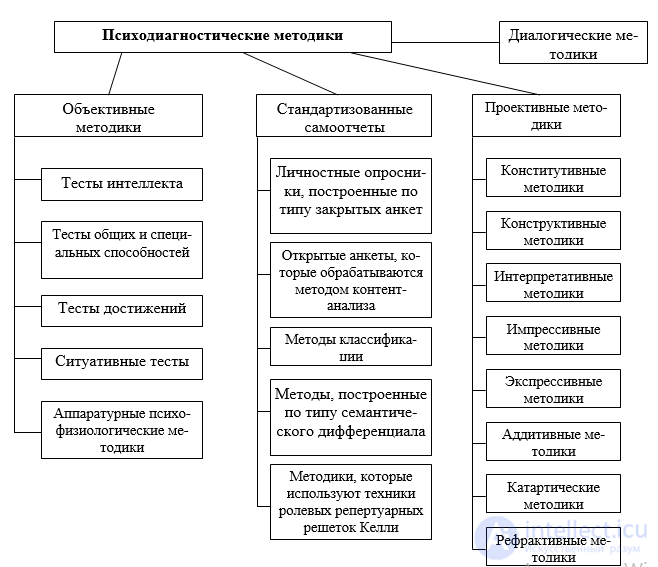
Fig. 1. Operational classification of psychodiagnostic techniques
The (main) classification of psychodiagnostic techniques, based on distinguishing the operational approaches embedded in a technique, can be represented as the diagram shown in Figure 1. Other classifications of psychodiagnostic techniques exist, based on different criteria.
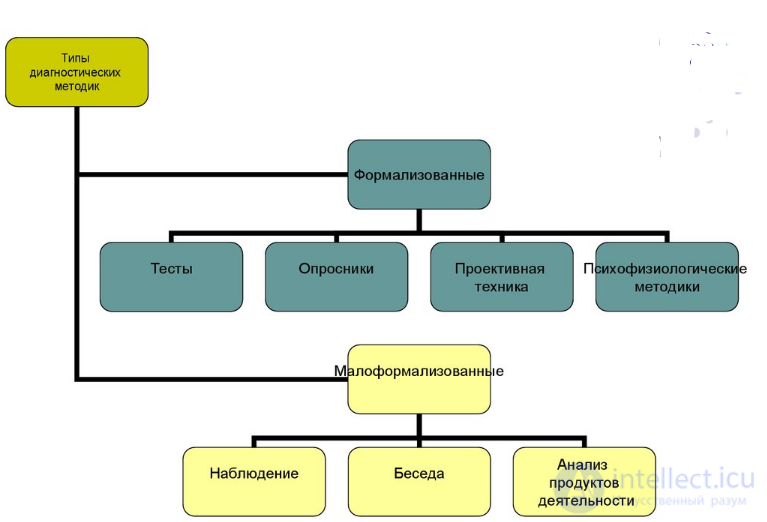
V. Techniques are divided into two large groups by degree of regulation: formalized and semi-formalized techniques.
Included among formalized techniques are tests, questionnaires, projective techniques, and psychophysiological techniques. They are characterized by:
These techniques make it possible to gather diagnostic information quickly, in a relatively short time, and in a form that allows examinees to be compared with one another both quantitatively and qualitatively.
Semi-formalized diagnostic techniques include observation, conversation, and analysis of products of activity. These techniques provide very valuable information about the subject, especially when the object of study is mental processes and phenomena that are difficult to objectify (for example, poorly conscious subjective experiences, personal meanings, etc.) or that are extremely variable in content (for example, the dynamics of goals, states, moods, etc.).
Psychological conversation (interview). At first glance, this method appears the simplest and most effective, yet it is the most subjective of all methods. This is because the psychodiagnostician obtains information about the subject by influencing them with questions. As a result, the outcome of uncovering personal problems turns out to be quite different depending on whether or not a trusting contact is established between the interviewer and the interviewee. This is an interactive method, i.e. a method of direct interaction, combining the gathering of information with psychological and pedagogical influence. This is precisely why the psychological conversation is used more often by counselling psychologists than by psychodiagnosticians.
Observation. This method includes three main varieties:
Exploratory observation. It is characterized by a number of features:
• The presence of a goal and object of observation. The psychodiagnostician identifies for themselves a list of mental properties that are the object of observation (for example, manifestations of empathy toward adults and peers). The goal may be defined, for example, as follows: to what extent are the specified mental properties expressed in the observed objects.
• The presence of a procedural scheme of observation, the same for all objects of observation: the conditions of observation, the time, the number of sessions and their frequency, the number of objects observed per session (7±2), etc.
• The presence of observation indicators. In exploratory observation, any behavioural manifestations are identified and described from which a conclusion can be drawn about the presence of a certain degree of the mental property being sought.
Thus, the main result of exploratory observation is the identification of a system of indicators (words, actions, gestures, etc. that characterize manifestations of the mental property under study).
Standardized observation. In this type of observation, the psychologist follows a ready-made set of instructions in which the author of the standardized observation technique has already specified a set of indicators. These indicators are often coded, i.e. assigned a brief designation under which they are recorded in the protocol. The frequency of occurrence of the coded indicators in the protocol is then tallied according to a specific principle.
Participant observation. It is characterized by the fact that the observer is in real working or informal relationships with the people whom he observes and evaluates.
Content analysis – analysis of the content of a test document or a set of documents (protocols of projective techniques, essays, letters, etc.) by counting the frequency of occurrence of certain elements or coded indicators.
Semi-formalized techniques are very labour-intensive (for example, observation of the person examined is sometimes carried out over several months) and rely to a large extent on the psychologist's professional experience, psychological training and intuition. Only a high standard of practice in conducting psychological observations and conversations helps avoid the influence of random and extraneous factors on the results of an examination or test. At present, they are reaching a new level of development owing to the priority given in modern psychodiagnostics to qualitative, substantive analysis.
VI. By the nature of the norms on the basis of which the results obtained by a technique are assessed and interpreted, a distinction is drawn between norm-referenced and criterion-referenced techniques. Norm-referenced techniques are techniques in which the qualification of research results is carried out on the basis of a statistical norm obtained from a standardization sample. Criterion-referenced techniques use, for assessing and interpreting diagnostic results, a frame of reference which takes the form of a sociocultural standard (the level of a trait explicitly or implicitly required by society) or the optimal state of the object of psychodiagnosis, represented by the functional systems of «activity» or «mental state».
VII. Subject classification, in which the basis for dividing techniques into groups is the subject of diagnosis. This classification distinguishes the following groups of techniques:
1. Techniques for diagnosing mental processes:
a) cognitive functions (sensation, perception, representation, memory, imagination, thinking);
b) regulatory functions (attention or attentional regulation, emotional regulation, volitional regulation).
2. Techniques for diagnosing general and special abilities (primarily intelligence), as well as techniques for diagnosing the level of mental development.
3. Techniques for diagnosing the specifics of mental states:
a) functional states (working capacity, fatigue, activation, inhibition, etc.);
b) emotional states (emotional discomfort, frustration, mood, joy, irritation, loneliness, etc.).
4. Techniques for diagnosing personality traits:
a) constitutional traits (primarily temperament);
b) individual-style traits (primarily character);
c) value-motivational traits (drives, needs, motives, value orientations, personality orientation, etc.).
5. Techniques for diagnosing the specifics of individual self-awareness (self-esteem, self-attitude, self-concept, personal meanings, etc.).
6. Techniques for diagnosing interpersonal relationships:
a) professional relationships (management style, socio-psychological climate, conflict relationships, role interactions, characteristics of relationships within a team, etc.);
b) family relationships (marital and parent-child relationships).
Ultimately, the choice of diagnostic approach and specific technique is determined by the research task, with whose formulation the psychodiagnostic process begins.
Building on the attempt presented above to divide psychodiagnostic techniques into groups, let us try to propose a more detailed classification of them, first identifying the general criteria according to which the methods of psychodiagnosis will then be divided into specific groups. These criteria are as follows.
1. The type of test tasks used in the technique.
2. The addressee of the test material used in the technique.
3. The form in which the test material is presented to the subjects.
4. The nature of the data used for drawing conclusions about the results of psychodiagnosis.
5. The presence of test norms in the technique.
6. The internal structure of the technique.
By the type of test tasks employed, psychodiagnostic techniques are divided into questionnaire-based (using questions addressed to the subject), assertion-based (using statements or assertions with which the subject must express agreement or disagreement), productive (employing some form of the subject's own creative output: verbal, imagistic, material, spontaneously created or reproduced by the subject according to instructions), performance-based (the subject is given the task of performing a set of practical actions, the nature of which is used to judge their psychology), and physiological (here psychodiagnosis is based on analysis of involuntary physical or physiological reactions of the human body).
For example, to assess a person's psychology one can use their answers to direct or indirect questions, their agreement or disagreement with various statements, the results of their oral, written, pictorial, technical or other activity, their voluntary and involuntary actions and reactions to certain stimuli, and much more. The same purpose can also be served by the electroencephalogram, electrocardiogram, electromyogram, galvanic skin response (GSR) and other reflexes, including cardiovascular reflexes and reflexes of the respiratory system.
By the addressee of the test material, psychodiagnostic techniques are divided into conscious techniques, which appeal to the subject's consciousness, and unconscious techniques, aimed at a person's non-conscious reactions. Questionnaires can serve as an example of the first type, and projective techniques as an example of the second.
By the form in which the test material is presented to the subject, psychodiagnostic techniques are divided into form-based (presenting test material in written or some other sign form: a drawing, a diagram, etc.), technical (presenting the subject with test material in audio, video or film form, or through other technical devices and machines), and sensory (presenting material in the form of physical stimuli addressed directly to the sense organs).
By the nature of the data used for psychodiagnostic conclusions, techniques are divided into objective (using indicators that do not depend on the consciousness and wishes of the subject or the experimenter) and subjective (using data that depend on the wishes and consciousness of the experimenter or subject, relate to their inner experience and depend on it). Tests that involve analysis of physiological or reflex indicators, or of the practical results of the subject's activity, in which subjectivity of judgement is reduced to a minimum, can serve as an example of the objective type. On the other hand, a classic example of the subjective type is a technique that relies mainly on introspection and conclusions drawn on the basis of intuition and inner experience.
By the criterion of the presence of test norms, psychodiagnostic techniques are divided into those that have such norms and those that lack them. Finally, by internal structure, psychodiagnostic techniques can be divided into unidimensional and multidimensional. The former are characterized by the fact that they diagnose and assess a single quality or trait, while the latter are designed for the psychodiagnosis and assessment of several similar or dissimilar psychological qualities of a person at once. In the latter case, a psychodiagnostic technique is, as a rule, subdivided into several specific techniques — subscales assessing individual psychological qualities. For example, the well-known Spielberger–Hanin test for assessing anxiety is a unidimensional technique, while Cattell's personality test is a multidimensional technique.
One and the same psychodiagnostic technique can simultaneously be considered and classified from different angles, according to different criteria. For this reason, almost any technique can be assigned not to one, but to several classification groups at once. In this connection, the criteria for classifying psychodiagnostic techniques identified and described above should be viewed not as mutually exclusive but as complementary to one another in characterizing different techniques, as possible aspects of their analysis and division into classes.
All methods of psychodiagnosis can be divided into scientific and practical ones, although such a division is conventional. Most well-known psychodiagnostic techniques are used both in practical psychodiagnosis and in scientific-research experimentation. However, there is still a difference between them, which lies in the fact that research techniques are mainly oriented toward identifying and subsequently studying a particular psychological quality for purely scientific purposes, whereas practical techniques are oriented toward assessing the degree of its development and using it for practical purposes. Moreover, a scientific technique may be unique, labour-intensive, expensive, and applicable only within the framework of scientific research, being, because of these qualities, unsuitable for widespread practical psychodiagnosis. A practical technique, by contrast, must be universal, simple and relatively inexpensive.
Observation (systematic, purposeful perception) is a basic method for the psychological study of professional activity. Observation is used to determine the nature of professional tasks, the structure of work operations, the direction and intensity of information flows, the involvement of various analyser systems in receiving information, the objects of attention and memorization, the specifics of professional interaction, etc. Assessing an employee's level of professionalism is necessary for developing a differentiated job profile describing the psychological requirements for both the rank-and-file worker and the «extra-class» professional.
Observation is the «oldest» method in psychology and consists in the deliberate, systematic and purposeful perception of phenomena with the aim of studying their specific changes under certain conditions and uncovering the meaning of these phenomena, which are not directly given. In cases where data on overt behaviour or on individuals' actions are obtained, the method of observation plays a very important role. The main problem that arises when using the method of observation is how to ensure the recording of certain specific classes of characteristics so that the «reading» of the observation protocol is understandable to another researcher and can be interpreted in terms of a hypothesis.
Observation as a research method has a number of obvious advantages. Even before developing a research programme, a specialist should get a feel for the specifics of the object, become familiar with local practices in the distribution of authority, values and social roles, and understand the characteristics of the environment, etc.
At the same time, observation is an ordinary and far from the only method of sociological research, which is related to the limitations of the method itself.
It should also be noted that not all social phenomena lend themselves to direct observation. For example, it is very difficult to identify non-objectified production interconnections, dependencies and relationships by means of observation. Other methods are also needed for their study: content analysis, surveys, and others. Moreover, observation is only possible at the moment the event occurs.
Types of observation
The following types of observation are distinguished: structured, unstructured, participant, non-participant, field, laboratory, systematic, and random.
Unstructured observation (sometimes called uncontrolled) usually has no clear plan. In the course of such observation, the elements of the object under study are not defined, the question of units of measurement and their quality is rarely posed, and the proportion of redundant information is high. Reliance is placed mainly on the observer's intuition, whose aim is to obtain preliminary information about the object.
Structured (controlled) observation involves:
- developing a system of documents and indicators characterizing the elements of the object selected for observation;
- having a developed plan;
- analysing the observers' attitudes regarding the nature and structure of the object under study.
Controlled observation serves as the main method of gathering primary information or supplements other diagnostic methods. Non-participant observation (sometimes called external) is conducted by a researcher who remains outside the object and tries to minimize their interference in the course of events. Such observation essentially amounts to recording events. In participant observation, the diagnostician takes part in the processes being studied, interacts with the employees, and may even intervene in events. Field research is conducted in the natural environment of the given object (in a village, a city, etc.). Laboratory research, on the other hand, is artificially organized by a specialist who creates an experimental situation and models its external conditions.
Finally, systematic and random observations differ in the frequency and specific purpose of the research. The former make it possible to identify precisely the dynamics of the processes under study.
A drawback of the systematic observation method is the difficulty of operationalizing and comparing data across different periods, since there is a risk of drawing a conclusion based on data of different orders.
The following documents are used to record various actions of the object of observation:
a) the observation card – intended for recording observation indicators in a strictly formalized and, as a rule, coded form;
b) the observation protocol – intended for the combined recording of observation results in formalized and non-formalized procedures. It reflects the algorithm of interaction between the various observation cards;
c) the observer's diary – intended for recording the results of observation. It notes not only information about the object, but also the researcher's actions during the observation, and provides an assessment of the instruments used.
To obtain a clearer, more objective and more distinct picture, methods such as a «photograph» of the working day, time study, self-observation and analysis of the results of work activity are widely used.
Time study usually serves to determine and analyse labour norms and to determine their duration. Time study is used for the purpose of:
– determining, and sometimes establishing, the time norms needed to perform work operations. In general, the time norms established for performing a particular type of operation depend on the degree of complexity of the individual elements;
– checking existing documented time norms and the degree to which they are met in work activity;
identifying the reason why established norms are not being met;
– determining labour costs when operations are too brief to be recorded by other methods.
To carry out a time study, an ordinary or graphical form of a time chart is used. Before conducting a time study, the psychologist needs to inform the worker and explain the tasks and objectives of the forthcoming time study, and try to relieve the worker's tension.
«Photograph» of the working day is a temporary recording of all labor actions performed by an employee during a single working day, the work regime, rest time, forced work stoppages, and so on.
Observation (systematic, purposeful perception) is a basic method of the psychological study of professional activity. Observation is used to determine the nature of professional tasks, the structure of work operations, the direction and intensity of information flows, the involvement of various analyzer systems in receiving information, objects of attention and memorization, features of professional interaction, etc. Assessing an employee's professionalism is necessary for developing a differentiated job profile (professiogram) that describes the psychological requirements for both an ordinary employee and an «extra-class» professional.
Advantages of the observation method: direct perception and recording of acts of socio-professional behavior; reflection of specific processes in specific situations; more precise measurement of the degree of intensity of acts or behavior patterns; the ability to verify indirect methods (questionnaires and surveys); removal of the influence of response sets on the stereotypy of answers to questionnaires and the corresponding forms of psychological defense; the possibility of a holistic assessment of the social situation.
Disadvantages of the observation method: the strong influence of the observer's attitudes and mental and functional states on the results of his activity; perceptual readiness to confirm one's own hypothesis; the influence of the persons being observed; difficulties of interpretation due to causal-attributive distortions; significant expenditure of time; errors of a personal and psychological origin:
a) the «halo effect» (halo – the rings of light around the sun and moon), based on the observer's generalized impression, an evaluation of individual manifestations of a serviceman's personality in "black-and-white terms";
b) the «leniency effect», manifested in the tendency to give an exaggeratedly positive assessment of what is happening;
c) the «central tendency error», consisting in the tendency to average out assessments of the processes observed;
d) the «logical error», based on a false judgment about the closeness of the connection between certain human qualities (for example, the tendency to believe that courteous people are necessarily kind);
e) the «contrast error», that is, the emphasizing of traits in the subject that are opposite to those possessed by the observer;
f) «first-impression stereotypes» - the dependence of one's attitude toward a person on the first impression, often determined by professional, ethnic and age factors.
The experimental method — is the principal method of psychology; it is distinguished by the fact that the researcher deliberately creates circumstances that stimulate the manifestation of a particular mental phenomenon. This makes it possible to establish the influence of individual factors on its emergence and dynamics.
A test — is a special kind of trial in which the subject either performs a specially designed task or answers questions that differ from the questions of questionnaires or interviews. Questions in tests are indirect in nature. Tests are not a specific socio-psychological method; they are widely used in various fields of psychology. When the use of tests in social psychology is discussed, what is most often meant are personality tests, and less often, group tests. There are not so many tests of significance for diagnosing a group. As an example, one can name the widely used sociometric test, which will be examined separately in the section devoted to the small group.
There is no particular specificity to the use of this method in socio-psychological research: all the methodological norms for the use of tests accepted in general psychology are valid here as well.
The survey — is a method in which a person answers a series of questions put to him. Among the numerous types of surveys, interviewing and questionnaires (especially in studies of large groups) are the most widespread in social psychology.
The method of questionnaire survey — is a written survey in which communication between the researcher and the respondent, who is the source of the necessary information, is mediated by a questionnaire.
Interviewing — is a method of collecting information that involves the researcher's verbal address to a specific set of people with questions whose content represents the problem being studied. In the course of an interview, all the ways in which one person influences another that are described in social psychology come into play, and all the laws of people's perception of one another and the norms of their communication operate.
The main methodological problems that arise in applying these methods lie in the construction of the questionnaire. The first requirement here is the logic of its construction, ensuring that the questionnaire provides exactly the information required by the hypothesis, and that this information is maximally reliable.
The study of documents is of great importance, since this method makes it possible to analyze the products of human activity. A particular problem arises here from the fact that the document is interpreted by the researcher, that is, a person with his own individual psychological characteristics. The ability to comprehend a text, for example, plays the most important role in the study of a document.
To overcome «subjectivity» in the researcher's interpretation of a document, a special technique known as «content analysis» (literally: «analysis of content») is introduced. This is a special, more or less formalized method of document analysis in which specific «units» are identified in the text and the frequency of their use is then counted. It makes sense to apply the content-analysis method only in cases where the researcher is dealing with a large body of information, such that numerous texts have to be analyzed.
The existence of numerous psychodiagnostic techniques is explained not only by the large number of properties that have to be assessed with their help, but also by the fact that practically all techniques have limitations in their application, which makes it necessary to create and use other techniques that do not have such limitations.
Advantages and disadvantages of certain types of techniques
The advantage of techniques directed at consciousness is that they make it possible to judge the psychology of a given person directly on the basis of what he says about himself or what other people say about him. However, the subject may answer the questions addressed to him insufficiently sincerely or uncritically, including under the influence of a subjectively perceived instruction, a biased attitude toward the psychodiagnostician, or the psychodiagnostic situation itself. In a word, the conscious subjective distortion of test results is one of the most serious drawbacks of this group of techniques. It is true that certain special devices used by the designers of such techniques, in particular the introduction into their structure of control questions or statements that specifically assess the respondent's degree of sincerity, make it possible to substantially reduce the level of subjectivity of the results obtained. At the same time, let us note once again: it is practically impossible to completely avoid this drawback in techniques of this type, which makes them not always a valid, reliable and unambiguous measuring instrument.
The advantage of objective techniques, which rely on involuntary actions and reactions as well as products of activity, is that they make it possible to avoid subjectivity and are therefore sufficiently reliable. At the same time, their validity, unambiguity and precision sometimes leave something to be desired. Let us explain. Objective indicators do not always reflect, through their changes, precisely those psychological properties they are meant to assess. For example, physiological reactions do not always correspond to a person's psychological properties and states. They are, moreover, linked to momentary physical states of the organism and not only to psychological processes, and in this sense are not entirely unambiguous. For indicators of this kind it is difficult to develop a fine measurement scale that would make it possible to detect various degrees of manifestation of the quality being diagnosed and to assess them in a differentiated way. In other words, objective indicators are not precise measures of the strength of the property they reflect; suppose, for instance, that conclusions about a child's particular attitude toward members of his family are drawn from features of a family drawing made by the child himself. Such a drawing, as numerous studies have shown, can indeed reflect the relationships that have developed within the family, but, besides this, it also reflects the child's artistic and drawing abilities, his desire to draw, his wish to please the psychologist, his mood at the moment of testing, and much else besides. Depending on all of this, the character of the drawing may change, including those features by which the child's attitude toward individual family members is usually judged.
Projective techniques, compared with all those already discussed, have one very significant advantage: as a rule, they are valid and relatively reliable when the user has a high level of professional training. They are less subjective and are little affected by random, situational influences. Their drawback is the labor intensity and the significant time expenditure required to obtain the needed psychodiagnostic result.
Characteristic features of formalized techniques
Regulation.
Objectification of the research procedure (strict adherence to instructions, strictly defined ways of presenting stimulus material, non-interference by the researcher in the subject's activity, etc.).
Standardization (establishing uniformity in the conduct of scoring and presentation
of results).
Reliability.
Validity.
Characteristic features of poorly formalized techniques. They are very labor-intensive (for example, observation of the person being studied is sometimes carried out over several months).
They are based on professional experience.
They require psychological preparedness on the part of the diagnostician himself.
Tests (Eng. test — trial, examination, assay) — are standardized and usually brief, time-limited tri
Tests (Eng. test — trial, examination, assay) — are standardized and usually brief, and limited in
time trials, intended to establish quantitative and qualitative individual-psychological differences between people.
A distinctive feature of tests - they consist of tasks to which a correct answer must be given.
By form, tests can be
By content, they are divided
продолжение следует...
Часть 1 3. Methods of Psychodiagnostics: Classification and Types
Часть 2 Self-check questions - 3. Methods of Psychodiagnostics: Classification and Types

Comments