
Lecture
Psychodiagnostics (from Greek ψυχή — soul, and Greek διαγνωστικός — able to recognize) — a branch of psychology, which develops the theory, principles and tools for assessing and measuring the individual psychological characteristics of personality .
Psychodiagnostics – is the science and practice of making a psychological diagnosis. As a branch of psychological knowledge, diagnostics is intended for measuring,
assessing and analyzing the individual psychological and psychophysiological characteristics of a person, as well as for identifying differences between groups of people,
united by some characteristic.
Psychodiagnostics is understood as an area of psychological practice – the work of a diagnostician in identifying various qualities, psychological and
psychophysiological characteristics, and personality traits.
Psychodiagnostics is intended to ensure the collection of information about the characteristics of the human psyche, behavior, and interpersonal relationships.
Psychodiagnostics – a branch of psychological science that develops methods for identifying and studying the individual psychological characteristics of the personality
of a person and of groups.
As a theoretical discipline, psychodiagnostics examines the patterns underlying the making of valid and reliable diagnostic judgments, the rules of «diagnostic inference», by means of which a transition is made from the signs and indicators of a particular mental state, structure, or process to establishing the presence and degree of expression of these psychological and
pedagogical «variables».
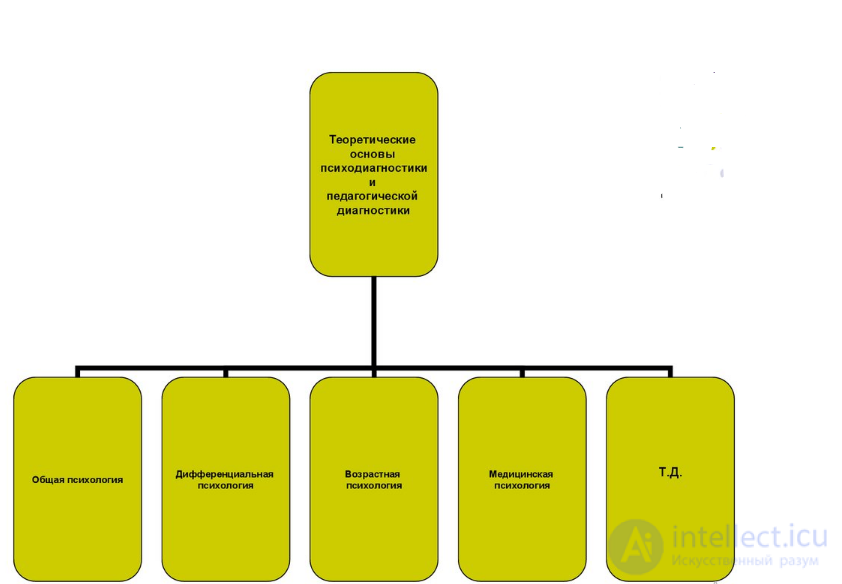
Psychological test (from English test - trial, examination, check) - a specially designed procedure for identifying, studying and measuring one or more psychological qualities or characteristics of a person. An essential condition of this procedure is the unchanging structure of the stimulus situation (the content of the tasks, the sequence of their presentation, the form of the answer sheet, etc.). The test must always be the same for all subjects. It is precisely this condition that makes it possible to measure and compare the behavioral reactions (characteristics) of different people.
Test battery - a set of psychological tests designed to collect the information about a subject that is necessary from the standpoint of making a personnel decision. A test battery is created on the basis of a preliminary professiographic study, in the course of which a psychological analysis of the activity is carried out and the individual psychological qualities of professionals associated with professional success are identified. The total duration of the tests included in the battery should not exceed three hours.
Psychological trait - a stable property of a person that characterizes a generalized way, or strategy, of behavior in relation to a given type of situation. In psychodiagnostic methods a trait is transformed into test scales. A subject's result on a test scale shows the degree to which the trait under study is expressed in them.
Test scale - a tool for the numerical measurement of a subject's psychological properties. A score on a test scale indicates the degree to which the psychological quality being measured is expressed in the subject. The most common scales found in tests are the "sten" scale (covering a range of scores from 1 to 10 points, used in Cattell's 16PF questionnaire) and the T-scale (covering a range of scores from 1 to 100 points, used in the MMPI). A test may contain anywhere from one to several hundred scales. For example, the Minnesota Multiphasic Personality Inventory (MMPI) has more than two hundred.
Test norm - this is the result of a statistical analysis and the derivation of indicator characteristics for a given psychological test, based on a sample of subjects with homogeneous socio-demographic characteristics (gender, age, education, region, etc.). A test norm has two main parameters: the sample mean and the standard deviation.
The sample mean Xmean and standard deviation S are used to evaluate a subject's result A as follows:
1. If A < (Xmean - S), then the subject is considered to have demonstrated a low result on the given scale (test);
2. If A > (Xmean + S), then the result is considered high;
3. If (Xmean + S) > A > (Xmean - S), then this is an average result.
Validity - a comprehensive characteristic of a test that provides information on what a given method measures and how well it does so. Validity is one of the most important parameters of any psychodiagnostic method. If a test is "invalid", it cannot be used. There are several subtypes of validity. Predictive validity is a characteristic of a test that makes it possible to assess the quality of a prediction regarding a subject based on the results of that test. Content validity is a characteristic of a test that makes it possible to assess the content and completeness of the method in terms of the features of the mental quality domain being measured.
Reliability - a characteristic reflecting the accuracy of the measurement of individual psychological traits by means of a given test. It is known that many factors affect a test result: heightened emotional tension, fatigue, the characteristics of the setting and of the examiner's personality, and the subject's motivation. The factors responsible for the spread of results can conditionally be divided into two groups:
Two types of reliability are used to assess the accuracy of a test: reliability-as-consistency and reliability-as-stability.
Reliability-as-consistency - an indicator of a method characterizing the level of its internal homogeneity with respect to the trait being measured. It is determined by splitting the questionnaire items into two groups and calculating the correlations of each group with the overall test (scale) score. It can be said that reliability-as-consistency shows how well and coherently the questionnaire items "work" in terms of revealing the given trait.
Reliability-as-stability (or test-retest reliability) - an indicator of the stability of a test result over time. It is calculated as the correlation coefficient between the results of the same group of subjects with a two-week interval.
Correlation analysis - a set of mathematical statistics methods used to study the relationship between variables (indicators). It is used in psychodiagnostics when addressing questions of test validity and reliability. Correlation analysis procedures make it possible to assess the level of significance of the relationship between the variables under study (in other words, the probability of error in advancing a hypothesis about a relationship between variables), as well as the magnitude and direction of the influence of one variable on another. In the course of correlation analysis, so-called "correlation coefficients" are calculated - quantitative indicators of the magnitude and direction of the influence of variables.
Factor analysis - a set of mathematical statistics methods aimed at revealing hidden patterns within an array of variables. It makes it possible to move from a set of measured indicators of the phenomenon under study to generalized factors that allow hypotheses to be advanced about the structure of the phenomenon. The method of factor analysis was used in the creation of R. Cattell's 16 PF questionnaire and in identifying the integral intellectual factor "g", which manifests itself when intelligence is measured using various tests (C. Spearman, 1936).
Complex professional activity – is work that can be characterized by the simultaneous presence of more than three of the following features:
It is generally accepted that diagnostics should be carried out in three stages:
1) screening diagnostics
2) differential diagnostics
3) in-depth psychological study of the individual with the aim of developing an individual program of development, correction, etc.
Psychodiagnostics took shape in the late XIX — early XX centuries . W. Wundt, although he believed that the higher mental functions constituting the essence of personality research were not subject to experimental study, was the first to experimentally investigate perception, memory, attention, reaction speed, and the like under laboratory conditions. W. Stern is considered the founder of the psychology of individual differences (differential psychology); as early as 1900 he urged psychologists to study not only general psychological patterns but also individuality . The concept of «psychodiagnostics» itself first appeared in H. Rorschach's 1921 publication, «Psychodiagnostics: A Diagnostic Test Based on Perception» , in which the famous «Rorschach inkblot» test was described. One of the founding fathers of psychodiagnostics worth noting is Leopold Szondi.
In the XX century psychodiagnostics and its applications were intensively developed, and they now form an extensive structure of methods and techniques . The tools of modern psychodiagnostics are divided into two groups: strictly formalized methods and weakly formalized methods .
Strictly formalized methods include tests, questionnaires, some projective techniques, and psychophysiological methods. Strictly formalized methods are characterized by detailed regulation, standardization (establishing uniformity in conducting, processing, and presenting the results of diagnostic experiments), objectification of the examination or testing procedure (precise adherence to instructions, strictly defined ways of presenting stimulus material, non-interference by the researcher in the subject's activity, etc.), reliability, and validity. Many strictly formalized methods have been brought to the level of computer implementation .
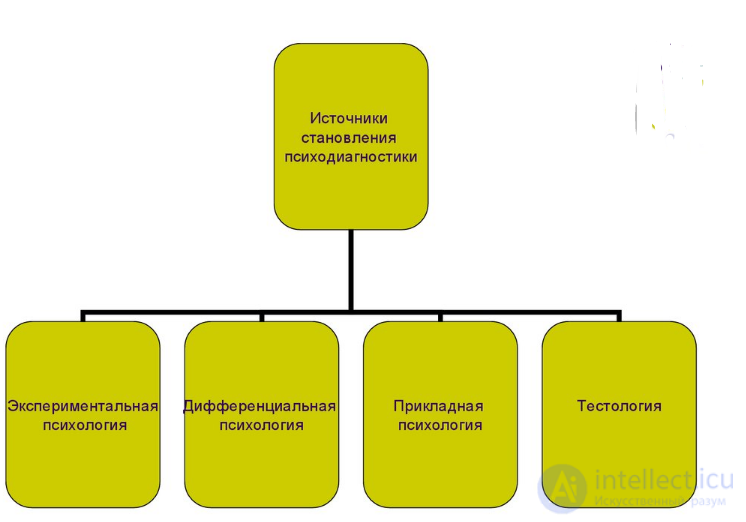
Weakly formalized methods — these are observations, conversations and interviews, and analysis of the products of activity. They provide valuable information about the subject, especially when the object of study consists of mental processes and phenomena that are poorly suited to objectification and formalization (for example, poorly recognized subjective experiences, personal meanings) or that are extremely variable in content (the dynamics of goals, states, moods, etc.). Weakly formalized methods are very labor-intensive (for example, observation of the subject is sometimes carried out over the course of several months) and require a great deal of professional skill and experience on the part of the psychodiagnostician.
Weakly formalized and strictly formalized diagnostic methods complement one another and should be used together. The development of new intelligent methods of data analysis is gradually expanding the scope of computer applications in psychodiagnostics . New technologies make it possible to use the simulation of psychological intuition by computer systems .
The accumulated experience of applying psychodiagnostics is summarized in numerous textbooks[10], encyclopedic collections of methods and tests[11], and in reference literature[
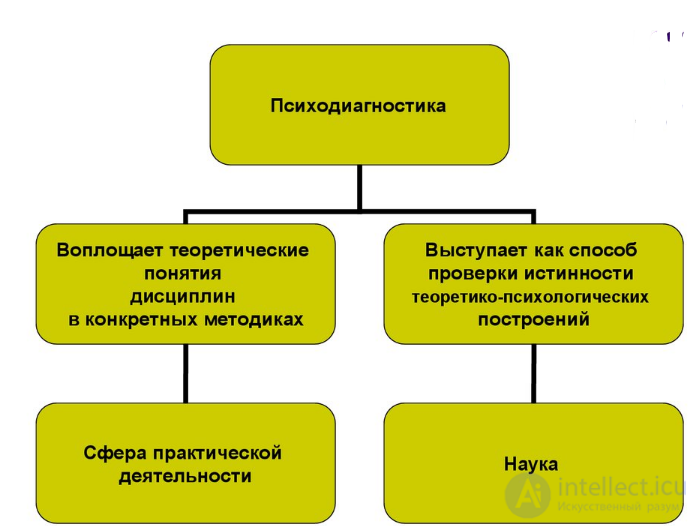
Levels of psychodiagnostics
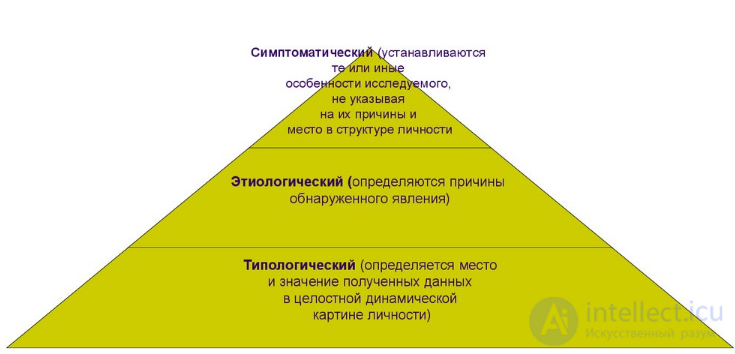
Figure: levels of psychodiagnostics according to Vygotsky
Educational (school) diagnostics (uses a variety of methods and tests that are created in accordance with psychometric requirements and are intended for measuring success in mastering educational material)
Clinical psychodiagnostics is aimed at studying the individual psychological characteristics of a patient (the structural-dynamic characteristics of the personality, attitude toward the illness, mechanisms of psychological defense, etc.).
Professional psychodiagnostics is applied to determine vocational guidance and in professional selection
The main areas of application of psychodiagnostics:
Cases of seeking help from a psychologist can be assigned to two main types[12]:
Options for using psychodiagnostic data:
The psychologist's code of ethics requires a clear definition of the goals and objectives of the psychodiagnostic work (that is, the formalization of the request) already at the preliminary stage.
The main requirements for a psychological report[13]:
Mark ONE correct answer
1. The distinguishing features of psychodiagnostic activity consist in:
2. The place of psychodiagnostics as a science in the system of psychological knowledge:
3. Fundamental psychodiagnostics studies:
4. Applied psychodiagnostics studies:
5. Practical psychodiagnostics includes:
6. Psychodiagnostics as a scientific discipline consists of the following components:
7. The state of the object of psychodiagnostics in relation to the norm:
8. A psychodiagnostic task includes the following components:
9. A component of the psychodiagnostic situation is:
10. The psychodiagnostic situation of a client is characterized by:
11. The tools of psychodiagnostics are represented by:
12. Standardization of methods is:
13. The reliability of a method is:
14. The validity of a method is:
15. Mental development is:
16. The negative logical criterion in the concept of «norm» is:
17. The positive logical criterion is represented by:
18. The psychometric norm is:
19. The psychoqualimetric norm is:
20. The psychodiagnostic description of an object:
21. Classifications of psychodiagnostic situations:
22. The modern classification of psychodiagnostic methods:
23. The psychodiagnostic process is characterized by:
24. The stages of the psychodiagnostic process:
25. The following components are distinguished in the structure of a psychodiagnostic report:
26. The emergence of experimental psychology is associated with the name of:
27. Differential psychology studies:
28. The emergence of applied psychology is associated with the work of the following scientists:
29. The following psychologists are considered the founders of test-based diagnostics:
30. Classification of psychodiagnostic methods:

Comments