
Lecture
Topic goal: to study game-based methods in personnel diagnostics, and the conditions for their application and use.
Discussion topic: The potential of game-based methods and the conditions for their application for diagnostic purposes.
A business game — is a method of simulating decision-making by managers or specialists in various production situations, carried out according to given rules by a group of people or by a person with a PC in an interactive mode, in the presence of conflict situations or informational uncertainty.
Game-based methods and business games create situations in which participants can demonstrate their skills and make decisions in a controlled, simulated environment. They give participants the opportunity to interact with one another, work in a team, solve problems, apply strategies and analyse the results of their actions.
The main advantage of using game-based methods and business games for diagnostic purposes lies in the fact that they create more realistic and practical conditions for assessing participants. Such methods make it possible to assess skills that can be difficult to measure with standard tests or interviews, such as leadership, decision-making under pressure, communication, and so on.
In addition, game-based methods and business games can be adapted to specific assessment goals and needs. They can be used to assess various aspects, including leadership, creative thinking, managerial skills, communication and conflict resolution.
It is important to note that the use of game-based methods and business games for diagnostic purposes requires proper planning and design. It is necessary to define the specific goals of the assessment, choose suitable games and methods, adapt them to the participants, and collect reliable and objective data for analysis.
The wide variety of business games can be systematised according to a number of characteristics. The most important of these are: the intended purpose of the business game, the breadth of its thematic scope, the areas of management simulated, the degree of freedom in decision-making, the level of uncertainty in decisions, the nature of communication between participants, the degree of openness of the game, the complexity of the model used, the tools of the game, and the form in which it is conducted, among others.
Let us characterise each of the features of this classification in more detail:
1. Among the business games used in personnel management, and indeed in management as a whole, depending on their function and intended purpose, a distinction is made between:
training (including trainer) business games. These are the most widespread and serve to train and upgrade the qualifications of managerial staff and other employees, primarily highly skilled ones;
business games for solving practical problems (for example, finding optimal solutions when reorganising a department). They are also used for collective or individual preparation of management decisions, taking into account the variety of factors affecting the situation and the different options for solving the problem;
project business games. These go beyond personnel management, although they do include this aspect, which is critical to the organisation's activity. Project business games are used when designing organisational systems (enterprises, their structural units, etc.) and their changes. This is a fairly complex type of game, requiring a high level of organisational and managerial competence on the part of its participants;
research business games. These are used to analyse the behaviour of individual employees or entire teams depending on changes in the external or internal conditions of their activity (for example, when studying the possibilities of using various pay systems within an organisation). Research business games model specific organisational situations in a «what if...?» mode. This makes it possible to forecast various scenarios of change in organisational situations.
2. The breadth of the thematic scope reflects the scale and complexity of the tasks solved during the business game.
A comprehensive business game involves working out methods for solving a complex problem in the unity of its most important aspects. This is, for example, a simulation of a manager's activity in resolving a production conflict with given parameters.
A specific (single-purpose) business game serves to solve one particular task, for example, a game for studying and comparing the effectiveness of collective and individual activity of group members.
3. The degree of freedom of decisions and actions of the game's participants can vary.
If a game allows only a limited, predetermined range of possible decisions and corresponding behavioural alternatives (actions), it is considered rigid. In rigid games the content of each player's step is strictly fixed in accordance with a formal model of the simulated processes. Decision-making in them comes down to choosing one of the alternatives offered, with all the main actions carried out within strictly defined time intervals.
Conversely, if players act freely while observing the general conditions of the game, and their decisions are not governed by an established set of alternatives, the game is soft. In soft games the actions of participants are limited only by the general scenario of how events unfold, within which the players themselves determine the sequence of their actions. There are also intermediate (semi-rigid) types of games.
4. Depending on the degree of uncertainty of the situation, business games are divided into deterministic and probabilistic ones.
Deterministic games are characterised by certainty of the situation and fixed values of its main parameters, which allows players to make decisions that are unambiguously right or wrong.
Probabilistic games, on the other hand, are distinguished by an unclear situation and the variability of many of its parameters, which means that only probabilistic assessments of the situation are possible, and decisions are made with a certain degree of risk.
Depending on their substantive design and goals, the games most widely used in personnel management can be divided into:
Role-playing – is a method in which the game's participants, by acting out particular roles in a risk-free situation, reveal behavioural traits of theirs that are significant for the organisation, and, with the help of the facilitator, one another, and on their own, critically analyse them, learn a more effective way of behaving, and practise improving it. The roles used in games of this type can be highly varied: boss, project manager, specialist, employee, instructor, and so on.
Trainees have the opportunity to independently propose the topics most significant to them (for example, the topic «How can I best present my boss with a proposal to change my working schedule»). Whoever proposed a topic for acting out often plays the main role and chooses a partner (for example, to work through the roles of boss and subordinate). The other members of the group observe the course of the game and analyse the actors' behaviour. At certain moments in the game (mainly when selecting and working out optimal variants of role behaviour), they may intervene in its process and, replacing one of the main players, act out their own, alternative course of action in that role. This is called doubling of actors.
To help participants overcome stiffness, ease their entry into the role, and behave naturally, it is desirable to minimise the facilitator's interference in the course of the game.
The facilitator's functions are mainly reduced to familiarising participants with the conditions, goals and techniques of the game, ensuring that it proceeds normally, general oversight of its process, and, if necessary, providing methodological assistance in achieving the game's objectives, as well as a general summing-up that includes, where appropriate, individual advice and recommendations for its participants.
Role-playing games are useful not only for the direct participants – the actors – but also for the participant-observers, especially if the group is homogeneous, i.e. made up of people roughly similar in status, experience and range of professional interests.
In enterprises, role-playing games are most often used to train managers in conducting interviews correctly, assigning tasks, securing employees' support for a collective task, leading a team, and so on. With their help, employees improve their knowledge and skills in making independent decisions, promptly calculating their consequences, and developing business communication, among other things. Role-playing games are especially effective in career-oriented training, when an employee acts out the set of functions arising from their future job duties.
Basing role-playing games on everyday, personally significant situations ensures a high degree of engagement and involvement on the part of the participants. This, in turn, facilitates the personal acceptance of the behavioural models being developed, the internalisation of decisions and recommendations, and the transfer of behavioural patterns worked out in the game into everyday practical relationships.
A planning game – is the sequential, often stage-by-stage, acting-out and working-through (analysis and reflection) of individual typical dynamic, changing situations, on the basis of which general conclusions are drawn for solving a complex organisational problem. This type of game is distinguished by a closer approximation to real organisational situations. A planning game models a complex problem of a real or possible course of events, as it were, in the form of slow-motion filming, i.e. it makes it possible, so to speak, to stop and capture particular moments in the development of the situation, reflect on them, and find optimal ways of solving problems.
Planning games are quite diverse. They can be classified. By application: universal, special, sector-specific. By content: functional, integrational. By influence: stochastic, deterministic. By type of participant: individual, group. By the relationship of the players: solo, parallel, competitive. By the tallying of results: manual, computerised.
The starting point of a planning game – is a complex organisational problem. The essence of this problem, as well as the goals and course of action of the participating groups, are usually set out in written form. Planning games are distinguished by their complexity and a comparatively large number of participants – their minimum number is usually 20-30 people, who are divided into several groups.
The game consists of several time blocks, each lasting approximately two hours. 2-4 blocks are played per day. In total, an average-length game has 9-12 of them, i.e. the game is designed to last 3-4 days.
The game begins on the basis of documents received by its participants describing the situation, the group's tasks, the goals and the general nature of the actions of the other groups. The subsequent decisions of the planning game's participants directly affect its course. As a result, the game develops as a result of the actions, reactions to them, and interactions of all its participants. Overall direction of the game and assistance to its participants is provided by instructors (moderators). They act together with a panel of experts intended to resolve problems that arise but are not provided for by the game's conditions. After the game portion is completed, assessments are made and results are summed up separately for each group, and these are then reported and analysed at a joint meeting of the groups. Finally, the overall results of the game are summed up at a plenary session, whose task includes not only assessing the effectiveness of the game and the actions of its participants, but also developing specific recommendations for the practical solution of organisational problems.
Scheduled games are conducted under conditions as close to reality as possible. They first became widespread in the military sphere, but today they are also widely used in management, including in personnel management.
An example of a scheduled game topic – the reorganization of an enterprise with the aim of forming a new department, to which other divisions must transfer part of their tasks, authority and employees.
The specific situation method. It most fully embodies the situational approach to management. The main idea of this approach – the actions of a manager (and to a large extent of other employees as well), while based on the goals, values and norms of the organization, must proceed from the specific, actually existing situation, taking into account its most important parameters and their changes.
In the business game «specific situation method» the real state of the organization is represented in the form of a business situation (in relation to economics it is often called a «business situation»). A business situation is an imitation, an ideal representation of a real situation from the life of an organization, or an artificially created situation recreating typical problems that arise in organizational life. A business situation is expressed in the form of a specific set of parameters and variables that have a decisive influence on the organization at a given time.
The description of the situation mainly includes information. Information about the subject – an individual, group or organization occupying a central place in the situation. Information about partners, competitors and/or other actors with whom the subject of the situation interacts. About the conditions within which the situation exists and changes.
The content of the situation can be conveyed in various ways: in writing, orally, using a video film or an audio recording. There are several types of specific situations. From the point of view of the game's outcome, they are divided into problem-based and project-based.
The specific situation method develops the skills and abilities of individual or group solving of assigned tasks. Such abilities are extremely necessary for a manager in real work, since they must continuously make non-standard decisions caused by changes in the state of affairs. The specific situation method develops in participants breadth and flexibility of thinking, helps teach them to use information rationally, independently analyze facts, sense and evaluate a situation, critically examine different points of view, discuss them and defend their own position, be ready to apply various tools and methods, and find optimal solutions under conditions of uncertainty.
The brainstorming method was created in 1941 by Alex Osborn — an employee of the American advertising agency of super-professionals «BBD&O». The method serves for the rapid solution of problems and is based on stimulating the creative activity of the people taking part in it and proposing the maximum possible number of solution variants. After all the variants have been voiced, those that are best suited for successful implementation in practice are selected. Brainstorming usually consists of three mandatory stages, differing in organization and rules of conduct.
As a rule, two groups are formed for brainstorming. The first group consists of people – idea generators, who propose solutions. The second group consists of the so-called commission, which deals with processing the proposed solutions.
The result is the most effective and original way of solving the problem posed.
The synectics method. The word "synectics" translated from Greek means "the joining together of different elements". The complete dictionary of the English language gives this definition: "Synectics groups – groups of people of different specialties who meet in an attempt to find creative solutions to problems through unlimited training of the imagination and the combining of incompatible elements". Synectics was proposed by William Gordon in the mid-1950s.
Synectics is based on brainstorming. Synectics involves the creation of permanent groups. Such groups, accumulating techniques and experience, naturally work more effectively than randomly assembled collectives.
Synectics makes extensive use of analogies and associations that help to find new ideas. One could say: synectics is professional brainstorming carried out using analogies and associations.
Structure of the modern synectics process
Formulating the problem in general terms. The statement of "the problem as given".
Analysis of the problem. At this stage the synectors work together with an expert. Ways are sought to turn an unfamiliar and unusual problem into some familiar formulations. Each participant, including the expert, must find and originally formulate one chain of solution. The statement of "the problem as it is understood".
They then begin an excursion through various fields of technology, wildlife, politics, psychology, religion and so on, with the aim of identifying how similar (analogous) problems might be solved in these fields far removed from the one at hand. The main purpose of the excursion is to find a new point of view on the problem under consideration. This approach allows thought to move far away from the discussion of the topic and, in the opinion of the synectors, promotes the activation of creative thinking.
Next, the new ideas discovered in the process of generation are transferred (or moved) to the problem, and their potential is identified.
The final part of the synectics session – the development and maximal concretization of the idea recognized as the most successful – is already carried out in a special technical language.
The Gordon method, unlike most other methods for awakening creative initiative, assumes that members of the working group do not know in advance exactly which problem will be discussed, so they are not constrained by established notions and habitual patterns. The session is opened by the facilitator, who outlines in the most general terms a certain concept related to the problem of interest to him. Group members express their ideas on what they have heard. Then, under the facilitator's guidance, the initial concept and some other related questions are clarified. After that, the very problem for which the whole discussion was actually organized is revealed. As a result, participants begin to voice quite specific proposals and set out their thoughts on how to realize what has been conceived.
The Delphi method was developed in the 1950s–1960s in the USA. It is very effective both in everyday life and in professional activity. The Delphi method is convenient to apply, and it can be used by any individual or group of people; the only thing that matters is knowing how it is done.
Its authors are usually considered to be Olaf Helmer, Norman Dalkey and Nicholas Rescher. Its main features are anonymity, multiple rounds and remote (non-face-to-face) participation. The basic premise is the idea that if the individual assessments of experts on a specific situation are properly generalized and processed, a consensus opinion can be obtained that will possess the maximum degree of reliability and validity.
The essence of the method is that, by means of a set of specific actions such as brainstorming sessions, interviews and surveys, a way of determining the correct solution is found. A certain group of independent experts can assess and predict an outcome far better than a structured group of people. Independent experts may not even know about one another, which makes it possible to exclude the clash of different positions, as well as the collective influence caused by working together and conformity. In addition, the method can be carried out anywhere, regardless of the location of the participants.
The simulation game most often consists of two parts: a functional part and a support part.
The functional part of the game includes one or several scenarios, each of which can be played out either in isolation or in connection with other scenarios. A scenario can consist of episodes. An episode is a complete set of procedures, for example the functions of management.
The support part of the simulation game includes informational, mathematical, technical and organizational support.
The general scheme for making decisions on the problem being studied in the game provides that "for each game simulation a program is drawn up in which the tasks to be solved are defined. Analysis of such programs shows that in the course of the game trainees receive information with possible options for solving these tasks (the sources of information are observations of players' behavior, the results of a questionnaire survey, and proposals voiced by players during the plenary discussion). This information is processed and analyzed by the organizers of the game. The results of the analysis are recorded in the report on the outcome of the game"
In addition to the conventional division of games into «rigid», «free» and «intermediate», based on the independence of the players' actions and the strictness of the rules, there are also other grounds (criteria) for classification. Thus, thanks to the specific nature of the game process and the constant development and modification of games, researchers in socio-psychological training propose distinguishing games according to the following criteria1.
simulation games in which the roles of group participants do not correspond to their real activity, sex, age, psychological characteristics, etc., or a person may play himself, but in situations unusual for him.
Simulation game «The ideal image of a teacher-game facilitator»
Task. You must create the ideal image of a teacher-game facilitator. After reviewing the form proposed below, mark the characteristics you consider most useful for making the right decision, taking into account the activity for which you are selecting a teacher.
Instruction 1. Your task is to rank, individually for each player, the 20 characteristics listed below. The criterion for evaluating qualities and abilities is their significance for game-facilitation activity. Quality or ability 1, 2, etc. are the least important, a low rating, 20 — the highest rating; 9, 18, etc. — the most significant for this activity. Remember: no number may be repeated!
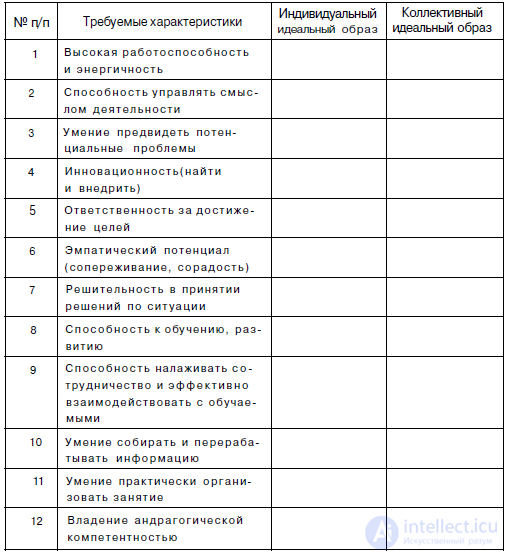
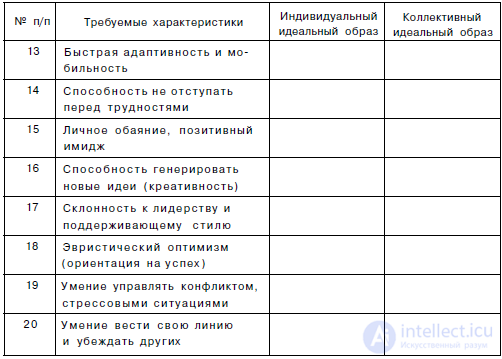
Instruction 2. After everyone has ranked the characteristics and recorded the results in the column «Individual ideal image», the whole group is divided into subgroups of 3 — 7 people (depending on the numerical composition of the group) and discusses a collective decision in teams, i.e. creates a collective ideal image of the teacher.
Discussion rules:
1) a decision may not be made by voting;
2) percentages may not be calculated;
3) it is not permitted to pressure partners with statements such as: «I said so!»;
4) compromise is undesirable.
The goal — through negotiation and collective discussion based on the argumentation of each person's position, to work out a joint consensus decision.
Instruction 3. Conduct an intergroup discussion, in the course of which the correctness of the chosen characteristics is determined by measuring them against the functions of the teacher-game facilitator.
Debriefing. Based on the results of the game, teams should draw up a «Memo» for the teacher-game facilitator on the sequence of steps for preparing and conducting a session using intensive interactive technology. Then present and evaluate the «Memos» and sum up the results of the game.
Simulation game «Plane crash in the desert»
Situation. An August morning. The plane on which you were flying has just made an emergency landing in the Sahara Desert. The plane is completely destroyed and burned out. The entire crew has died. Only your group has survived. Immediately before the crash the plane's navigator said that the nearest settlement is located to the northeast at a distance of 115 km.
All around there is only sand and isolated desert bushes, and even those are completely dried out. The latest weather forecast promised an air temperature of 45—50°C for the coming days. This means that the temperature at the surface of the ground is 10°C higher. You are lightly dressed — a short-sleeved shirt, shorts, socks, street shoes. Each of you has in your pocket a little money, a comb, a handkerchief, a pack of cigarettes and a pen. After the plane crash you salvaged 15 items. Whether you survive depends on whether you manage to reach the nearest settlement.
Your task — to arrange the 15 items listed below in order. The criterion for evaluation is the item's significance for sustaining your life. Item 1 is the most important, item 15 — the least important.
In your evaluation take into account the following:
- the number of survivors equals the number of members of your group;
- you yourself are a participant in the situation;
- the group has decided to stay together during the undertaken trek;
- all items are in good condition and fit for use.
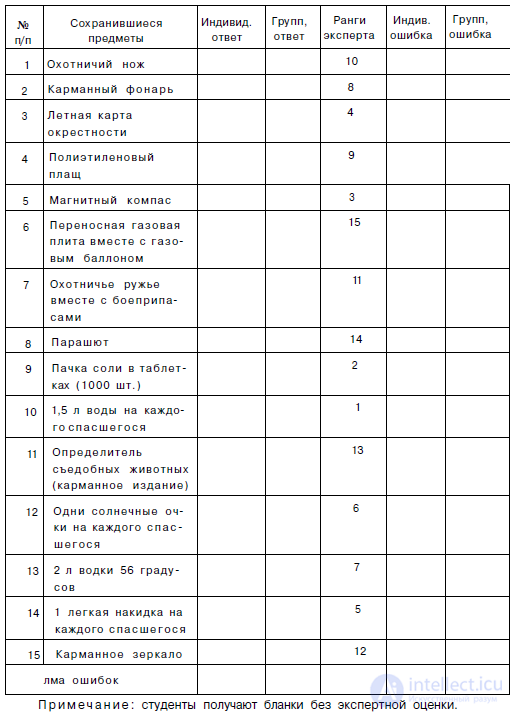
Procedures:
1) making individual decisions;
2) working out a collective decision in groups;
3) the expert decision and the counting of individual errors;
4) intergroup interaction: discussion, counting of group errors;
5) analysis of the results and summing up of the game.
The case method of instruction began to be used as early as the beginning of the 20th century. The leading role in disseminating the case method belongs to Harvard Business School. Subsequently, especially in recent times, the case method has found wide application in the West in the field of studying management and marketing. The result of applying the method is not only knowledge but also professional practical skills.
The technology of the method is fairly simple. According to certain rules, a model of a specific situation that occurred in real life is developed, reflecting the set of knowledge and practical skills that students need to acquire. This model takes the form of a text ranging from several pages to several dozen pages, which is called a «case». Participants read and study the case beforehand, drawing on the most varied sources of information for this purpose. This is followed by a detailed discussion of the content. In doing so, the instructor acts as facilitator, generating questions, recording answers, and sustaining the discussion, i.e. acting as the dispatcher of the process of co-creation.
In conclusion, the use of game-based methods and business games for diagnostic purposes represents an effective tool for assessing the skills and competencies of participants. They help create more realistic and practical conditions for assessment and provide valuable data on the capabilities and potential of participants.
Name the types of game-based methods and the conditions for their use.
What is the essence of the brainstorming method?
How does the synectics method differ from the brainstorming method?
What is the essence of the Gordon method?
What is the meaning of the Delphi method?
Describe the technology of the case method.

Comments