
Lecture
Assertiveness (from Eng. assertiveness < Eng. to assert — to affirm, to insist < Lat. assertus < Lat. asserere — to affirm) — according to the American psychotherapist Manuel Smith (Manuel J. Smith) — a person's ability to be independent of external influences and evaluations, to regulate their own behaviour independently and to be responsible for it.
In everyday life, the behavioural pattern of most people tends toward one of two extremes: passivity or aggression. In the first case, a person who voluntarily takes on the role of a victim is driven by self-doubt, fear in the face of change, or, conversely, fear of losing what has already been achieved. In the second — an open or veiled desire to manipulate others, subordinating them to one's own interests. The aggressor is guided by the principle «you owe me because I am stronger», the victim — «you owe me because I am weak, and the weak must be supported». Unlike these two common types of communication, assertive behaviour (assertiveness) relies on a fundamentally different principle: «I owe you nothing, and you owe me nothing, we are partners».
You also have the right to:
Manuel Smith developed a model of assertive (self-affirming) behaviour. Below are the assertive rights, as well as the manipulative biases which, according to the authors of the concept of assertiveness, block these rights:
Criticism of assertiveness rights lies in pointing out the illegitimacy of describing a person's rights through a certain number of theses, and the impossibility of a person existing without regard for public opinion . Social psychology theory demonstrates a way of inducing emotional dependence on a guru through the profanation of the philosophical (personal-worldview) question of rights and obligations, coupled with motivation to abandon personal reasoning
Sergey Stepanov, in his book «Myths and Dead Ends of Pop Psychology», devoted a chapter to criticizing Manuel Smith's model.
…The quintessence of this approach is the so-called «assertive rights of the person» […] In essence, this code of rights, which forms the key provisions of any assertiveness training, is a set of new, assertive attitudes proposed for adoption in place of the old, supposedly unfit ones. […] At first glance, the positive orientation of these principles toward freeing a person from alien attitudes imposed by self-serving manipulators, from false authorities, meaningless rituals and burdensome conventions is appealing. On the other hand, one cannot help but be wary of the artlessly American preaching of individualism, which, if taken literally, risks leading to unfortunate consequences. Indeed, if these remarkable rights are formulated more specifically and taken to their logical conclusion, they easily take on roughly the following form.
- No one's opinion of me and my behaviour matters as much to me as my own. No one's opinion should shake my self-esteem. In other words, one can simply disregard the opinions of others. If I like to pick my nose and blow it into the curtains, and other people condemn this, then I, of course, am right, not they. And I am entitled to do this without feeling the slightest awkwardness.
- Since I know what I am doing myself, there is no need for others to understand my behaviour, let alone approve of it. I act correctly by definition.
- If it is more convenient for me to believe that no one's problems concern me, I can, with a light heart, not give a damn about anyone or anything.
- Firm convictions and unshakable principles are a sign of rigidity. On the contrary, it is perfectly normal to praise today what you criticized yesterday, and vice versa.
- There is no need to be afraid of mistakes. There is nothing terrible about mistakenly sentencing an innocent person to death, or, say, with a clumsy push of a button, aiming an anti-aircraft missile at a passenger plane. As one wise leader of one freedom-loving nation used to say: «There's no need to make a tragedy out of this»
- A wonderful excuse for one's own ignorance is the magic formula «I don't know». Well, I don't know, and no one can hold me accountable! And if, say, some picky examiner is not satisfied with that, then he is simply an unscrupulous manipulator and aggressor.
- There is no need whatsoever to earn the favour of other people. What is it needed for at all, if I decide everything in my life myself?
- In one's behaviour, one can abandon common sense and elementary logic and follow one's mood exclusively.
- The desire to understand another person is a completely unnecessary and futile effort. It is much simpler to cut it short: «I don't understand you!»
- On any subject that does not affect my personal interests, I am entitled to spit from a great height and declare this publicly.
Now be honest with yourself: how would you feel about a person professing such life principles, should you happen to cross paths with them (especially since you probably already have, more than once)? And would you really want to become like that yourself?
— Stepanov S.S. Myths and Dead Ends of Pop Psychology. — Moscow: EKSMO, 2012.
Assertiveness techniques can vary greatly. Manuel Smith, in his 1975 book « When I Say No, I Feel Guilty», proposed the following behavioural options:
The «broken record» technique [15] consists of simply repeating your requests or refusals each time you meet resistance. This term comes from vinyl records, whose surface, if scratched, causes the turntable's needle to endlessly repeat the same few seconds of the recording. «As with a broken record, the key to this approach is repetition ... until your partner stops rejecting the answer». [16]
The drawback of this technique is that when resistance continues, your requests may lose force each time you need to repeat them. If requests are repeated too often, this can backfire on your words. In these cases, it is necessary to have some sanctions on hand.
Fogging [15] consists of finding some limited truth that one can agree with in what the antagonist is saying. More precisely, one can agree in part or agree in principle.
Negative inquiry [15] consists of requesting further, more specific criticism.
Negative assertion [15] is agreeing with criticism without lowering one's demands.
I-statements can be used to voice one's feelings and desires from a personal standpoint, without passing judgment on the other person or blaming them for one's feelings.
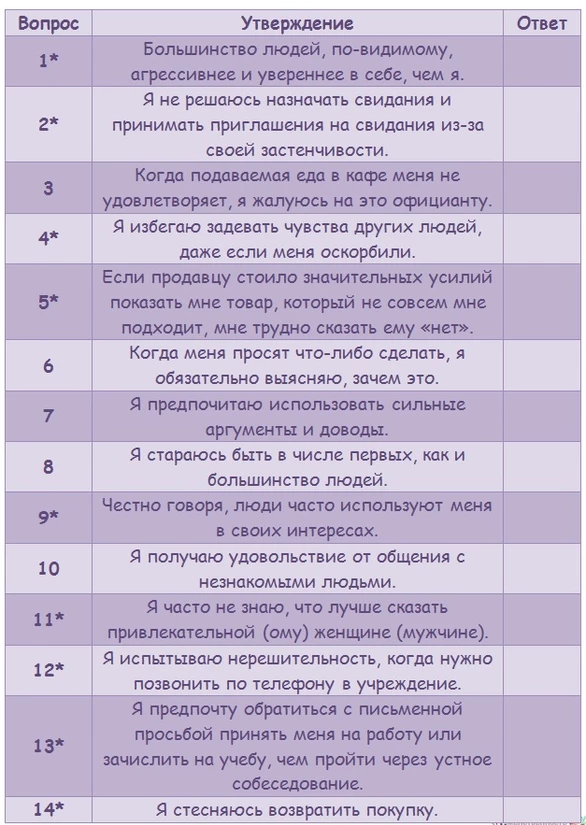
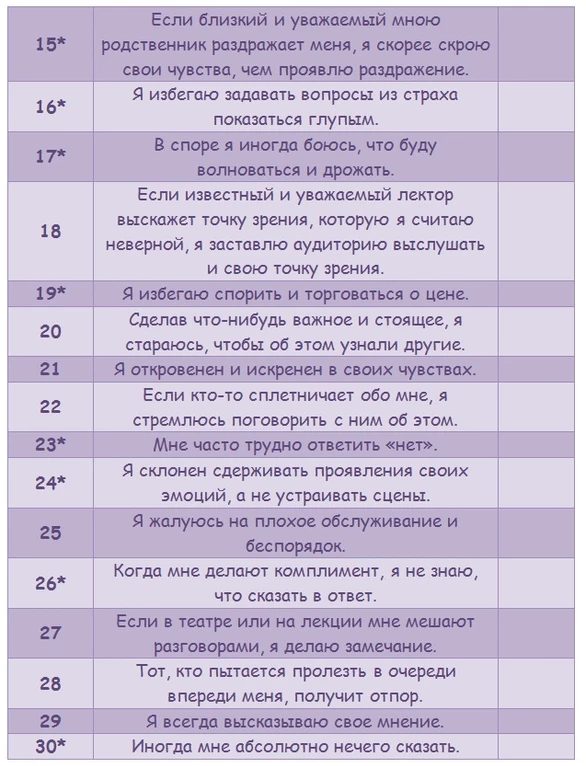
A psychodiagnostic technique that assesses the degree of self-confidence. It is designed for people aged 18 and over, with no restrictions based on education, social status or occupation.
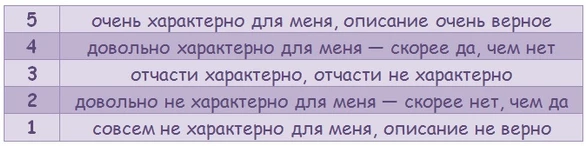
The test contains 30 statements describing various types of behaviour. You need to indicate your degree of agreement or disagreement with each of the statements given:
— «very characteristic of me, the description is very true»,
— «fairly characteristic of me — more yes than no»,
— «partly characteristic, partly not characteristic»,
— «fairly not characteristic of me — more no than yes»,
— «not at all characteristic of me, the description is not true».
The test offers 30 statements describing various types of behaviour. Try these statements on yourself and indicate your degree of agreement.
Let's sum up:
1. Find the sum of points for questions not marked with an asterisk (numbers 3, 6, 7, 8, 10, 18, 20, 21, 22, 25, 27, 28, 29).
2. Find the sum for the questions marked with an asterisk (numbers 1, 2, 4, 5, 9, 11, 12, 13, 14, 15, 16, 17, 19, 23, 24, 26, 30).
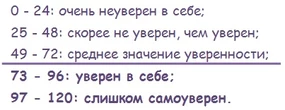
3. Add the number 72 to the first sum and subtract the second sum.
Summarizing the results:
Several studies have found that assertiveness training is a useful tool in the prevention of alcohol use disorders. Psychological skills in general, including self-confidence and social skills, have been proposed as an intervention for various disorders, with some empirical support.
In connection with gender theory « Tannen argues that both men and women would benefit from learning to use the other's style ... Thus, women would benefit from assertiveness training, and men from sensitivity training».

Comments