
Lecture
Reliability is understood as the property of a product to retain, over a given period of time and within established norms, the values of its functional parameters under specified conditions (given operating modes and conditions of use, maintenance, storage and transportation).
In the theory and practice of reliability of technical products the concept of operating time is widely used, meaning the duration of operation of a product, expressed in hours, switching cycles or other units depending on the type and functional purpose of the product.
A failure is understood as the complete or partial loss of a product's operability as a result of one or more functional parameters going beyond the limits of established norms specified in the technical documentation.
By time to failure is understood the total operating time of a product from the moment it enters into operation (service) until the occurrence of the first failure.
Reliability is a complex property which, depending on the purpose of the product and the conditions of its use, may include failure-free operation, durability, maintainability and storability, or certain combinations of these properties.
Many concepts and definitions of reliability theory are based on such notions as operability and failure-free operation [1, 2, 4].
Failure-free operation – the property of a product to continuously retain an operable state over a certain period of time or operating time.
To understand the other components of reliability (maintainability, durability and storability), as well as the concepts of resource and service life, which are used to judge durability, we recommend referring to the works
[1, 2, 4].
At present various classification schemes for failures exist.
One of the schemes is presented in Table 1.1 .
Sudden failure (previously also called instantaneous) is a failure characterized by an abrupt change in the value of one or more parameters of a product. This failure usually leads to a complete loss of operability of the product.
Gradual failure (previously also called parametric) is understood as a failure arising as a result of a gradual, usually continuous and monotonic, change in the value of one or more functional parameters of a product and their going beyond the limits of the norms specified in the technical documentation. Other types of failures can be found in [1, 2, 4].
Approximate distribution of the number of REE failures: failures due to design errors – 40…50 %, failures due to manufacturing errors – 30…40 %, failures due to incorrect operator actions – 20…30 %.
|
Classification criterion |
Type of failure |
|
Nature of occurrence of the failure |
Sudden Gradual |
|
Duration of existence of the failure |
Permanent Temporary Intermittent (temporary failures following one after another) |
|
Nature of manifestation of the failure |
Overt Latent |
|
Dependence of failures on one another |
Dependent Independent |
|
Cause of occurrence of the failure |
Design-related Manufacturing-related Operational Degradation-related |
It has been observed that in 75…80 % of cases Table 1.1 various causes of failures manifest themselves Classification of failures of RED and their components in the form of a failure of components. This leaves a noticeable psychological impression on consumers regarding the true causes of failures.
By their physical nature, failures of components and devices are random events. Therefore techniques of probability theory are suitable for the quantitative description of failures [1, 4].
Analysing failures, it is easy to establish that the random variable describing failures is the time to failure (in the general case, the operating time to failure).
At present, in domestic and world practice, in 95…99 % of cases the assumption of an exponential distribution of time to failure of components is used, under which the density of the distribution of time to failure is given by the expression
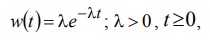 (1.1)
where – the distribution parameter for the component under consideration, numerically equal to its failure rate.
The characteristic w(t) does not find wide practical application as a reliability indicator of products, however it is used to determine failure-free operation indicators.

Comments