
Lecture
Dispatch — is the mechanism for selecting which code (method, function, block) to execute and who controls the call. It also determines which code to invoke when accessing an object or interface, when several implementation variants are available.
Examples:
Key point:
In object-oriented programming languages, such as C++, Java, and Python, the dispatch mechanism plays a key role in implementing polymorphism. When a method is called through a reference or pointer to a base class, the system needs to determine which version of the method to execute: the original one from the base class, or the one overridden in the derived class. Virtual method tables or other similar mechanisms are usually used for this.
Building software systems with well-organized dispatch reduces the amount of repetitive code, simplifies adding new capabilities, and makes maintaining large projects more convenient. When designing, it is important to consider not only the chosen type of dispatch — static or dynamic — but also its effect on performance, features of the class hierarchy's organization, and potential problems arising from method overriding.
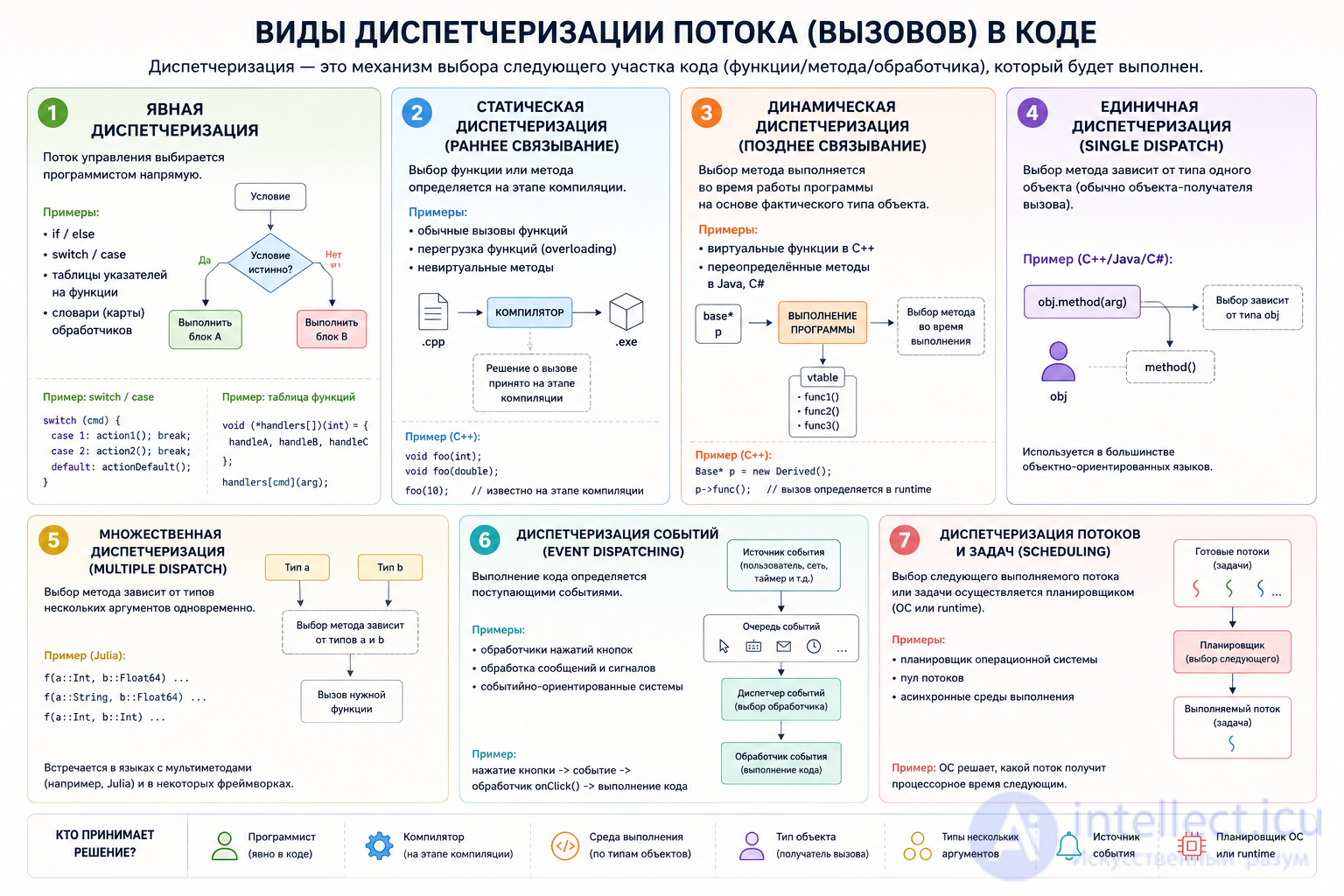
When it comes to dispatch of the program's execution flow (calls) in code, several types are usually distinguished:
If the question relates to threads of execution in operating systems, dispatch there is usually understood to mean:
Thus:
| Type of dispatch | Who chooses the execution path |
|---|---|
| Explicit | The programmer (if, switch, function tables) |
| Static | The compiler |
| Dynamic | The runtime environment, based on object types |
| Event-based | The event source |
| Thread scheduling | The OS scheduler or runtime |
Dispatch is widely used across various areas of software development, ensuring the selection of the needed method implementation and supporting polymorphic behavior. Below are a few practical examples.
| Project | Language | Use of dispatch | Recommendations |
|---|---|---|---|
| Message processing system | Java | Dynamic dispatch allows calling handlers for various types of messages through a common MessageHandler interface. |
It is recommended to allocate a separate class for each message type, which helps reduce the number of conditional constructs in the code. |
| Graphics engine | C++ | Virtual methods of the base class Renderable ensure that the appropriate rendering method is called for each scene object. |
The number of virtual methods should be limited in the most frequently executed parts of the rendering loop, in order to reduce additional overhead. |
| Web application with a REST API | Python | The dynamic dispatch mechanism is used to route HTTP requests to the appropriate controller methods. | It is advisable to use decorators for explicitly binding routes and to cache the results of frequently executed requests. |
The examples given show that dispatch contributes to the creation of flexible and scalable software solutions, in which new behavior can be added without modifying existing logic. When designing such systems, it is important to take into account the intensity of method calls and choose the appropriate type of dispatch based on performance requirements.

Comments