
Lecture
The falling factorial (the names lower, gradually falling or descending factorial are sometimes used) is written using the Pochhammer symbol and is defined as

The rising factorial (the names Pochhammer function, Pochhammer polynomial , upper, gradually rising or ascending factorial are sometimes used) is defined as

The value of both factorials is taken to equal 1 (the empty product ) for n = 0.
The Pochhammer symbol, proposed by Leo August Pochhammer, — is the notation  , where n
 — a non-negative integer. Depending on the context, the Pochhammer symbol may represent the falling factorial or the rising factorial defined above. Care must be taken when interpreting the symbol in each particular article. Pochhammer himself used the notation with a completely different meaning, namely to denote the binomial coefficient
  .
.
In this article the symbol is used to represent the falling factorial, and the symbol x(n) — for the rising factorial. These conventions are adopted in combinatorics . In the theory of special functions (in particular, the hypergeometric function) the Pochhammer symbol is used to represent the rising factorial A useful list of formulas for manipulating rising factorials in this latter notation is given in the book by Lucy Slater. Knuth used the term factorial powers, which include rising and falling factorials
If x — is a non-negative integer, then gives the number of n-permutations of x-element set or, equivalently, the number of injections from a set with n elements into a set of size x. However, for these values other notations are used, such as and P(x,n). The Pochhammer symbol is used mostly for algebraic purposes, for example, when x is an unknown quantity, and in this case denotes a certain polynomial in x of degree n.
The first few rising factorials:
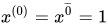
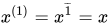



The first few falling factorials:
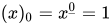
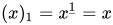



The coefficients obtained on expanding the brackets are the Stirling numbers of the first kind.
The rising and falling factorials can be used to express binomial coefficients:
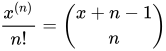 and (x)nn!=(xn).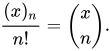
Then many identities for binomial coefficients carry over to rising and falling factorials.
The rising factorial can be expressed through a falling factorial starting from the other end,

or as a falling factorial with the opposite argument,

The rising and falling factorials are well defined in any unital ring, and therefore x may be, for example, a complex number, a negative number, a polynomial with complex coefficients or any complex function.
The rising factorial can be extended to real values n by means of the gamma function:
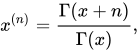
and in the same way the falling factorial:
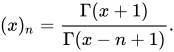
If we denote by D the taking of the derivative with respect to x, we obtain

The Pochhammer symbol is an integral part of the definition of the hypergeometric function — the hypergeometric function is defined for |z| < 1 by the power series
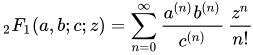
provided that c is not equal to 0, −1, −2, ... . Note, however, that in the literature on the hypergeometric function the notation (a)n is used for the rising factorial .
.
The falling factorial appears in the formula that represents polynomials using the finite-difference operator △ and which is formally similar to Taylor's theorem. In this formula and in many other places the falling factorial
  in computing finite differences plays the role that
  plays in computing the derivative. Note, for example, the similarity of

to
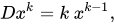
Similar facts hold for rising factorials.
The study of analogies of this type is known as «umbral calculus». The basic theory describing such relations, including falling and rising functions, is considered in the theory of sequences of polynomials of binomial type and Sheffer sequences . The rising and falling factorials are Sheffer sequences of binomial type, as shown by the following relations:
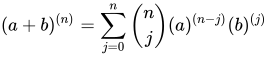
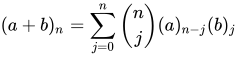
where the coefficients are the same as in the power-series expansion of Vandermonde's binomial identity).
Similarly, the generating function of the Pochhammer polynomials is then equal to the sum of umbral exponentials,
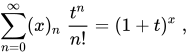
since  .
.
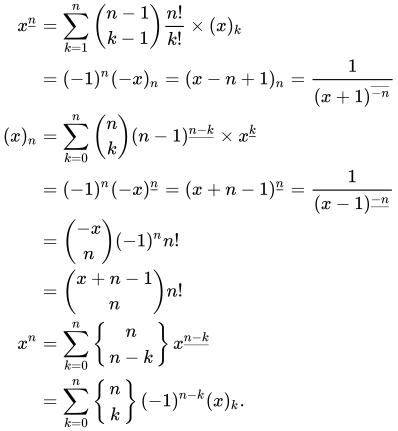
The falling and rising factorials are related to each other by means of the Lah numbers and by means of sums of integer powers of the variable x , using the Stirling numbers of the second kind, as follows (here
 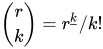 ):
):
Since the falling factorials are a basis for the ring of polynomials, we can express the product of two of them as a linear combination of falling factorials:

The coefficients of (x)m+n−k are called connection coefficients and have a combinatorial interpretation as the number of ways to glue together k elements from a set of m elements and a set of n elements. We also have a connection formula for the ratio of two Pochhammer symbols
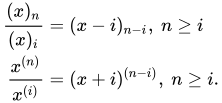
In addition, with the help of the following identities:
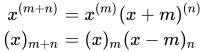
the rising and falling factorials can be generalized to negative orders:

Finally, the duplication formula and the multiplication formulas for rising factorials give the following relations:


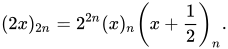
An alternative notation for the rising factorial
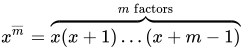 for integer m≥0,
And for the falling factorial
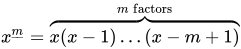 for integer m≥0;
goes back to A. Capelli (1893) and L. Toscano (1939) respectively . Graham, Knuth and Patashnik proposed pronouncing this expression as "rising of x to m" and "falling of x to m" respectively.
Other notations for the falling factorial include  or xPn
 . (See the articles «Permutation» and «Combination».)
The alternative notation  for the rising factorial x(n) is used less frequently. To avoid confusion in the case when the notation is used for the rising factorial, then for the ordinary falling factorial the notation is used
  .
.
The Pochhammer symbol has a generalized version, called the generalized Pochhammer symbol, and is used in multivariate analysis. There is also a q-analogue, the q-Pochhammer symbol.
A generalization of the falling factorial, in which the function is evaluated on a decreasing arithmetic progression:
 .
.
The corresponding generalization of the rising factorial

This notation unifies the rising and falling factorials, which equal  and
and  respectively.
For any fixed arithmetic function f:N→C and symbolic parameters x,t
 , the associated generalized products of the form
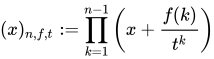
can be studied from the point of view of classes of generalized Stirling numbers of the first kind, defined by means of the following coefficients of x in the expansion  , and then by means of the following recurrence relation:
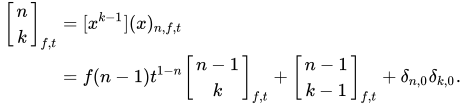
These coefficients satisfy numerous properties analogous to those of the Stirling numbers of the first kind, as well as recurrence relations and functional equalities connected with f-harmonic numbers 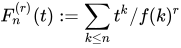 .
.

Comments