
Lecture
A clique of an undirected graph is a subset of its vertices, any two of which are joined by an edge. Cliques are one of the basic concepts of graph theory and are used in many other mathematical problems and constructions with graphs. Cliques are also studied in computer science — the problem of determining whether a clique of a given size exists in a graph (the clique problem) is NP-complete. Despite this difficulty, many algorithms for finding cliques are studied.
Although the study of complete subgraphs began with the formulation of Ramsey's theorem in graph-theoretic terms by Erdős and Szekeres . The term «clique» came from the work of Luce and Perry , who used complete subgraphs in the study of social networks to model cliques of people, that is, groups of people acquainted with each other . Cliques have many other applications in science, and, in particular, in bioinformatics.
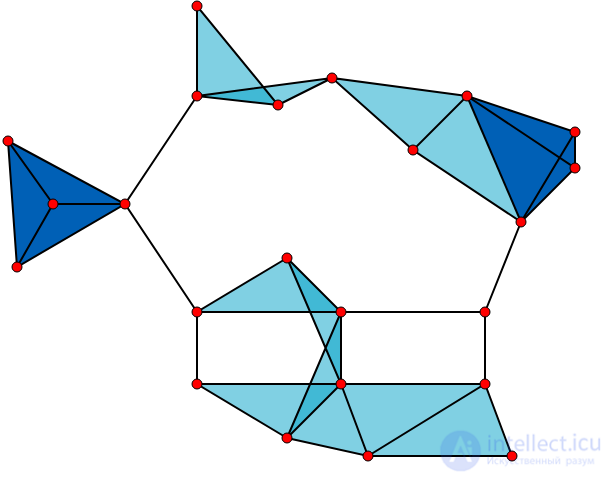
A graph with 23 cliques containing 1 vertex (the vertices of the graph), 42 cliques consisting of 2 vertices (the edges of the graph), 19 cliques consisting of 3 vertices (the shaded triangles) and two cliques consisting of 4 vertices (the dark-blue areas).
Six edges belong to no triangle, and 11 light-blue triangles form maximal cliques.
The two dark-blue 4-cliques are both maximum and maximal, and the clique number of the graph equals 4.
A clique in an undirected graph  is a subset of vertices
  , such that for any two vertices in
  there exists an edge joining them. This is equivalent to the statement that the subgraph induced by , is complete.
A maximal clique, or a clique that is maximal with respect to inclusion — is a clique that cannot be extended by adding vertices to it. In other words, in the given graph there is no clique of larger size in which it is contained.
A maximum clique, or a clique that is maximum in size — is a clique of maximum size for the given graph.
The clique number  of the graph
  — is the number of vertices in the maximum clique of the graph . The intersection number of the graph — is the smallest number of cliques that together cover all edges of the graph .
The notion opposite to a clique — is an independent set, in the sense that each clique corresponds to an independent set in the complement graph. The clique cover problem consists of finding as few cliques as possible that contain all vertices of the graph.
A related term — is a biclique, a complete bipartite subgraph. The bipartite dimension of a graph — is the minimum number of bicliques needed to cover all edges of the graph.
Mathematical results concerning cliques include the following.
 vertices and more than
  edges must have a clique of three vertices.
 vertices can contain at most
  maximal cliques. The graphs satisfying this bound — are the Moon — Moser graphs
  — a special case of Turán graphs, arising as the extremal case of Turán's theorem.
Some important classes of graphs can be defined by their cliques:
 come after the vertex ., the cliques containing , come consecutively.
In addition, many other mathematical constructions involve cliques of graphs. Among them:
— is an abstract simplicial complex  with a simplex for each clique in ;
 with a vertex for each clique in the graph and edges joining two cliques that differ by one vertex. This graph is an example of a median graph and is connected with the median algebra on the cliques of the graph — the median
  of three cliques
  ,
,  and — is the clique whose vertices belong to at least two of the cliques , and ;
A concept close to complete subgraphs — is partitions of graphs into complete subgraphs and complete minors of a graph. In particular, Kuratowski's theorem and Wagner's theorem characterize planar graphs by forbidding complete and complete bipartite subgraphs and minors, respectively.
In computer science the clique problem — is the computational problem of finding the maximum clique or cliques in a given graph. The problem is NP-complete, one of Karp's 21 NP-complete problems . It is also hard for parametric approximation and hard to approximate. Nevertheless, many algorithms have been developed for working with cliques, running either in exponential time (such as the Bron — Kerbosch algorithm), or specializing in families of graphs, such as planar graphs or perfect graphs, for which the problem can be solved in polynomial time.
Below is a list of freely distributed software for finding a maximum clique.
| Name | License | API language | Short description |
|---|---|---|---|
| NetworkX | BSD | Python | approximate solution, see the max_clique procedure (dead link) |
| maxClique | CRAPL | Java | exact algorithms, DIMACS implementations |
| OpenOpt | BSD | Python | exact and approximate solutions, ability to specify edges that must be included (MCP) |
The clique problem belongs to the class of NP-complete problems in the field of graph theory. It was first formulated in 1972 by Richard Karp.
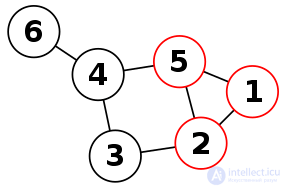
A clique in an undirected graph is a subset of vertices, any two of which are joined by an edge of the graph. In other words, it is a complete subgraph of the original graph. The size of a clique is defined as the number of vertices in it. The clique problem exists in two variants: in the decision problem one is required to determine whether a clique of size k exists in a given graph G, whereas in the computational variant one is required to find a clique of maximum size in a given graph G.
The NP-completeness of the clique problem follows from the NP-completeness of the independent vertex set problem. It is easy to show that a necessary and sufficient condition for the existence of a clique of size k is the presence of an independent set of size at least k in the complement of the graph. This is obvious, since the completeness of a subgraph means that its complement contains no edge.
Another proof of NP-completeness can be found in the book «Introduction to Algorithms».
As for other NP-complete problems, an efficient algorithm for finding a clique of a given size has not been found at present. An exhaustive search of all possible subgraphs of size k with a check of whether at least one of them is complete — is inefficient, since the total number of such subgraphs in a graph with v vertices equals the binomial coefficient 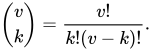
Another algorithm works as follows: two cliques of size n and m are «glued» into a larger clique of size n+m, where a clique of size 1 is taken to be a single vertex of the graph. The algorithm terminates as soon as no more merges can be performed. The running time of this algorithm is linear, but it is heuristic, since it does not always lead to finding a clique of maximum size. As an example of an unsuccessful termination one can cite the case where the vertices belonging to the maximum clique turn out to be separated and located in cliques of smaller size, and the latter can no longer be «glued» together.
König's theorem. In a bipartite graph the size of the maximum matching equals the size of the minimum vertex cover.
From König's theorem it follows that
the size of the maximum clique =
the size of the maximum independent set in the complement graph =
the number of vertices of the graph – the size of the minimum vertex cover =
the number of vertices of the graph – the size of the maximum matching in the complement graph
Example
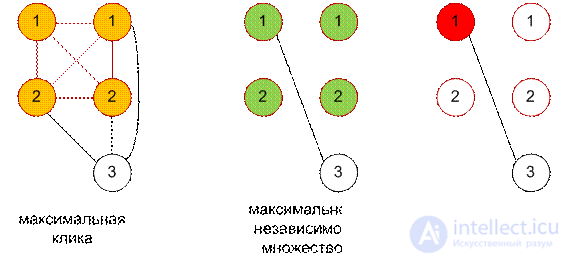
Let us consider the second example. The size of the maximum clique of the graph equals 4. The size of the maximum independent set in the complement graph equals 4.
Many different bioinformatics problems have been modeled using cliques. For example, Ben-Dor, Shamir and Yakhini[10] modeled the problem of partitioning gene expression into groups as the problem of finding the minimum number of changes needed to transform a data graph into a graph formed by disjoint sets of cliques. Tanay, Sharan and Shamir[11] discuss a similar problem of biclustering gene-expression data, in which the clusters must be cliques. Sugihara used cliques to model ecological niches in food chains. Day and Sankoff describe the problem of describing evolutionary trees as the problem of finding maximum cliques in a graph in which the vertices represent characteristics, and two vertices are joined by an edge if there exists a perfect phylogeny , combining these two characteristics. Samudrala and Moult modeled protein-structure prediction as the problem of finding cliques in a graph whose vertices represent positions of parts of the protein, and by searching for cliques in a protein-protein interaction network , Spirin and Mirny found clusters of proteins that interact closely with each other and interact weakly outside the cluster. Graph power analysis — is a method of simplifying complex biological systems by finding cliques and related structures in these systems.
In electrical engineering, Prihar used cliques to analyze communication networks, and Paull and Unger used them to design efficient circuits for computing partially defined Boolean functions. Cliques are also used in automatic test-pattern generation — a large clique in the incompatibility graph of possible faults gives a lower bound on the set of tests . Kong and Smith describe the application of cliques to finding hierarchical structures in electrical circuits.
In chemistry, Rhodes et al. used cliques to describe chemical compounds in a chemical database , having a high degree of similarity. Kuhl, Crippen and Friesen used cliques to model the positions at which two chemical compounds bind to each other.

Comments