
Lecture
Primorial (English: Primorial) — in number theory, a function over the sequence of natural numbers, similar to the factorial function, with the difference that the primorial is the successive product of the prime numbers less than or equal to a given number, whereas the factorial is the successive product of all natural numbers less than or equal to a given number.
The term «primorial» was introduced into scientific use by the American engineer and mathematician Harvey Dubner in 1987.
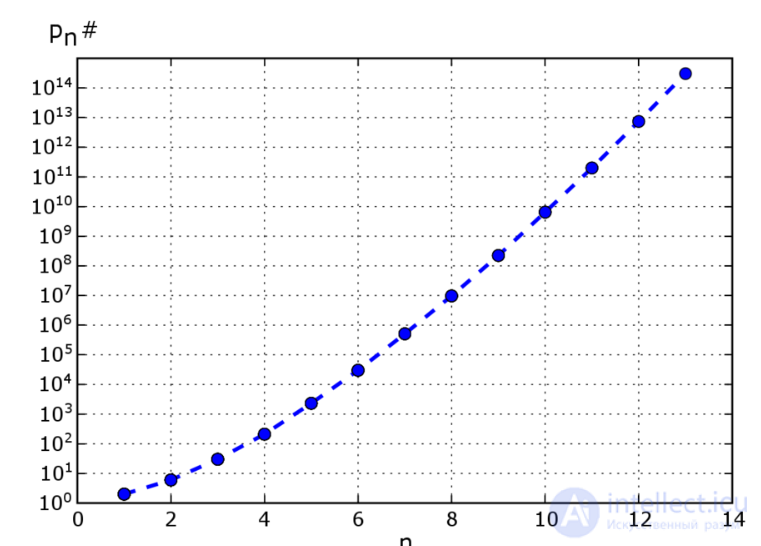
pn# as a function of n on a logarithmic scale
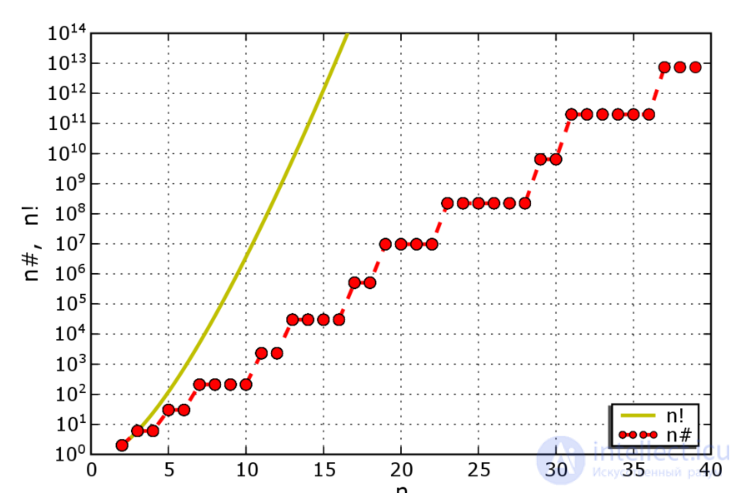
n# as a function of n (highlighted in red), compared with n!. Both graphs are on a logarithmic scale
For the n-th prime number pn, the primorial pn# is defined as the product of the first n prime numbers:
,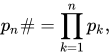
where pk — is the k-th prime number.
For example, p5# denotes the product of the first 5 prime numbers:
.
Thus, the first six primorials:
1, 2, 6, 30, 210, 2310 (sequence A002110 in OEIS, which also includes p0# = 1 as the empty product).
Asymptotically, the primorials pn# grow according to
pn#=e[1+o(1)]nlogn,
where o(⋅) is little-«o» notation.
In the general case, for a positive integer n, the primorial n# can be defined as the product of the prime numbers less than or equal to n:
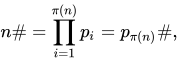
where π(n) is the prime-counting function (sequence A000720 in OEIS), giving the number of primes ≤ n, which is equivalent to
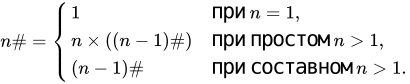
For example, 12# is the product of the prime numbers each of which is ≤ 12:

Thus, π(12)=5 can be computed as

Consider the first 12 primorials:
1, 2, 6, 6, 30, 30, 210, 210, 210, 210, 2310, 2310.
We see that for composite numbers each term of this sequence simply duplicates the previous one. In the example above, we have that 12# = p5# = 11#, since 12 is a composite number.
The natural logarithm of n# — is the first Chebyshev function, written as θ(n) or ϑ(n), which approaches the linear n for large values of n.
The primorials n# grow according to

Primorials play an important role in the search for prime numbers in arithmetic progressions of primes. For example, adding the numbers 2236133941 + 23# yields a prime number that begins a sequence of thirteen primes obtainable by successively adding 23#, and ending with the number 5136341251. 23# is also the common difference in arithmetic progressions of fifteen and sixteen primes.
Every highly composite number can be represented as a product of primorials (for example, 360 = 2 · 6 · 30)].
All primorials are square-free numbers, and each of them has prime divisors of any number smaller than the primorial. For every primorial n, the ratio ϕ(n)/n is smaller than for any integer, where ϕ is Euler's function.
Every primorial is a weakly totient number.
The Riemann zeta function for positive numbers greater than one can be expressed using the primorial and the Jordan function Jk(n):

| n | n# | pn | pn# |
|---|---|---|---|
| 0 | 1 | does not exist | does not exist |
| 1 | 1 | 2 | 2 |
| 2 | 2 | 3 | 6 |
| 3 | 6 | 5 | 30 |
| 4 | 6 | 7 | 210 |
| 5 | 30 | 11 | 2310 |
| 6 | 30 | 13 | 30030 |
| 7 | 210 | 17 | 510510 |
| 8 | 210 | 19 | 9699690 |
| 9 | 210 | 23 | 223092870 |
| 10 | 210 | 29 | 6469693230 |
| 11 | 2310 | 31 | 200560490130 |
| 12 | 2310 | 37 | 7420738134810 |
| 13 | 30030 | 41 | 304250263527210 |
| 14 | 30030 | 43 | 13082761331670030 |
| 15 | 30030 | 47 | 614889782588491410 |
| 16 | 30030 | 53 | 32589158477190044730 |
| 17 | 510510 | 59 | 1922760350154212639070 |
| 18 | 510510 | 61 | 117288381359406970983270 |
| 19 | 9699690 | 67 | 7858321551080267055879090 |
| 20 | 9699690 | 71 | 557940830126698960967415390 |
The compositorial of a number n, unlike the primorial, is the product of the composite numbers less than or equal to n. The compositorial equals the ratio of the factorial and the primorial of the number:  . The first fifteen compositorials (excluding repeated values) are 1, 4, 24, 192, 1728, 17280, 207360, 2903040, 43545600, 696729600, 12541132800, 250822656000, 5267275776000, 115880067072000.

Comments