
Lecture
A partition of a number  — is a representation of as a sum of positive integers called parts. The order of the parts is not taken into account (unlike compositions), that is, partitions that differ only in the order of the parts are considered equal. In the canonical notation of a partition, the parts are listed in non-increasing order.
The number of partitions  of a natural number is one of the fundamental objects of study in number theory.
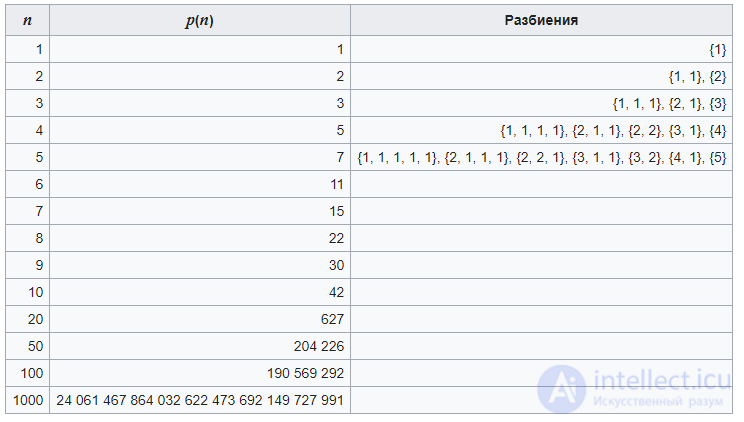
For example, {3, 1, 1} or {3, 2} — are partitions of the number 5, since 5 = 3 + 1 + 1 = 3 + 2. In total there are  partitions of the number 5:
{1, 1, 1, 1, 1},
{2, 1, 1, 1},
{2, 2, 1},
{3, 1, 1},
{3, 2},
{4, 1},
{5}.
Some values of the number of partitions are given in the following table:
The sequence of the number of partitions has the following generating function:
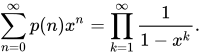
This formula was discovered by Euler in 1740.
While studying the generating function of the sequence , Euler focused his attention on its denominator, that is, on the product  . When the parentheses are expanded, this infinite product takes the following form:

The exponents of  on the right-hand side — are numbers of the form
  where
where  — is an integer, and the sign at
  equals
  . For natural :
  — these are the pentagonal numbers.[2]
Based on this observation, Euler conjectured that the pentagonal number theorem must hold:
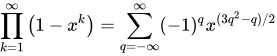 .
.
Subsequently this theorem was proved by Euler. It makes it possible to compute the numbers of partitions by dividing formal power series.
An asymptotic expression for the number of partitions was obtained by Hardy and Ramanujan in 1918 and independently by the Russian mathematician Uspensky in 1920
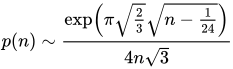 as
as 
This expression gives, for example,  .
.
Subsequently Hardy and Ramanujan found a more precise expression in the form of a sum, and finally Rademacher found a convergent series for the asymptotic representation of the number of partitions.
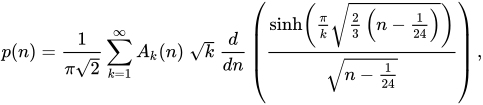
where

Here the summation is over  coprime with
  , and
, and  — is the Dedekind sum. The series converges very quickly.
The number of partitions of the number into summands not exceeding satisfies the recurrence formula:

with initial values:
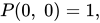
 for all
In this case, the number of all possible partitions of the number equals  .
.
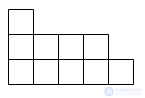
The Young diagram of the partition 10 = 5 + 4 + 1.
Partitions are conveniently represented as visual geometric objects called Young diagrams, named after the English mathematician Alfred Young[en]. The Young diagram of a partition  — is a subset of the first quadrant of the plane, divided into cells, each of which is a unit square. The cells are arranged in rows; the first row has length
  , above it is a row of length
  , and so on up to the -th row of length
  . The rows are aligned to the left edge.
More formally, a Young diagram — is the closure of the set of points  such that
 and
and 
where  denotes the integer part of .
In the English-language literature, Young diagrams are often drawn reflected about the abscissa axis.
A similar object, called a Ferrers diagram, differs in that
Partitions arise naturally in a number of mathematical problems. The most significant of these is the representation theory of the symmetric group, where partitions naturally parametrize all irreducible representations. Sums over all partitions frequently occur in mathematical analysis.

Comments