
Lecture 16 min.
Trigonometric functions are elementary functions that historically arose from the study of right triangles and expressed the dependence of the side lengths of these triangles on the acute angles at the hypotenuse (or, equivalently, the dependence of chords and heights on the central angle of an arc in a circle). These functions have found wide application in a great variety of fields of science. As mathematics developed, the definition of trigonometric functions was extended; in the modern understanding their argument may be an arbitrary real or complex number.
The branch of mathematics that studies the properties of trigonometric functions is called trigonometry.
The trigonometric functions traditionally include:
direct trigonometric functions:
 );
); );
);derived trigonometric functions:
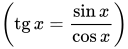 ;
;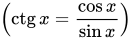 ;
;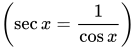 ;
;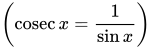 ;
;inverse trigonometric functions:
In the typography of literature in different languages, the abbreviated notation of trigonometric functions differs; for example, in English-language literature the tangent, cotangent and cosecant are written  ,
,  ,
,  . Before the Second World War, in Germany and France these functions were written in the same way as is customary in Russian-language texts , but later the English-language notation for trigonometric functions was adopted in the literature of those countries.
Besides these six widely known trigonometric functions, some rarely used trigonometric functions (versine, etc.) are occasionally found in the literature.
The sine and cosine of a real argument are periodic, continuous and infinitely differentiable real-valued functions. The other four functions on the real axis are likewise real-valued, periodic and infinitely differentiable, except for a countable number of discontinuities of the second kind: for the tangent and secant at the points  , and for the cotangent and cosecant at the points
  .
.
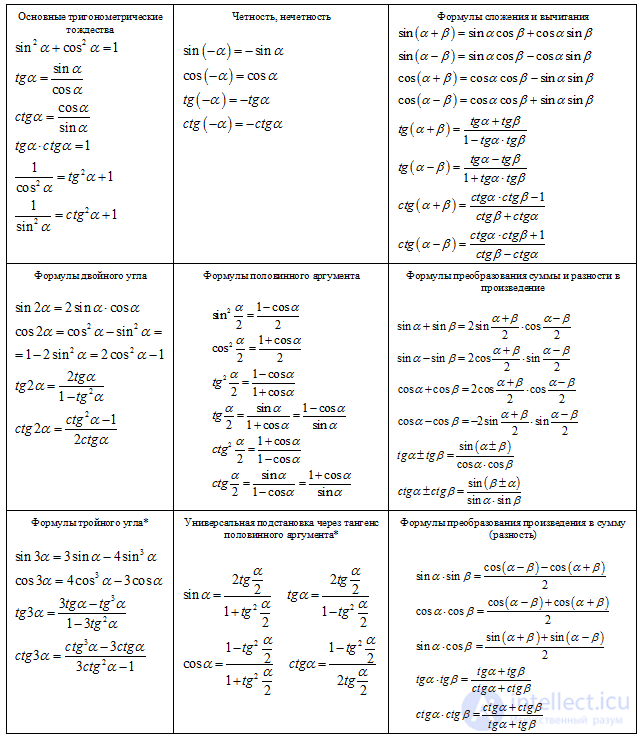
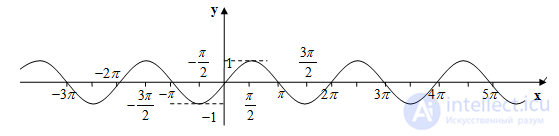
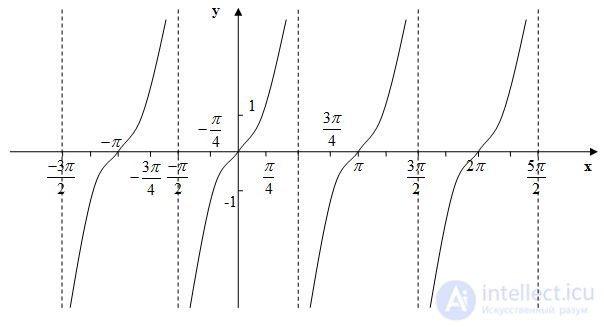
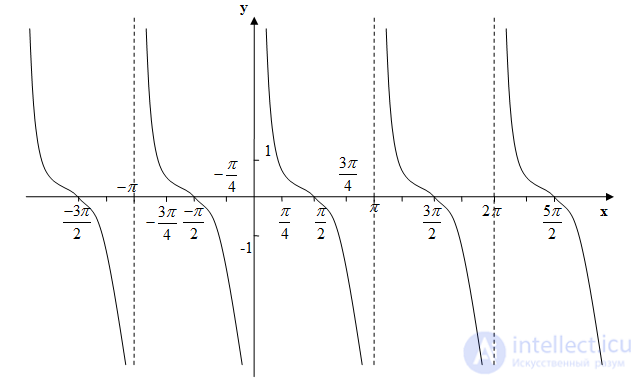
The graphs of the trigonometric functions are shown in Fig. 1.
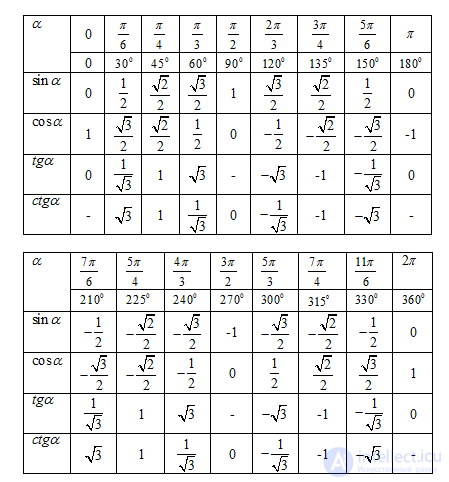
Cosine wave
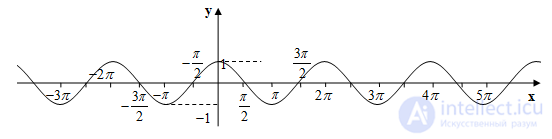
Sine wave
Tangent curve
Cotangent curve
The invention of a way of measuring angles in degrees dates to the 3rd–2nd millennia BC. The very first trigonometric function was the chord corresponding to a given arc. The first trigonometric tables (2nd century BC), needed for astronomy, were constructed for this function.
For the first time in the history of science, in the 5th–12th centuries, Indian mathematicians and astronomers began to consider half of a chord instead of the full chord, which corresponds to the modern concept of the sine. They called the half-chord "ardhajiva", which meant "half of a bowstring". Besides sin x, the Indians also considered the quantity 1 – cos x, which they called "utkramajiva", and the quantity cos x, which they called "kotijiva".
Ancient Greek scholars did not know the modern notation for trigonometric functions; instead of the sine they used the chord. The Greek word "chord" means "bowstring". The first tables of chords have come down to us in Ptolemy's book "Almagest" (2nd century AD).
In India, in the treatise of the mathematician Aryabhata, in 499 the functions sine, cosine and versed sine are found. They were considered only for an acute angle.
The new trigonometric functions that we still use today were introduced by scholars of the Middle and Near East in the 9th–10th centuries. The concepts of "tangent" and "cotangent", like the first tables of these new trigonometric quantities, were born from the study of sundials (gnomonics). A sundial was a pole stuck vertically into the ground. Time was read from the length and direction of the shadow cast by the pole. The dial was a flat area with pegs driven into the ground.
In total there are six trigonometric quantities: sine, cosine, tangent, cotangent, secant, cosecant.
In Europe, the first work in which trigonometry was treated as an independent branch of mathematics was the work of the German astronomer and mathematician Regiomontanus, "Five Books on Triangles of Every Kind", written in 1462–1466. In it the author systematized and set out all the knowledge of trigonometry known up to that time.
The concepts of such trigonometric functions as the tangent, cotangent, secant and cosecant were defined with complete rigor, starting from consideration of the trigonometric circle, by the Iranian mathematician Abu al-Wafa. The modern names of these functions were given between the 15th and 17th centuries by European scholars. Thus the term "tangent", from the Latin for "touching", was introduced in the 15th century by the founder of trigonometry in Europe, Regiomontanus. In the 16th century Fincke introduced the term "secant". In the 17th century the scholar Gunter, an assistant of Briggs, the inventor of decimal logarithms, introduced the names "cosine" and "cotangent", where the prefix "co" denotes complement (complementum).
The modern notation for the sine and cosine, sin x and cos x, was first introduced in 1739 by J. Bernoulli in a letter to the St. Petersburg mathematician L. Euler. The latter concluded that this notation was very convenient and began to use it in his mathematical works. In addition, Euler introduced the following abbreviated notation for the trigonometric functions of an angle x: tang x, cot x, sec x, cosec x. Euler then established the connection between trigonometric and exponential functions and gave a rule for determining the signs of the functions in the different quadrants of the circle. Euler established the modern view of trigonometric functions as functions of a numerical argument.
In 1770 the name Trigonometric functions appeared and has been retained to this day. It was introduced by G. S. Klügel in his work "Analytic Trigonometry".
The most significant studies in trigonometry are associated with the names of Nasir al-Din al-Tusi (1201–1274), John Wallis (1616–1703), James Gregory (1638–1675), Isaac Barrow (1630–1677), Roger Cotes (1682–1716), Isaac Newton (1643–1727), and Leonhard Euler (1707–1783).
The sine line (the line  in Fig. 2) was originally called "arha-jiva" ("half-bowstring", that is, half of the chord of a given arc, since an arc with its chord resembles a bow with its string) by Indian mathematicians. Then the word "arha" was dropped and the sine line began to be called simply "jiva". Arab mathematicians, when translating Indian books from Sanskrit, did not translate the word "jiva" with the Arabic word "watar", which denotes a bowstring and a chord, but transcribed it in Arabic letters and began to call the sine line "jiba" (جيب). Since short vowels are not written in Arabic, and the long "i" in the word "jiba" is written the same way as the semivowel "y", the Arabs began to pronounce the name of the sine line as "jaib", which literally means "hollow" or "bosom". When Arabic works were translated into Latin, European translators rendered the word "jaib" with the Latin word sinus, "sine", which has the same meaning (it is in this meaning that it is used as the anatomical term sinus). The term "cosine" (Latin cosinus) is an abbreviation of the Latin complementi sinus, meaning "complementary sine".
The modern abbreviated notations  ,
,  were introduced by William Oughtred and Bonaventura Cavalieri and were established in the works of Leonhard Euler.
The terms "tangent" (Latin tangens, "touching") and "secant" (Latin secans, "cutting") were introduced by the Danish mathematician Thomas Fincke in his book "Geometria rotundi" (Geometria rotundi, 1583).
The term trigonometric functions itself was introduced by Klügel in 1770.
Terms for the inverse trigonometric functions were introduced later — arcsine, arccosine, arctangent, arccotangent, arcsecant, arccosecant — by adding the prefix "arc" (from Latin arcus, "arc"), by J. Lagrange and others.
Trigonometry, or trigonometric functions, are used in astronomy (especially for calculating the positions of celestial objects), where spherical trigonometry is required, in marine and air navigation, in music theory, in acoustics, in optics, in the analysis of financial markets, in electronics, in probability theory, in statistics, in biology, in medical imaging, for example computed tomography and ultrasound, in pharmacy, in chemistry, in number theory, in seismology, in meteorology, in oceanography, in many physical sciences, in land surveying and geodesy, in architecture, in phonetics, in economics, in electrical engineering, in mechanical engineering, in civil engineering, in computer graphics, in cartography, in crystallography, in game development and in many other fields.
Geodesy
Ancient astronomy
The beginnings of trigonometry can be found in the mathematical manuscripts of Ancient Egypt, Babylon and Ancient China. Problem 56 of the Rhind Papyrus (2nd millennium BC) asks for the slope of a pyramid whose height is 250 cubits and whose base side is 360 cubits long.
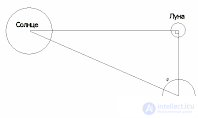
A few decades later Claudius Ptolemy, in his works "Geography", "Analemma" and "Planisphaerium", gives a detailed account of trigonometric applications to cartography, astronomy and mechanics. Among other things, the stereographic projection is described, and several practical problems are investigated, for example: to determine the altitude and azimuth of a celestial body from its declination and hour angle. From the point of view of trigonometry, this means that one must find a side of a spherical triangle from the other two sides and the opposite angle.
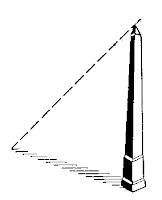
The gnomon is the most ancient astronomical instrument, a vertical object (a stela, column or pole),
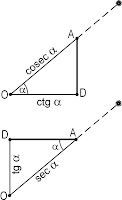
Thus, the cotangent was understood as the length of the shadow of a vertical gnomon 12 (sometimes 7) units high; originally these concepts were used to calculate sundials. The tangent was the name given to the shadow of a horizontal gnomon. The cosecant and secant were the names given to the hypotenuses of the corresponding right triangles (the segments AO in the figure on the left).
Architecture
Trigonometry is widely used in construction, and especially in architecture. Most compositional solutions and the construction of
The proportions in the construction of the statue were ideal. However, when the statue was raised onto a high pedestal, it looked ugly. The sculptor had not taken into account that in perspective many details diminish toward the horizon, and when viewed from below the impression of its ideal quality is no longer created. Many calculations were carried out
The situation changes, since the statue is raised to a height, so the distance from the top of the statue to the person's eyes increases, and therefore the sine of the angle of sight increases. By comparing the changes in the distance from the top of the statue to the ground in the first and second cases, a proportionality coefficient can be found. We will subsequently obtain a drawing, and then a sculpture which, when raised, will visually appear close to the ideal.
Medicine and biology.
A model of biorhythms can be built using trigonometric functions. To build a biorhythm model, one must enter a person's date of birth, the reference date (day, month, year) and the length of the forecast (number of days).
The heart formula. As a result of a study conducted by Vahid-Reza Abbasi, a student at Iran's Shiraz University, physicians for the first time gained the ability to organize information relating to the electrical activity of the heart, or, in other words, electrocardiography. The formula is a complex algebraic-trigonometric equality consisting of 8 expressions, 32 coefficients and 33 main parameters, including several additional ones for calculations in cases of arrhythmia. According to physicians, this formula greatly simplifies the process of describing the main parameters of heart activity, thereby speeding up diagnosis and the start of the treatment itself.
Trigonometry also helps our brain to determine distances to objects.
American scientists claim that the brain estimates the distance to objects by measuring the angle between the plane of the ground and the plane of sight. Strictly speaking, the idea of "measuring angles" is not new. Even the artists of Ancient China drew distant objects higher in the field of view, somewhat neglecting the laws of perspective. The theory of determining distance by estimating angles was formulated by the 11th-century Arab scholar Alhazen. After a long period of oblivion, in the middle of the last century the idea was revived by the psychologist James
forgotten again.
The movement of fish in water follows a sine or cosine law if you fix a point on the tail and then examine the trajectory of its motion. When swimming, the body of the fish takes the shape of
Measurement work
C=180-a-b, sinC=sin(180-a-b)=sin(a+b)
Then, using the law of sines, we find d.
Computational intelligence and machine learning
Using an activation function in the form of a linear threshold extends the range of values of the neuron's output, but it still remains a linear transformer, which considerably reduces the approximating capabilities of the network. In addition, the presence of two points of discontinuity, where the function is not differentiable, makes it impossible to use the linear threshold in gradient-based learning algorithms, which use the derivative of the activation function.
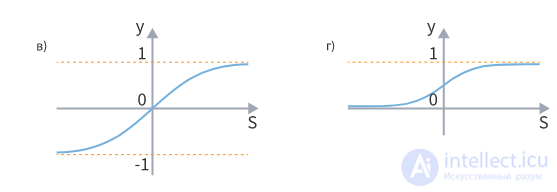
Therefore, when training multilayer neural networks, sigmoid activation functions, so named for their characteristic S-shaped form, are used most often. Examples of such functions are the hyperbolic tangent (graph (c) in the figure) and the logistic function (graph (d)), given by the corresponding formulas:
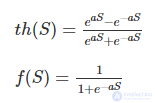
These are monotonically increasing functions, differentiable over the whole domain of definition, which makes them applicable in learning algorithms that use the derivatives of the activation function. Usually all neurons of a network have the same activation function.

Comments