
Lecture 3 min.
A numerical interval - is the set of all points of the number line bounded by a given number or numbers (points on the number line).
A numerical interval of any kind (the set of values of x lying between certain numbers) can always be represented in three kinds of mathematical notation: special interval notation, chains of inequalities (a single inequality or a double inequality), or geometrically on the number line; all these notations have the same meaning. They give restriction(s) on the values of some mathematical object or variable quantity (a variable, any expression containing a variable, a function, etc.).
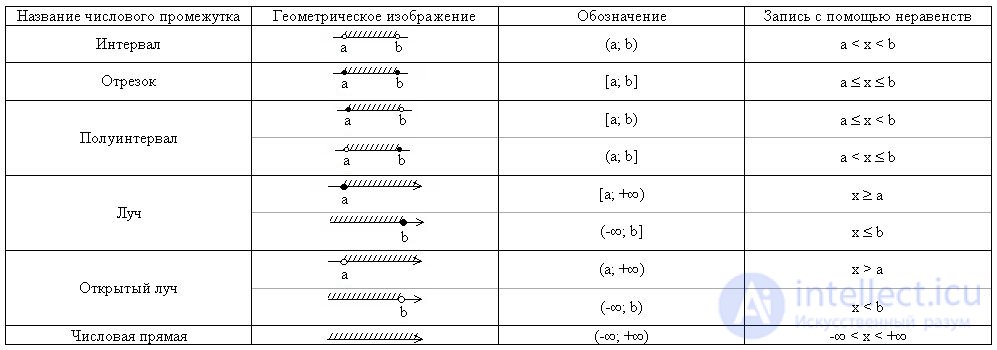
open interval — the region of intersection of two open rays
closed interval — (segment) in mathematics, the set of numbers or points on a line between two numbers or points a and b, including the points a and b themselves
half-open interval — the set of points of a line lying between points A and B, where one of the points A or B is not included in the half-open interval.
ray or half-line — a line that has a starting point but no end, or the part of a line consisting of a given point and all points lying on one side of it. Any point on a line divides the line into two rays .
open ray — the set of points of a line lying on one side of a boundary point that does not belong to the given set.
number line— a line on which the following are chosen: some point O as the origin; a positive direction, indicated by an arrow; and a scale, that is, a unit of length. Thus, the number line is a visual geometric image of the set of real numbers  .
.
The extended (affinely extended) real number line is the set of real numbers supplemented by two points at infinity:  (positive infinity) and
  (negative infinity), that is,
  . It should be understood that
  are not numbers and are of a somewhat different nature, but an order relation is defined for them, as for real numbers. Also, the elements and themselves are considered unequal to each other.
Moreover, for any real number  the inequalities
  are by definition assumed to hold. In some teaching materials the term "extended number line" is used for the number line extended by a single point at infinity, not related to the real numbers by an order relation, so sometimes, for clarity, the line with one infinity is called the projectively extended line, and the one with two infinities the affinely extended line.
The plus sign for the element is often not omitted, unlike for other positive numbers, in order to avoid confusion with the unsigned infinity of the projectively extended number line. However, the sign is sometimes omitted anyway, and in such cases the projective infinity is usually denoted as  .
.

Comments