
Lecture
Trigonometry (from Greek trigōnon , «triangle» and metron , «measure» ) is a branch of mathematics that studies the relationship between the lengths of sides and the angles of triangles . The field emerged in the Hellenistic world during the 3rd century BC from applications of geometry to astronomical studies . The Greeks focused on the calculation of chords , while mathematicians in India created the earliest known tables of values for trigonometric ratios (also called trigonometric functions ), such as sine .
Throughout history, trigonometry has been applied in areas such as geodesy , land surveying , celestial mechanics , and navigation .
Trigonometry is known for its many identities , , which are equations used for rewriting trigonometric expressions to solve equations, to find a more useful expression, or to discover new relationships.
Hipparchus , who is credited with compiling the first trigonometric table , has been described as «the father of trigonometry».
Sumerian astronomers studied angle measure, using a division of circles into 360 degrees. They, and later the Babylonians , studied the ratios of the sides of similar triangles and discovered some properties of these ratios, but did not turn it into a systematic method for finding the sides and angles of triangles. The ancient Nubians used a similar method.
In the 3rd century BC, Hellenistic mathematicians such as Euclid and Archimedes studied the properties of chords and inscribed angles in circles, and they proved theorems equivalent to modern trigonometric formulas, although they presented them geometrically rather than algebraically. In 140 BC, Hipparchus (of Nicaea , Asia Minor) gave the first tables of chords, analogous to modern tables of values of sines , and used them to solve problems of trigonometry and spherical trigonometry . In the 2nd century AD, the Greco-Egyptian astronomer Ptolemy(of Alexandria, Egypt) constructed detailed trigonometric tables ( Ptolemy's table of chords ) in Book 1, Chapter 11 of his Almagest . Ptolemy used the length of a chord to define his trigonometric functions, which differs slightly from the sine convention we use today. (The value that we call sin (θ), can be found by looking up the length of the chord for double the angle of interest (2θ) in Ptolemy's table, and then dividing that value by two.) Centuries passed before more detailed tables were produced, and Ptolemy's treatise remained in use for performing trigonometric calculations in astronomy throughout the following 1200 years in the medieval Byzantine , Islamic, and later Western European worlds.
The modern sine convention is first attested in the Surya Siddhanta , and its properties were further documented by the 5th-century (AD) Indian mathematician and astronomer Aryabhata . These Greek and Indian works were translated and expanded by medieval Islamic mathematicians . By the 10th century, Islamic mathematicians were using all six trigonometric functions, had tabulated their values, and applied them to problems in spherical geometry . the Persian polymath Nasir al-Din al-Tusi has been described as the creator of trigonometry as a mathematical discipline in its own right. Nasir al-Din al-Tusi was the first to treat trigonometry as a mathematical discipline independent of astronomy, and he developed spherical trigonometry into its present form. He listed the six distinct cases of a right triangle in spherical trigonometry, and in his work « On the Sector Figure» he stated the law of sines for plane and spherical triangles, discovered the law of tangents for spherical triangles, and provided proofs for both of these laws. Knowledge of trigonometric functions and methods reached Western Europe through a Latin translation of the Greek Almagest of Ptolemy.as well as the works of Persian and Arab astronomers, such as Al-Battani and Nasir al-Din al-Tusi . One of the earliest works on trigonometry by a northern European mathematician is De Triangulis in the 15th century by the German mathematician Regiomontanus , who was encouraged to write it, and was supplied with a copy of the Almagest , by the Byzantine Greek scholar Cardinal Bessarion of Nicaea with whom he lived for several years. At the same time the Cretan completed another translation of the Almagest from Greek into Latin.George of Trebizond . Trigonometry was still so little known in 16th-century Northern Europe that Nicolaus Copernicus devoted two chapters of De Revolutionibus orbium coelestium to explaining its basic concepts.
Because of the demands of navigation and the growing need for accurate maps of large geographic areas, trigonometry grew into a major branch of mathematics. Bartholomeus Pitiscus was the first to use the word, publishing his « Trigonometry» in 1595. Gemma Frisius first described the method of triangulation still used today in surveying. It was Leonhard Euler who fully incorporated complex numbers into trigonometry. The works of the Scottish mathematicians James Gregory in the 17th century and Colin Maclaurinin the 18th century had an influence on the development of trigonometric series Also in the 18th century, Brook Taylor defined the general Taylor series .
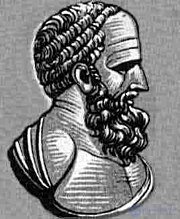
The first trigonometric tables were apparently compiled by Hipparchus, who is now known as «the father of trigonometry» .
Ancient Greek mathematicians, in their constructions involving the measurement of arcs of a circle, used the technique of chords. A perpendicular to a chord, dropped from the center of the circle, bisects the arc and the chord subtending it. Half of the bisected chord is the sine of the half-angle, and that is why the sine function is also known as the «half-chord». Because of this relationship, a significant number of trigonometric identities and theorems known today were also known to the ancient Greek mathematicians, but in the equivalent chord form. Although there is no trigonometry in the strict sense of the word in the works of Euclid and Archimedes, their theorems are presented in geometric form, equivalent to specific trigonometric formulas. Archimedes' theorem for dividing chords is equivalent to the formulas for the sines of the sum and difference of angles. To compensate for the lack of a table of chords, mathematicians of the time of Aristarchus sometimes used a well-known theorem, in modern notation — sinα/sinβ < α/β < tgα/tgβ, where 0° < β < α < 90°, together with other theorems.
The first trigonometric tables were probably compiled by Hipparchus of Nicaea (180—125 BC). Hipparchus was the first to tabulate the corresponding values of arcs and chords for a series of angles. The systematic use of the full circle of 360° was established chiefly thanks to Hipparchus and his table of chords. Perhaps Hipparchus took the idea of such a division from Hypsicles, who had earlier divided the day into 360 parts, although such a division of the day may have been suggested by Babylonian astronomers as well.
Menelaus of Alexandria (100 AD) wrote «Sphaerica» in three books. In the first book he set out the foundations for spherical triangles, similar to Book I of Euclid's «Elements» on plane triangles. He presented a theorem, for which there is no analogue in Euclid, that two spherical triangles are congruent if their corresponding angles are equal, but he did not distinguish between congruent and symmetric spherical triangles. Another of his theorems states that the sum of the angles of a spherical triangle is always greater than 180°. The second book of «Sphaerica» applies spherical geometry to astronomy. The third book contains «Menelaus's theorem», also known as the «rule of six quantities».
Later, Claudius Ptolemy (90 — 168 AD) in the «Almagest» expanded upon Hipparchus's «Chords in a Circle». The thirteen books of the «Almagest» are the most significant trigonometric work of the whole of antiquity. The theorem that was central to Ptolemy's calculation of chords is also known today as Ptolemy's theorem, which states that the sum of the products of the opposite sides of a convex cyclic quadrilateral is equal to the product of the diagonals. A special case of Ptolemy's theorem appeared as proposition 93 of Euclid's «Data».
Ptolemy's theorem entails the equivalence of the four sum and difference formulas for sine and cosine. Later, Ptolemy derived the half-angle formula. Ptolemy used these results to construct his trigonometric tables, although these tables may have been derived from the works of Hipparchus.
The replacement of chords with sines was a major achievement of medieval India. This replacement made it possible to introduce various functions related to the sides and angles of a right triangle. Thus, in India the foundation of trigonometry as the study of trigonometric quantities was laid.
Indian scholars used various trigonometric relations, including those that in modern form are expressed as



The Indians also knew formulas for multiple angles  where
where 
Trigonometry is necessary for astronomical calculations, which are set out in the form of tables. The first table of sines is found in the «Surya Siddhanta» and in Aryabhata. Later, scholars compiled more detailed tables: for example, Bhaskara gives a table of sines in increments of 1°.
South Indian mathematicians in the 16th century achieved great success in summing infinite numerical series. Apparently, they engaged in this research while looking for ways to compute more accurate values of the number π. Nilakantha verbally states the rules for expanding the arctangent into an infinite power series. And an anonymous treatise «Karanapaddhati[en]» («Technique of Calculations») gives rules for expanding sine and cosine into infinite power series. It must be said that in Europe similar results were not reached until the 17th-18th centuries. Thus, the series for sine and cosine were derived by Isaac Newton around 1666, and the arctangent series was found by J. Gregory in 1671 and G. W. Leibniz in 1673.
From the 8th century, scholars of the Near and Middle East developed the trigonometry of their predecessors. In the mid-9th century, the Central Asian scholar al-Khwarizmi wrote a treatise «On Indian Reckoning». After the treatises of Muslim scholars were translated into Latin, many ideas of Greek, Indian, and Muslim mathematicians became the property of European, and later world, science.
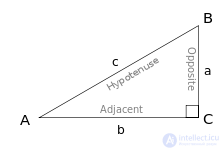
In this right triangle: sin A = a / c ; cos A = b / c ; tan A = a / b .
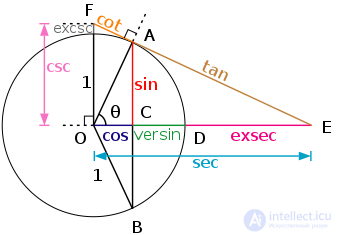
Trigonometric functions of an angle θ within the unit circle
Trigonometric ratios are the ratios between the sides of a right triangle. These ratios are given by the following trigonometric functions of a known angle A , where a , b and c refer to the lengths of the sides in the accompanying figure:
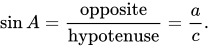
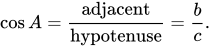

The hypotenuse is the side opposite the 90-degree angle in a right triangle; it is the longest side of the triangle and one of the two sides adjacent to angle A . The adjacent leg is the other side that is next to angle A . The opposite side is the side that is opposite angle A . The terms « perpendicular» and « base» are sometimes used to refer to the opposite and adjacent sides, respectively. See below in the « Mnemonics» section.
Since any two right triangles with the same acute angle A are similar , the value of the trigonometric ratio depends only on the angle A .
The reciprocals of these functions are named cosecant (csc), secant (sec) and cotangent (cot), respectively:



Cosine, cotangent, and cosecant are named as such because they are, respectively, the sine, tangent, and secant of the complementary angle, abbreviated to «co-».
With the help of these functions, one can answer virtually any question about arbitrary triangles using the law of sines and the law of cosines These laws can be used to compute the remaining angles and sides of any triangle, if two sides and their angle are known, or two angles and a side, or all three sides.
A mnemonic in trigonometry
Mnemonics are commonly used to remember facts and relationships in trigonometry. For example, the ratios of sine , cosine , and tangent in a right triangle can be remembered by representing them and their corresponding sides as strings of letters. For example, the mnemonic SOH-CAH-TOA:
S ine = O pposite ÷ H ypotenuse
C osine = A djacent ÷ H ypotenuse
T angent = O pposite ÷ djacent
One way to remember the letters is to sound them out phonetically (i.e. SOH-CAH-TOA , which is pronounced «so KÀ- toe -uh» / s oʊ k æ t oʊ ə / ). Another way is to expand the letters into a sentence, such as « S OMe O LD H ippie C aught another H ippie T rippin' O n acid».
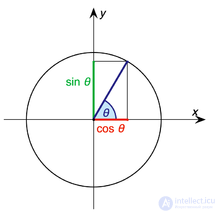
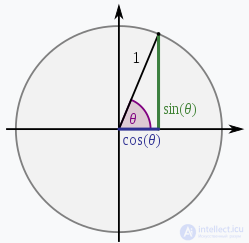
Fig. 1a - Sine and cosine of an angle θ, defined using the unit circle.
Trigonometric ratios can also be represented using the unit circle , which is a circle of radius 1 centered at the origin of the plane. In this setting, the terminal side of an angle A, placed in standard position, will intersect the unit circle at the point (x, y), where  and also
  . This representation makes it possible to compute commonly encountered trigonometric values, for example, in the following table:
| Function | 0 |  |
 |
 |
 |
 |
 |
 |
 |
|---|---|---|---|---|---|---|---|---|---|
| sine | 0 |  |
 |
 |
1 | |
|
|
0 |
| cosine | 1 | |
|
|
0 |  |
 |
 |
-1 |
| tangent | 0 |  |
 |
 |
undefined |  |
 |
 |
0 |
| secant | 1 |  |
 |
 |
undefined |  |
 |
 |
-1 |
| cosecant | undefined | |
|
|
1 | |
|
|
undefined |
| cotangent | undefined | |
|
|
0 | |
|
|
undefined |
Using the unit circle , it is possible to extend the definitions of trigonometric ratios to all positive and negative arguments (see Trigonometric function ).
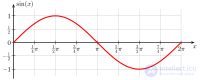
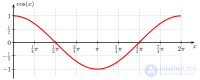
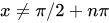
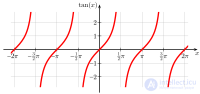
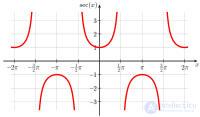
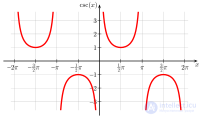
The following table shows the properties of the graphs of the six main trigonometric functions: [37] [38]
| Function | Period | Domain | Range | Graph |
|---|---|---|---|---|
| sine |  |
 |
 |
 |
| cosine | |
|
|
 |
| tangent | |
 |
|
 |
| secant | |
|
 |
 |
| cosecant | |
 |
|
 |
| cotangent | |
|
|
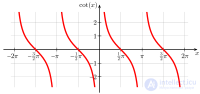 |
Since the six main trigonometric functions are periodic, they are not injective (or 1 to 1) and, therefore, are not invertible. However, by restricting the domain of a trigonometric function, it can be made invertible.
The names of the inverse trigonometric functions, together with their domains and ranges, can be found in the following table:
| name | Usual notation | Definition | Domain x for real result | Range of usual principal value ( radians ) |
Range of usual principal value ( degrees ) |
|---|---|---|---|---|---|
| arcsine | y = arcsin ( x ) | x = sin ( y ) | −1 ≤ x ≤ 1 | -π/2≤ y ≤π/2 | −90 ° ≤ y ≤ 90 ° |
| arccosine | y = arccos ( x ) | x = cos ( y ) | -1 ≤ x ≤ 1 | 0 ≤ y ≤ π | 0 ° ≤ y ≤ 180 ° |
| arctangent | y = arctan ( x ) | x = tan ( y ) | all real numbers | -π/2< y <π/2 | -90 ° < y <90 ° |
| arccotangent | y = arccot ( x ) | x = cot ( y ) | all real numbers | 0 < y < π | 0 ° < y <180 ° |
| arcsecant | y = arcsec ( x ) | x = sec ( y ) | x ≤ −1 or 1 ≤ x | 0 ≤ y <π/2 or π/2< y ≤ π | 0 ° ≤ y <90 ° or 90 ° < y ≤ 180 ° |
| arccosecant | y = arccsc ( x ) | x = csc ( y ) | x ≤ −1 or 1 ≤ x | -π/2≤ y <0 or 0 < y ≤π/2 | −90 ° ≤ y <0 ° or 0 ° < y ≤ 90 ° |
If the trigonometric ratios are considered as functions of a real variable, they can be represented by an infinite series. For example, sine and cosine have the following representations: [41]
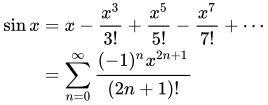
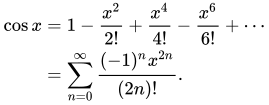
Using these definitions, the trigonometric functions can be defined for complex numbers. When extending the function of real or complex variables, the following formula holds for the complex exponential:

This complex exponential function, written in terms of trigonometric functions, is particularly useful.
Trigonometric functions were among the earliest applications of mathematical tables. Such tables were incorporated into mathematics textbooks, and students were taught to look up values and how to interpolate between listed values to obtain higher accuracy. Slide rules had special scales for trigonometric functions.
Scientific calculators have buttons for calculating the main trigonometric functions (sin, cos, tan, and sometimes cis and their inverses). Most of them allow you to choose the method of measuring angles: degrees, radians, and sometimes gradians. Most programming languages provide function libraries that include trigonometric functions. The floating-point hardware module included in the microprocessor chips used in most personal computers has built-in instructions for calculating trigonometric functions.
In addition to the six ratios listed earlier, there are additional trigonometric functions that have had historical significance, though today they are rarely used. These include the chord ( crd ( θ ) = 2 sin (θ/2) ), the versine ( versin ( θ ) = 1 - cos ( θ ) = 2 sin 2 (θ/2) ) (which appeared in the earliest tables [51] ), the coversine ( coversin ( θ ) = 1 - sin ( θ ) = versin (π/2- θ ) ), the haversine ( haversin ( θ ) =1/2versin ( θ ) = sin 2 (θ/2) ) the exsecant ( exsec ( θ ) = sec ( θ ) - 1 ), and the excosecant ( excsc ( θ ) = exsec (π/2- θ ) = csc ( θ ) - 1 ). See List of trigonometric identities for more information on the relationships between these functions.
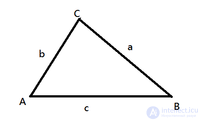
Triangle with sides a, b, c and respectively opposite angles A, B, C
In the following identities, A, B and C are the angles of a triangle; a, b, c — are the lengths of the sides of the triangle lying opposite the corresponding angles.
The sides of a triangle are proportional to the sines of the opposite angles. For an arbitrary triangle

where  — is the radius of the circle circumscribed around the triangle.

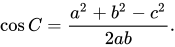
The square of a side of a triangle is equal to the sum of the squares of the other two sides minus twice the product of these sides and the cosine of the angle between them:

or:
Euler's formula states that for any real number  the following equality holds:

where  — is the base of the natural logarithm,
  — is the imaginary unit. Euler's formula provides a connection between mathematical analysis and trigonometry, and also allows the sine and cosine functions to be interpreted as weighted sums of the exponential function:


The above equations can be obtained by adding or subtracting Euler's formulas:


followed by solving for the sine or cosine.
These formulas can also serve as the definition of trigonometric functions of a complex variable. For example, making the substitution x = iy, we obtain:
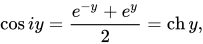

Complex exponentials allow trigonometric calculations to be simplified, since they are easier to manipulate than sinusoidal components. One approach involves converting sinusoids into the corresponding exponential expressions. After simplification, the result of the expression remains real. The essence of the other approach is to represent sinusoids as the real parts of a complex expression and to carry out manipulations directly with the complex expression.

If  — there are no real solutions.
If  — the solution is a number of the form

If — there are no real solutions.
If — the solution is a number of the form 

The solution is a number of the form 

The solution is a number of the form 
An important special branch of trigonometry, used in astronomy, geodesy, navigation and other fields, is spherical trigonometry, which examines the properties of the angles between great circles on a sphere and the arcs of these great circles. The geometry of a sphere differs significantly from Euclidean planimetry; for example, the sum of the angles of a spherical triangle generally differs from 180°, and a triangle can consist of three right angles. In spherical trigonometry, the lengths of the sides of a triangle (arcs of great circles of the sphere) are expressed by means of the central angles corresponding to these arcs. Therefore, for example, the spherical sine theorem is expressed as
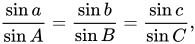
and there are two cosine theorems, dual to each other.
For centuries, spherical trigonometry has been used to determine the positions of the Sun, Moon and stars [53], predict eclipses and describe the orbits of the planets.
Nowadays, the triangulation method is used in astronomy to measure the distance to the nearest stars [55], as well as in satellite navigation systems . [16]
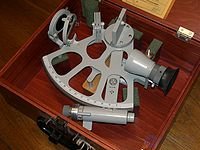
Sextants are used to measure the angle of the sun or stars relative to the horizon. Using trigonometry and a marine chronometer , the position of a ship can be determined from such measurements.
Historically, trigonometry was used to determine the latitude and longitude of sailing ships, plot courses and calculate distances during navigation.
Trigonometry is still used in navigation through such tools as the global positioning system and artificial intelligence for autonomous vehicles .
In land surveying , trigonometry is used to calculate lengths, areas and the relative angles between objects. [58]
On a larger scale, trigonometry is used in geography to measure distances between landmarks [59]
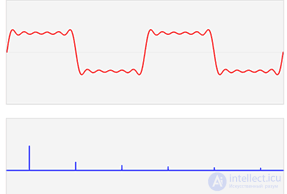
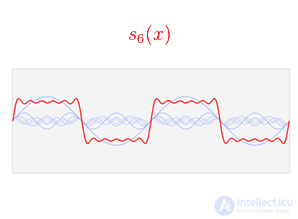
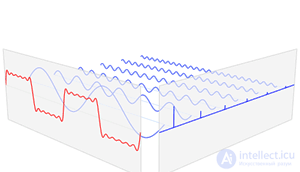
The function  (red) is the sum of six sinusoidal functions of different amplitudes and harmonically related frequencies. Their summation is called a Fourier series. The Fourier transform,
 (in blue), which shows the dependence of amplitude on frequency, reveals 6 frequencies ( at odd harmonics ) and their amplitudes ( 1 / odd number ).
The sine and cosine functions are fundamental to the theory of periodic functions , such as those that describe sound and light waves. Fourier discovered that every continuous, periodic function can be described as an infinite sum of trigonometric functions.
Even non-periodic functions can be represented as an integral of sines and cosines using the Fourier transform . This has applications, among other fields, in quantum mechanics and communication .
Main articles: Optics and Acoustics
Trigonometry is useful in many physical sciences , including acoustics and optics . In these fields it is used to describe sound and light waves , as well as to solve problems related to boundaries and transmission.
Other fields that use trigonometry or trigonometric functions include music theory , geodesy , sound synthesis , architecture , electronics , biology , medical imaging ( computed tomography and ultrasound ), chemistry , number theory (and hence cryptology ), seismology , meteorology , oceanography , image compression , phonetics , economics , electrical engineering , mechanical engineering , civil engineering , computer graphics , cartography , crystallography and game development .
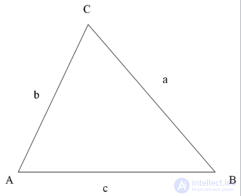
Triangle with sides a , b , c and respectively opposite angles A , B , C
Trigonometry is known for its numerous identities, that is, equations that are true for all possible inputs. [80]
Identities involving only angles are known as trigonometric identities . Other equations, known as triangle identities , [81] relate both the sides and the angles of a given triangle.
In the following identities A , B and C are the angles of a triangle, and a , b and c are the lengths of the sides of the triangle, opposite the corresponding angles (as shown in the diagram). [82]
Law of Sines
The Law of Sines (also known as «the sine rule») for an arbitrary triangle states: [83]

where  is the area of the triangle, and R is the radius of the circumscribed circle of the triangle:
Law of Cosines
The Law of Cosines (known as the cosine formula, or «the owl's rule») is an extension of the Pythagorean theorem to arbitrary triangles: [83]
or equivalently:
Law of Tangents
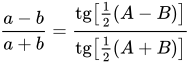
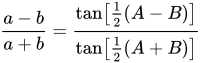
The Law of Tangents , developed by Viète , is an alternative to the cosines when solving for the unknown edges of a triangle, providing simple calculations when using trigonometric tables. [84] This gives:
Area
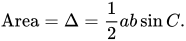
Given two sides a and b and the angle between the sides C , the area of the triangle is defined as half the product of the lengths of the two sides and the sine of the angle between the two sides:
Heron's formula is another method that can be used to calculate the area of a triangle. This formula states that if a triangle has sides of length a , b and c , and if the semiperimeter is equal to
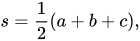
then the area of the triangle is equal to: [85]
 ,
,
where R is the radius of the circumscribed circle of the triangle.
Pythagorean identities
The following trigonometric identities are related to the Pythagorean theorem and are true for any value: [86]



Euler's formula
Euler's formula , which states that , gives the following analytical identities for sine, cosine and tangent in terms of e and the imaginary unit i :

Other trigonometric identities
Other commonly used trigonometric identities include the half-angle identities, the sum and difference of angles identities, and the product-to-sum identities. [29]

Comments