
Lecture 7 min.
Let the function  be strictly monotonic (increasing or decreasing) and continuous on its domain
  , and let the range of this function be
  . Then a continuous, strictly monotonic function
  with range
  is defined on the interval
  , and it is the inverse of .
In other words, it makes sense to speak of an inverse function for a function on a particular interval only if is either increasing or decreasing on that interval.
The functions f and g are called mutually inverse.
Why consider the concept of inverse functions at all?
It comes from the problem of solving equations . The solutions are precisely what is written using inverse functions.
For example, suppose we need to solve the equation  .
.
The solutions are the points 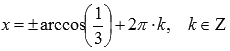 .
.
The cosine and arccosine functions are precisely inverses of each other on their domain.
Let us look at several examples of finding inverse functions.
We begin with linear mutually inverse functions.
Example.
Find the inverse of the function  .
.
Solution.
The domain and the range of this function are the whole set of real numbers. Let us express x in terms of y (in other words, solve the equation for x ).
 is the inverse function, although here y is the argument and x is a function of that argument. To keep to the usual notation (this makes no essential difference), we swap the letters x and y and write
  .
.
Thus, and are mutually inverse functions.
Here is a graphical illustration of mutually inverse linear functions.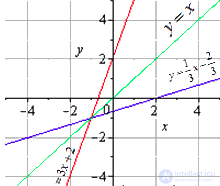
Clearly, the graphs are symmetric about the line y=x (the bisector of the first and third quadrants). This is one of the properties of mutually inverse functions, which we discuss below.
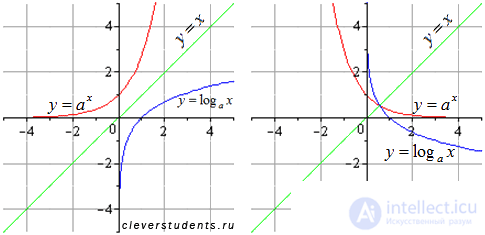
Now let us look at an example of finding the logarithmic function that is the inverse of a given exponential function.
Example.
Find the inverse of the function  .
.
Solution.
The domain of this function is the whole set of real numbers, and its range is the interval  . Let us express x in terms of y (in other words, solve the equation for x).
 is the inverse function. Swapping the letters x and y , we get
  .
.
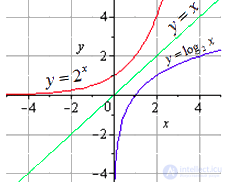
Thus, and are the exponential and logarithmic functions, which are mutually inverse on their domain.
The graph of the mutually inverse exponential and logarithmic functions.
Let us list the properties of mutually inverse functions and .
 and
and  . coincides with the range of the function and vice versa. is increasing, then is increasing too; if is decreasing, then is decreasing too.
A remark on property 1).
We recommend paying VERY CLOSE attention to the domain and range of functions.
For example: 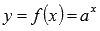 and
and 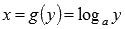 are mutually inverse functions. By the first property we have
 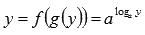 . This equality holds only for positive y ; for negative y the logarithm is undefined. So do not rush to write expressions such as
  , and if you do write it, you should add the phrase "for positive y".
The equality  , in turn, holds for any real x.
We hope you have grasped this subtle point.
One must be especially careful with trigonometric and inverse trigonometric functions.
For instance, 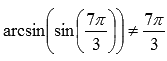 , since the range of the arcsine is
  , and
, and  does not fall within it.
The correct form is
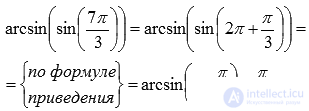
In turn, 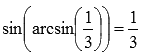 is a valid equality.
That is,  for
for  and
and 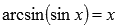 for
for  .
.
Once again we stress: BE CAREFUL WITH THE DOMAIN AND THE RANGE!
Mutually inverse power functions, graphs.
For the power function  with
with  , the inverse is also a power function
  If we swap the letters, we obtain a pair of mutually inverse functions and
Graphs for positive a and negative a.
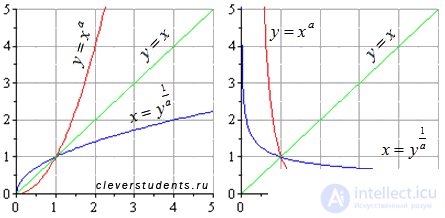
Mutually inverse exponential and logarithmic functions  and
and  , graphs.
We assume that a is a positive number not equal to one.
Graphs for  and for
Mutually inverse trigonometric and inverse trigonometric functions.
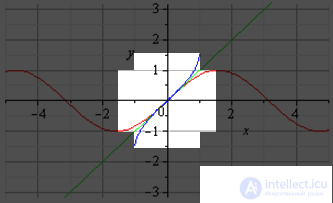
Graph of the principal branch of the sine and the arcsine (light region).
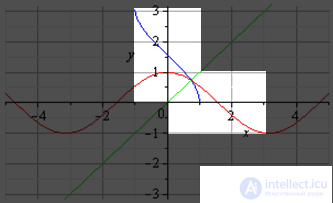
Graph of the principal branch of the cosine and the arccosine (light region).
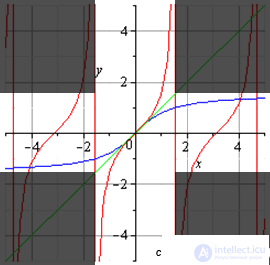
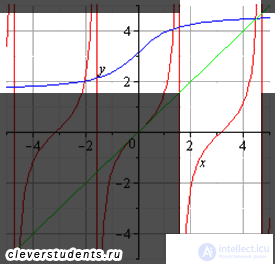
Graph of the principal branch of the tangent and the arctangent (light region).
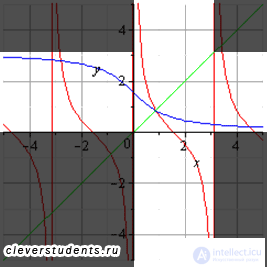
Graph of the principal branch of the cotangent and the arccotangent (light region).
If you need inverse functions for branches of trigonometric functions other than the principal ones, the corresponding inverse trigonometric function must be shifted along the ordinate axis by the required number of periods.
For example, if you need the inverse function for the branch of the tangent on the interval  (this branch is obtained from the principal branch by a shift of
  along the ox axis), it will be the branch of the arctangent shifted along the oy axis by .
That is all on inverse functions for now.
Not to be confused with Reciprocal.
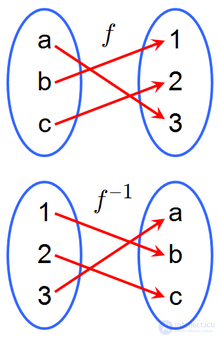
A function and its inverse function
  . If
. If , then
An inverse function is a function that reverses the dependence expressed by a given function. For example, if a function of x gives y, then its inverse function of y gives x. The inverse of a function is usually denoted, and sometimes the notation  is also used.
A function that has an inverse is called invertible.
A function is called the inverse of a function
  if the following identities hold:
 for all
 for all
 is called a left inverse of a function if for all
  . is called a right inverse of a function if for all
  .
.To find the inverse function, one must solve the equation  for
for  . If it has more than one root, then the inverse of does not exist. Thus, a function
  is invertible on an interval
  if and only if it is one-to-one on that interval.
For a continuous function  , it is possible to express
  from the equation
 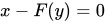 if and only if the function is strictly monotonic (see the implicit function theorem). Nevertheless, a continuous function can always be inverted on the intervals of its strict monotonicity. For example,
  is the inverse function of
  on
on  , although on the interval
  the inverse function is different:
 .
.
Neither continuity nor monotonicity of the original function is necessary for an inverse function to exist. Example: the function 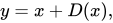 where
where  is the Dirichlet function, is discontinuous and not monotonic, yet an inverse exists for it :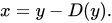
 , where
 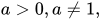 then
then 
 , where
  are fixed constants and
 , then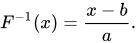
 , then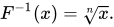
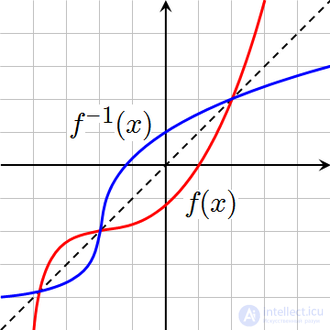
Graphs of a function and its inverse
 is the set
  , and its range is the set
  .
.
or
 ,
,
 ,
,
or, more briefly,
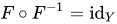 ,
,
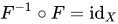 ,
,
where {\displaystyle \circ } denotes the composition of functions, and
  are the identity maps on and respectively.
 such that
  ("right inverse") is called a section of the map
  . is the inverse of:
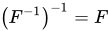 .
.
 be a bijection. Let
  be its inverse function. Then the graphs of the functions
  and
and  are symmetric about the line
 .has an inverse
  , then the graphs of these functions are symmetric about the line .
The inverse of a function analytic in some neighborhood of the point  can be represented as a power series:
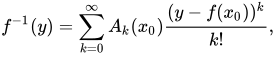
where the functions  are given by the recursive formula:
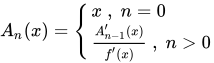

Comments