
Lecture 3 min.
The plus-minus sign ( ) is a mathematical symbol placed before an expression, meaning that the value of the expression may be either positive or negative. It is often used, for example, to indicate:
Symbols with a similar appearance: ⼟ · ⼠
Example 1:
 sec per day" means that the error of the watch, in one direction or the other, does not exceed 2 sec per day.
Example 2, where the "plus-minus" symbol must be understood literally, as indicating a choice between two alternatives, is the well-known formula for computing the two roots of the quadratic equation ax2+bx+c=0 :
:
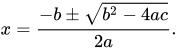
This formula is a compact notation combining the formulas for the first and second roots:

Example 3, similar to the second, is trigonometric:

Example 4. Here the interpretation of the plus-minus symbol is different: the sign of a monomial must be chosen depending on its position in the series:

The plus-minus sign appeared in the work of Albert Girard (1626), who wrote this symbol as follows: ou+−  (the French word ou means "or"). The symbol was given its modern form by William Oughtred in 1631 .
The plus-minus sign has a variant: the minus-plus sign ( ). It is used together with one or more plus-minus signs and means that the plus sign in the plus-minus strictly corresponds to the minus sign in the minus-plus, and vice versa. Example:

This is a compact notation for two formulas:

Sometimes other signs are used in a similar way, for example greater-or-less ≷ : the expression

means two inequalities
 and a⩽b+ε.
In chess notation, the symbol ± means that after the corresponding move White has the advantage, and the symbol ∓ means that Black has the advantage.
| Symbol | Unicode code |
Unicode name |
Name | HTML hex |
HTML decimal |
HTML named |
|---|---|---|---|---|---|---|
| ± |
U+00B1 | Plus-minus sign | Plus-minus sign | ± | ± | ± |
| ∓ |
U+2213 | Minus-or-Plus sign | Minus-plus sign | ∓ | ∓ |
0xB1.\pm and \mp respectively.0177 on the numeric keypad.%%p.
Comments