
Lecture 20 min.
The civilization of ancient Mesopotamia is considered to have been the first civilization on Earth. It was in Mesopotamia, in the 4th millennium BC, that the first irrigation canals were built — the birthplace of the irrigation revolution. Irrigation led to a sharp rise in population, and by the end of the 4th millennium the first cities had appeared on the banks of the Tigris and Euphrates. The cities of Mesopotamia were temple communities, descended from the clan communities of the first settlers. At first the communities were small, and work was carried out jointly on a common field. Later the community grew, and the fields were divided among its members, with part of the land set aside for the temple; at first the temple lands were worked jointly by the community, but later, when landless poor appeared, the priests began hiring them as laborers or tenants.
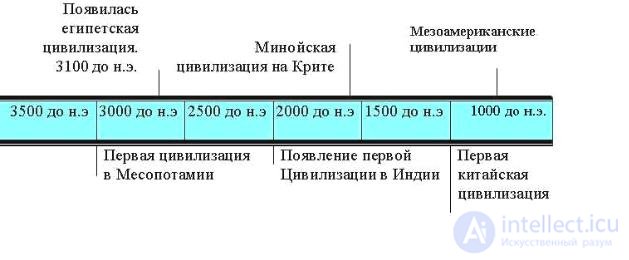
Fig. Chronological table
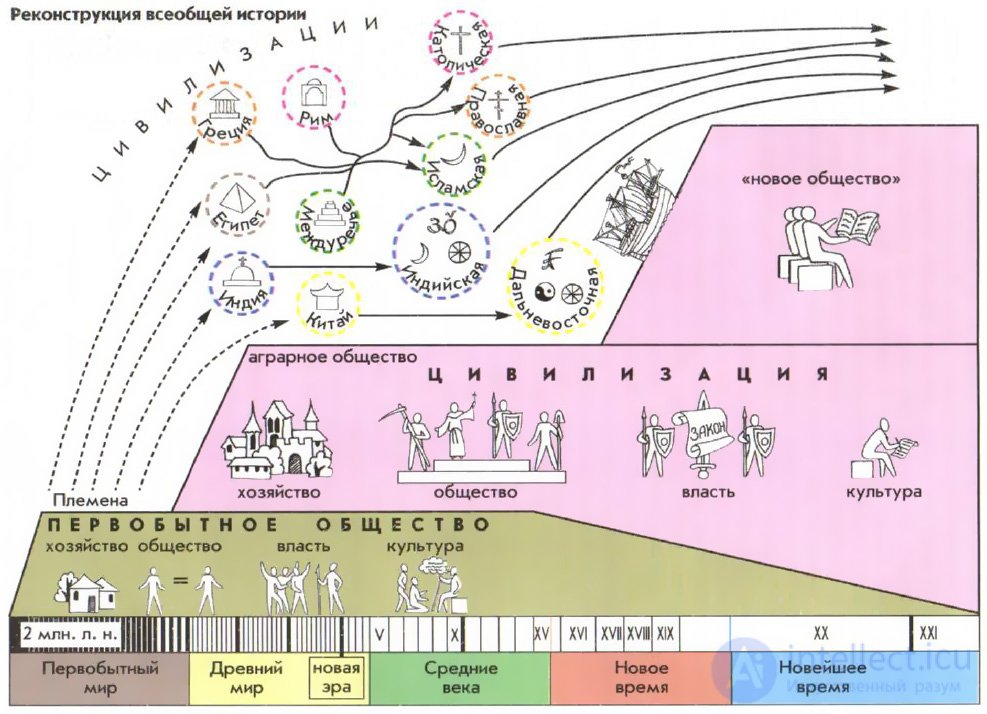
Fig. Diagram of the development of society and civilizations
The complex temple economy required record-keeping and calculation; at first, pictographic drawings were used for records, and these stylized drawings later evolved into hieroglyphs. To denote verbs, scribes used phonetic similarities — for example, to convey the word "to return," which in Sumerian was "gi," they drew the sign for reed, since "reed" in Sumerian was also "gi." Later, hieroglyphs came to be used to represent individual syllables that were combined into words — this is how syllabic writing appeared. The Sumerians and their Semitic neighbors pressed hieroglyphs into clay tablets with a reed stylus; the hieroglyphs consisted of several wedge-shaped strokes — this was the so-called cuneiform script. It is clear that cuneiform signs bore little resemblance to the concepts they conveyed, and they soon turned into conventional symbols. At the turn of the 2nd–1st millennia, one of the Semitic peoples, the Phoenicians, improved cuneiform and created an alphabet of 22 letters. The Greek and Aramaic alphabets descended from the Phoenician alphabet; Latin and Slavic descended from Greek; Persian, Arabic, and Indian descended from Aramaic. The alphabet never reached China and Japan, and the peoples of these countries still use hieroglyphs to this day.
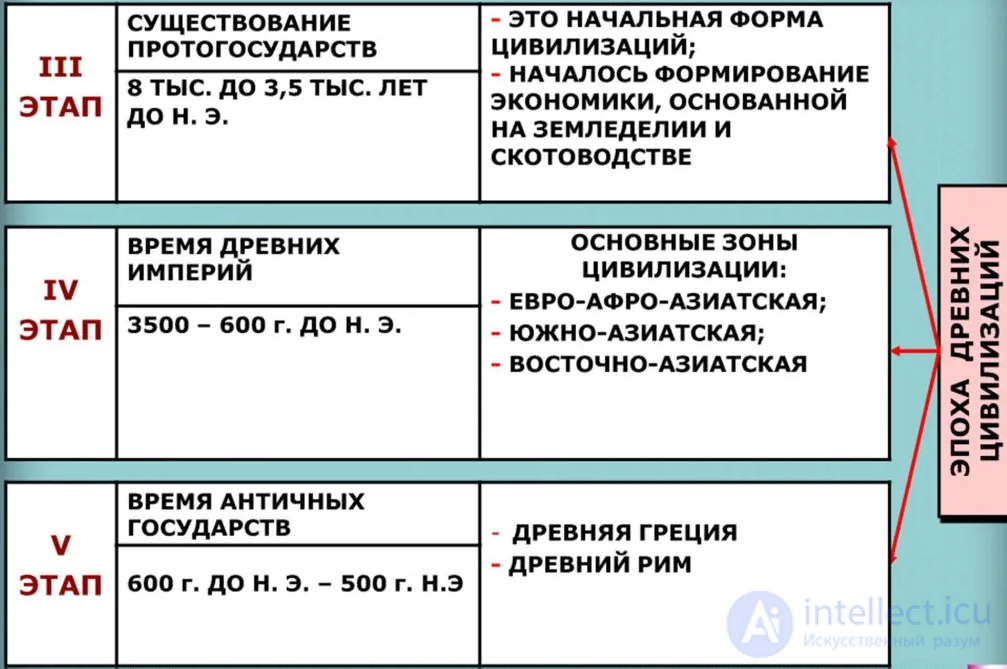
Fig. The age of ancient civilizations
Scribal schools called "edubba" existed at Sumerian temples. Scribes had to know not only writing but also how to calculate the size of a harvest, the volume of a granary, or the area of a field. The temples were engaged in trade and moneylending, so scribes often had to perform all sorts of calculations, including computing interest. By the end of the 3rd millennium a positional number system for recording numbers had already been created — however, it was not decimal, as it is today, but sexagesimal, with different symbols used to denote units and tens. On the basis of this system, tables of multiplication, division, and exponentiation were compiled (scribes found dividing large numbers difficult and preferred to consult a table). The heirs of the Sumerians, the Babylonians, knew how to solve quadratic equations, knew the "Pythagorean theorem," the properties of similar triangles, could calculate the volume of a pyramid, drew plans of fields, and drew maps — though not always to scale.
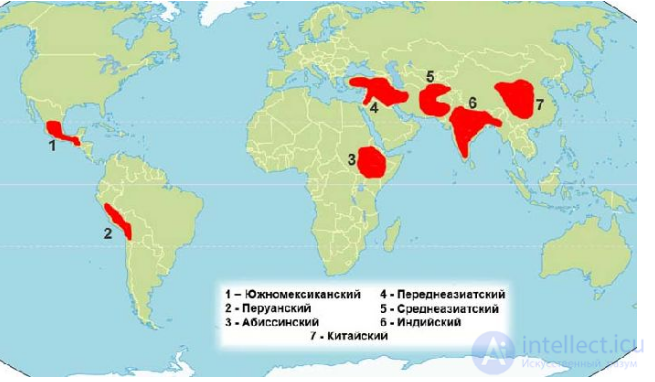
Fig. 1. Centers of agricultural origin according to Vavilov.
An important task facing the priests was creating a calendar; the calendar was needed above all to determine the timing of agricultural work. The Babylonian calendar was lunar: a lunar month consisted of 29 or 30 days (the period of the lunar phase cycle is 29.5 days), and the year consisted of 12 months. Because the solar year is 11 days longer than the lunar year, the New Year shifted over time and could fall in summer or autumn; therefore, an extra month was periodically inserted.
The Babylonian calendar was not particularly accurate; a much more precise calendar was created in the 3rd millennium BC in Egypt. The Egyptian calendar consisted of 12 months of 30 days each, with 5 additional days inserted at the end of the year, so that the year totaled 365 days. This calendar differed from the modern one only in the absence of leap days; leap days were introduced by Julius Caesar in 46 BC.
The task of devising a calendar was linked to astronomical observations: it was noticed that the flooding of the Nile always occurred on the same day, when the star Sirius appeared above the horizon. The Egyptians began recording the positions of the stars, grouped them into constellations, and created the first star tables. By observing the positions of the stars in the night sky, the Egyptians learned to tell time. Astronomy was always closely linked to magic; star tables served not only practical purposes but also purposes of divination. In the 1st millennium BC, the first astrologers appeared in Babylon.
It is notable that the keepers of knowledge — scribes, astrologers, and healers — at that time were mostly priests. Egyptian and Babylonian priests kept their knowledge secret, not allowing the uninitiated access to it. This was partly because Egyptian temples housed workshops for imitating gold and silver; the priests' chemical experiments taught them to counterfeit precious metals. Much of the priests' knowledge remained a secret to later generations — for example, the secret of mummification.
The Middle East was the birthplace of many simple machines and tools — the kind that were still used by many rural people as recently as the last century. These were, above all, the spinning wheel, the hand loom, the potter's wheel, and the well sweep. The appearance in Egypt of the well sweep, the "shaduf," made it possible to raise water to "high fields" and increased the area of cultivated land tenfold. In the 1st millennium BC, Babylonia saw the appearance of the water-lifting wheel, the "sakia," and a rope running over pulleys fitted with leather buckets, the "cherd."
The civilization of Babylonia is sometimes called the "kingdom of clay": Mesopotamia has no forests or stone, and the only building material available is clay. Houses and temple towers, ziggurats, were built of clay, only their outer surfaces faced with brick. In Egypt, temples and pyramids were built of stone. The Great Pyramid of Khufu is 146 meters high and consists of 2.3 million stone blocks, each weighing 2 tons. These blocks were transported on sledges laid over wooden rollers; they were raised to the top of the pyramid along inclined ramps. From the quarries to the construction site, the blocks were delivered on enormous barges 60 meters long with a displacement of 1,500 tons.
According to Herodotus, 100,000 people worked on the construction of the Great Pyramid as part of a labor levy, being replaced every three months. This labor obligation, which applied to the entire population, made it possible to build not only pyramids but also enormous irrigation works; in the 2nd millennium the Fayum Canal was built, which made it possible to irrigate vast areas of land in Lower Egypt.
The greatest technical achievement of the Ancient East was the mastery of metal smelting. It appears that the secret of copper smelting was discovered by accident during the firing of pottery. People then learned to smelt copper in primitive furnaces; such a furnace was a pit dug in the ground about 70 cm in diameter, surrounded by a stone wall with an opening for the air blast. Bellows were made from goatskins fitted with a wooden nozzle. The temperature in such a furnace reached 700–800 degrees, which was sufficient to smelt the metal.
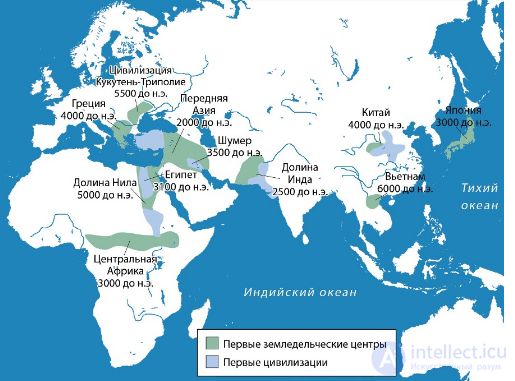
The civilizations of the ancient world arose during different historical periods, from the 5th to the end of the 1st millennium BC.
The first copper artifacts appeared in the Middle East in the 6th millennium BC; copper, however, is a comparatively rare and, moreover, soft metal — it is inferior in hardness to flint. A genuine technical revolution occurred only with the mastery of iron metallurgy, at the end of the 2nd century BC. According to legend, the first iron smiths were the mysterious Chalybes, who lived in the mountains of Armenia. At that time — and for a long time afterward — furnaces could not reach the temperature needed to melt iron (1530 degrees); the metal was obtained through the bloomery process, in the form of a bloom, a porous lump mixed with slag. The Chalybes devised a way to remove the slag through prolonged forging, producing hard, low-carbon iron.
Iron ore is far more common than copper ore, which is why iron became a widespread metal. An iron plowshare improved the tilling of soil, and an iron spade made it possible to dig irrigation canals. Previously, under the slash-and-burn system, clearing a new plot required the effort of the whole clan; now, with an iron axe, saw, and spade, a single person could manage it, and as a result the clan began to break up and individual plots emerged.
Enormous changes also took place in warfare; in the 8th century BC the Assyrian king Tiglath-Pileser III created a "royal regiment" armed with iron swords. This was a fundamental discovery, followed by a wave of Assyrian conquests and the creation of the great Assyrian Empire — a new cultural sphere whose components included not only iron swords and a standing army but also the whole of Assyrian tradition, including the autocratic power of kings. Thus history once again showed that people's lives are shaped by technical discoveries.
The beginning of the "Iron Age" was a time of flourishing for the great civilization of the Near East, the civilization of Assyria and Babylon. In the 6th century BC the 400-kilometer Pallukat Canal was built, which made it possible to irrigate vast expanses of desert land. Babylon grew into an enormous city with a population reaching 1 million people. Babylon was famous for its "Tower of Babel," the ziggurat of Etemenanki, its "Hanging Gardens," and a bridge across the Tigris; this bridge was 123 meters long and rested on 9 brick piers. The triple walls of Babylon were astonishing in their strength — the inner wall was 7 meters thick.
Wide avenues crossed the city, and the Babylonians lived in multistory brick houses. This was also the time when banks and joint-stock companies appeared — in terms of everyday life, this world was not so very different from modern bourgeois society. Just as today, "psychotherapy" was very much in fashion — illnesses were treated mainly with incantations, and the incantations often helped. There were, it is true, also physicians who treated with herbs; they formed a separate guild that was at odds with the incantation-therapists — but the rivalry between the two medical schools ended in defeat for the "herbalists." As in every age, merchant traders traveled to distant lands; large ships woven from reeds carried hundreds of passengers and sailed to Arabia and India. Travelers kept in touch with their homeland by means of carrier pigeons.
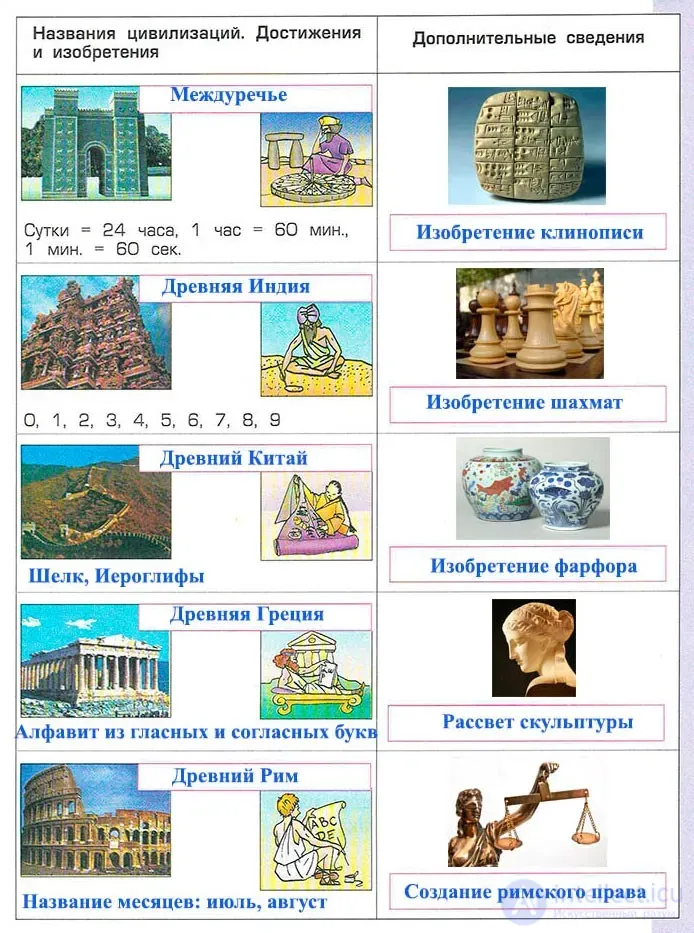
The world beyond India remained unknown to the Babylonians; they believed that beyond it lay the world ocean, and that beyond the ocean the earth met the dome of the sky. There were seven such domes of heaven in all, and the gods lived in the seventh heaven; beneath the earth lay the kingdom of the dead. These Babylonian beliefs were shared by neighboring peoples as well, including the Hebrews; from the Hebrews they found their way into the Bible.
Of all the peoples of the Middle East, the Phoenicians, a tribe of seafarers and merchants, knew the most about the surrounding world. The Phoenicians built ships with a keel, ribs, and a continuous deck; such a ship could cross the Mediterranean and emerge into the Atlantic Ocean in 70 days. The Phoenicians reached the shores of the Gulf of Guinea and Britain, and in the 6th century BC they sailed around Africa. Two remarkable discoveries are also credited to the Phoenicians: glass and purple dye.
According to legend, glass was discovered by accident when a ship carrying saltpeter was wrecked and the sailors lit a fire of saltpeter on the shore. Purple dye was made from mollusk shells; the secret of its manufacture was closely guarded, and purple clothing was worn only by kings and priests.
In ancient times, the Indians achieved the greatest success in the art of weaving. India was the birthplace of cotton, a plant that astonished foreigners; in Europe it was long believed that cotton grew on trees. Indian craftsmen wove the finest cambrics and muslins; a cambric shawl could be drawn through a ring. Fabrics were dyed with indigo — indigo is still used today, for example, to dye jeans.
India also grew another remarkable plant — rice. At the beginning of our era, Indian peasants mastered the technology of growing paddy rice. This was a fairly complex technology. First the community would build a dam on a stream and dig a pond, from which irrigation ditches were led off. Rice seedlings were grown in a special nursery with a controlled microclimate and then transplanted onto flooded fields. Later, carp began to be raised in the flooded fields to control weeds. The yield of paddy rice was twice that of wheat, and moreover not one but two or three harvests were gathered per year. This was a new fundamental discovery, a new victory of man over nature.
This new fundamental discovery brought with it the emergence of a new cultural sphere. Indian colonists and traders brought paddy rice to the shores of Indochina, to Burma, and to Indonesia; along with paddy rice, they brought their culture, their writing system, and their religion — so that the countries of Indochina are often called "Farther India." Following paddy rice, Buddhism came to China and Japan. The spread of paddy rice meant an expansion of the ecological niche; the same territory could now support a population three or four times larger — as a result, South and Southeast Asia became the most densely populated region of our planet.
Eastern Asia is separated from the western part of the continent by mountains and deserts, and so a distinctive civilization of its own developed there. The Chinese remained unfamiliar with many achievements of the West — they did not know the alphabet, did not know how to build stone buildings, and did not know grapes or wine. On the other hand, China mastered technologies that remained unknown to the West for a long time. The Chinese learned to weave silk, invented paper in the 2nd century, and porcelain in the 6th century.
For a long time China remained isolated from the rest of the world.
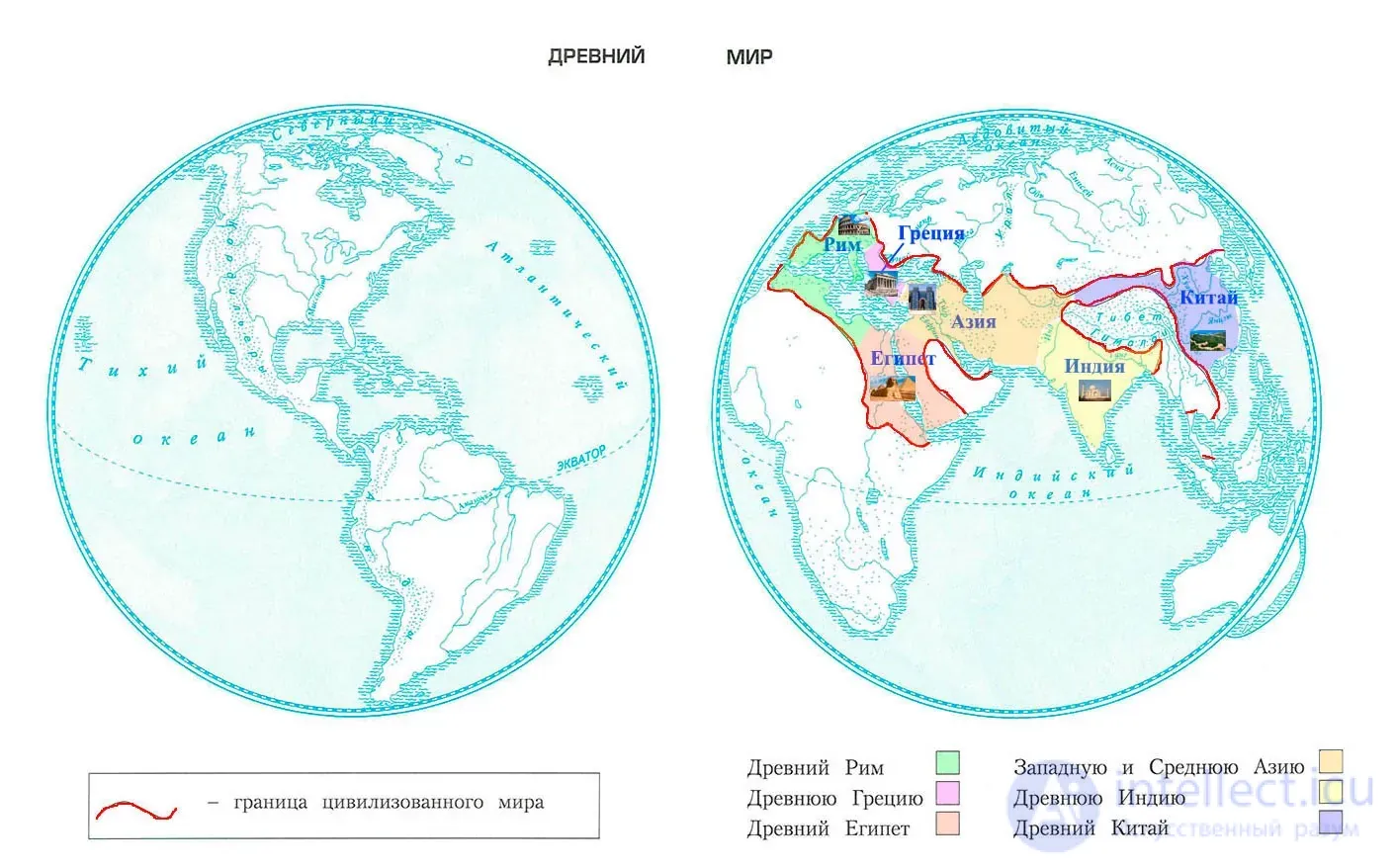
The Chinese believed that their country was the "Celestial Empire," surrounded by four seas — the Eastern, the Southern, the Sandy, and the Rocky. The Rocky Sea was the mountainous land of Tibet, and the Sandy Sea was the boundless Gobi Desert. In 138 BC, Emperor Wu sent the guard officer Zhang Qian to reconnoiter the desert; Zhang Qian was captured by the Xiongnu, later escaped, wandered the desert for a long time, then crossed the Tian Shan mountains and unexpectedly discovered another world — a land where, just as in China, there were rivers, cultivated fields, and great cities.
Thus the Chinese discovered the outside world for themselves; from this world they borrowed glass, spices, and the art of building in stone. The Great Silk Road became the connecting thread between the two worlds, and it was along this road that the achievements of the two civilizations were exchanged.
In the 6th century, two monks came to Constantinople along the Great Silk Road; acting on the orders of the Byzantine emperor Justinian, they smuggled silkworm larvae out of China, hidden inside their staffs. Silk production was then set up in Byzantium, and later in Persia. In 751, in one of the battles in Central Asia, the Arabs captured several Chinese who knew the secret of papermaking; after this, paper began to be produced in the Middle East as well. The Chinese also invented the compass, which reached Europe a thousand years later, in the 13th century. The most remarkable achievement of Chinese civilization was the creation of blast furnaces and the production of cast iron. The furnaces were charged with coal and ore with a high phosphorus content; the blast was provided by powerful bellows driven by a water wheel. In appearance, Chinese furnaces were rectangular trenches lined with fireproof brick; crucibles containing ore were placed in them, with coal poured between the crucibles; this technology made it possible to produce cast iron as well as malleable, low-carbon iron — that is, steel. In the 11th century, in Henan province, an astonishing structure was erected — a 13-story iron pagoda; it was built of cast-iron plates without the use of wood or stone. The secrets of producing cast iron and porcelain remained hidden from Europeans until the beginning of the Modern Age.
At a time when clan-and-tribal relations still prevailed in Europe, the first states were arising in the main "Babylonian" centers of agriculture. The significance of the earliest civilizations lies in the fact that, owing to their scattered locations across the planet, humanity began to develop trade relations, foreign policy, and unique linguistic and racial groups. Specialization of production and the first polytheistic religious cults also took shape.
1. The very first state to appear on Earth is considered to be the state of…
2. Which people used a base-60 (sexagesimal) number system for their calculations?
3. The African state that arose earlier than Egypt and traded with it is called this.
4. From which period does the history of China begin?
5. Into how many parts was the Maya calendar divided?
6. Which Indian city is associated with the "war of the gods"?
7. In which millennium BC did Chinese civilization arise?
8. Which myth brought widespread fame and mass interest to Sumerian culture?
9. Which of the listed cities is the odd one out?
10. Which civilization achieved great heights in jade carving?
Hints and answers
1. The very first state is considered to be the state of the Sumerians, which appeared at the end of the 4th millennium BC on the bank of the Euphrates.
2. The sexagesimal system is a positional number system with an integer base of 60. It was invented by the Sumerians in the 3rd millennium BC and was used in ancient times throughout the Middle East. Using this number system, the Sumerians devised the clock with 60 seconds, 60 minutes, and 12 hours, as well as a calendar with 12 months.
3. The Land of Punt was a territory in East Africa known to the ancient Egyptians, regarded as the proto-civilization of Ethiopia. The Egyptians sent numerous expeditions to Punt to bring back ebony, incense, black eye paint, ivory, tame monkeys, gold, slaves, and the skins of exotic animals.
4. Chinese civilization arose approximately 5,000 years ago along the Yellow River (Huang He). The legendary period of the Three Sovereigns and Five Emperors marked the beginning of statehood.
5. The Maya calendar was divided into three parts — the religious calendar (260 days), the practical calendar (365 days), and the chronological calendar (360 days).
6. Mohenjo-daro, which translates from Sindhi as "Mound of the Dead," is the most ancient Indian city, the ruins of which were discovered in the early 20th century. According to legend, this highly developed city was destroyed as a result of a "war of the gods"
7. Chinese civilization is one of the oldest in the world, having arisen approximately in the 3rd millennium BC.
8. The chief cultural legacy of the Sumerians is the myth of the Anunnaki and the creation of man. According to a modern interpretation, man was created by the Anunnaki through genetic engineering as a slave to perform hard physical labor for the "gods." Is there an error in the question?
9. Sippar, Kish, and Uruk were major city-states in ancient Mesopotamia. Memphis was an ancient Egyptian city located at the boundary between Upper and Lower Egypt.
10. The Maya civilization was characterized by high achievements in art, in particular in jade carving.

Comments