
Lecture 8 min.
Systems art is art influenced by cybernetics and systems theory, reflected in natural systems, social systems, and the social characteristics of the art world itself.
Systems art emerged as part of the first wave of the conceptual art movement that spread in the 1960s and 1970s. Closely related and partly overlapping terms include the anti-form movement, cybernetic art, generative systems, technological art, systems aesthetics, systems art, systems painting, and systems sculpture.
By the early 1960s, minimalism had developed into an abstract art movement (rooted in geometric abstraction via Malevich, the Bauhaus, and Mondrian) that rejected the idea of relational and subjective painting, the complexity of Abstract Expressionist surfaces and emotional zeitgeist, and the controversy present in the arena of action painting. Minimalism held that extreme simplicity could encompass all the sublime representation required in art. The term "systematic art" was introduced by Lawrence Alloway in 1966 to describe the methods that artists such as Kenneth Noland, Al Held, and Frank Stella used to create abstract paintings.
Minimalism in painting, associated with artists such as Frank Stella, is, unlike other fields, a modernist movement. Depending on context, minimalism can be interpreted as a precursor of the postmodern movement. From the perspective of writers who sometimes classify it as a postmodern movement, early minimalism originated and flourished as a modernist movement producing groundbreaking works, but it partly abandoned that project when several artists shifted direction toward the anti-form movement.
In the late 1960s, the term post-minimalism was introduced by Robert Pincus-Witten to describe minimalism-derived art that carried content and contextual nuances that minimalism had rejected, and it was applied to the works of Eva Hesse, Keith Sonnier, Richard Serra, and other artists, as well as to the later works of former minimalists Robert Smithson, Robert Morris, Bruce Nauman, Sol LeWitt, Barry Le Va, and others. Minimalists such as Donald Judd, Dan Flavin, Carl Andre, Agnes Martin, John McCracken, and others continued producing their late modernist paintings and sculptures until the end of their careers.
Audio feedback and the use of tape loops, sound synthesis, and computer compositions reflected a cybernetic understanding of information, systems, and cycles. Such techniques became widespread in the music industry in the 1960s. The visual effects of electronic feedback became a subject of artistic exploration in the late 1960s, when video equipment first reached the consumer market. Steina and Woody Vasulka, for example, used "all manner of ways and combinations of audio and video signals to generate electronic feedback in their respective media."
Together with related works by Edward Ihnatowicz, Wen-Ying Tsai, and the cybernetician Gordon Pask, as well as the animistic kinetics of Robert Breer and Jean Tinguely, the 1960s gave rise to a strand of cybernetic art deeply concerned with the general contours within and between the living and the technological. A line of cybernetic art theory also emerged in the late 1960s. Writers such as Jonathan Benthall and Gene Youngblood drew on cybernetics. The most significant contributors here were the British artist and theorist Roy Ascott, with his essay "Behaviourist Art and the Cybernetic Vision" in the journal Cybernetica (1966–67), and the American critic and theorist Jack Burnham. In his book "Beyond Modern Sculpture" of 1968, Burnham developed cybernetic art into a broad theory grounded in art's drive to imitate and ultimately reproduce life. Also in 1968, curator Jasia Reichardt organized the landmark exhibition Cybernetic Serendipity at the Institute of Contemporary Arts in London.
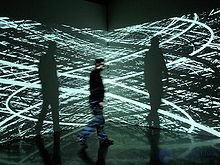
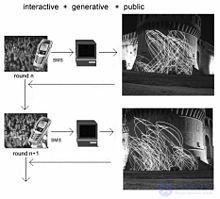
Generative art is art that has been generated, composed, or constructed in an algorithmic manner using systems defined by computer software algorithms or by similar mathematical, mechanical, or randomized autonomous processes. Sonia Landy Sheridan created the "Generative Systems" program at the School of the Art Institute of Chicago in 1970 in response to social changes brought about in part by the communications revolution between computers and robots. The program, which brought together artists and scientists, was an attempt to turn the passive role of the artist into an active one, promoting the study of contemporary scientific and technological systems and their relationship to art and life. Unlike copy art, which was a simple commercial byproduct, Generative Systems was actually engaged in developing elegant yet simple systems intended for creative use by the broader population. Generative Systems artists tried to bridge the gap between the elite and the newcomer by directing the line of communication between them, thereby delivering first-generation information to a greater number of people and bypassing entrepreneurs.
Process art is an artistic movement as well as a creative sensibility and worldview in which the final product, art and craft, the art object, is not the primary focus of attention. "Process" in process art refers to the process of forming art: gathering, sorting, juxtaposing, associating, and forming patterns. Process art is concerned with actual doing; art as rite, ritual, and performance. Process art often entails innate motivation, rationale, and intentionality.. Art is therefore regarded as a creative journey or process rather than as a result or finished product. In art discourse, the work of Jackson Pollock is considered an antecedent. Technological art's use of intuitive insight clearly echoes Dadaism. Change and transience are the central themes of process art. The Guggenheim Museum states that Robert Morris held a groundbreaking exhibition in 1968 along with an essay defining the movement, and the museum's website states: "Process artists were engaged with issues related to the body, chance occurrences, improvisation, and the liberating qualities of nontraditional materials such as wax, felt, and latex. Using them, they created eccentric forms in disorderly or irregular arrangements arising from actions such as cutting, hanging, and dropping, or from organic processes such as growth, condensation, freezing, or decay." .
According to Chilvers (2004), "in 1966 the British art critic Lawrence Alloway introduced the term "systems art" to describe a type of abstract art characterized by the use of very simple standardized forms, usually geometric in character, either as a single concentrated image or repeated within a system organized according to a clearly visible organizing principle. He regarded Kenneth Noland's chevron paintings as examples of systems art and considered it a branch of minimal art."
John J. Harris held that there are points of convergence in the ideas underlying the development of 20th-century art, such as serial art, systems art, constructivism, and kinetic art. These forms of art often arise not directly from observations of things visible in the external natural environment, but from observations of depicted forms and the relationships between them. [10]According to Harris, systems art represents a deliberate attempt by artists to develop a more flexible frame of reference. A style in which its frame of reference is perceived as a model to be imitated, rather than as cognitive systems, leads only to the institutionalization of an imposed model. But shifting the meaning of an image onto its place within a systemic structure does not eliminate the need to define the constituent elements of the system: if they are not defined, one will not know how to construct the system. [10]
Systems painting, according to Auping (1989), "was the name of a highly influential exhibition at the Guggenheim Museum in 1966, organized and curated by Lawrence Alloway. The exhibition contained numerous works that many critics today would consider part of minimal art." [11] In the catalogue, Alloway noted that ... "paintings such as those presented in this exhibition are not impersonal, as is often claimed. The personal is not erased through neat technique: anonymity is not a consequence of a picture's high-class finish." [12] The term "systemic colouring"[13]
According to Feldman (1987), " serial art, serial painting, systems sculpture, and ABC art were art styles of the 1960s and 1970s in which simple geometric configurations are repeated with little or no variation. Sequences become important, both mathematically and in a linguistic context. These works are based on the simple arrangement of basic volumes and voids, mechanically produced surfaces, and algebraic permutations of forms. The effect on the viewer, however, is far from simple ". [14]

Comments