
Lecture 23 min.
Digital art or digital art , often used synonymously with computer art , is a colloquial umbrella term for art that is created digitally with the help of a computer . In a narrower sense, this art has become possible only through the special properties of digital media, for example the countability of all information, its separability from a specific data carrier, or the use of algorithms .
It was only in the 1990s that the term "digital art" became common.
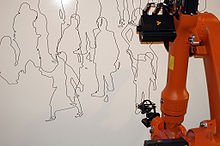
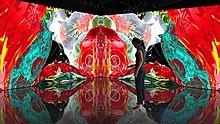
Digital art is a part of media art . In connection with digital art, overlapping terms are sometimes used:
Electronic art can encompass all artworks and works containing functioning analog or digital electronics , whether in art genres such as architecture , performance , dance , sculpture and music , or in newer fields such as robotics or computer animation . Electronic art was originally analog, and today it does not necessarily have to be digital.
Computer art was originally a collective term for all art created with the help of a computer performing a central function. Especially in its early days it was not always digital; analog computers could also be used . For example, the use of computers as live musical instruments was considered audio computer art (see ).
Digital art is based on digitally encoded information . The information is essentially processed by the computer in digital form and presented in a form suitable for artistic use. Information can be digitized using input devices such as scanners, keyboards and measuring instruments. Many forms of digital art are shaped by the distinction between the purely digital work, the binary files, and their audio and visual representation. Whether the works exist as digital codes and stored forms, for example as image files , sound files, algorithms, hypertexts , executable programs, or code for web pages, we can speak of digital art in the narrower sense. In some cases the files and digital operations are even the actual work of art itself. Artistically significant digital code written by hand can already be digital art.
If works of digital art are not complete without their presentation on a medium, the presentation can be artistically influenced through the chosen hardware and software . With software, the movement of variables leads to results that are not precisely predictable artistically, and even an open-ended design is possible. The presentation of a file need not be limited to reproduction through loudspeakers, monitors and projections: it can include three-dimensional material sculptures, light installations or multimedia events. At the biennale.py virus for the 49th Venice Biennale, the presentation consisted of a collective multimedia performance in which the audience and the media, often without noticing it themselves, became indispensable actors.
Computer-based digital art and media-based digital art are distinguished from an art-historical point of view:
Computer art is created on the basis of traditional art genres and forms, using the computer as a tool. Areas of visual art that were previously analog, such as printmaking, painting and photography, are continued in digital form. Likewise, artworks in the field of moving images, video and film, and broadcast media - radio and television - are increasingly created digitally while following the conventions of the analog tradition in media art . The same applies to "electronic or digital music" (see the section "Art created by computer").
"Media-based digital art", on the other hand, uses computers and networks or other digital devices, such as mobile phones, as an independent medium, including Internet-based work, so that its own art forms, such as net art ( net.art ) (Software Art ), produce digital installations and works of art in the field of virtual reality (see the section "Media-based digital art").
The Ars Electronica festival in Linz is dedicated to defining developments in all fields of electronic art. Continuous attention is paid to computer and digital art. Ars Electronica inspires creativity and promotes artists through the Ars Electronica Prize, which is sometimes called the "Oscar of digital art" .
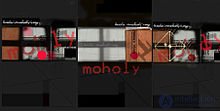
Digital visual art, usually referred to for short as "digital art", mainly refers to "computer-generated art" and is mostly output onto two-dimensional media (Internet / print / projection). More broadly, visual output from a computer is called computer graphics .
Distinctions within digital visual art:
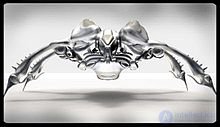
GFX is a playful abbreviation for graphical effects . Similar to analog art forms such as comics or graffiti , which are linked to youth scenes and youth culture, GFX is connected to the GFX scene or demoscene , a digital youth culture or online culture in which graphical effects were originally programmed for home computers and game consoles such as the C64 , Atari ST , Commodore Amiga or Xbox. Even today, GFX graphics and animation programming is based on processes that are especially suited to coordinating graphics and sound output directly by the computer, at an exceptional quality, and thus demonstrating the computer's capabilities. GFX is an independent art form that, on the one hand, is inseparably linked to computer games as an applied art, but, on the other hand, also produces independent works that are collected as contemporary art ( for example AVZG by Yehoshua Lackner).
The increasing availability of inexpensive computing power means that the range of digital technologies available to artists is expanding considerably. For example, AI ( artificial intelligence ) and artificial neural networks have been used experimentally since the 1980s . AI-based art forms belong to computer art, but work with a different creative mechanism than all other art forms. In addition to the artist's creative abilities, natural laws and chance, non-mechanical, non-human, self-learning entities are now used, whose results appear creative: machine learning, artificial intelligence and artificial neural networks.
Participants in the debate hold differing opinions on the classification and evaluation of this apparently creative digital technology. The artist collective Obvious, which achieved a five-figure auction result for the AI-generated portrait of Edmond de Belamy in 2018 , suggests that AI possesses creative properties: "Creativity is not for humans only," while AI pioneer and digital artist Joseph Ayerle explains: Artificial intelligence "... can create, but that is not creativity" [10].
NFT art, a type of NFT, or crypto art (German Crypto Art ), is found in digital art that exists in the form of non-fungible tokens (NFTs), which are bought and sold digitally. Non-fungible tokens are unique and cannot be reproduced or destroyed. While fungible tokens are used as cryptocurrency, they can be found wherever virtual goods can be collected and traded as unique objects, in addition to art, including for individual items in computer games. [11] Since the creation of an NFT is a digital encryption operation, NFT art is also synonymous with crypto art or cryptoart.[12]
NFT artworks can appear in any digital form, as digital images, digital films, animated GIF files or virtual reality installations, which after creation are "minted" into tradable NFTs and sold or auctioned on digital platforms. This definition of the term goes hand in hand with the fact that "NFT art" does not imply any stylistic restrictions. In February 2021 , the Christie's auction house put up for auction the digital artwork Everydays: The First 5000 Days , by the American graphic designer and digital artist Beeple , , who had not previously been represented by a classical gallery. [15]The collage of 5000 small images set a record for digital art and was sold at auction for 42,329,453 Ether (equivalent to approximately 69.3 million US dollars). At the time of the auction, it was the third-highest auction price ever for a work by a living artist.
It is a cause for concern that among the large number of NFT marketplaces there also appear to have been cases of NFT data disappearing from owners' collections under unexplained circumstances.
Electronic music, similar to early visual computer art, was originally created using analog generators such as oscillators, the Melochord , the Trautonium , ring modulators , noise generators and filters . Computer music and electronic music are now largely digitized. One of the first musical applications of the digital computer was Lejaren Hiller's digital musical composition ILLIAC Suite in 1957 (for ILLIAC, see the list of vacuum-tube computers ). In 1961 Iannis Xenakis developed his theory of composition based on a new method of sound synthesis using sound quanta. Physicist Wilhelm Fucks, with his computer-generated composition Quatro Due [17] of 1963, is considered a pioneer of digital music in Germany. Because of long computation times and small storage capacity, fully digitized music production did not come into use until the late 1970s, when a faster generation of computers appeared.
Media-based digital art tends toward interactivity and multimedia . It concerns the interaction between the artwork and people, in which participants can use the artwork to form a complex network and an artificial world. Websites, software interfaces, game interfaces and program-controlled installations serve predominantly as a visual and auditory interactive user interface . Additional spatial-orientation devices are used for tactile interaction.
New art forms include:
The collective term "network art" covers artistic work in analog or digital networks together with work within art networks. Internet or web presences that form independent works of art through their programmed behavior or through interaction with a visitor on screen can fall under both categories.
With the beginning of the global spread of the World Wide Web, from 1993 with the emergence of the Mosaic browser, websites became interesting as an artistic medium. A form of digital network art arose as art made with websites, for which terms such as Internet Art and Web Art became established in the English-speaking world. The artist group net.art had a particular influence. Among its members were Vuk Cosic , Jodi.org , Alexei Shulgin, Olia Lialina , Heath Bunting, Rachel Baker, Minerva Cuevas, Daniel Garcia Andujar and Marcus Valentin. In terms of content, the artists' works had little in common. Authors such as Tilman Baumgartel, Josephine Bosma, Hans Dieter Huber and Pit Schultz described the group as a parody of an avant-garde movement.
Network art and digital art overlap in many areas, especially where digital art involves telematic networks or allows network participants to combine works of art.
One of the origins of software art is considered to be creatively coded computer operations that go beyond ordinary programming and sometimes even work better precisely because they break the rules. The term "hacking" was first used at the Massachusetts Institute of Technology . However, software art as a consciously distinct art form only became widely known by the end of the 1990s, for example through de-programmed computer games or other downloadable programs (examples: runme.org [19] ), which encourage users to do so in order to rethink their relationship to the Internet, computers and their own nervous system.
Digital poetry began, on the one hand, with the computer as a simple tool for poetry, and, on the other hand, as an exploration of the possibilities of creating signs, words and language that can only be developed within a computer environment. Raymond Queneau wrote early digital poetry in 1962. In 1980, Jean-Pierre Balpe developed the first algorithmic poem generator, "Poèmes d'Amour". Today's digital poetry often goes far beyond wordplay, poetry, visual poetry and programmed dialogues and can manifest itself in all suitable expressions of media-based digital art.
One of the events at the 2001 Venice Biennale was Internet poetry in Caterina Davinio's "Bunker of Parallel Actions" . Also worth mentioning is Net Poetry from the 1990s onward: jodi.org (Joan Heemskerk and Dirk Paesmans). [20]
Code poetry, written in computer languages such as Algol or Perl, is not only generated by the computer but can also be executed as code. [21] The same applies to scripting languages (such as JavaScript , Perl , Python and AppleScript ), which are used to control computers but whose scripts can also be written as poetic messages.
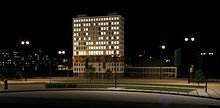
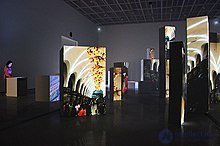
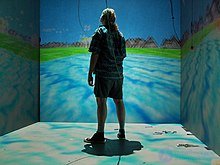
The visitor becomes a user and interacts within the art installation through body movements, noises, sounds, language or other media (mobile phones, etc.) with programs that respond mainly visually and acoustically. Typical digital "interactive installations" of this kind are the works of Michael Saup and the Blinkenlights project.
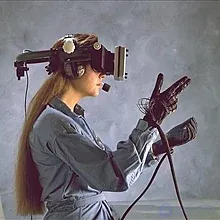
Virtual reality can be an essential element of software-controlled installations and forecasts. Virtual spaces and other worlds of digital art have sculptural and architectural aspects. They can be lived as a virtual existence involving text, graphics, animation, speech, virtual sound reality, and even physical experience. By entering virtual spaces as a virtual persona or avatar, one can develop a living dream world.
Virtual reality includes:
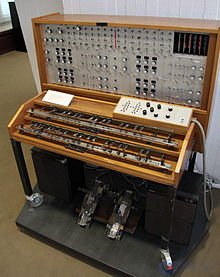
Futurism in the early 20th century embraced the use of machines. Electronic musical instruments such as the Trautonium (1924) emerged from this spirit of the age. Using sound equipment, wireless communication technology, and later television technology, electronic art could be produced from the early 20th century onward, though it was not yet digital. On the other hand, art based on numerically designed gaming instruments, such as dice, has existed for far longer. It is literally digital, without the use of machines.
Pioneers of the artistic use of electronic and digital devices worked at institutions such as Bell Laboratories, the Massachusetts Institute of Technology (MIT), the Cologne Studio for Electronic Music, and the Stuttgart Technical University, where Max Bense taught. [22]
Electronic music studios existed earlier than computer art studios. At the dawn of electronic art there were musicians. [23] Ben F. Laposky, who created the first electronic graphics, called this visual music. The flourishing of computer art is connected to electronic music in various ways:
However, analog electronics remained the basis of playback in music until computers became fast enough to reproduce sound in real time.
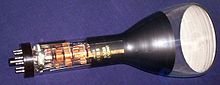
From the early 1950s to the 1960s, audiovisual artists used cathode-ray tubes to create images on screen by deflecting the cathode beam. At first, the images were strongly influenced by the fact that the devices were mainly oscilloscopes. Ben F. Laposky, who began creating images on such screens in 1950, recorded this animated curve graphics using high-speed cameras and called them "Oscillons." Herbert W. Franke also used analog-controlled devices from 1953 to 1956 and named part of the resulting body of work "Oscillograms."
In the 1950s, scientists at Bell Laboratories succeeded in using a digital computer to generate and control all the instructions for creating images before they were photographed on screen. The arrangement of devices was given the name "automatic plotter." [24] Printing vector graphics on paper using pen plotters became possible only later.
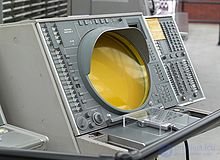
The step toward more sophisticated computer graphics began with the cathode-ray screen of the Whirlwind computer, developed at the Massachusetts Institute of Technology (see History of Computer Graphics).
Among the pioneers of graphic computer art in German-speaking countries were people who were either influenced by information aesthetics (Max Bense) or connected with computer scientists (for example, Kurd Alsleben). They could only work in connection with data-processing centers such as DESY in Hamburg, since computers were still room-filling systems in the 1950s and 1960s. In this period of creative work, the development of theoretical foundations and their technological-artistic realization was linked to the expectation of a new aesthetics ("Thus aesthetics is objective and material.An aesthetics that operates not by speculative but by rational means" - Bense, 1969).
As output methods using plotters (microfilm plotters and pen plotters) improved, more and more artists became interested in computers. While the first programs for pen plotters were developed for architects and representatives of similar professions, artists such as Frieder Nake and Herbert W. Franke created their own programs for plotters. With program code and description languages for graphic forms and effects, a system of graphic description was available for the first time in the history of visual art; it was comparable to musical notation, but surpassed it in that the program code also reveals the generative principle, the order manifested in the images.[26]
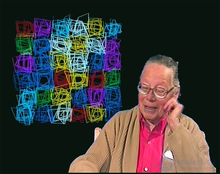
Besides computer scientists, it was initially mainly artists who took an interest in working with computers, such as Vera Molnár, who came from concrete and abstract art. Manfred Mohr, who made the journey from action painter and jazz musician to pioneer of computer art, has a different background.
In 1965, almost simultaneously in the USA and Germany, computer art was exhibited in galleries for the first time - not by artists, but by scientists: Bela Julesz and A. Michael Noll in New York, Georg Nees and Frieder Nake in Stuttgart. [27]
Georg Nees, who wrote the first graphic commands in ALGOL 60, [28] produced one of the earliest fully computer-controlled sculptures in 1968 using a milling machine and a Siemens 4004 computer. It was exhibited at the 1970 Venice Biennale. [29]
In the 1970s, mainframes were replaced by smaller and more interactive computing systems that could be controlled using a keyboard and monitor, and that could output raster graphics. Lawrence Gartel introduced methods and techniques from video art in 1975: video synthesizers and the first video-painting programs for controlling graphics on a monitor. The new possibilities for image manipulation were used by artists who had previously worked with analog media and are not usually mentioned as representatives of digital art: Peter Greenaway for film, together with Istvan Horkay; Jeff Wall, Thomas Ruff, and Andreas Gursky for photographic art.
In the late 1970s, the first approaches to digital communication networks emerged, and with them media-digital art, which understands networks themselves as a medium that can be shaped artistically. The basis was initially formed by online computer conferences, and later by the first mailbox systems, such as the ARTBOX and FAX networks (see ARTEX [30]).
As computing speed and memory capacity increased, interactive graphics processing on a monitor became standard. Graphics could be output as proofs on desktop printers. Yoichiro Kawaguchi began using 3D-modeling programs for digital art in the 1980s.
With image-processing programs such as Paintbox in the 1980s and Adobe Photoshop from the 1990s onward, existing photographic image material could be artistically manipulated.
The Digital Art Museum (DAM) offers a list of essays and a well-founded list of artists who influenced the development of digital art (see Web links).
The digitization of what had meanwhile become "traditional" media has led to their digital reformulation. For example, video art, originally created in analog format, is now recorded digitally. This has given rise to a new culture and art of video clips presented on websites.
Today, two- and three-dimensional images of all kinds can be processed and created using appropriate programs. They can be supplemented with a temporal dimension. Digital visual art can transform into video art, as in the work of Yves Netzhammer. On the one hand computer art and the disciplines of classical art, and on the other hand media-digital art in the narrower sense of the word, are distinct from one another, yet they also flow into one another.
Julian Opie's digital visual art largely consists of bringing large-format digital works into museums and public spaces. People rendered as digital images or landscapes created digitally are displayed in continuous motion on large flat screens in suitable buildings.
Besides the past and present of digital art, which is mainly understood as "computer-generated," there is also the past and present of "media" digital art, which is connected to media art and net art.

Comments