
Lecture
The Dunning–Kruger effect is a psychological phenomenon describing the tendency of some people with a low level of competence in a given area to hold an inflated opinion of their own abilities. As a consequence, such people may underestimate the difficulty of a task and overestimate their own skills, quite often displaying an unrecognized lack of knowledge and experience.
The Dunning–Kruger effect — a metacognitive bias that arises when a person with a low level of competence in some subject begins to regard themselves as an expert on that subject, while drawing mistaken conclusions and making poor decisions, yet failing to recognize their own mistakes because of the incompleteness of their knowledge, abilities and skills, arriving at a false assessment of the limits of their competence and an inflated view of their own abilities (even in unfamiliar areas of knowledge and in actions performed for the first time).
Highly skilled people, by contrast, tend to underrate their own abilities and to suffer from insufficient confidence in their own strengths, considering others to be more competent. Thus, less competent people generally hold a higher opinion of their own abilities than is typical of competent people (who, moreover, tend to assume that others rate their abilities just as low as they themselves do). Holders of a high level of skill also mistakenly believe that tasks that are easy for them are just as easy for other people (see curse of knowledge).
This effect was studied by social psychologists David Dunning and Justin Kruger, and its description leads to the following key ideas:
Low competence and underestimation: People with low competence in a particular area may be unable to correctly assess their own skills. They tend, as a rule, toward overconfidence and believe that they are far better than they actually are.
High competence and underestimation: Conversely, people with a high level of competence may underestimate their own abilities. They may assume that what seems easy to them is also easy for others.
Self-understanding: To overcome the Dunning–Kruger effect, it is important to develop self-understanding and to be critically self-critical. This can help both to avoid overestimating one's own abilities and to overcome the lack of confidence in those who are genuinely competent.
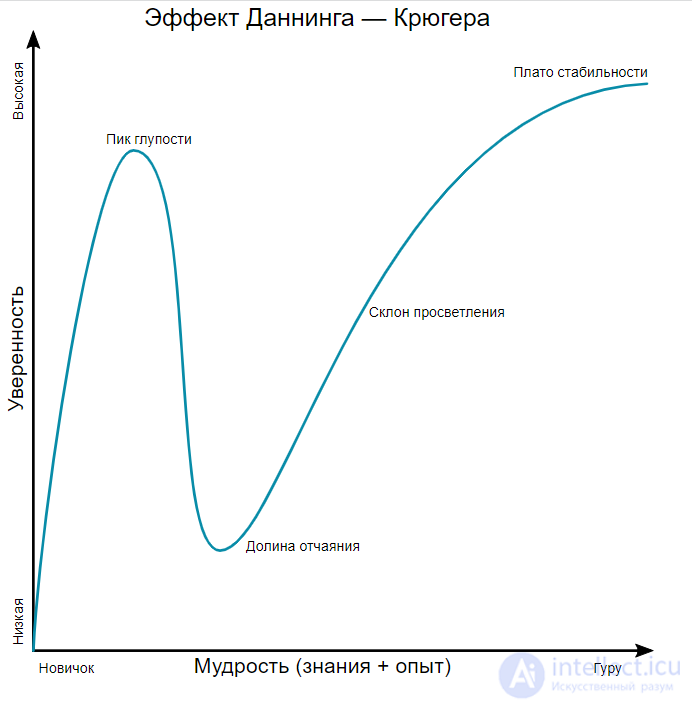
The hypothesis that such a phenomenon exists was put forward in 1999 by Justin Kruger and David Dunning, who in doing so cited statements by Charles Darwin and Bertrand Russell:
Confidence is more often born of ignorance than of knowledge.
— Charles Darwin
One of the painful things about our time is that those who feel certainty are stupid, and those who have any imagination and understanding are full of doubt and indecision.
— Bertrand Russell
To test the hypothesis they had put forward, Kruger and Dunning conducted a series of experiments involving students — those attending psychology courses at Cornell University. In doing so they drew on the findings of earlier researchers, which had shown that incompetence largely stems from a lack of knowledge of the fundamentals of a given activity, be it reading comprehension, driving a car, playing chess, playing tennis, and so on.
They put forward the hypothesis that the following is characteristic of people with low proficiency in any kind of activity:
The results of the experiments, which confirmed the hypothesis put forward, were published in English in December 1999 in the Journal of Personality and Social Psychology .
For this research the authors of the article were awarded the Ig Nobel Prize in Psychology for 2000.
The results of other similar studies were presented in 2003 and 2008.
Although the principle itself was formulated in 1999, the authors note similar observations among philosophers and scholars:
as well as in the above-quoted statements of Bertrand Russell and Charles Darwin.
Geraint Fuller (Geraint Fuller) noted in his commentary on the article that a similar idea is expressed in William Shakespeare's play As You Like It:
The fool doth think he is wise, but the wise man knows himself to be a fool.
A specialist is like a gumboil: his fullness is one-sided.
— Kozma Prutkov, “Fruits of Reflection” (1854)
Among people who know about the Dunning — Kruger effect, there is often a not entirely correct understanding of this psychological phenomenon. The first misconception is that the Dunning — Kruger effect applies only to “incompetent” people. In reality, the cognitive bias described is present in every person. First, a specialist in one area of human knowledge is a layperson in another area and may not be aware of it. Second, even within one particular area, the tendency to overestimate one's own level is characteristic of most people, including people of average competence and above, only the error in assessment is smaller for more competent people. And only the smallest minority, the most competent people, may underestimate their own level.
Every hunter, in my opinion, goes through three stages. At first he is nervous and unsure of himself. Then, as he masters the basics of hunting in the bush, he becomes overconfident and considers himself invulnerable. Later he learns that hunting in the bush carries great risk and that risk is often the consequence of foolishness. At the time I was in the second stage and nearly perished while moving into the third.
— John Hunter, “Hunter”, chapter three (1952)
There is disagreement about the magnitude and practical consequences of the Dunning–Kruger effect compared with other psychological effects. Claims about its significance often focus on how it leads affected people to make decisions that have bad consequences for themselves or others. For example, according to Gilles E. Gignac and Marcin Zajenkowski, this may have long-term consequences, since poor performers go on to pursue careers for which they are unsuited. However, high-performing workers who underestimate their skills may forgo viable career opportunities that match their skills in favor of less promising ones that are below their level of qualification. In other cases, poor decisions can also have short-term consequences. For example, Pavel et al. believe that excessive self-confidence can lead pilots to fly a new aircraft for which they do not have sufficient training, or to perform maneuvers that exceed their qualifications.
Emergency medicine – is another area where a correct assessment of one's own skills and treatment risks is important. According to Lisa Ten Eyck, it is necessary to take into account the tendency of trainee doctors toward excessive self-confidence, in order to ensure an appropriate degree of oversight and feedback. Schlosser et al. believe that the Dunning–Kruger effect can also negatively affect economic activity. This is the case, for example, when the price of a good, such as a used car, falls because of buyers' uncertainty about its quality. An overconfident buyer, unaware of their own lack of knowledge, may be willing to pay a much higher price, since they do not take into account all the potential defects and risks associated with the price.
Another consequence concerns areas in which researchers rely on people's self-assessment to evaluate their skills. This is often the case, for example, in career counseling or in assessing the information literacy skills of students and professionals . According to Khalid Mahmood, the Dunning–Kruger effect indicates that such self-assessments often do not correspond to actual skills. This means that they are unreliable as a method of collecting data of this kind. Regardless of the area under consideration, the metacognitive ignorance often associated with the Dunning–Kruger effect can prevent low-performing people from improving. Since they are not aware of many of their shortcomings, they may have little motivation to address and overcome them.
Not all descriptions of the Dunning–Kruger effect focus on its negative aspects. Some also concentrate on its positive aspects, for example, on the idea that ignorance is sometimes bliss. In this sense, optimism can encourage people to perceive their situation more positively, and excessive self-confidence can help them achieve even unrealistic goals. To distinguish the negative aspects from the positive ones, two important stages have been proposed that matter for achieving a goal: preparatory planning and execution of the plan. According to Dunning, excessive self-confidence can be useful at the execution stage, since it increases motivation and energy. But it can prove harmful at the planning stage, since the agent may ignore poor odds, take unnecessary risks, or fail to prepare for unforeseen circumstances. For example, excessive self-confidence can benefit a general on the day of battle, since his troops gain additional inspiration. But in the preceding weeks it can prove disadvantageous if it leads to ignoring the need for reserve troops or additional protective equipment.
In 2000, Kruger and Dunning were awarded the satirical Ig Nobel Prize in recognition of the scientific work recorded in “their modest report”.
In the scientific community there is currently doubt about the correctness of this term, primarily about the appropriateness of the word “effect” . There has also been repeated doubt about the existence of the “effect” and its influence, including because of the non-replicability of the original results obtained in the studies of Kruger and Dunning, and also because of a conflict with the results of statistical analysis obtained in later studies
The Dunning–Kruger effect is widely discussed in the context of education, professional development, psychology, and interpersonal relationships. It highlights the importance of learning, feedback, and the development of critical thinking for a more accurate assessment of one's own abilities and for problem-solving.

Comments