
Lecture
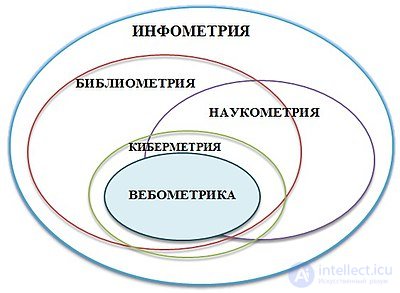
Informetrics — a scientific discipline whose subject is the measurement of the quantitative characteristics of information.The term
The term informetrics (Fr. Infométrie) was proposed in 1979 by the French researcher O. Nacke .
Informetrics covers the production, transmission and use of all forms of information, regardless of their origin .
In essence, it is a scientific discipline whose subject is the measurement of the quantitative characteristics of information, including semantic ones .
By composition, informetrics distinguishes :
Since the formation of informetrics as a scientific discipline its research has been based on the use of the statistical laws of Zipf and Lotka, and on the works of a number of researchers, such as Derek de Solla and Eugene Garfield .
• Hirsch h-index, or the Hirsch index — a scientometric indicator proposed in 2005 by the Argentine-American physicist Jorge Hirsch of the University of California, San Diego originally for evaluating the scientific productivity of physicists . The Hirsch index is a quantitative characteristic of the productivity of a researcher, a group of researchers, a research organization or a country as a whole, based on the number of publications and the number of citations of those publications[2
• Kardashian Kardashian Index (Eng. K-Index) — a measure of the discrepancy between a researcher's social media interest and their publication statistics .
Proposed in 2014. The index compares the number of a researcher's followers on Twitter with the number of citations of their published papers. The name is a reference to the high popularity on social media of the American actress Kim Kardashian. It is assumed that a high  -index indicates inflated scientific popularity, while a low one suggests that the researcher is underrated. The author of the index calls researchers with
  “Kardashians of science” (Eng. Science Kardashian). The main criticism of the index relates to tying a researcher's significance to the number of citations of their work
• RSCI Russian Science Citation Index (RSCI) — a bibliographic database of scientific publications by Russian researchers and a citation index of scientific articles.
To provide users with the data they need on publications and citation rates of articles, an analytical toolkit called ScienceIndex has been developed on the basis of the RSCI database. The RSCI project has been under development since 2005 by the company “Scientific Electronic Library” (ELIBRARY.ru)[
• g-index g-index (scientometrics) — this is an index for measuring scientific productivity, calculated on the basis of bibliometric indicators. Proposed in 2006 by Leo Egghe
• i-index i-index — this is an index of the publication activity of a research organization, calculated on the basis of bibliometric indicators. Proposed in 2006 independently by Kosmulski M. and Prathap G.
- Scopus “Scopus” or “Skopus” (a recent version of the official name: SciVerse Scopus) — a bibliographic and abstract database and a tool for tracking the citation of articles published in scientific journals. Indexes 24 thousand titles of scientific publications in technical, medical and humanities fields from 5 thousand publishers . The database indexes scientific journals, conference proceedings and serial book publications, as well as “professional” journals (Trade Journals).
- Web of Science (WoS) — “Web of Science” , previous name ISI (Eng. Web of Knowledge) — a search internet platform, combining abstract databases of publications in scientific journals and patents, including databases that take into account the mutual citation of publications. https://clarivate.com/webofsciencegroup/solutions/web-of-science/
- Google Scholar Google Scholar — a free search engine for the full texts of scientific publications of all formats and disciplines. The project has been running since November 2004, initially in beta status. The Google Scholar index includes data from most peer-reviewed online journals of the largest scientific publishers in Europe and America. In terms of functionality, Google Scholar is similar to the sites Scirus, CiteSeerX and GetCITED.
- PubMed — an English-language text database of medical and biological publications, created by the National Center for Biotechnology Information (NCBI) of the USA on the basis of the “biotechnology” section of the United States National Library of Medicine (NLM) . A key component of PubMed is MEDLINE . It was first introduced in January 1996 . Accessible through NCBI-Entrez[en] — a central search system that includes PubMed, PubChem and other major medical databases. Contains more than 30 million records .
- eLIBRARY.ru — a Russian scientific electronic library, integrated with the Russian Science Citation Index (RSCI).
- ISTINA (Intelligent System for Thematic Research of Scientometric Data) of Moscow State University ISTINA is designed for recording and analyzing the scientific activity of organizations' staff. https://istina.msu.ru/

Comments