
Lecture
A performance review is a formal assessment in which a manager evaluates an employee's job performance, identifies strengths and weaknesses, offers feedback, and sets goals for future performance. Performance reviews are also called performance appraisals or job appraisals. In the past, many organizations conducted annual performance reviews for all of their staff; however, more and more companies are moving to a performance management system with frequent feedback, in which managers hold quarterly, monthly, or even weekly reviews. In fact, some organizations abandon formal performance reviews altogether in favor of more casual manager check-ins and one-on-one meetings.
An employee appraisal is a one-on-one meeting between managers and employees to discuss how the employee is meeting the organization's goals and expectations. It takes place from one to four times a year, or more often.
The purpose of a performance review is to give the employee honest feedback on their work, note their strengths, and give the employee an opportunity to voice their concerns.
These people fill out a questionnaire, answering questions about the employee's performance, behavior, and competence. The employee also takes the same survey as a self-review form.
When done right, performance reviews can help employees understand what they do well, how they can improve, how their work fits into the company's larger goals, and what is expected of them. Managers who use performance reviews effectively can more easily recognize high-performing employees, fix problems before they become insurmountable, communicate expectations, encourage growth and development, and promote employee engagement.
Whether a performance review is formal or casual, employees should be encouraged to prepare for it. Here are some suggestions you can offer employees that will help make the review successful for both sides:
Prepare notes. Encourage employees to make notes before each performance review. They should document the topics they want to discuss, their strengths and weaknesses, and their goals.
Brainstorm examples. Employees should be ready to share specific examples of how they achieved the goals set at the last review and how they have improved overall.
Self-assessment. Employees should practice self-assessment by conducting a mock performance review. They should identify new strengths and weaknesses, achievements, and goals.
Come with questions. Employees should have a safe environment in which to ask questions at a performance review. Preparing questions in advance can help ensure that everything they need to ask gets asked.
Every six months, team members are evaluated on two criteria:
Productivity is assessed by how well a person handles their work and does what is asked of them.
There are 3 rating options:
1 - does nothing.
2 - fulfills all the commitments they have taken on, but only in a perfunctory way.
3 - does more than is asked of them.
They take on responsibility, ask for additional assignments, and organize things.
The second criterion is learning and professional development. It assesses whether the employee is developing or simply working and completing their tasks, and how quickly they learn. A person may do excellent work and receive high marks for it, but not develop, and receive a low score on this parameter.
This will affect the overall Performance review rating.
Development levels:
1 - learned nothing. In six months to a year, the employee has learned nothing new, has not come with questions, and has not shown interest in the development strategy.
2 - asks questions only within their own level. For example, they are a mid-level developer or mid-level manager and study problems only at that depth, without looking above or below.
3 - learns additional material and exceeds expectations in this respect. They may be an entry-level manager, but they think about a development strategy for their own growth. Or they solve tasks above their level that no one could solve for a long time. Somewhere they read something, asked around, went to a conference, and found the solution. They teach other employees.
In a performance review, both the employee and the manager are expected to take it seriously. However, since the manager conducts the review and has the power to significantly affect the employee's career, most of the responsibility for keeping it polite and productive falls on them. Here are some topics and comments that managers should avoid in order to maintain a favorable atmosphere.
Before sitting down with any employee, prepare for thoughtful communication that will build your employee up rather than tear them down.
Performance reviews should be neither entirely negative nor entirely positive. Excessive criticism is likely to demotivate the employee; but on the other hand, there is almost always something that can be improved.
Criticism without an example. By giving examples and suggesting ideas for improvement, you can help the employee do their job more effectively rather than putting them on the defensive. Prepare examples of both achievements and areas for improvement, and share them throughout the review.
Comparisons: this is not the place to rank employees or pit them against each other. Focus only on the work of the employee you are reviewing.
False praise: although you should look for something positive in every performance review, false praise will only mislead the employee, make them think they are doing better than they are, and deprive them of the opportunity to improve.
Speculation: spreading rumors about the company, or raising hopes of a raise or promotion that may turn out to be impossible, causes unnecessary speculation and sometimes disappointment.
Repetitive comments: some important things need to be repeated, but if you find yourself giving the same advice and the same praise at every performance review, try changing something. Perhaps the message is not getting through the way you are sharing it now and needs further discussion. If both managers and employees write down what is said in performance reviews, you can build on the advice and goals of each meeting rather than rephrasing the same thing over and over.
"Always" and "never": every rule has an exception. Ultimatums and sweeping statements are rarely accurate and can put people on the defensive.
"I wish I had more time": performance reviews should be a priority for managers and employees alike. They help ensure that everyone's personal goals align with the company's goals, and they provide valuable information on how employees and the manager can improve their work. When performance reviews come first, the whole company wins.
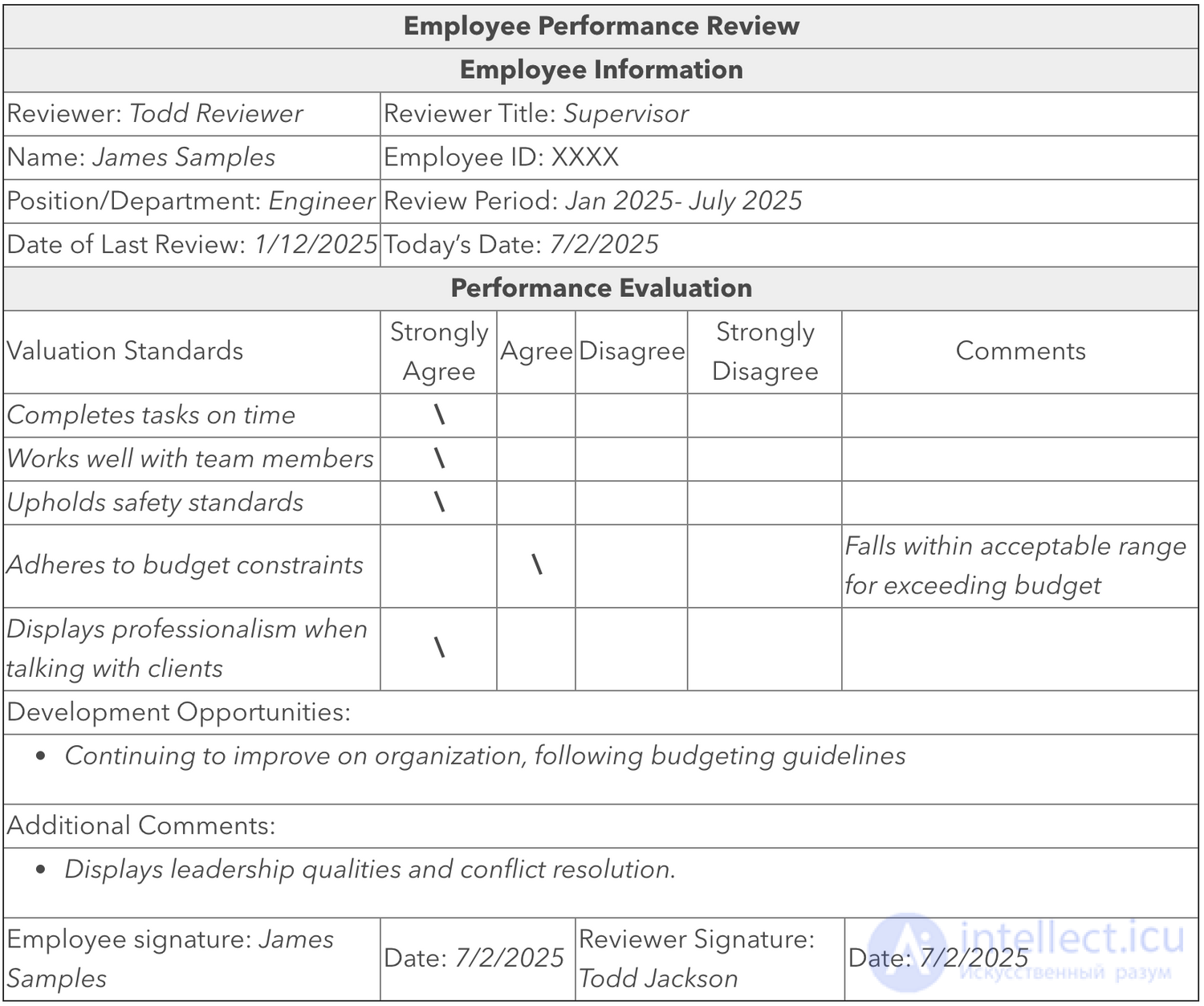
At the beginning of your form, the purpose or title of the form should be stated. The next section should contain the employee's name, job title, and ID number. Next come the manager's name and the date of the review period. The review period is the time since hiring or since the last review.
Professional competence
This rating criterion is based on how well the employee does their job. Use the employee's job description as the basis for measuring their performance.
Here are some examples of professional qualities:
Leave space for comments next to each criterion item. This will provide a better understanding of the score. Leave additional space at the end of the review for employee feedback and questions, additional comments, and goal-setting actions. They will be able to refer to these comments when reviewing the meeting later.
Here is an example of an employee performance review form:

Comments