As a team grows, the team lead and senior management begin to think about assessing employees' competencies. In this article I want to describe the first steps in introducing employee assessment and the benefits you can get from it.
A good tool is a competency matrix combined with competency diagrams.
Terms
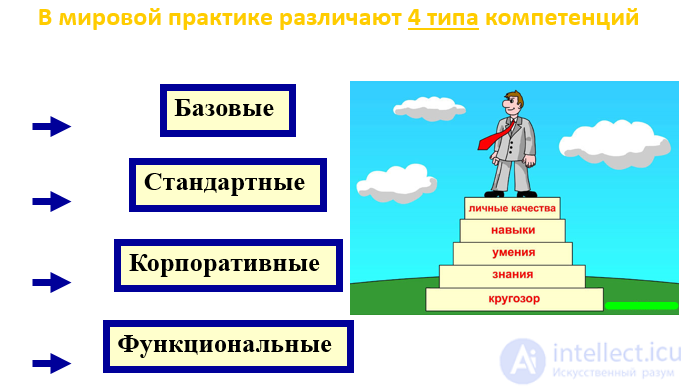
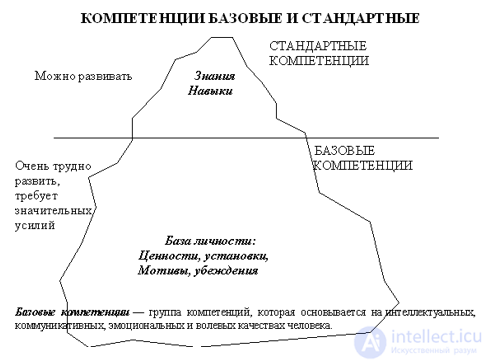
Standard competencies – behavioral components that are easily acquired or developed through training.
Core competencies – behavioral components based on the structure of a person's values; they are hard to change (they cannot be quickly trained). Their presence in ready-made form must be checked during selection.
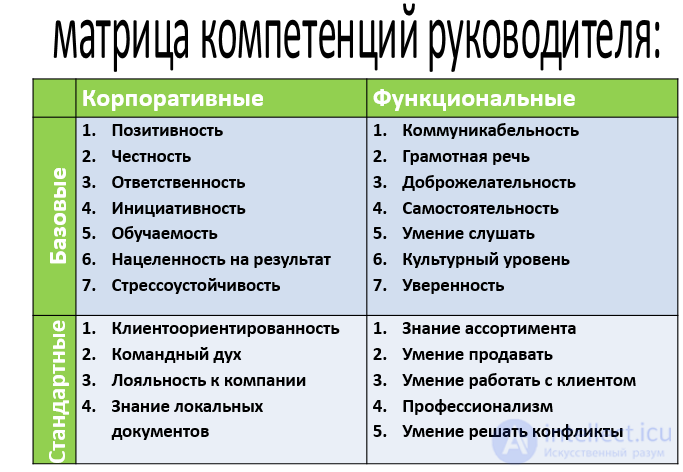
Corporate competencies – what all employees of the Company must demonstrate in their behavior, regardless of position and status. For example: "focus on results" and "customer orientation".
Functional competencies - the skills and abilities related to the area of professional activity. For example, a financial director must be able to read a balance sheet, and a head of a group of programmers must be proficient in the most important programming languages
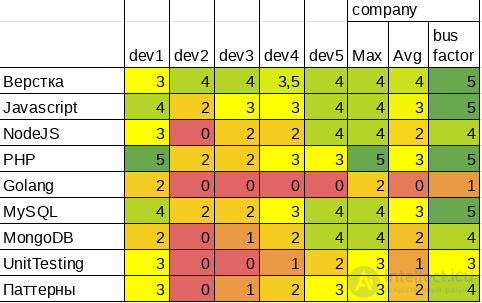
A competency matrix is a table with data on the set of competencies of employees. The table cells contain a number indicating the level of proficiency in a competency.
Description of competencies.
CORPORATE - STANDARD
- Positivity- Assesses the degree of optimism, the prevailing emotional attitude, a creative approach to improving the existing state of affairs, systems, procedures, customer services, etc., and the attitude toward new tasks and undertakings.
- Honesty- Assesses the degree of openness and sincerity, the ability to openly state that problems exist and to admit limits in the ability to solve them.
- Responsibility- Assesses the ability to finish what was started and to carry out assigned tasks independently at a high level of quality.
- Initiative- Assesses the level of activity and the ability to make constructive suggestions and help colleagues in carrying out work tasks
- Learning ability- Assesses the speed of acquiring new knowledge, the ability to quickly apply new knowledge in practice, the drive for self-improvement, and continuous upgrading of qualifications, professional knowledge and skills
- Results orientation- Assesses the ability to identify priority tasks and complete them on time and in full. The emphasis in a situation is placed not on difficulties but on ways of solving them. Attention is focused not on the ways of achieving the goal but on the final result
- Stress resistance- Assesses the degree of emotional stability. The ability to constructively withstand emotional pressure. To find a mutually beneficial way out of disputed and conflict situations.
- Team spirit- Assesses the ability to work in a team, exchange information, support colleagues, the degree of friendliness toward them, and readiness to help.
- Loyalty to the company- Assesses adherence to internal corporate norms and standards, both documented and unwritten, and the degree of loyalty and corporate "patriotism"
- Knowledge of internal documents and standards- Assesses knowledge of standards, regulations and instructions. Compliance with established rules. Adherence to the norms set out in regulatory documents
FUNCTIONAL - CORE
•Energize others and get energized:
- - Positivity in everything
- •Set no boundaries
- •Informal communication
- •Show a different view of the process
- •Keep a balance (equilibrium) across all activities (sports, work)
- •Negativity = a phenomenon – do not react to it-
- - Eat properly
•Be open:
- - Be able to hear
- •Encourage open communication
- •Ask the team the question "how"
- •Share and gather information
•Striving for excellence
- - Strives for continuous development and takes independent steps for professional growth (reads specialized literature, keeps up with global innovations and trends in the professional field; successfully masters new technologies and approaches and applies them in work)
- •Seeks to expand the area of responsibility and the versatility of knowledge (responds with interest to proposals to master an adjacent product).
- •Takes responsibility for their own professional development (- sees their strengths and weaknesses as a specialist,
- • - sets specific goals for raising their qualifications to the level the Bank will require in the future).
- •Is open to feedback (proactively collects feedback and responds constructively to criticism; changes their behavior in light of feedback to achieve better results at work)
•Communication skills
- - Communicate openly and honestly
- •Express your thoughts
- •My idea + your idea = the best idea
- •Listen to those around you
- •Criticize less
- •Think positively
- •Ask for feedback
•People management
- •Understand people (organizational climate)
- •Delegate (The director's free time. Gets everything done)
- •Share responsibility for a subordinate's results (The director's reaction to an employee's suggestion. Employees' initiative. Number of suggestions, participation in working groups. Number of messages in the "Jabber" chat).
- •Be able to identify and develop competencies (appraisal results, % of employees who match the competency model)
- •Share knowledge and information
- •Develop responsibility for results (control) (% of bonus received)
- –Motivate (show what the employee will gain from the result) (motivate by the result, be able to talk to an employee about the result in terms of the employee's interests).
- –Be a role model (an example).
- –Constructiveness (discuss the matter, not the person). (Discussing the matter, not the person. Problems = suggestions)
- –Set priorities. (Meets KPIs)
- –Inform in a high-quality and regular way
- –Point out directions for development (tell about the company's strategy)
- –Encourage independent decision-making
•Make decisions
- - Ability to analyze
- •Ability to listen and to hear
- •Choose realistic, practical solutions
- •Assess risks
- •Adapt decisions to new conditions
- •Take responsibility
- •React quickly (speed of decision)
- •Get feedback on the decision (20/80) whether it is clear or not. Explaining does NOT mean telling = asking.
FUNCTIONAL - STANDARD
•Global vision
- - Synthesize information about the industry
- - Broaden your horizons
- - Do what will matter only in the future (5+ years ahead)
- - First think "what" and "why", then "how" (the team too)
•Defend your ideas
- - Show and explain the benefits of implementing ideas
- - Defend with questions
- - Emotion + arguments in defense
- - Align personal interests with the essence of the idea
- - Strength in simplicity and clarity
- - Give simple analogies
- - Be able to accept criticism
- - Link the idea to priority areas.
•Defend your ideas
- - Show and explain the benefits of implementing ideas
- - Defend with questions
- - Emotion + arguments in defense
- - Align personal interests with the essence of the idea
- - Strength in simplicity and clarity
- - Give simple analogies
- - Be able to accept criticism
- - Link the idea to priority areas.
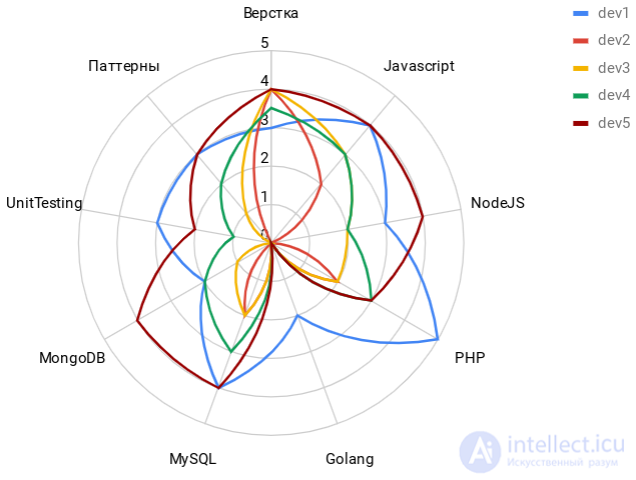
A competency chart is a radar chart that visualizes the numerical competency scores of employees.
The classical approach
A competency matrix contains a list of skills that an employee must apply in their work. When I developed my first competency matrix, I ended up with about 200 competencies to assess. Collecting that much data is quite labor-intensive, and keeping it up to date is even harder. I could not bring myself to use such a tool.
At the same time, competency matrices are widely used in many industries, from retail to manufacturing, and they are used very successfully. It turned out that in other fields a competency matrix contains about 20 skills, or even fewer. Why not reduce the number of competencies in our field as well?
Getting started
It is worth starting small. In the first steps we can even sacrifice accuracy.
The plan:
- Choose up to 20 competencies to assess. For example: programming languages, individual types of databases, test automation, 1. patterns, and so on.
- Collect data from the employees. Each employee determines their own level of proficiency in a technology on a scale from 1 to 5.
- Normalize the data. This is done by the employee who performs the assessment. The normalization will be subjective, but errors are acceptable at the rollout stage.
- Enter the resulting data into a single competency matrix.
- Be sure to save the data collected from the employees. It is very interesting to watch how employees' self-assessments change over time.
Data collection
Competencies can and should be assessed during job interviews and hiring. Additional assessments should also be carried out during the work itself, at least once every six months. This lets you track the dynamics of development.
It is worth adding to the matrix a number that reflects the employee's interest in developing a competency. Then you will be able to choose the right project for an employee, and to see how your employees' interest in various technologies changes over time.
From the competency matrices of individual employees it is easy to build a competency matrix for the company or for a particular team.
It is also very useful to build a competency matrix for a project.
Analysis
So, you have collected the data. Now it is time to get at least some benefit from it.
The resulting matrices give you the following possibilities:
- See the bus factor.
- Determine an employee's level and growth areas.
- Help select a team.
- Help match projects and teams to each other.
Bus factor
Suppose you have 5 employees and you ended up with the following matrix:
This matrix makes it possible to determine the bus factor.
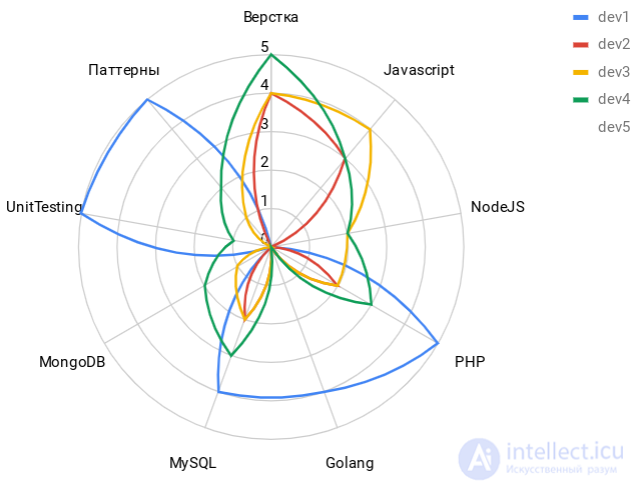
In this matrix you can see that it is hardly worth using Golang in the company yet. Nobody wants to depend on a single employee.
Let's look at the resulting competency chart. The bus factor is visible here too. The same employee is the clear leader in PHP knowledge. And that would seem to be a good thing, since he can write any code. And that is really so. He even managed to figure out asynchronous PHP. But who will be able to maintain that code afterwards?
It is worth restricting his use of non-standard approaches, or assigning him the task of teaching such techniques to the other employees. But there is no need to venture into asynchronous PHP.
Determining an employee's level and growth areas
Employee dev2 comes to you demanding a raise. You need to decide how justified his demand is. To do this, add abstract employees to the matrix with the competencies of a junior, a middle frontend developer and a middle backend developer.
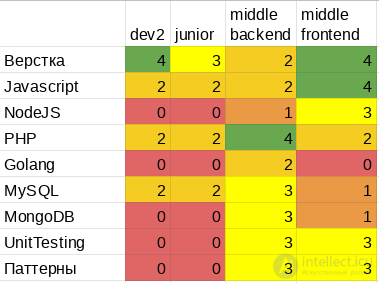
The matrix immediately shows that the employee has outgrown the junior level. But he clearly does not measure up to either of the middle levels.
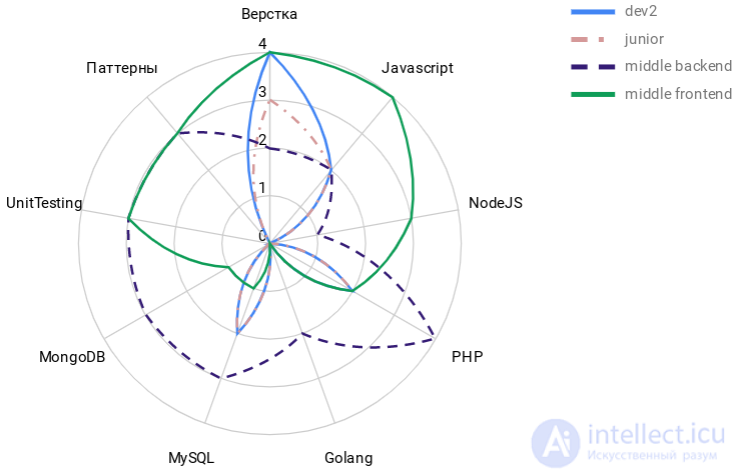
The chart clearly shows that it is more logical for this employee to grow toward frontend, and it makes clear the directions in which he needs to develop to earn a promotion.
Selecting an IT team
Active knowledge sharing happens only within a team. For adequate communication in a team, the interests of its members must overlap significantly. It is hard to imagine active knowledge sharing between a pure backend developer and a pure frontend developer, or between a mobile developer and a system administrator.
The task:
You have 5 developers available. You need to pick a team of 4 people for a project. At the same time, you must ensure active knowledge sharing within the team.
The developers:
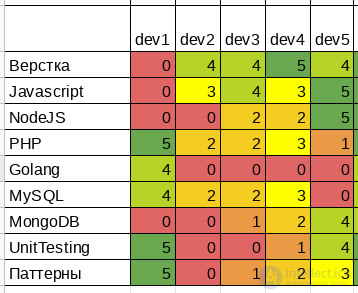
The matrix clearly shows a strong backend developer, 3 full-stack developers and a strong frontend developer.
It is hard to imagine active knowledge sharing between dev1 and the rest of the team. His knowledge and interests overlap only weakly with those of the others. In the areas where knowledge overlaps, dev1 is far ahead of the others in skill level, and it will be difficult for him to pass knowledge on to the rest of the team.
Dev1 and dev5 will have eternal disagreements about which database is the best.
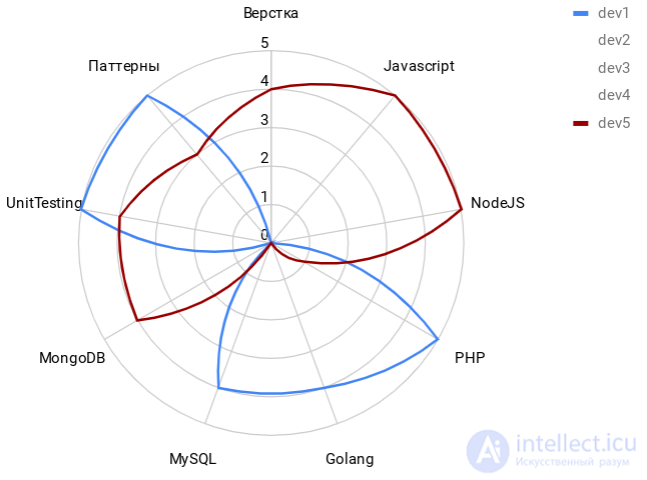
These are downright obvious imbalances in interests. Although some interests do coincide, there are clearly fewer of them than those that differ.
However, I would give preference to the following team:
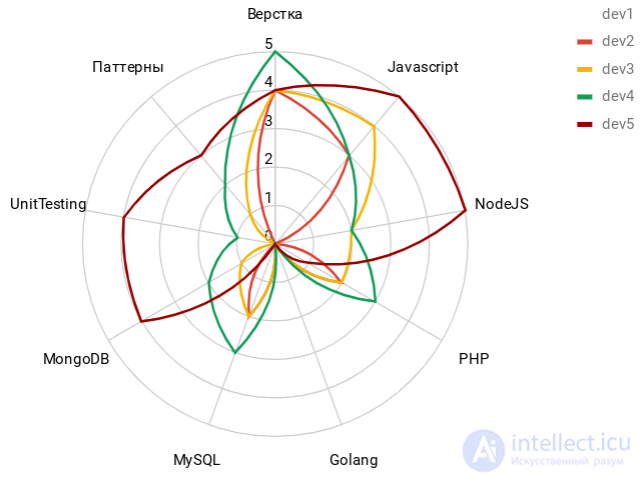
The growth areas for each of the employees are obvious here too.
In a similar way you can match projects and teams to each other.
And these are only the simplest uses of a competency matrix and chart.
So competency assessment has started to benefit the company. But then the question arises: how do we improve accuracy? Only at this point is it worth making the matrices more complex. Even then, the large matrix should be reduced to a small matrix, and the visualizations should be built from the small matrix.
A Google Doc will not be enough for convenient use of the matrices. If you know a tool of this kind, please mention it in the comments.
P.S. This is a greatly simplified model. A team lead must know their team. The competency matrix and chart are just one of many tools in a team lead's toolbox.
See also
- [[b8629]]
- [[b8940]]
- [[b4720]]
See also


Comments