
Lecture
The «360-degree» method is a method of current personnel appraisal that consists of determining the degree to which an employee fits their position by surveying the employee's work environment.
It is among the TOP-5 most popular appraisal tools in Russia.
The term «360-degree appraisal method» was introduced by Ward in 1987. Ward defined this method as the systematic collection of information about the performance of an individual or group, obtained from those around them" .
The 360-degree technique began to be actively used in the West in the 1990s. In the early 2000s, Russian HR specialists began adopting this experience from their Western colleagues, and now this method is a popular means of personnel appraisal in Russia as well.
The essence of the «360-degree» technique is that the employee is appraised by their entire work environment: managers, subordinates, colleagues, and clients. The result of the appraisal is a rating of the employee's attributes (the degree of fit for the position is assessed against a list of competencies); also, thanks to the self-assessment component, this method can be used as a source of feedback. An employee is appraised by the 360-degree method through a survey of their environment: their manager, colleagues, and subordinates. If other interested parties (consumers, clients, suppliers, partners) are added to the appraisal, the 360 method turns into a 540-degree technique.
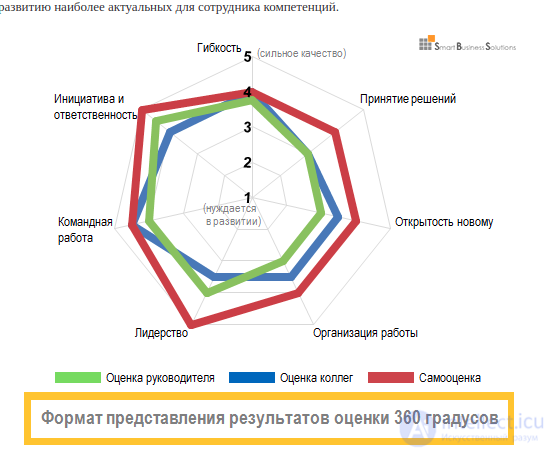
Raters assign scores for competencies on special questionnaires; the survey may be conducted anonymously, indicating the rater's category (colleague, manager, client), or non-anonymously. The arithmetic mean is then calculated for each competency, and a competency chart is built. At the final stage, the appraisal results are presented to the employee being assessed. As a result of the 360-degree appraisal, conclusions can be drawn for the employee's self-development, for developing competencies, improving relationships with colleagues, and decisions can also be made about training, inclusion in the talent pool, and so on. Decisions about an employee's professional development, promotion/demotion, and other personnel decisions cannot be made on the basis of a 360 appraisal alone—there is a separate procedure, appraisal certification, for that.
Recent studies have shown that averaging the values across competencies reduces the objectivity of the information provided to the employee. Thus, despite the anonymity of the survey, subordinates tend to overrate, while managers tend to underrate. As a result, relationships among employees skew the competency rating by 18-39%, and the average ratings across all of an employee's competencies by 96%. In addition, the objectivity of the technique is reduced by the rater's response style (whether the employee tends to over- or underrate), the influence of this factor being estimated at 3-15% .
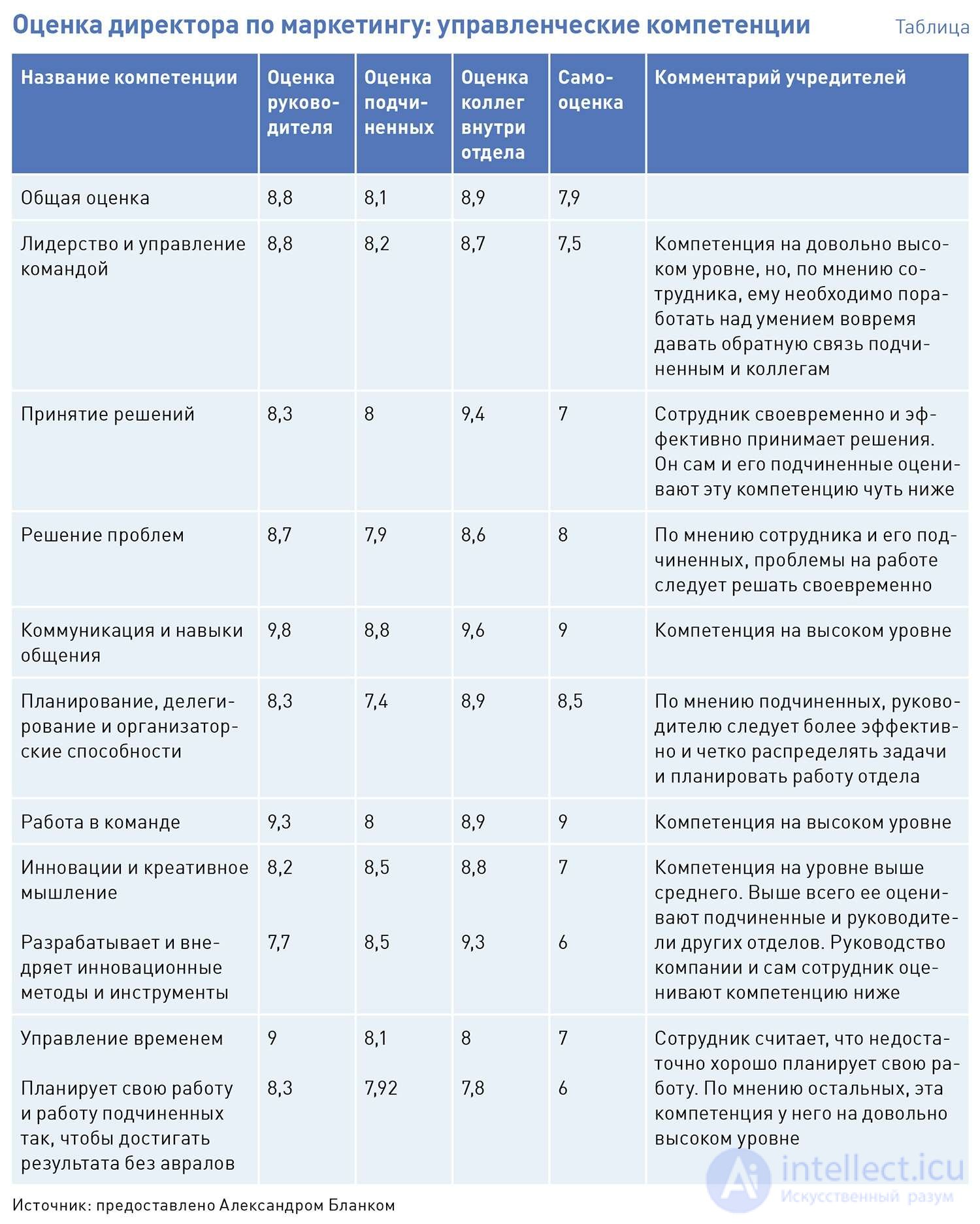
»?
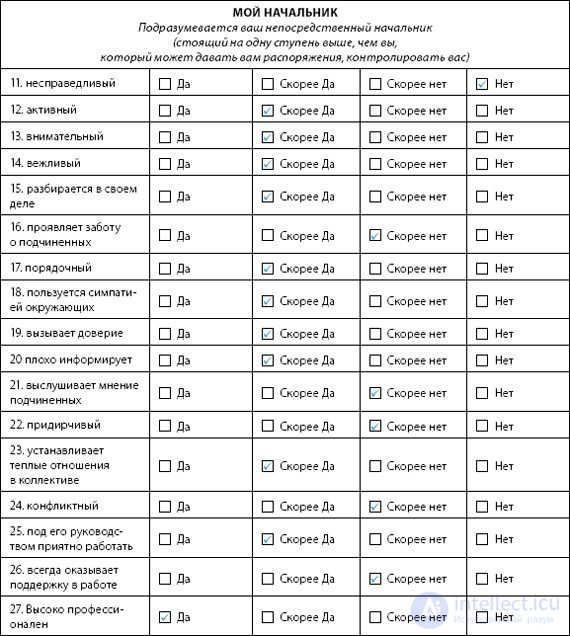
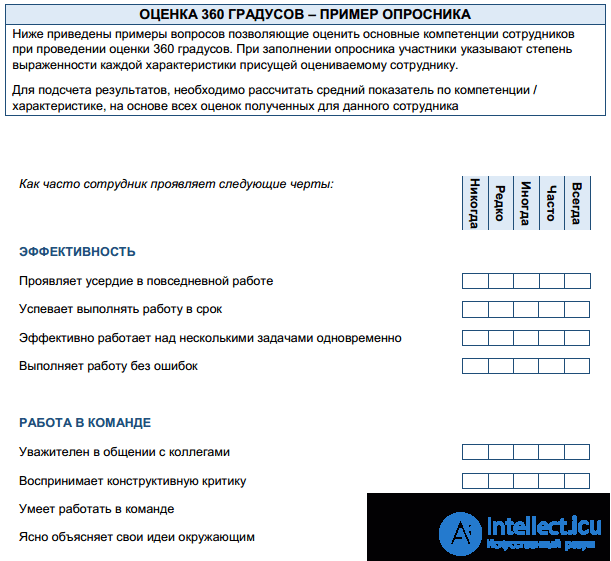
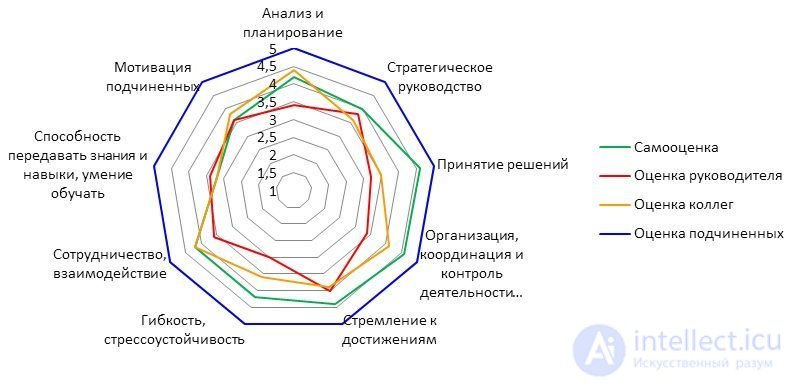
Depending on the purpose of the assessment, either individual employee competencies (e.g., initiative, conflict-proneness, etc.) may be assessed, or a set of various competencies: conflict-proneness, business acumen, level of technical skills, leadership and teamwork skills, intelligence, career ambition, work/life balance, professional integrity, and so on.
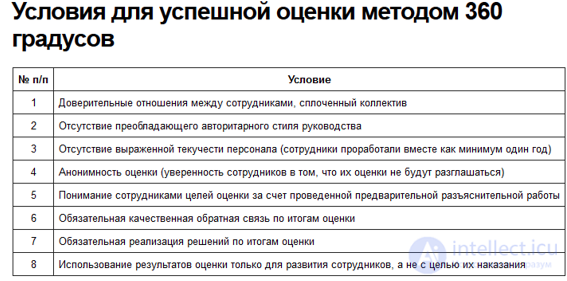
First, the survey of the employee's environment should be conducted anonymously. Studies have found that in the case of a non-anonymous survey, the correlation with independent evaluation results of company employees was 0.09 and was not statistically significant. In the «partial anonymity» variant, where the assessment was combined with one of the other evaluations, the correlation with independent assessments by other employees was 0.27 and was statistically significant. Correspondingly, at maximum anonymity, the significant correlation was 0.3. This is related to the business environment's concerns about worsening relationships within the team, as well as fear of possible conflict.
Anonymity can be guaranteed in two ways:
Second, this assessment method is recommended for use in electronic form, since the employee is not distracted from the work process, and processing the results takes less time.
Third, the 360-degree method should be used only in combination with other personnel assessment methods: this method is subjective, since it involves the employee being assessed by their business environment.
Fourth, when conducting a 360-degree assessment, the person being evaluated is subjected to stress, so the fact that the assessment is being carried out must be justified — for example, in career planning, in compiling a list of employees to be sent for training, or as part of a scheduled personnel appraisal.
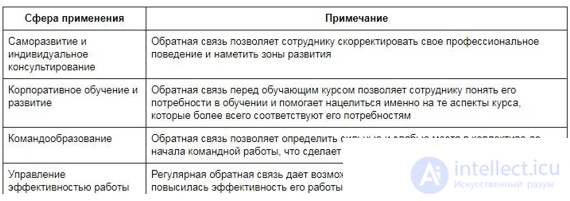
Many 360-degree feedback tools are not adapted to the needs of the organizations in which they are used. 360-degree feedback is not equally useful in all types of organizations and for all types of jobs. In addition, the use of 360-degree feedback tools for evaluation purposes is increasingly criticized, since performance criteria may be invalid and position-based, employees may be insufficiently trained to assess colleagues' performance, and feedback providers may manipulate these systems. Manipulation of feedback ratings by employees has been reported at several companies that used 360-degree feedback for performance evaluation, including GE (Welch 2001), IBM (Linman 2011), and Amazon (Kantor and Streitfeld 2015).
Some U.S. military personnel have criticized the use of 360-degree feedback programs in hiring decisions because of concerns about validity and reliability. [10] Other branches of the U.S. government have likewise questioned feedback reviews. [11] Nevertheless, these organizations continue to use multi-rater feedback in their development processes.
It is assumed that using the 360-degree review approach surpasses other traditional forms of assessment and feedback for evaluating employee performance. When successfully implemented, this method leads to substantial positive changes and provides a more effective, thorough, and accurate evaluation of performance reviews. Participants must feel that the survey instruments are reliable and valid; otherwise, such a multi-source approach may be seen as problematic. Management must ensure that employees are aware of the survey's context in order to achieve maximum accuracy and minimize response bias. Several inconsistencies and errors can arise in the feedback depending on:
The extent and level of training in 360-degree feedback for both the rater and the ratee can affect the accuracy of the feedback. If no guidance is given, individual bias may affect the rater's ratings and interpretation of the feedback. [13] However, even where training activities are provided, unconscious bias can still arise from factors such as cultural influences or the quality of the relationship between the rater and the ratee. [14] In addition, if there are potential consequences arising from the rater's feedback, the rater's motivation may shift from providing accurate feedback to providing feedback based on self-motivated reasons, such as promotion or causing harm to a specific person. [13] [15]Consequently, it is extremely important to establish a foundation of trust between raters and participants in order to increase rater accountability and the accuracy of the feedback. [16]
In addition, it is important to understand who will receive the collected data and who will maintain its confidentiality. The manager or HR employee overseeing the data collection will need to ensure its confidentiality. When participants remain anonymous, they are more likely to provide more accurate feedback, because their fear of reprimand is removed, which increases the accuracy of the review. Moreover, the data should be accessible only to the vetted employee and manager who will facilitate the feedback for developmental purposes. [16]
It is also very important to standardize the way information is collected during the review process. 360-degree feedback can be subject to reduced accuracy depending on the survey style used. Studies have shown that feedback results can vary depending on the rating scale used in the survey [13], as well as on the length of the survey. [16] In addition, raters' responses can vary depending on when they completed the survey. [14]
A study of patterns in rating accuracy shows that the length of time a rater has known the person being rated has the most significant effect on the accuracy of a 360-degree review. The study shows that the most accurate are the subjects in the "known for one to three years" group, followed by those "known for less than one year", followed by those "known for three to five years", while the least accurate are those "known for more than five years". The study concludes that the most accurate ratings come from those who have known the person in question long enough to move past a first impression, but not so long as to begin to form a favorable generalization. [17]
It has been suggested that ratings involving multiple raters often produce conflicting opinions and that there may be no way to determine whose feedback is accurate. [18] Studies have also shown that self-ratings tend to be significantly higher than ratings received from others. [19] The motivation and bias of feedback providers must be taken into account.
Several studies [20] show that using 360-degree feedback helps improve employee job performance, since it helps those being rated see different perspectives on their work. A 5-year study [21] found no improvement in overall ratings from year 1 to year 2, but ratings rose each year from year 2 to year 4. Reilly et al. (1996) found that effectiveness increased between the 1st and 2nd administrations, and this improvement persisted 2 years later. Additional studies show that 360-degree feedback can predict future performance. [22]
Some authors, however, argue that there are too many confounding variables associated with 360-degree ratings to reliably generalize their effectiveness. [23] Bracken et al. (2001b) and Bracken and Timmreck (2001) focus on features of the process that are also likely to have a major impact on behavior change. Greguras and Robie (1998) traced how the number of raters used in each particular category (direct subordinate, peer, manager) affects the reliability of feedback. Their study showed that direct subordinates are the least reliable and, consequently, greater participation is required to obtain reliable results. Several studies [24]demonstrated that the response scale can have a major effect on the results, and some response scales are better than others. Goldsmith and Underhill (2001) report a powerful effect when the person being rated follows up with raters to discuss their results — something that cannot be done if the feedback is anonymous. Other potentially powerful factors influencing behavior change include how raters are selected, manager endorsement, the quality of the instruments, training and orientation of raters, participant training, supervisor training, coaching, integration with human-resource management systems, and accountability. [25]
Some researchers argue that the use of multi-rater assessment does not improve company performance. One 2001 study found that 360-degree feedback was associated with a 10.6% decline in market value and concluded that «there is no evidence that [360-degree feedback] actually improves performance, increases retention, reduces the number of complaints, or outperforms forced ranking and standard performance-appraisal systems». [26]
One body of research has proposed four paradoxes that explain why 360-degree assessment fails to yield accurate data: (1) the role paradox, in which the rater is caught in a contradiction, being simultaneously a colleague and a judge; (2) the group-work paradox, which recognizes that the overwhelming majority of work performed in a corporate setting is done in groups rather than individually; (3) the measurement paradox, which shows that qualitative or personal methods are far more effective than simple ratings in promoting change; and (4) the reward paradox, which shows that people rating their colleagues care more about the reward tied to completing the task than about the actual content of the assessment itself. [27]
Additional research [28] found no correlation between an employee's multi-rater scores and his or her top-down performance-appraisal ratings (provided by the employee's supervisor). They report that although multi-rater feedback can be effectively used for assessment, care must be taken in its implementation, or the results will be compromised. [29] This research shows that 360-degree feedback and performance appraisal yield different results. Consequently, when evaluating overall performance, traditional appraisal should be used together with 360-degree feedback.

Comments