
Lecture
A program of projects is a set of interrelated projects whose management is coordinated to achieve benefits and a degree of control that would not be available if they were managed separately.
A program is a set of interrelated projects and other activities aimed at achieving a common goal and carried out under common constraints."
Duncan Ferns identifies three broad categories of programs:
The sources of the methodological base of a corporate project management methodology (CPMM) may include proprietary models, "best practices", and generally accepted methods and models, but the methodological support for managing projects, programs and project portfolios should still rest on professional standards.
Today, project management is one of the most structured and standardized areas of management. The proof is a whole family of professional standards describing various aspects of project management [3; 5; 7]. The main developers of project management standards are the Project Management Institute (PMI) in the USA, the International Project Management Association (IPMA), the Project Management Association of Japan (PMAJ), the International Organization for Standardization (ISO), and the UK's Central Computer and Telecommunication Agency (CCTA). The existing standards can be classified as follows:
A program is a set of interrelated projects, subprograms and program operations whose management is coordinated to obtain benefits that would not be available if they were managed separately. Programs may include elements of work that are related to them but lie outside the scope of the individual projects of the program. A project may or may not be part of a program, but a program always contains projects.
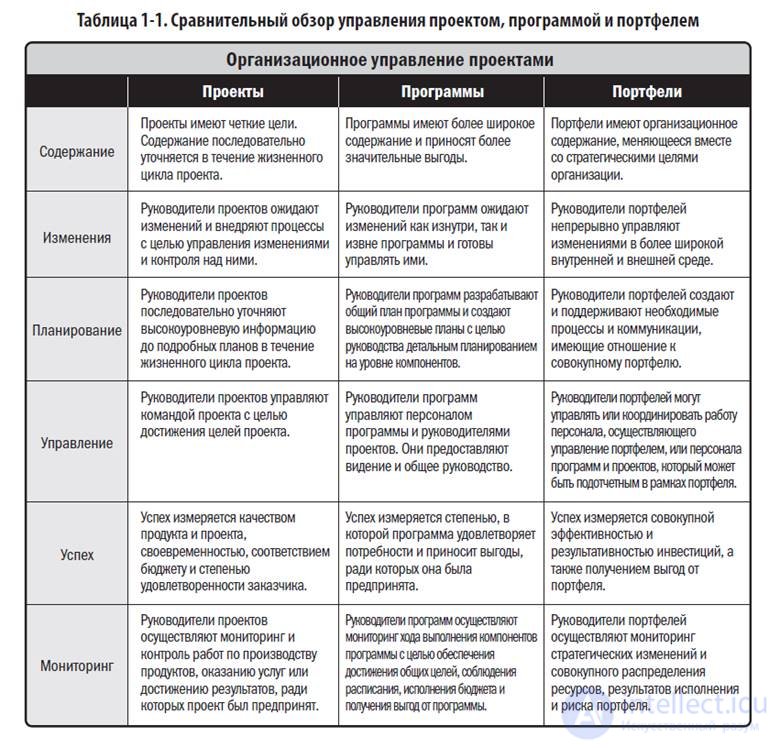
Program management is the application of knowledge, skills, tools and methods to a program to meet the requirements placed on the program and to obtain benefits and control that would not be available if the projects were managed separately.
Projects within a program are linked through a common end result or shared capabilities. If the only link between projects is a common client, seller, technology or resource, the effort should be managed as a portfolio of projects rather than as a program.
Program management focuses on the interdependencies of projects and helps determine the optimal approach to managing them.
An example of a program is a new satellite communications system, with projects to design the satellite and the ground stations for satellite communications, to build each of them, to integrate the system, and to launch the satellite.
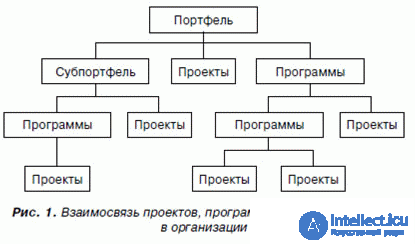
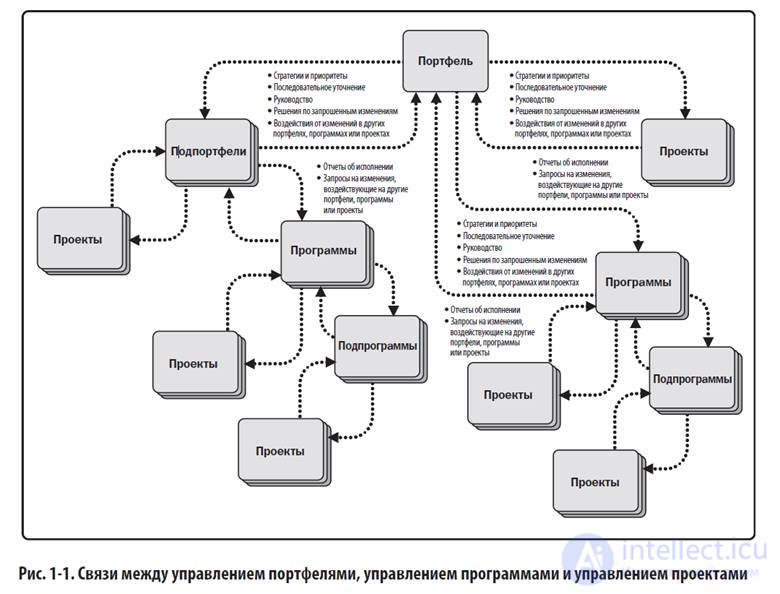
A portfolio is a set of projects, programs, subportfolios and operational activities managed as a group in order to achieve strategic objectives. Programs are grouped within a portfolio and consist of subprograms, projects and other work managed in a coordinated way in support of the portfolio. Individual projects that are either inside or outside a program are equally considered part of the portfolio. Although the projects or programs of a portfolio are not necessarily interdependent or directly related, they are linked to the organization's strategic plan through the organization's portfolio.
Portfolio management is the centralized management of one or more portfolios to achieve strategic objectives. Portfolio management focuses on ensuring that projects and programs are analyzed in order to set priorities for resource allocation, and on aligning and bringing portfolio management into line with the organization's strategies.
.
All three types of programs have goals that tie disparate projects together, and it is in this goal that the very synergy effect mentioned in the definition of a program resides.
These goals are closely tied to the performance indicators of the projects that make up the program. All of this makes it possible to decompose the program goal by breaking it into subgoals (subprograms or projects will be responsible for achieving them) that must unconditionally be met in order to achieve the program goal. For example, to create a new car you need to make a new engine, a new body, and so on. It turns out that the goal decomposition structure of a program will be part of the company's strategy. This is especially visible in programs related to the business cycle, because if the company uses a balanced scorecard, then parts of the interrelated indicators will be programs, and the internal links of the indicator system will be the structural decomposition of the program.
As a result, when choosing the "right" projects to make up a program, they can first be assigned to the decomposed parts of the program, and the choice of projects can then be made within each part, which greatly reduces the number of possible different programs that could be assembled from them. The internal dependencies of individual projects within the program will in this case only help with project selection and with balancing and allocating resources, because any dependency reduces the set of solutions from which a choice has to be made.
In innovative companies, such a decomposition of programs may correspond to the functional structure, because in these cases departments, as a rule, specialize in some stage of product development or in individual characteristics of the product, which simplifies the introduction of program management even further, since it allows part of the responsibility and work to be delegated to the departments.
Portfolio, program and project management form a hierarchical structure. At the top of the pyramid is portfolio management, which contains all the programs and projects, prioritized according to their business goals. Next comes program management, which contains many interrelated projects, since they support particular business goals. At the bottom is the project.
Project portfolio management is a process characterized by alignment with the direction of the business. Project management priorities are set through an optimization process appropriate to the organization. Risks and rewards are taken into account and balanced, and programs are selected on the basis of their fit with the organizational strategy. Oversight is provided by the execution of programs and projects, so the portfolio can be adjusted if necessary. Strategic changes can also trigger portfolio adjustments.
The key characteristic of program management is business support and funding. By definition, based on decisions made at the portfolio management level, programs are sponsored by business needs. A program takes ownership of benefits and is, by and large, measured by the achievement of those benefits. Programs may also have "benefit streams", or sets of interrelated benefits, such as increased R&D capabilities combined with greater market penetration, which cut across many functions of the organization. Because programs, being by nature composed of many projects, pass through the functions of an organization, they contain all the elements of a business system and are therefore oriented toward general management.
program management: Centrally coordinated actions undertaken to achieve the goals of a program and to realize (extract) its benefits."
Project management is concerned with delivering capabilities, usually defined within a program. Projects are driven by strategies, but they do not hold the strategic initiative, as programs do. Instead, a project receives inputs, then develops and implements a tactical plan. Monitoring and the final measurement of success are often based on tactical considerations, such as budget and schedule, rather than on the achievement of strategic business goals.
Program management is the process of managing several interrelated projects, aimed at improving the efficiency of resource use, reducing risks and completing each project successfully. In practice and in its goals, program management is closely related to systems engineering and industrial engineering.
The program manager oversees the goal and status of all projects in the program and can support activity at the project level to make sure that the overall goals of the program will be achieved, possibly by providing data for decisions that cannot be reached at the project level, or by conveying the program perspective to the project manager when needed, or by suggesting ideas and approaches to solving project problems that affect the program. As a rule, a program needs to identify and manage cross-project dependencies, and often the project portfolio management office is not familiar enough with the risks, problems, requirements, design or solution to deal with this effectively. The program manager supplies this information, learning it from the project managers, although in large and/or complex projects a separate role may be needed. Nevertheless, there is a growing understanding that the program manager needs information in order to be sure that the overall goals of the program are achievable.
Governance
The structure, process and procedure for controlling operations and performance-change objectives. Governance should include a set of metrics for measuring the condition and status of the program in the most important areas.
Alignment
The program must maintain the top-level vision, goals and objectives.
Assurance
Review and approve the program, and make sure that standards are followed and that the program conforms to the vision.
Leadership
Make sure that regular reviews are carried out, that accountability is in place, and that there is leadership of the projects, stakeholders and suppliers.
Integration
Make sure that the component parts fit together properly to form a proper whole. Optimize performance along the value chain, both functionally and technically.
Finance
Track the main costs together with the administrative costs of the program.
Infrastructure
Resource allocation affects costs and the success of the program. Infrastructure should cover offices, version control and IT.
Planning
Develop a plan, taking into account information about projects, resources, time constraints, monitoring and control .
Improvement
Continuously monitor performance, explore and develop new opportunities, and systematically apply learning and knowledge to the program.
There are two different views of how programs differ from projects.
On the one hand, the outcome of projects is a deliverable (physical goods or a service rendered) , while the outcome of programs is consequences . From this point of view, the outcome of a project might be a new plant, a hospital or an information system. By combining these projects with other deliverables and changes, their programs may lead to increased revenue from a new product, shorter queues at a hospital, or lower operating costs thanks to improved technology.
The other view is that a program is merely either a large project or a set (or portfolio) of projects. In that case, the purpose of using a program is to take advantage of economies of scale and to reduce coordination costs and risks. The project manager's task is to complete their project successfully. The program manager, on the other hand, may not be interested in individual projects, but is concerned with the aggregate result or end state. For example, a financial institution's program may include a project aimed at taking advantage of a growing market and another aimed at protecting against the downsides of a falling market. These projects are opposite in their successful outcomes, yet belong together to the same program.
According to the view in which the outcome of programs is consequences and that of projects is products, program management is concerned with doing the right projects. The program manager is compared to a chess player, and the projects are the pieces that are used or sacrificed . Project management, by contrast, is concerned with doing projects right. Also according to this view, successful projects are delivered on time, within budget and to requirements, while successful programs bring long-term improvements to the organization. Improvements are usually identified through the benefits they bring. An organization should choose the group of programs that most closely match its strategic goals while remaining within its capabilities. On the other hand, the view of a program as simply a large project or a set of projects implies that a program should quickly bring tangible benefits.
Consider the following set of projects:
According to one view, these are different projects within a program. But in practice they can also be subprojects within a single project. Which approach should be chosen? Both program management and project management are practical disciplines, so the answer to this question should be "whatever works", and that depends very much on the nature of the organization in which the project is carried out. As a rule, a program is broken down into projects according to the organizational structure. The design project is carried out by the design team, the plant manages the modification of the production line, and so on. Organizational structure and organizational culture are the key factors that determine how a program is built.
The difference between the terms "outcome" and "consequences" is not very clear except in the everyday sense. Each of the projects described above aims to create some "thing" known as an "output" or "product", and together they improve the organization. Where the line is drawn between the benefit that brings about an improvement and its component parts depends partly on preference and partly on the culture and structure of the organization. In any case, the benefits will be enjoyed for a long time after the program and all of its components have ended. The point is that, in order to achieve the maximum benefit, all the parts must be integrated into a single whole. What the process by which the integration takes place is called matters little compared with understanding its usefulness and managing the integration process well.
Many programs are concerned with creating a capability for change. The benefit arises only when that capability is handed over to line management and put to use by the parent organization. In other words, the program team cannot deliver the benefit itself. The benefit comes only from using the new capability.
Programs are usually created to fulfill strategic goals, for example, to become the fourth-largest supermarket in the region by 2015 or to reduce losses by 5% within two years.
According to Project Management Institute (PMI) standards, "A program is a group of related projects managed in a coordinated way to obtain benefits and control not available from managing them individually. Programs may include elements of related work outside the scope of the discrete projects in the program… Some projects of a program may deliver incremental benefits to the organization before the program itself is completed."
Program management also pays particular attention to coordinating and prioritizing resources across projects, managing the interdependencies between projects, and managing the overall costs and risks of the program.
Program management can be a layer above project management, focusing on selecting the best group of projects, assessing them against objectives, and providing an environment in which they will be executed successfully. Program managers should not interfere in the management of the individual projects themselves.
The main difference between program management and project management is the nature of a project itself — a project always has a specific end date; otherwise it is an ongoing program.
One view of the difference between a project and a program in business is as follows:
Another view, and another successful way of managing, does not accept the list above as the factors that distinguish projects from programs, but rather sees program management as the management of a portfolio of projects. From this point of view, program management is the process of selecting projects, regulating the pace of their execution, and regulating their scope, in order to maximize the value of the portfolio as economic or other external conditions change.
Yet another approach holds that program management is nothing more than one large and complex project, in which the integration aspect of project management is more important than in smaller projects. Integration management is the main feature of the Project Management Institute's approach to project management.
In practice, no clear dividing line is visible. Projects (or programs) can be small and simple, or large and complex. What is a project in one organization may be a program in another. It all depends on the culture within that organization.

Comments