
Lecture
A milestone in project management is a checkpoint, a significant, key moment (for example, a transition to a new stage or a new phase in the course of a project). As a rule, such a moment is associated with the completion of some key activity, the signing of important documents, or any other significant actions provided for by the project plan. A shift in a milestone leads to a shift of the entire project.
In addition to signaling the completion of some key stage, the term milestone is used to mean the making of an important, key decision that can change the whole course of the project. In this sense, milestones mark not only checkpoints of the process but also indicate the direction of movement.
A milestone is a checkpoint, an important moment, a stage. Historically, milestones were stone slabs indicating distances to settlements, which were placed along roads and served as a guide for travelers.
Milestones are tools used in project management to mark specific points on a project timeline. These points can signal anchors, such as the project start and end dates, or the need for an external review or verification of inputs and budget. Some product contracts include a "milestone payment", which may be paid when certain points are reached.
In many cases, milestones do not affect the duration of a project. Instead, they focus on the main points of progress that must be reached to achieve success.
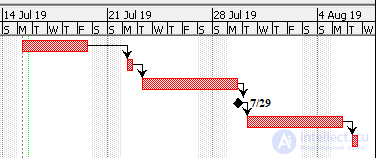
When a milestone is placed in project management software, it is treated as a task with zero duration and is shown with a special symbol (in this case, a black diamond).
Milestones can significantly increase the value of project planning. Combined with a planning methodology such as the Program Evaluation and Review Technique or the critical path method, milestones allow project managers to determine much more accurately whether a project is on schedule. By constraining the dates associated with milestones, a critical path can be determined for the major schedule intervals in addition to the whole project. Reserve/slack can also be calculated for each schedule interval. Such segmentation of the project schedule into intervals makes it possible to identify schedule problems earlier and to see better the activities whose completion is critical.
Milestones are similar to project dashboard reviews. A number of activities that were planned at the start of the project, with their individual deadlines, are checked for their status. This process also provides an opportunity to check the state of the project.
Milestones are often used to monitor progress, but there are limits to their effectiveness. They usually show progress only on the critical path and ignore non-critical activities. Resources are usually moved from non-critical activities to critical ones to ensure that milestones are met. This creates the impression that the project is on schedule when in fact some activities are being neglected.

Comments