
Lecture
Introduction
The Early Function Points method (a method for early prediction of the size of a future program) was proposed by Roberto Meli in 1997 (Italy), as shown in the works .
This method is notable in that the effort required to develop a project can be estimated at different levels of knowledge: from a superficial idea of how the program will work to a deeply detailed view of how the system works. The accuracy of the calculated values depends on the level of knowledge. With an approach based on detailed information about the system, the calculation will be more accurate and less subject to change in later stages of work on the project . In this example of calculating the effort of an IT project, the functions are used at the level of perception of the future project, so the calculations given are approximate and will be periodically revised as the project is developed.
The Early Function Points method involves estimating such objects as logical data elements, macrofunctions, functions, microfunctions and functional primitives .
Functional primitives are elementary processes that cannot be broken down further (input, output and query processes) [8-9].
Microfunctions are functional primitives (create, delete, update and retrieve) and data management functions.
Functions are functional primitives related to the operational needs of users.
Macrofunctions are functions related to the customer's system, to an entire application or to a part of it.
Logical data elements are a group of related data elements, classified into five levels of complexity: "low," "medium," "high," "complex," "very complex"
With a high level of knowledge about the future application, all of the listed objects are used. But for the example of a mobile application, ILF, EIF, EI, EO and EQ can be used. And the following algorithm should be followed:
Initial data
Let us determine what functions our mobile application for a coffee shop, intended to automate orders, will have:
The project tasks will include:
All data needed for the application to work is stored in a database. The program's database includes the following tables (Table 1).
Table 1. Structure and composition of the databases
|
Database name |
Number of fields |
|
Customer |
5 |
|
Staff |
4 |
|
Menu item |
4 |
Calculating the effort for developing a software product for a coffee shop
The application will consist of the following windows:
Following the Early Function Points method used and the base tables of rank and complexity assessment of the Function Points method, we will compile a table of information characteristics for further calculation (Table 2).
Table 2. Initial data for the calculation
|
Name |
Number of data elements |
Rank |
|
External inputs |
||
|
Screen with the authorization form |
2 |
3 |
|
Screen for entering registration information |
6 |
3 |
|
Screen for entering dish or drink information |
4 |
3 |
|
Name |
Number of data elements |
Rank |
|
Screen for entering staff information |
4 |
3 |
|
Main screen |
7 |
3 |
|
External outputs |
||
|
User profile |
5 |
4 |
|
External queries |
||
|
Dish or drink query |
1 |
3 |
|
Authorization validity query |
2 |
3 |
|
Menu query |
2 |
3 |
|
Staff roster query |
4 |
3 |
|
Order query |
3 |
3 |
|
Internal logical files |
||
|
User data |
5 |
7 |
|
Staff data |
4 |
7 |
|
External interface files |
||
|
Menu database |
4 |
5 |
|
Total |
53 |
Using the data from Tables 2 and 3, we calculate the number of function points using formula (1):
 , (1)
, (1)
where Fi are the complexity adjustment factors, taking integer values from 0 to 5 depending on the complexity of implementing the corresponding characteristic of the project (Table 3).
Table 3. Values of the system parameters
|
No. |
System parameter |
Value (Fi) |
|
1 |
Data communications |
3 |
|
2 |
Distributed data processing |
5 |
|
3 |
Processing performance |
3 |
|
4 |
Operational constraints |
3 |
|
5 |
Transaction rate |
4 |
|
6 |
Online data entry |
3 |
|
7 |
End-user efficiency |
4 |
|
8 |
Online update |
3 |
|
9 |
Processing complexity |
2 |
|
10 |
Reusability |
4 |
|
No. |
System parameter |
Value (Fi) |
|
11 |
Ease of installation |
2 |
|
12 |
Ease of operation |
2 |
|
13 |
Multiple sites |
3 |
|
14 |
Ease of change |
3 |
The total value of the complexity adjustment factors (Σ Fi) turned out to be 44.
Using formula (1), we calculate the number of function points:
FP = 53 × (0.65 + 0.01 × 44) = 57.77.
The resulting FP estimate is converted to a LOC estimate V using the following formula (2):
V = Klang × FP, (2)
where Klang depends on the programming language used to implement the software.
The development of this software project will use the C# programming language with a programming language coefficient (Klang) equal to 53, so the calculation is as follows:
V = 53 × 57.77 = 3061.81 LOC.
Based on the calculated number of lines of code (V), we classify this program as organic software. Accordingly, we take the coefficients N1 = 3.2; N2 = 1.05 and N3 = 0.38 from Table 4.
Table 4. Coefficients N1, N2, N3
|
Software type |
N1 |
N2 |
N3 |
|
Organic |
3.2 |
1.05 |
0.38 |
|
Semi-detached |
3.0 |
1.12 |
0.35 |
|
Embedded |
2.8 |
1.20 |
0.32 |
We calculate the nominal effort (without taking into account labor cost coefficients, cost factors and complexity) using formula (3):
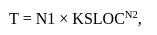 (3)
(3)
where KSLOC (thousands of lines) = V / 1000, and the values of N1 and N2 are determined from Table 4.
According to the data obtained, the effort of creating the mobile application is:

The development time is calculated using formula (4):
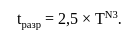 (4)
(4)
Using formula (4), we obtain the time to create the mobile application:
tdev. = 2.5 × TN3 = 2.5 × 10.36^0.38 = 6.08 months.
Following the recommended rule for distributing project costs, 40-20-40:
we obtain the time in months for developing the project (Table 5).
Table 5. Distribution of time costs
|
Phase |
Share of costs, months |
|
Analysis and design |
2.432 |
|
Coding |
1.216 |
|
Testing and debugging |
2.432 |
|
Total time costs |
6.08 |
Based on the data obtained, we can state that developing the mobile application for the coffee shop will require about 11 developers, 3062 lines of code and 6.08 months to create this software project under the conditions listed. As development proceeds, the data obtained will change, but at the initial design stage we can already estimate the effort for this software in this way.
Thus, we carried out a calculation using the Early Function Points method, as a result of which we determined the duration of application development, the required number of lines of code and the required number of developers for this project [13-14], even though the calculations and derivations of the Early Function Points method used here relied on information about functions that was not detailed to the precision that can be achieved at later stages of the software project life cycle.

Comments