
Practice
In this module we move from theory to practice. At this stage, students must apply the knowledge they've gained to recreate scenes, work with lighting, and assess the impact of artistic decisions on the player's perception of a scene. We will cover in detail:
How to recreate a film scene in a game engine.
Creating dynamic lighting that affects interactivity.
The特点 of lighting in the horror genre and its role in atmosphere.
Reviewing case studies of student work: strengths and areas for growth.
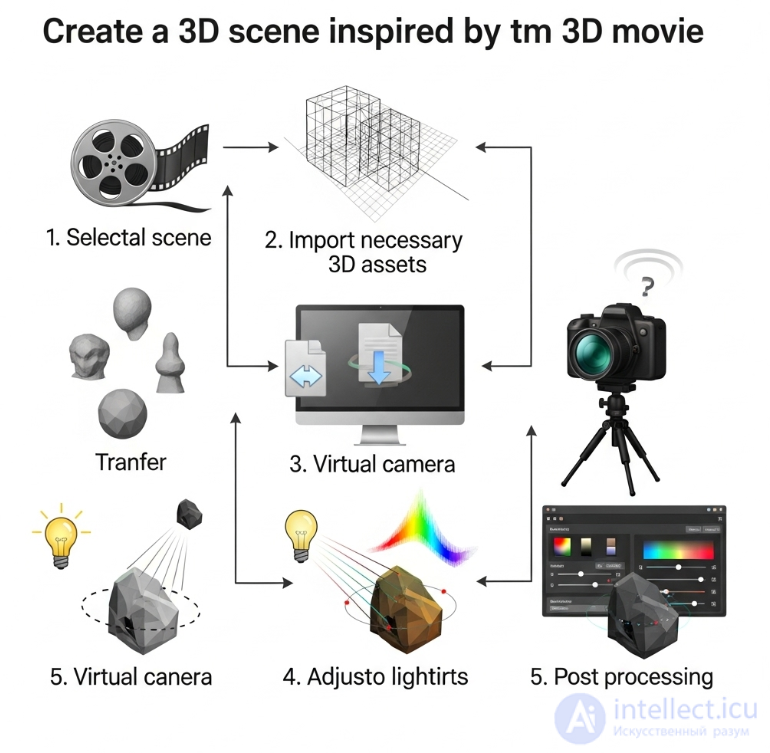
Goal: Convey the composition, atmosphere, and lighting scheme of the original cinematic scene.
Choosing a scene: It's best to pick a scene with clear composition and interesting lighting. Examples: Blade Runner 2049, The Revenant, The Shining.
Importing assets: Use ready-made 3D models or create your own. It's important to consider the style.
Camera positioning: Match the original's angle. Take focal length into account.
Lighting setup: Compare the reference and the scene. Use Spot Light, Area Light, and shadows.
Post-processing: Bloom, color correction, depth of field. Elements that make the scene «come alive».
Assignment: Choose a scene from a film, recreate it in a game engine, and achieve visual correspondence.
Goal: Add lighting to a scene that changes and reacts to the player's actions or events.
Event-based lighting: For example, a lamp turns on when entering a room.
Day/Night Cycle: Dynamic sun, changing shadows, sky transitions.
Gameplay lighting: Fire, flashes, signal lights that react to the game's state.
Light Probes and Reflection Probes for dynamic GI.
Scriptable Lighting — controlling light through code.
Light Layers and Masking — separating lighting by object.
Assignment: Implement a scene in which lighting changes based on the player's actions.
Horror — a genre whose goal is to evoke a feeling of anxiety and fear,
usually aimed at creating tense gameplay and scaring the player along the way.
Nostromo is generally considered the first game of the genre.
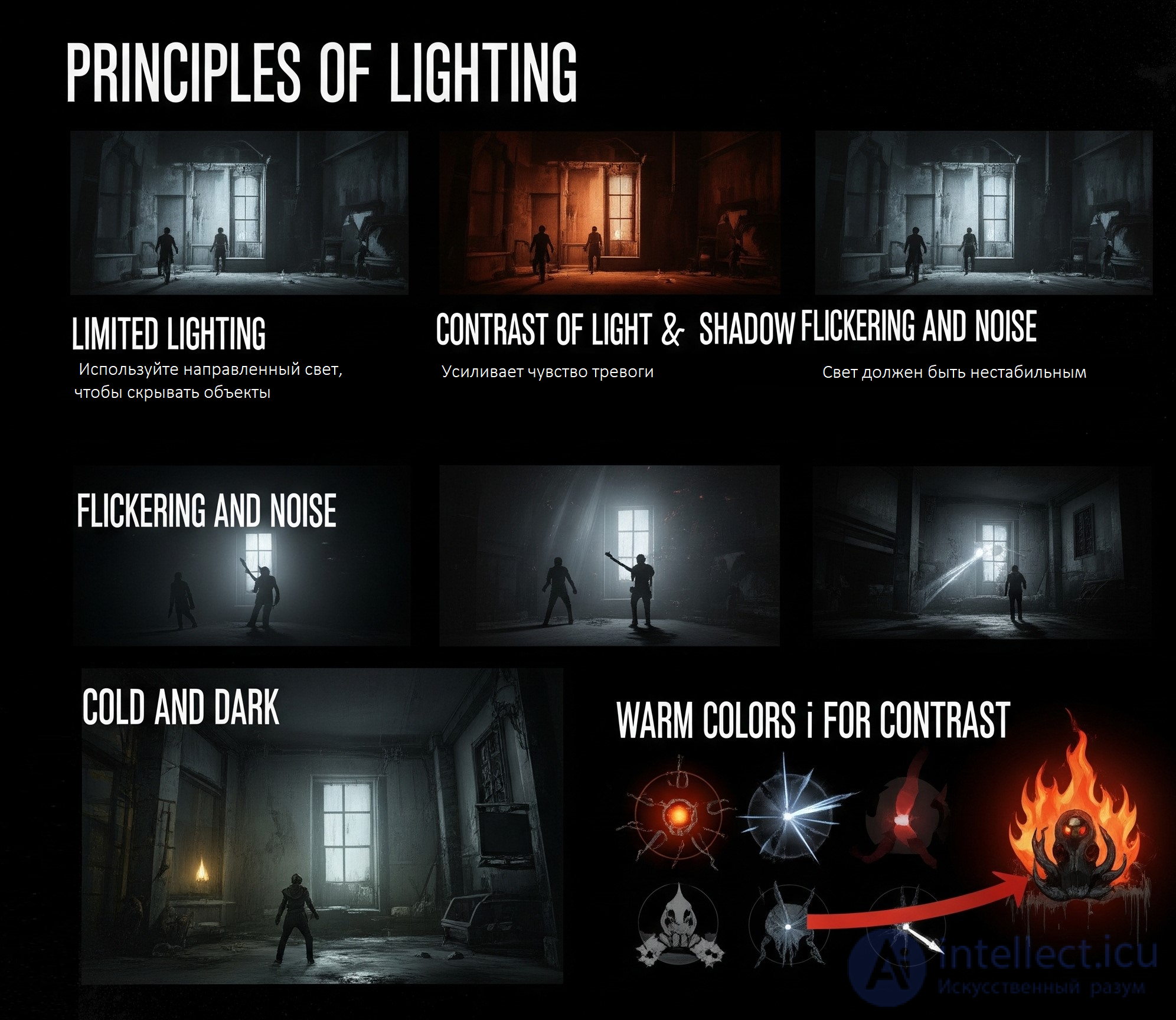
Key idea: In horror, light is a tool not only visually, but psychologically as well.
Limited lighting: Use directional light to conceal objects.
Contrast between light and shadow: Heightens the feeling of anxiety.
Flicker and noise: The light should be unstable.
Color palette: Cold and gloomy tones. Sometimes warm tones — for contrast.
Amnesia: The Dark Descent — total absence of lighting as a mechanic.
Silent Hill 2 — fog and diffused light create a sense of the unknown.
Outlast — the camera as the only light source.
Assignment: Create a short horror-style scene with a special focus on lighting.
Overlit or underlit scenes: Loss of atmosphere and depth.
Inconsistencies in shadows: Breaks realism.
Lack of logical light sources: Makes the scene implausible.
Visual correspondence to the reference.
Effectiveness of lighting for the narrative.
Use of the engine's technical tools.
Creative approach.
Constructive criticism: Point out what works and what doesn't.
Alternative solutions: Suggest ways to improve the scene.
Highlighting strengths: It's important to note what was done well.
In this module, you must not simply create a scene, but consciously use light as a means of directing the player's attention, emotions, and perception. The ability to work with lighting is one of the most important skills in game visualization.
1. What is the process called in which light scatters in the atmosphere?
2. Which color has the shortest wavelength in the visible spectrum?
3. What type of light source is used to simulate the sun in 3D scenes?
4. What lighting technique creates soft shadows and even illumination?
5. Which type of light is best suited for accent lighting in scenes?
6. Which effect is used to create volumetric light in games?
7. Which lighting method allows reflections to be calculated in real time?
8. What does the term PBR mean in lighting?
9. What type of lighting is used to create shadows that don't change over time?
10. Which type of light is best suited for lighting interiors?
11. Which color tone is often used to create a tense atmosphere in film?
12. Which lighting optimization method helps reduce the load on the processor in games?
13. Which type of light source is used to create realistic shadows in Unity?
14. Which effect is used to create bright glare around light sources?
15. Which type of lighting is best suited for creating realistic reflections on water?
16. Which type of lighting is used to create a soft-light effect in interiors?
17. Which color is most often associated with a cold atmosphere in film?
18. Which lighting method allows realistic shadows to be created in real time?
19. Which type of light source is used to simulate a light bulb in scenes?
20. Which effect is used to create a soft glow around bright objects?
21. Which type of lighting is used to create shadows that change depending on the movement of objects?
22. Which method is used to precompute lighting in game engines?
23. Which color tone is often used to create a warm and cozy atmosphere?
24. Which type of light is best suited for lighting large open spaces?
25. Which effect is used to create realistic shadows in the crevices of objects?
26. Which lighting method accounts for the physical properties of materials?
27. Which type of light source is used to create directional light with a clearly defined area?
28. Which color tone is often used to create a mystical atmosphere?
29. Which lighting method allows realistic reflections to be created on metallic surfaces?
30. Which type of light is used to create soft and even lighting in scenes?

Comments