
Lecture
Lighting is one of the most important tools of visual storytelling in film and games. It not only shapes the overall visual perception of a scene, but also performs a range of functions: from directing attention and creating mood to building spatial depth and emphasizing dramatic moments. Understanding the specifics of lighting in different types of locations allows an artist, cinematographer, or technical specialist not simply to imitate "realistic" light, but to consciously control the viewer's or player's perception.
In film, lighting is used to create a particular mood, emphasize genre features and visual style. In game projects it is further shaped by the technical constraints and capabilities of the engine, as well as the need to guide the player's attention while preserving interactivity and freedom of movement.
Typical locations — such as city streets, forests, dungeons, building interiors, sci-fi stations, or fantasy castles — form the visual backbone of most projects. Each of them requires a distinct approach to lighting, taking into account its style, storytelling goals, and technical execution. For example, a scene in a dark forest might use diffuse moonlight along with point sources such as campfires or lanterns to create an atmosphere of uncertainty and unease. Meanwhile, the interior of a futuristic laboratory might need harsh cold light with soft shadows and dynamic effects.
It is also important to consider the difference in approach between cinema and games. In film, the camera and point of view are predetermined, which allows a lighting scheme to be carefully built for a specific shot. In games, on the other hand, the camera is often controlled by the player, meaning the lighting must be universal, adaptive, and yet still not lose its artistic intent.
In this lecture we will look at the key principles of lighting in typical locations, compare approaches in film and games, and discuss techniques for enhancing a scene's emotional impact through light. Special attention will be given to reference analysis, narrative context, working with color, and the directionality of light sources. This will help not only deepen understanding of the visual language, but also expand the practical toolkit for creating expressive and memorable scenes.
The behavior of light over the course of a day is the result of the interaction of sunlight with Earth's atmosphere, the Sun's position above the horizon, and scattering characteristics. Below is a brief description of how light behavior changes during the day, evening, and night:
During the day
Light source: direct sunlight.
Character of the lighting:
Bright, directional.
Color — white or slightly yellow (depending on the Sun's altitude).
Shadows are sharp and high-contrast.
Reason: the Sun is high in the sky, its rays travel a minimal path through the atmosphere, scattering very little.
In the evening (sunset, twilight)
Light source: the Sun is approaching the horizon or has already gone below it.
Character of the lighting:
The light becomes softer.
Color — warm: from yellow to red.
Long shadows.
Reason:
The angle of incidence of sunlight is smaller, the path through the atmosphere is longer.
Short-wavelength blue and violet light is scattered away, leaving warm tones.
Twilight:
Gradual disappearance of direct sunlight.
The light becomes diffuse, weak, the sky — bluish-gray.
At night
Light source:
The Moon, stars, artificial lighting (in cities).
Character of the lighting:
Dimly lit or dark.
Color — blue-gray, cool.
Shadows are soft or absent (if there is no bright source).
Reason: absence of direct sunlight. The night sky may be lit by light pollution.
Definition:
The period lasting approximately the first hour after sunrise and the last hour before sunset, when the sun is low above the horizon.
Light characteristics:
Soft, warm (golden-orange) light.
Long, soft shadows.
High photogenic quality — ideal for portrait and landscape photography.
Reason:
Sunlight passes through a thicker layer of atmosphere → blue and violet rays are scattered → warm tones dominate.
Definition:
The period after sunset and before full darkness, or before sunrise, when the Sun is below the horizon at an angle of roughly 4° to 6–8°.
Light characteristics:
Cool tones (blues, violets).
Even, diffuse illumination.
Good balance between natural and artificial light.
Reason:
The Sun is below the horizon, but its light is still scattered in the upper layers of the atmosphere, giving the sky a rich blue color.
Exposure is the amount of light that reaches the camera's light-sensitive element (sensor or film). It determines how light or dark the resulting image will be.
The main parameters that affect exposure:
Shutter speed
The length of time during which light hits the sensor.
Longer shutter speed → more light → brighter frame.
Shorter shutter speed → less light → darker frame.
Aperture
The opening in the lens.
Denoted as f/number (for example, f/2.8, f/11).
A smaller number (wider opening) → more light.
Light sensitivity (ISO)
The sensitivity of the sensor.
Higher ISO → brighter image, but more noise.
Exposure refers to the amount of light that reaches the light-sensitive photographic material over a given period of time.
The three main parameters affecting exposure are sensitivity, shutter speed, and aperture.

A demonstration of the effect of shutter speed on a photograph. As shutter speed increases with aperture held constant, exposure increases

Key features:
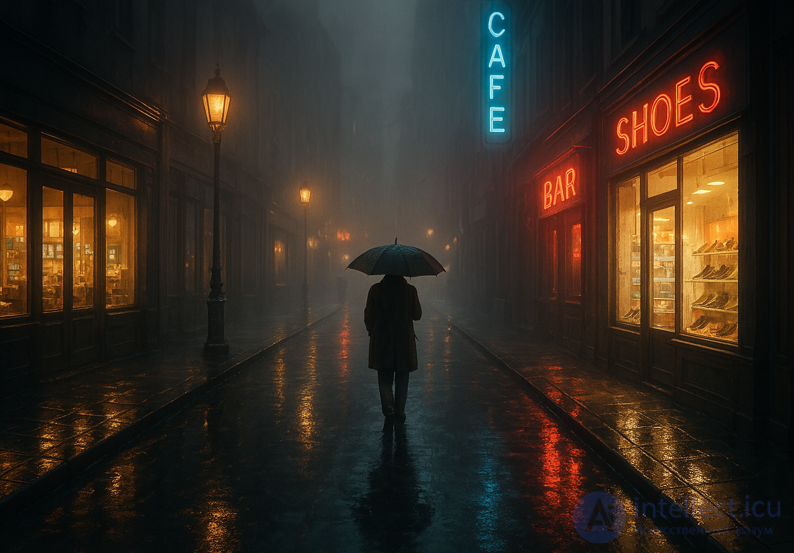
Shop window lighting: Often used as a local bright light source. Color temperature can range from warm (yellowish) to cool (bluish-white). It's important to account for reflections on wet asphalt and glare on glass.
Street lamps: The main source of lighting at night. Usually yellow or white. Work well combined with soft diffusion through fog.
Neon signs: Bright color accents. They add visual richness and are often used to establish a stylistic mood (especially in cyberpunk settings).
Atmospheric conditions:
Rain: adds reflections and mirror-like surfaces, enhancing the scene's depth.
Fog: scatters light, creates a soft "glow" around light sources, and reduces contrast.
Practice: Use combined lighting (neon + street lamps + reflections) to achieve a lively urban scene.
Types of lighting:
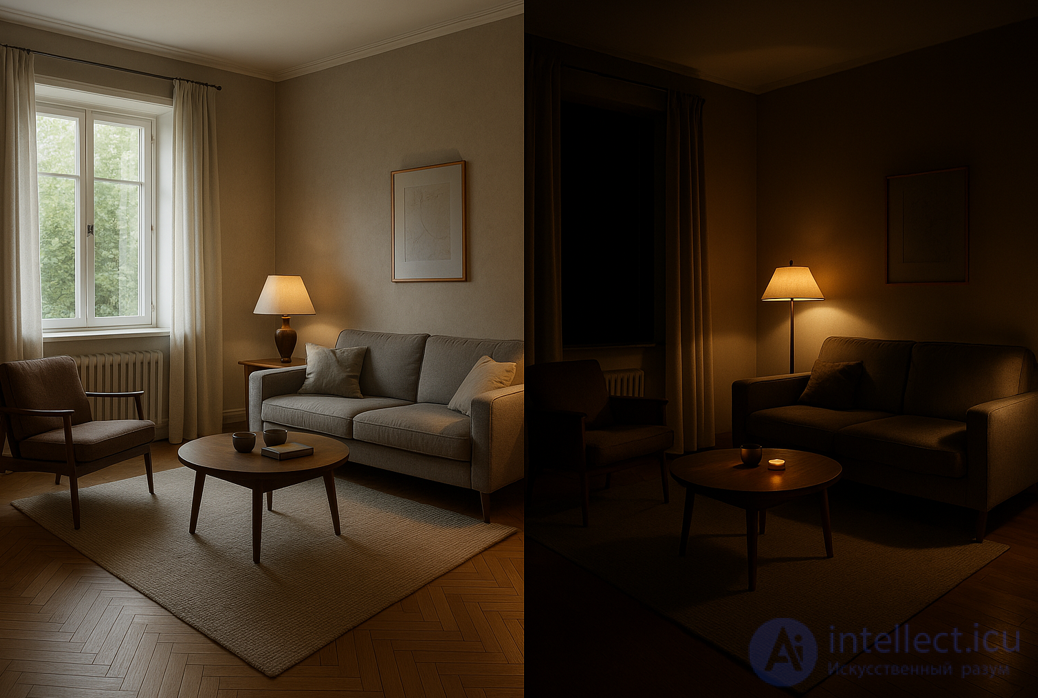
Daylight: Through windows and gaps. It's important to consider the angle of incidence and shadows cast by frames. Adds realism through soft natural lighting.
Night interior: Usually built around point sources — lamps, desk lights, screens.
Artificial light: Should match the type of space (office, apartment, warehouse). Color temperature ranges from cool (offices) to warm (home settings).
Shadow dynamics: Shadows from moving objects, the play of light from a TV or streetlight, add realism to the scene.
Tip: Watch the balance of light and shadow. Lighting that's too even makes a scene look flat.
Lighting context:
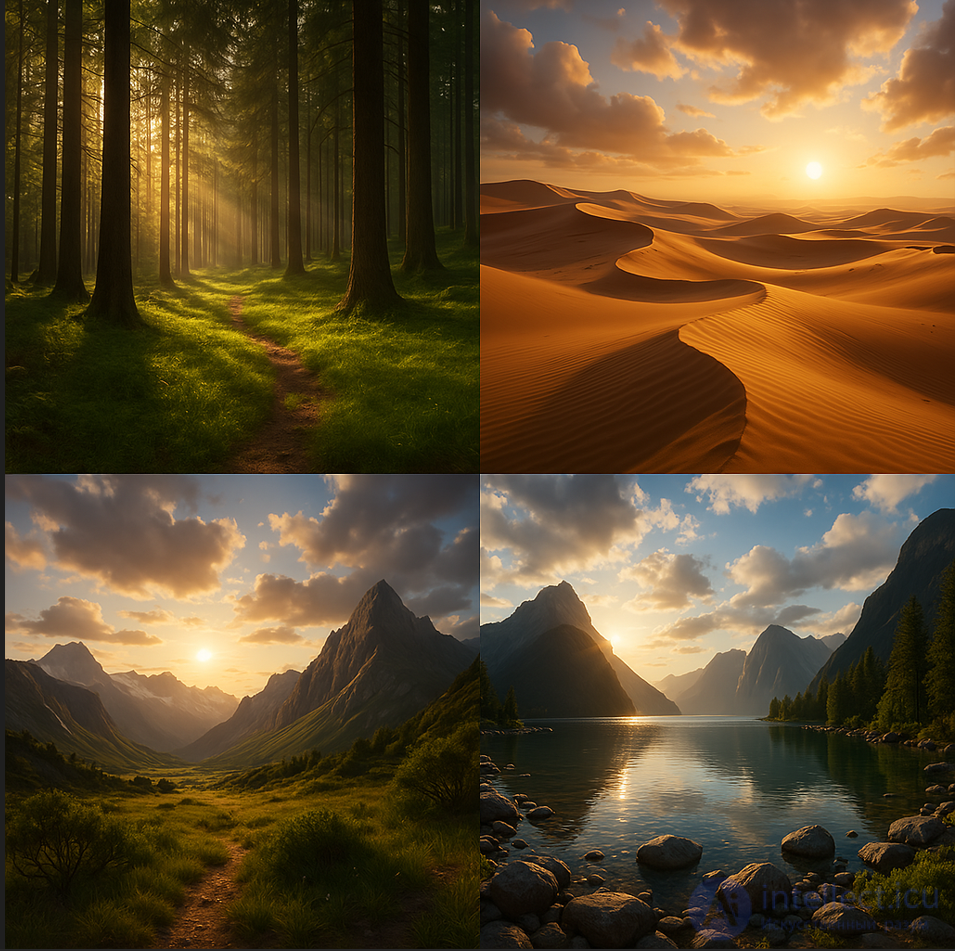
Forests: Light passes through foliage, creating dappled shadows. Morning/evening light adds a warm palette.
Deserts: Harsh, blinding light, strong contrasts. Little shelter from the sun. Shadows are sharp and short.
Mountains: Light can change abruptly due to clouds. Emphasis on light-and-shadow dynamics. Overexposure effects on peaks.
Water: Reflection and refraction. Glare, sun reflections, moving shadows from waves.
Practice: Use volumetric lighting to add a sense of space and air.
Lighting tasks:
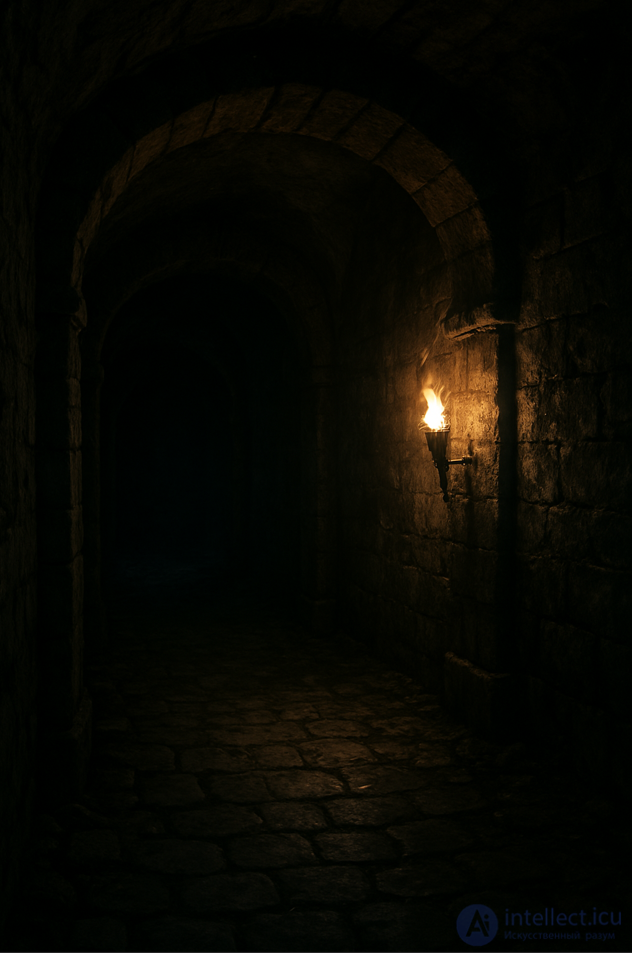
Gloomy atmosphere: Minimal light, local sources (torches, lamps). Dense shadows and high contrast.
Light accents: Help direct the player's attention. Used to highlight objects and paths.
Anxiety: Use pulsating light, flickering, red hues. Light that doesn't fully reveal objects works effectively.
Tip: Don't over-light dungeons. The less that's visible — the tenser the atmosphere.
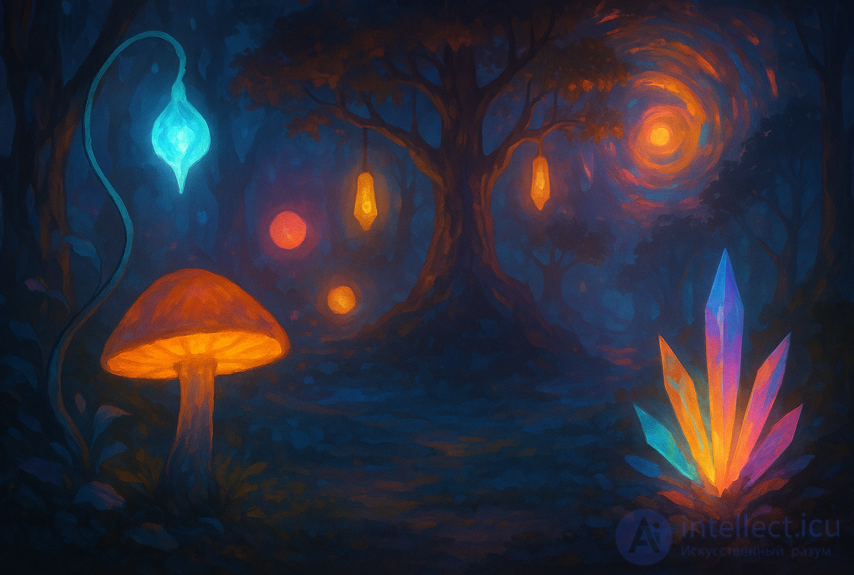
Features:
Unusual light sources: Glowing plants, magic, energy crystals.
Color perception: Departure from familiar color schemes (for example, a blue sun instead of a yellow one).
Abstract lighting: Light may have no obvious source, seeming to come "from thin air" — this works in surreal and stylized worlds.
Practice: The key is internal logic. Even fantastical light must remain consistent within the world's rules.
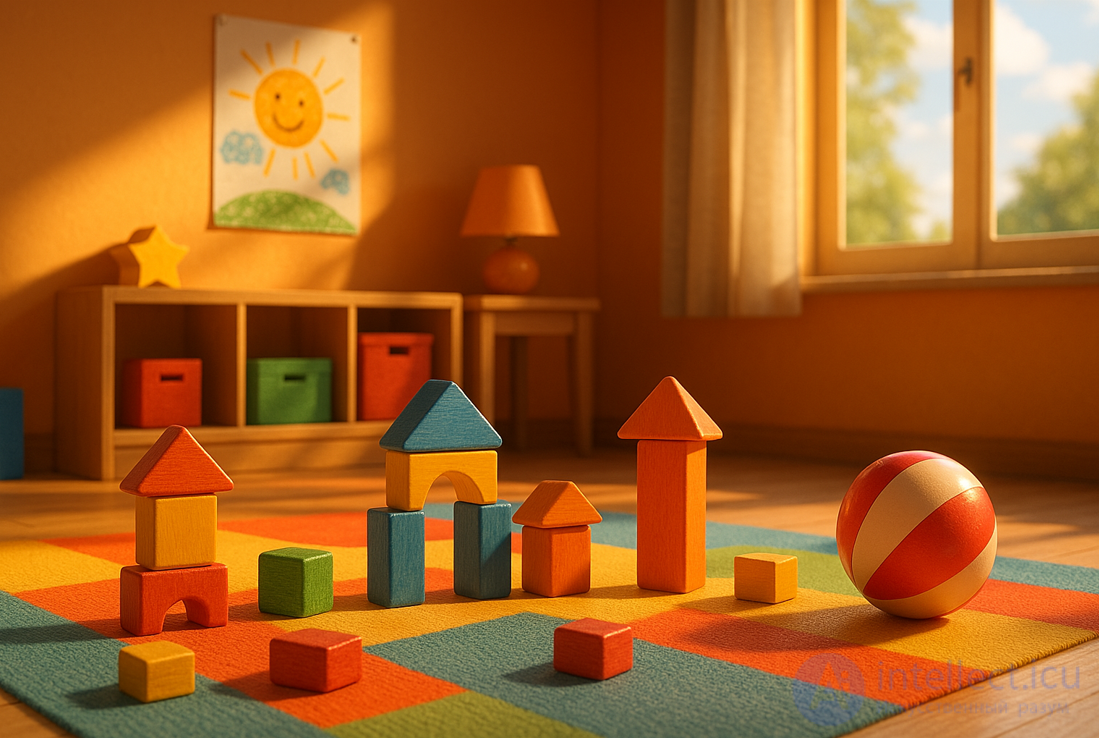
Lighting in children's games requires a special approach: it must not only be visually appealing, but also contribute to comfort, safe perception, and the child's emotional engagement.
Brightness and contrast
Lighting should be bright enough, but not blinding. A high level of scene readability is a key factor for perception by children, especially younger ones.
Soft shadows
Avoid harsh shadows and high contrast — they can frighten or tire children. It is better to use soft diffused lighting with smooth transitions.
Warm color palette
Warm tones (yellow, orange, pink) create a feeling of coziness and joy. Cold light (blue, gray) is used sparingly — more often in neutral or night scenes.
Fairy-tale and cartoon quality
Children's projects often use unrealistic light sources: glowing animals, objects, magical items. This supports an atmosphere of magic and fantasy.
Minimizing fear and anxiety
Avoid darkness and unclear flickering sources. Even if the game features night scenes, they should be «friendly» lit: for example, soft moonlight, fireflies, night lights.
Directional lighting as a gameplay cue
Light can direct attention: showing where to go, what to activate, what to pay attention to. This is especially important in games for young children, where intuitiveness matters more than the interface.
Examples of lighting by scene type
House or room
Bright lighting from windows, light bulbs, floor lamps. Interiors without harsh shadows. Soft daylight effects.
Natural scene
The sun — soft and large. Shadows — barely noticeable. Everything looks like a drawn fairy tale. Colors — saturated, but not acid-toned.
Magical worlds
Rainbow or glowing objects. Colored lighting with gradual transitions. Magical glowing paths, flying lights.
Night scenes
Muted but colored light is used: purple, blue, pink. Animations are often used to make the light «alive» and not frightening.
Use ambient light for general uniform illumination.
Avoid strong specular highlights — they can irritate children.
Apply post-processing with bright colors and a bloom effect for magical objects.
Limit shadows from multiple sources — they can create visual noise.
| Genre | Lighting |
|---|---|
| Horror games | Limited lighting, contrast, flickering light, emphasized shadows. Light is often used as a gameplay element (flashlight, flashes). |
| Platformers | Clear outlines, bright colors, emphasis on the main character and path. Lighting helps with orientation. |
| Realistic simulators | Maximally accurate physical lighting (global illumination, PBR materials). Realism — the main benchmark. |
| Stylized indie games | Stylized, expressive lighting. Often used for atmosphere and emotion rather than physical accuracy. |
Lighting — is not just a technical element, but an expressive tool of the artist and game designer. In every location and genre it serves a different purpose: to direct, to impress, to frighten, or to calm. Skillful combination of color, shadows, and light sources helps create unique, memorable game worlds. Lighting is the most important means of expression in visual media, and its skillful use directly affects the perception of the scene, mood, atmosphere, and interaction with space. The typical locations examined in the lecture allow us to identify the key features and approaches that should be considered when creating realistic, emotional, or stylized lighting.
City streets require a comprehensive approach to lighting: combining cool street lighting with the warm glow of shop windows, flickering neon signs, and reflections on wet asphalt creates a vivid, dynamic atmosphere. Additional effects such as rain or fog significantly enhance the depth and drama of the scene, intensifying the contrast between light sources and the surrounding environment.
Interior spaces are distinguished by a high level of detail and a variety of lighting scenarios. Daylight streaming through windows creates soft, diffused shadows, while nighttime or artificial lighting can be directional, localized, or decorative. Here, it's important to work with contrast, the color temperature of light sources, and the dynamics of shadow depending on the time of day.
Natural outdoor landscapes obey the laws of natural lighting. Sunlight passing through foliage, reflections off snow or water surfaces, soft plays of light from clouds — all of this requires careful work with color, diffusion, and the direction of light. Lighting should emphasize the scale of the space and the depth of the scene while maintaining realism.
Dungeons and enclosed spaces are the opposite of open locations by nature. Darkness dominates here, and every light source (a torch, a lamp, a crack letting in daylight) becomes a meaningful accent. Lighting is used to guide attention, create a sense of danger and tension, and highlight paths and objectives.
Fantastical and stylized worlds open up possibilities for abandoning realism in favor of expressiveness. Light can emanate from magical objects or surfaces, or even be abstract — governed not by the laws of physics but by the laws of artistic intent. Color here becomes a full-fledged tool for conveying emotion and meaning.
Games for children require soft, warm, and safe lighting. Bright colors, smooth gradients, and simplified shadow schemes are often used. Light should not frighten or create tension; it serves to orient the player, emphasize the pacing of the game, and create a positive perception. In children's games, lighting is not just a technical element but part of the narrative and emotional safety. It should be simple, clear, fairy-tale-like, and friendly. Well-designed lighting helps a child navigate the game world without getting tired or scared, and instead encourages curious exploration and play.
Genre specifics play a decisive role: in horror games, light is used sparingly to create fear and uncertainty; in platformers, it highlights gameplay elements and directions of movement; in simulators, it conveys the surrounding world convincingly; in indie games, it serves as part of the author's style, often exaggerated or experimental.
To summarize, lighting is not merely a technical element of a scene, but a full-fledged artistic and narrative tool. It should be meaningful, contextual, and serve the overall goal — whether that is conveying a realistic environment, creating a unique atmosphere, or emphasizing dramatic tension. Understanding the characteristics of lighting in typical locations gives content creators a powerful tool for managing the attention, emotions, and perception of the viewer or player.

Comments