
Lecture
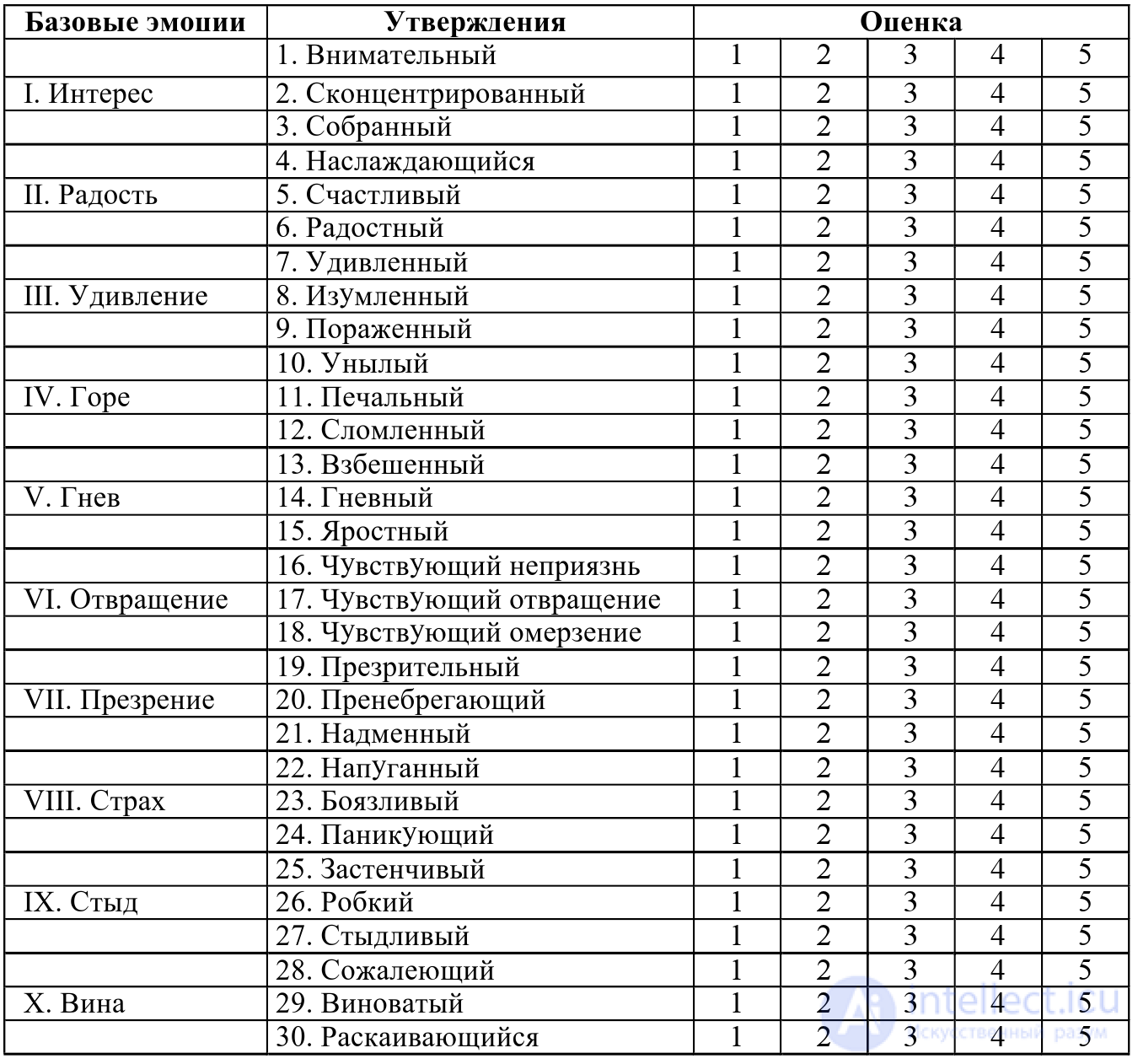
This method was developed by the well-known American psychologist C. Izard as an application of his theoretical concept, which advances the idea that there are 10 basic emotions that form the foundation of a person's entire emotional life. They are the emotions of interest, joy, surprise, grief, anger, contempt, disgust, fear, shame, and guilt.
The method includes 30 scales, presented as adjectives corresponding to different shades of emotional experience. To assess each of the 10 basic emotions, three sub-scales are used, arranged in the following order:
1. Interest (items 1-3); 2. Joy (items 4-6); 3. Surprise (items 7-9); 4. Grief (items 10-12); 5. Anger (items 13-15); 6. Disgust (items 16-18); 7. Contempt (items 19-21); 8. Fear (items 22-24); 9. Shame (items 25-27); 10. Guilt (items 28-30).
In this method all scales are direct, i.e. higher scores on them correspond to a greater intensity of the emotional experience.
Instructions. "Before you is a list of adjectives that describe different shades of the various emotional experiences of a person. To the right of each adjective is a row of numbers from 1 to 5, corresponding to increasing degrees of intensity of the given experience. We ask you to assess how characteristic each of the listed experiences is of you at the present moment by crossing out the corresponding number. Do not think too long over your choice of answer: your first impression usually turns out to be the most accurate!"
Your possible ratings:
1 - the experience is completely absent; 2 – the experience is slightly expressed; 3 – the experience is moderately expressed; 4 – the experience is strongly expressed; 5 – the experience is expressed to the maximum degree.
|
1 |
1 2 3 |
Attentive Concentrated Focused |
12345 12345 12345 |
|
2 |
1 2 3 |
Delighted Happy Joyful |
12345 12345 12345 |
|
3 |
1 2 3 |
Surprised Amazed Astounded |
12345 12345 12345 |
|
4 |
1 2 3 |
Gloomy Sad Broken |
12345 12345 12345 |
|
5 |
1 2 3 |
Enraged Angry Furious |
12345 12345 12345 |
|
6 |
1 2 3 |
Feeling dislike Feeling disgust Feeling revulsion |
12345 12345 12345 |
|
7 |
1 2 3 |
Contemptuous Disdainful Haughty |
12345 12345 12345 |
|
8 |
1 2 3 |
Frightened Fearful Panicking |
12345 12345 12345 |
|
9 |
1 2 3 |
Bashful Timid Ashamed |
12345 12345 12345 |
|
10 |
1 2 3 |
Regretful Guilty Remorseful |
12345 12345 12345 |
Positive emotions index_______________________________
Acute negative emotions index_________________________
Anxiety-depressive manifestations index_________________
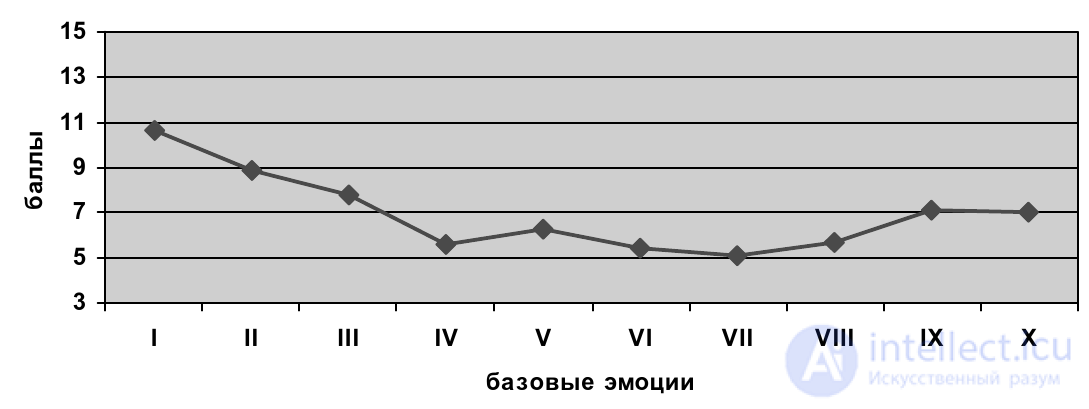
Data processing for the "Differential Emotions Scale" includes two stages. In the first, scores for each of the 10 basic emotions are calculated. This is done by summing the points on the three scales describing the manifestations of the corresponding emotions. The result is 10 indicators, each of which can range from 3 to 15 points. The accepted way of presenting these indicators is to construct an "emotion profile" in a coordinate system: the names or numbers of the basic emotions are plotted on the abscissa axis, and the scores obtained for each of them on the ordinate axis.
In the second stage, generalized indicators for enlarged groups of emotions are calculated.
Positive emotions index (PEI) – characterizes the degree of the subject's positive emotional attitude toward the present situation. It is calculated as the sum of the points on the first three blocks of basic emotions:
PEI=∑1,2,3 (interest + joy + surprise).
PEI values can range from 9 to 45 points.
Acute negative emotions index (NEI) – reflects the overall level of the subject's negative emotional attitude toward the present situation. It is calculated as the sum of the points on the next four blocks of basic emotions:
NEI=∑4,5,6,7 (grief + anger + disgust + contempt).
NEI values can range from 12 to 60 points.
Anxiety-depressive emotions index (ADEI) – reflects the level of relatively stable individual experiences of the anxiety-depressive complex of emotions, which mediate the subjective attitude toward the present situation. It is calculated as the sum of the points on the last three blocks of basic emotions:
ADEI = ∑ 8, 9, 10 (fear + shame + guilt).
ADEI scores can range from 9 to 45.
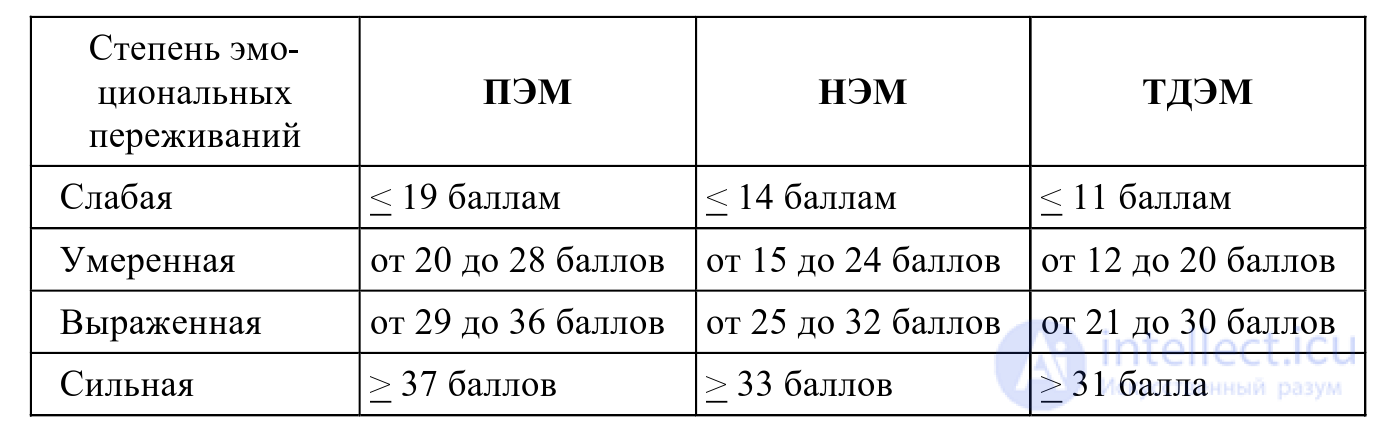
Interpretation of results.
|
Degree of emotional experiences |
PEI |
NEI |
ADEI |
|
Weak |
≤19 points |
≤14 points |
≤11 points |
|
Moderate |
From 20 to 28 points |
From 15 to 24 points |
From 12 to 20 points |
|
Pronounced |
From 29 to 36 points |
From 25 to 32 points |
From 21 to 30 points |
|
Strong |
>36 points |
>32 points |
>30 points |
+In addition to the general characterization of the degree of expression of the main types of emotional experiences, a qualitative analysis of specific kinds of emotions is carried out, which mediates the emotional coloring of current activity. To do this, the main peaks are identified on the emotion profile and related to the level of representation of the other emotions.
Processing of results
The data processing procedure for this method includes two stages.
At the first stage the scores for each of the 10 basic emotions are calculated – for this, the points on the three scales describing the manifestations of the corresponding emotions are summed. The result is 10 indicators of the basic emotions, each of which can range from 3 to 15 points.
Using the indicators obtained, an "emotion profile" can be constructed, where the names or numbers of the basic emotions are plotted on the abscissa axis, and the scores obtained for each of them on the ordinate axis. The figure shows a sample profile of basic emotions.
At the second stage generalized indicators for enlarged groups of emotions are calculated:
1) the positive emotions index (PEI), characterizing the degree of the subject's positive emotional attitude toward the present situation:
PEI = ? (Interest + Joy + Surprise);
2) the acute negative emotions index (NEI), reflecting the overall level of the subject's negative emotional attitude toward the present situation:
NEI = ? (Grief + Anger + Disgust + Contempt);
3) the anxiety-depressive emotions index (ADEI), determining the level of relatively stable individual experiences of the anxiety-depressive complex, which mediate a person's subjective attitude toward the present situation:
ADEI = ? (Fear + Shame + Guilt).
Ranges of score variation
The values of the indicators for this method can vary within the following ranges: PEI – from 9 to 45 points, NEI – from 12 to 60 points, ADEI – from 9 to 45 points.
Interpretation of results
Interpretation of the data on the generalized indicators of the DES method is carried out taking into account the following gradations for each of the indices:

Comments