
Lecture
Joy is an inner feeling of satisfaction, pleasure, cheerful mood and happiness; also a term of endearment.
It is a positive inner motivation for a person. Joy is considered the opposite of sadness and sorrow.
Joy is one of the basic human emotions. It plays an important role in a person's life and affects their biochemistry and psychological state. Let us look at joy from the standpoint of biochemistry and psychology.
Dopamine: Dopamine is one of the key biochemical factors associated with joy and pleasure. This neurotransmitter is released in the brain and is linked to a feeling of satisfaction. When a person experiences joy, the level of dopamine in the brain rises, creating a pleasant feeling.
Serotonin: Serotonin is another neurotransmitter that plays an important role in regulating mood. Low serotonin levels may be associated with depression and anxiety. Raising serotonin levels can produce a feeling of joy and improve mood.
Oxytocin: Oxytocin, known as the "love hormone" or the "touch hormone", can also be associated with a feeling of joy. It is released in response to pleasant social interactions, such as hugs, kisses and time spent with loved ones.
Joy can be separated from satisfaction and pleasure and even contrasted with them. Joy, as a "higher" feeling, is linked in the "soul" versus "body" opposition with the soul, while pleasure, as merely a "sensation, a reaction", is linked with the body. There is joy of contemplation, joy of movement, joy in sadness, joy of company, joy of knowledge, joy of beauty, joy of life, and, sometimes associated with the last of these, causeless joy.
Joy is an emotion that most people want to experience. You like being joyful. You feel wonderful. Whenever possible, you choose situations in which you will feel happy. You can arrange your life so as to experience joy as often as possible. Joy is a positive emotion. By contrast, fear, anger, disgust and sadness are negative emotions, and most people take no pleasure in them. Surprise is neither positive nor negative. To understand the experience of joy, we need to show how it differs from two related states that often occur together with it: pleasure and excitement.
Positive emotions: Joy is one of the positive emotions that help improve a person's psychological state. It helps reduce stress and fight negative emotions.
Motivation and reward: A feeling of joy can serve as motivation to repeat certain actions. For example, when a person feels joy after reaching a goal or completing a task, this strengthens their motivation to do it again in the future.
Social connections: Joy can be tied to social connections and interactions. Sharing joy with other people can strengthen social bonds and create a positive atmosphere.
Better physical health: Positive emotions, including joy, can have a beneficial effect on a person's physical health. They can strengthen the immune system and reduce the risk of various diseases.
A subjective sense of happiness: Joy is part of the overall subjective sense of happiness. It contributes to a better quality of life and a sense of well-being.
We will consider only those facial expressions of joy that are not accompanied by laughter, because when a person laughs, it is not at all difficult to tell that he is joyful. Even a silent expression of joy is fairly easy to recognize, except perhaps in cases where the face shows a mixture of emotions. The ease of recognizing expressions of joy has been demonstrated in studies conducted in a wide variety of cultures.
The eyelids and the lower part of the face have a characteristic appearance, while the brows and forehead do not necessarily take part in creating an expression of joy. In Fig. 1 the young man shows three facial expressions of joy. In each case the corners of his mouth are drawn back and slightly raised. In the smile the lips may remain closed (A), the lips may part while the jaws and teeth stay closed (B), or the mouth may be slightly open (C). In a full-mouth smile only the upper teeth may show, or the upper and lower teeth together, and the upper and/or lower gums may also be exposed. In chimpanzees these three types of smile may have different but related meanings, but so far there is no evidence that humans have any universal differences in the meanings of different smiles.
There is joy of contemplation, joy of movement, joy in sadness, joy of company, joy of knowledge, joy of beauty, joy of life, and, sometimes associated with the last of these, causeless joy.
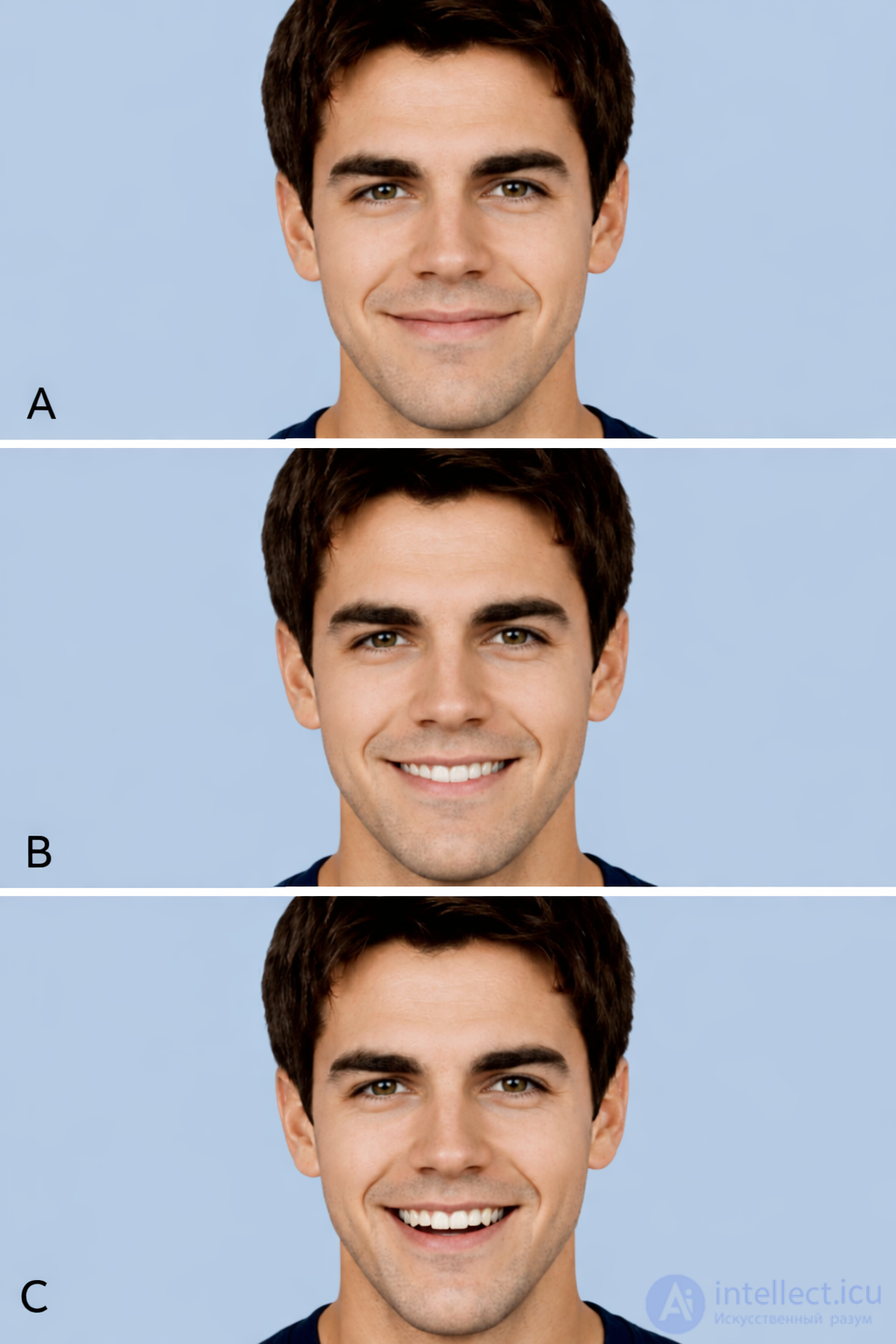
Figure 1
The young man also shows wrinkles running from the wings of the nose to the area beyond the corners of the mouth. These nasolabial folds result partly from the corners of the mouth being drawn back and raised, and are a characteristic sign of an expression of joy on the face. In addition, with a clearly pronounced smile the cheeks are raised, which makes the nasolabial folds more distinct. The skin below the lower eyelids is pulled upward, and small wrinkles appear on it beneath the eyes. Wrinkles known as "crow's feet" also form at the outer corners of the eyes. Such wrinkles do not appear in everyone, and they become more noticeable with age. If this were a young woman, they would be hidden under her hair. The stronger the smile, the more distinct the nasolabial folds will be, the higher the cheeks will rise, and the more noticeable the "crow's feet" and the wrinkles under the eyes will be. In a full-mouth smile (Fig. 1C) the cheeks may rise quite high, narrowing the eyes.
In the linguistic picture of the world, joy is one of the most important cultural concepts. Originally the emotion of joy was expressed through concrete notions: things, objects or events that evoke positive emotions (food, beauty, a holiday, rest). Compare the Old Russian "pleskanie", meaning "applause, triumph, joy", or "likovati", originally "to dance, to play" and later "to rejoice". Joy was associated with pleasure and also with desire (compare Old English lusten, meaning both "to rejoice" and "to want"), and was perceived as inseparable from them. With the advent of Christianity, in many European languages the concept of "joy" began to be associated with benevolence, kindness and tranquility.
Carroll E. Izard, one of the creators of differential emotions theory, having analyzed a huge amount of new experimental data on the evolution of emotions, writes that the development of the emotion of joy in a child proceeds somewhat differently from the development of the emotion of interest. Parents cannot "teach" a child joy; they can only entertain and amuse the child and involve him in games that help awaken the emotion of joy. Such experiences of joy are very important for a child's normal development, but they are short-lived and depend on the emotional generosity of the people around him. Parents should share their joy with the child, allowing him to experience this emotion indirectly, but ultimately a person must discover joy for himself. Only then will it become part of his lifestyle.
The capacity to experience joy is individual and depends on genetic factors. Some people are born with a high threshold for the emotion of joy, and this directly affects how happy, secure and confident they feel. After all, a person's cheerfulness largely determines how the people around him treat him. Other people, on the contrary, are born with little capacity to experience joy, so their threshold for arousing joy will be lower.
Studies of the emotionality of newborns and young children support the hypothesis of genetic factors in joy. In observations of Russian children in an orphanage, significant individual differences were found in the frequency of smiling and laughter, even though the children were raised in identical conditions.
In her work on laughter, Margaret Washburn found significant individual differences among her subjects. She presented children with various stimuli and recorded their reactions. Four of the children she observed first laughed at the age of 12 weeks, whereas in one child laughter could not be elicited until the age of 52 weeks. McGraw found that the "stress reaction" a baby shows in response to having a pacifier taken away at the age of 3-4 days remains practically unchanged up to the age of 8 months. She also found that babies who reacted less strongly to the removal of the pacifier at 3-4 days later, at 8 months, turned out to be more cheerful, more active and less tense.
Children have a remarkable capacity for creativity: they can turn any object at hand into a toy, into a source of joy. Only by awakening joy in a child can we be sure that this emotion is developing and that the child's life is sufficiently rich in joyful experiences.
A study by Moore, Underwood and Rosenhan showed that the experience of joy promotes altruistic behavior, whereas a sad experience usually leads to the opposite effect. The same researchers established that positive emotions increase the productivity of thinking and memory and encourage a creative approach to problem solving.
One of the difficulties in the psychophysiological study of emotions is the problem of activating an emotion. To activate an emotion under laboratory conditions, two main methods are usually used:
1) the subject uses the power of imagination to evoke the desired emotion in himself;
2) the desired emotion is activated by showing the subject a specially selected film.
In a study conducted by M. Rusalova, subjects were asked to imagine and mentally relive a situation of joy, and while they were experiencing it, the experimenters measured their heart rate and recorded changes in the electrical potential of the facial muscles. When the subjects imagined a joyful situation, they showed a marked increase in pulse rate and heightened activity of the facial musculature. As expected, the change in activity was noted in the muscles associated with the facial expression of joy.
Following Rusalova, Schwartz compared the electromyographic responses of subjects who were instructed to try to feel happiness, sadness or anger. It was found that muscle potentials change significantly from one emotion to another. It was also found that in healthy people, compared with depressed people, the profiles of muscle activity when experiencing joyful and ordinary situations show a pronounced tendency toward similarity.
Averill studied changes in the autonomic nervous system caused by joyful and sad experiences and identified four physiological parameters that distinguished sadness from mirth, but only one of these parameters, irregularity of breathing, distinguished the joyful state from the control emotional state. The author concluded that changes in breathing are more characteristic of the emotion of joy, whereas changes in the cardiovascular system are more characteristic of the emotion of sadness.
An emotion is not a brief flash but a process that develops over time. The dynamics of an emotion include:
1) the duration of the emotion;
2) the change over time in its intensity;
3) the change over time in its quality (for example, guilt turning into anger, surprise into fear, and so on).
The most extensive studies of the duration of emotions and the factors that determine it were carried out by the research group of Philippe Verduyn at the University of Leuven (Belgium) and are continuing at Maastricht University (the Netherlands). Verduyn's studies showed that joy lasts considerably longer than relief, irritation, tenderness, boredom, disgust, fear, surprise and shame. The average "lifetime" of some emotions was determined on a scale with 10-minute intervals and a total duration of 60 minutes. In the first study, in 2009, the figure obtained for joy was 26 minutes.
It was found that positive and negative emotions last for a shorter time when attention is diverted from them, and for longer when attention is focused on experiencing the given emotion.
A study from the University of British Columbia showed that people respond better to both negative and positive events if they sleep more. The researchers used survey data from almost 2,000 American adults aged 33 to 84. For eight days in a row, participants were asked about the length of their sleep, daily stress, and their experience of positive and negative events. A link was found between the amount of sleep and the feeling of joy: the less a person sleeps, the fewer positive emotions he experiences, even when positive events occur. Longer sleep makes positive events seem even better, thereby strengthening the emotion of joy.
The same study also showed that the inability to sustain positive emotions at times of stress puts people at risk of inflammation and even earlier death.

In the Gospels, joy is mentioned in connection with the annunciation of the birth of Jesus Christ (Luke 1:28):
Rejoice, O favored one! The Lord is with you!
In his letter to the Galatians, the Apostle Paul speaks of joy as a fruit of the Spirit of God (Gal 5:22).
The joy of the Good News and the joy of serving God have often been regarded as the main feature of Christianity.
Thomas Aquinas held that joy (gaudium) is a consequence of love. Joy, as one of the main attributes of religious feeling, is also considered outside Christianity. Thus Spinoza believed that at the highest level of knowing oneself in God, one becomes aware of God as the cause of joy.
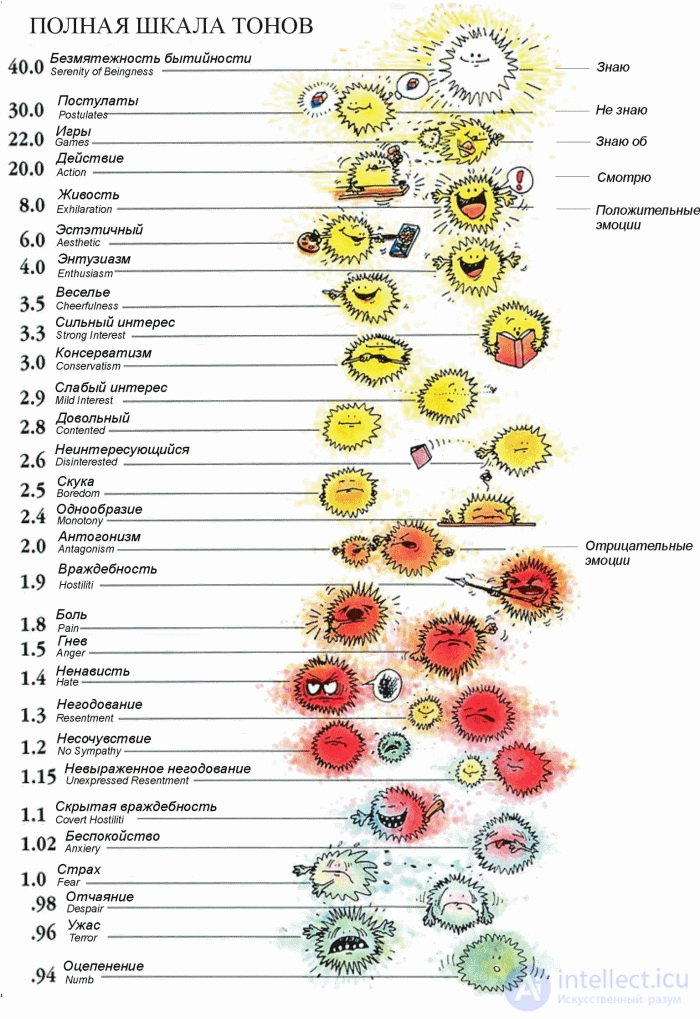
scale of emotions
The intensity of an expression of joy is determined mainly by the position of the lips, but the position of the lips is usually accompanied by deepening of the nasolabial folds and the appearance of more distinct wrinkles under the lower eyelids. In Fig. 1C the young woman expresses stronger joy than in Fig. 1B: her smile is wider, the nasolabial folds are more distinct, the eyes are narrower, and there are more wrinkles beneath them. The expression of joy in Fig. 1A is slightly weaker than in Fig. 1B. This is not because in Fig. 1B her mouth is open and in Fig. 1A closed, but because in Fig. 1B the corners of her mouth are drawn back farther (and the nasolabial folds are more noticeable) than in Fig. 1A. If the degree to which the corners of the mouth are drawn back and the depth of the nasolabial folds were about the same, then regardless of whether the mouth were open or closed in the smile, the intensity of the expression would be about the same. In Fig. 2 John shows examples of two smiles of approximately the same intensity.

Figure 2
A smile of joy can be much weaker than the smiles shown in Figs. 1 and 2.
In Fig. 3 the young woman shows two very faint smiles of joy, and below, for comparison, her neutral face is shown. Note that both of these smiles are weaker than her smile in Fig. 1A, but a smile is undoubtedly present here, because both faces look genuinely happy compared with the neutral face in Fig. 3C. In the photographs of the smiling young woman in Fig. 3 you can observe a slight tension of the lips and a slight drawing back of the corners of the mouth. This is easiest to see if you cover the rest of her face with your hand and compare the lips in all three photographs. Also note the trace of nasolabial folds appearing in both photographs, which is absent from the neutral face. You may also notice that the young woman's cheeks are slightly raised compared with the position of the cheeks in the neutral photograph, making her face look rounder. When the smile is this faint, no noticeable change in the position of the lower eyelids is observed, although the eyes look more joyful than in the neutral photograph. The state of joy is expressed only by the lower part of the face, since the eyes and the brows and forehead are the same in all three pictures. The photographs of the smiling young woman are composites: the neutral eyes and forehead are supplemented in them by lower eyelids and a mouth taken from images of a smiling face.
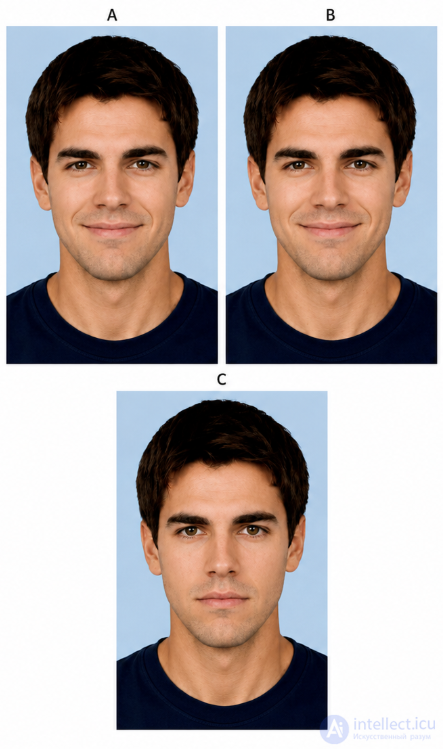
Figure 3
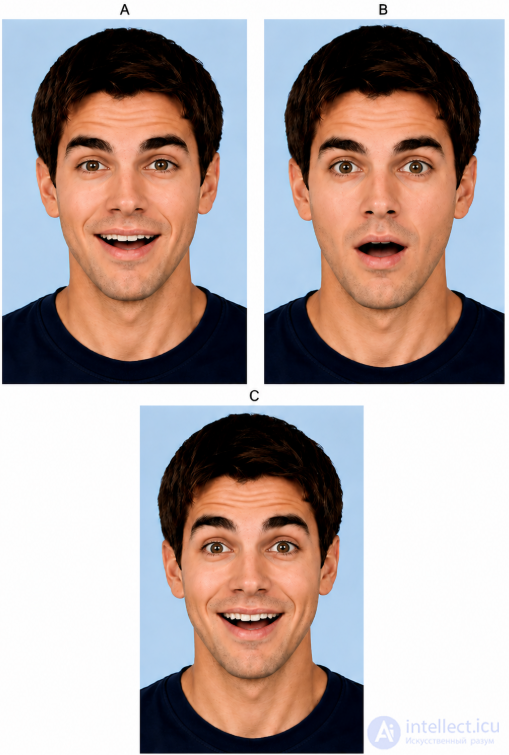
Figure 4: happiness and surprise
Joy is often blended with surprise. Something unexpected happens, and you evaluate what has happened positively. For example, a friend you have not seen for many years unexpectedly walks into a restaurant and sits down at your table. In Fig. 4A the young woman shows joy and surprise at the same time. Comparing her face with the face expressing only surprise (Fig. 4B), note that the difference is only in the lower part of the face. In the blended expression the mouth is not only open in surprise, but the corners of the mouth also begin to be drawn back in a smile. This blended expression results from combining elements of surprise and joy in the lower part of the face (you saw an example of another blended expression of emotions in Fig. 8).
The joy-surprise expression appears only for a brief moment, because surprise passes very quickly. By the time the young woman has evaluated the surprising event and begins to feel and express joy, her surprise has already passed. In Fig. 4C the young woman shows a combination of elements of surprise and joy (surprised brows, forehead and eyes; a joyful lower face and lower eyelids), but this expression is not a blend. She is not experiencing surprise and joy simultaneously, because the expression of joy dominates her face; the young woman is smiling broadly, and if she did experience surprise, it passed long ago. However, this type of facial expression will occur if a person adds an exclamatory note to his joyful expression. Enthusiasm and special attention can be shown in a similar way. Or such an expression may occur in greeting: the elements of surprise are retained so that the other person understands that meeting him is an "unexpected pleasure". With such a joyful expression, the raised brows and widely opened eyes may be held for several seconds along with the smile.
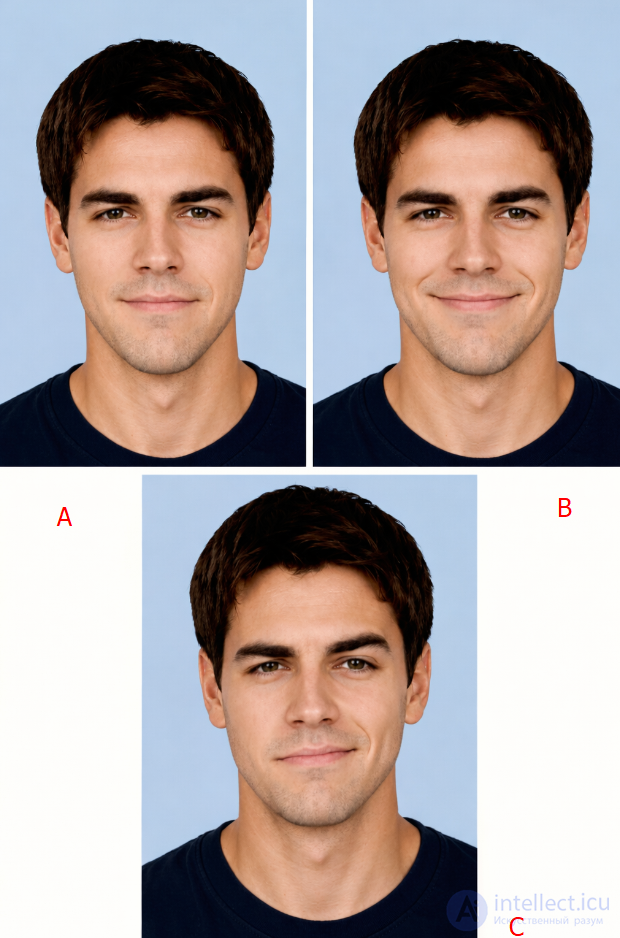
Figure 5: happiness and contempt
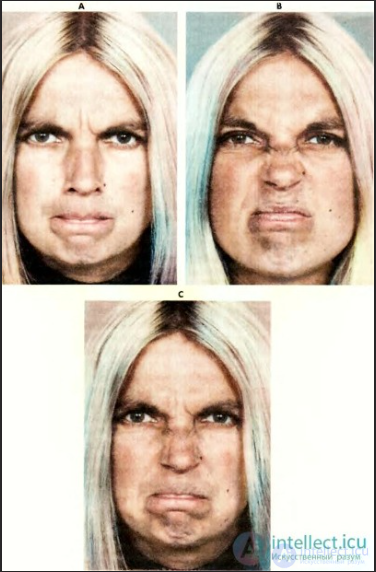
Joy can be combined with contempt, giving the face a smug or haughty look. In Fig. 5 John shows expressions of contempt (5A), joy (5B) and a combination of the two emotions (5C). Note that his mouth invariably stays in the position that expresses contempt, while his cheeks are raised and his lower eyelids are wrinkled from the expression of joy. A blend of joy and contempt can also be expressed by a contemptuously raised left or right corner of the mouth combined with smiling lips.
Figure 6: happiness and anger
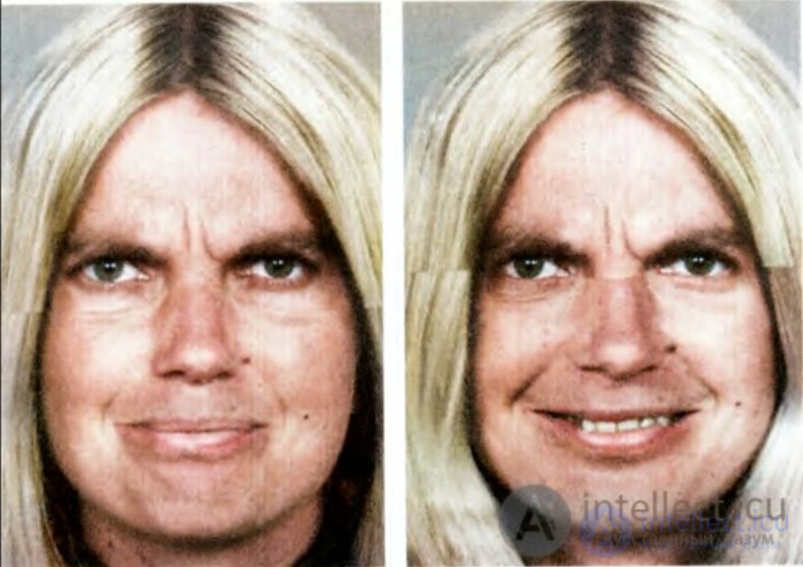
Joy is also combined with anger. Usually a smile or a slight smirk is used to mask anger, so that the person looks not angry but joyful. Sometimes a smile or slight smirk appears after an angry expression as a comment on the anger, indicating that the anger should not be taken too seriously, or that the person did not intend to move on to any aggressive action after expressing his anger, or that the person who provoked the anger may consider himself forgiven. In the latter case the smile or smirk does not look very sincere and is not blended with the expression of anger but is added afterward. However, a person can also be joyful and angry at the same time, enjoying his anger and his triumph over an opponent. Two examples of such pleasure-anger are given in Fig. 6. The lower part of the face expresses joy, and the brows, forehead and eyelids express anger. These faces say: "Well, I showed him!"
Figure 7: happiness and fear
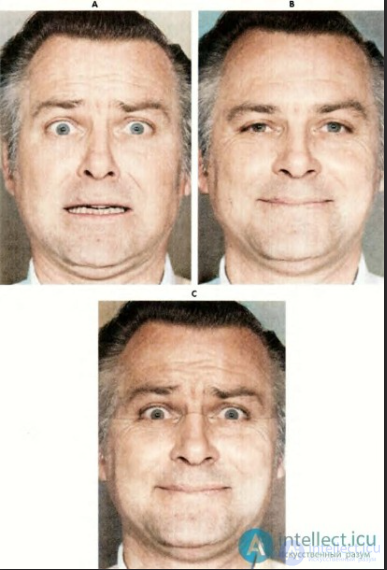
Joy is also combined with fear. Usually this expression is not a blend of two emotions but either a comment or a mask. In Fig. 7 John's face expresses fear (7A), joy (7B) and a combination of the two emotions (7C) (a smile with frightened eyes, brows and forehead). This combination of a smile with an expression of fear may occur when John, who is afraid, sits down in the dentist's chair smiling, thereby showing that he is ready to endure pain. Such an expression may also result from an unsuccessful attempt to mask fear. It may be a blend of two genuine emotions if John feels both fear and joy, for example while riding a roller coaster. Varieties of the blending of joy and sadness will be shown on the next page.
Joy is expressed by the lower part of the face and the lower eyelids (Fig. 8).
Figure 8
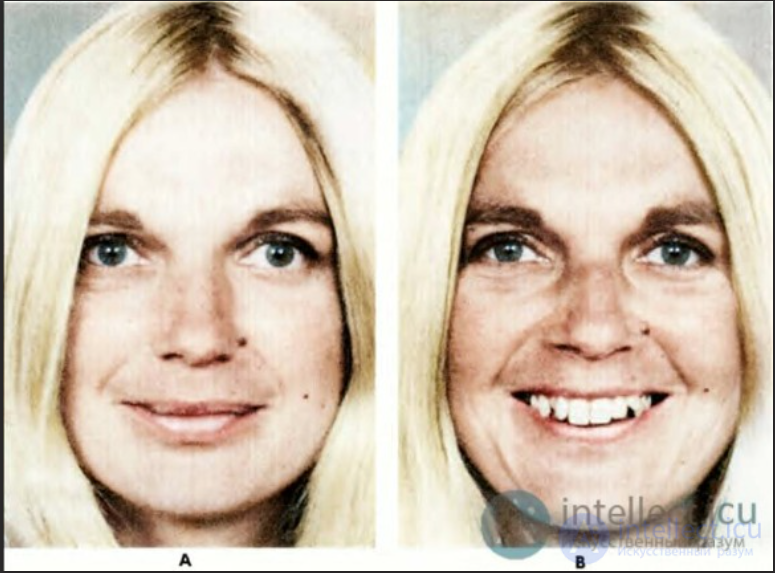
Because movements of the mouth and cheeks change the appearance of the lower eyelids, and because an expression of joy involves no noticeable movements of the brows and forehead, you will not be able to "construct" many of the faces shown here. Still, it is possible to assemble a few faces that demonstrate these findings.
|
|
|
|
|
|
|
Slight joy |
Moderate joy |
Moderate to strong joy |
A combination of joy and surprise |
A combination of joy and anger |
|
|
|
|
Moderate joy |
Moderate joy |
A combination of joy and contempt |









Comments