
Lecture
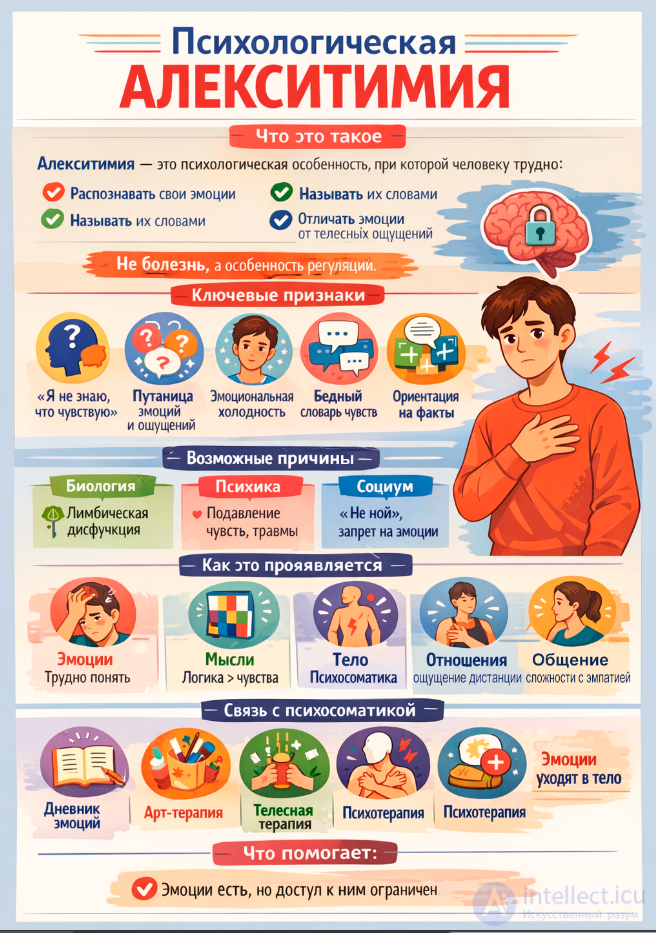
Alexithymia (from Ancient Greek ἀ- — a negating prefix, λέξις — word, θυμός — feeling; literally "without words for feelings") is difficulty in understanding, conveying, and verbally describing one's own state.
It can serve as a personality characteristic that includes the following features:
All of these features may be manifested to an equal degree, or one of them may predominate.
Alexithymia is regarded as a risk factor for psychosomatic diseases. This view is supported by clinical studies. The causes of alexithymia are unclear. It has been established that primary alexithymia responds poorly to psychotherapy. At the same time, psychotherapy of secondary alexithymia can be effective.
Alexithymia occurs in a significant proportion (up to 85%) of people with autism spectrum disorder. Diagnostic interviews, self-report scales, and projective techniques are used to measure alexithymia.
The term "alexithymia" was proposed in 1973 by Peter Emmanuel Sifneos. In one of his works, published as early as 1970, he described the features he had observed in patients of a psychosomatic clinic, which were expressed in a utilitarian way of thinking, a tendency to resort to action in conflict and stress situations, an impoverished fantasy life, a narrowing of affective experience and, especially, difficulty finding the right word to describe their feelings. Alexithymia literally means "without words for feelings" (or, in a close translation, "no words to name feelings"). By contrast, flexibility in expressing one's feelings became one of the important criteria for selecting patients for the brief psychotherapy in Sifneos's own model (short-term anxiety-provoking psychotherapy). The term has been criticized, including for a lack of relevance, but it has firmly taken its place in the literature on psychosomatic diseases, and the associated concept of alexithymia is gaining ever greater popularity, as reflected in the constantly growing number of publications in various countries. The development of the alexithymia concept was preceded by earlier observations establishing that many patients suffering from classic psychosomatic diseases and characterized by an "infantile personality" have difficulty with the verbal symbolic expression of emotions.
Various questionnaires have been used to determine the severity of alexithymia: the BIQ (Beth Israel Questionnaire), the APRQ (created on the basis of the BIQ scale), the SSPS (Sifneos Personality Scale), and the 22-item alexithymia scale of the MMPI was also used, but all these methods gave highly contradictory data, so they did not find wide use in scientific research.
The 26-item Toronto Alexithymia Scale [English] (TAS), proposed in 1985 by G.J. Taylor and co-authors, became more widespread. The Russian version of the TAS was adapted at the Bekhterev Psychoneurological Institute in 1994. When filling in the questionnaire, respondents characterize themselves using a Likert scale for their answers, from "strongly disagree" to "strongly agree", with half of the items having a positive code and the other half a negative one. The theoretical distribution of results ranges from 26 to 130 points; people who score 74 points or more on the TAS are considered "alexithymic", while a score below 62 corresponds to the absence of alexithymia. In 2000, studies based on the TAS showed that 5 to 23% of the healthy adult population have some alexithymic traits.
There is a tendency to develop a shorter scale based on the TAS, as evidenced by the creation of its 20-item version (TAS-20) in 1994. This scale boils down to assessing three main aspects of alexithymia: difficulty identifying feelings, difficulty verbalizing feelings, and the degree of focus on external events. Numerous studies using the TAS-20 have demonstrated the stability, reliability, and validity of its factor structure and, accordingly, of the results obtained, which attests to its scientific and practical value. The Russian-language version was presented and validated in 2010. As of 2020, the TAS-20 has been translated into more than 28 languages and is the most frequently used scale for measuring alexithymia. According to studies based on the TAS-20, alexithymia occurs in approximately 10% of the entire population.
Typical deficits usually include problems with recognizing, processing, describing, and working with one's own feelings, often characterized by the following signs:
Some people with alexithymia may seem to contradict the above characteristics, because they may experience chronic dysphoria or show outbursts of crying or rage. However, questioning usually shows that they are completely unable to describe their feelings or appear bewildered when answering questions about specific feelings.
According to Henry Krystal, people suffering from alexithymia think operationally and may seem overadapted to reality. However, in psychotherapy a cognitive disorder becomes evident, since patients tend to monotonously recount trivial, chronologically ordered actions, reactions, and events of everyday life. In general, these people may, though not always, seem oriented toward things and may even relate to themselves as robots. These problems seriously limit their receptiveness to psychoanalytic psychotherapy; psychosomatic diseases or substance abuse are often aggravated if these people turn to psychotherapy.
A common misconception about alexithymia is that people suffering from this disorder are completely unable to express emotions verbally and may not even acknowledge that they experience emotions. Even before the term was introduced, Sifneos (1967) noted that patients often mentioned things such as anxiety or depression. The distinguishing feature was their inability to describe these feelings, limiting themselves to a few restricted adjectives such as "happy" or "unhappy". The main problem is that people with alexithymia distinguish poorly between emotions, which limits their ability to tell them apart and describe them to others. This contributes to a sense of emotional detachment from oneself and difficulties in communicating with others, which makes alexithymia negatively associated with life satisfaction, even when depression and other accompanying factors are taken into account.
Alexithymia often co-occurs with other disorders. Studies show that alexithymia occurs in 50–80% of people with autism, and an overlap with sleep disorders has also been observed; other overlapping conditions are described below.
In a 2004 study that used the TAS-20 questionnaire, 85% of adults with ASD fell into the "impaired" category, and almost half into the "severely impaired" category; by contrast, among the control group of adults only 17% were "impaired", and none had "severe impairment". Fitzgerald and Bellgrove noted that "like alexithymia, Asperger syndrome is also characterized by core impairments of speech, language, and social relationships". Hill and Berthoz agreed with Fitzgerald and Bellgrove (2006) and stated in response that "there is some overlap between alexithymia and ASD". They also pointed to studies revealing impaired theory-of-mind skills in alexithymia, neuroanatomical findings indicating a common etiology, and similar social skill deficits. The exact nature of the overlap is unclear. Alexithymic traits in Asperger syndrome may be related to clinical depression or anxiety; the mediating factors are unknown, and it is possible that alexithymia predisposes to anxiety. One example is people with alexithymia who are more likely to engage in non-suicidal self-injury. On the other hand, although the total alexithymia score, as well as difficulty identifying feelings and externally oriented thinking factors, are significantly associated with ADHD, and although the total alexithymia score, difficulty identifying feelings, and difficulty describing feelings are also significantly associated with symptoms of hyperactivity and impulsivity, there is no significant association between alexithymia and inattention.
There are many other mental and personality disorders that overlap with alexithymia:
One study found that a higher level of alexithymia among mothers with PTSD related to interpersonal violence proportionally reduces their sensitivity in caring for a child. This latter study suggested that when treating adult PTSD patients who are parents, alexithymia should be assessed and addressed with regard to the relationship between parent and child and the child's social-emotional development. In particular, alexithymic traits overlap especially with schizoid, avoidant, dependent, and schizotypal personality disorders, substance use disorders, some anxiety disorders and sexual disorders, as well as some physical illnesses such as hypertension, inflammatory bowel disease, diabetes, and functional dyspepsia. Alexithymia is also associated with conditions such as migraine, lower back pain, irritable bowel syndrome, asthma, nausea, allergies, and fibromyalgia.
People with alexithymia tend to relieve the tension arising from unpleasant emotional states through impulsive behavior. Such actions include binge eating, substance abuse, perverse sexual behavior, or anorexia nervosa. The inability to regulate emotions cognitively can lead to a prolonged increase in the activity of the autonomic nervous system (ANS) and the neuroendocrine system, which can lead to somatic diseases. People with alexithymia also demonstrate a limited capacity to experience positive emotions, which led Krystal and Sifneos (1987) to describe many of these people as anhedonic.
Alexisomia is a clinical concept denoting difficulty in recognizing and expressing somatic, or bodily, sensations. The concept was first proposed in 1979 by Yujiro Ikemi, when he observed characteristics of both alexithymia and alexisomia in patients with psychosomatic diseases.
| Criterion | Alexithymia | Autism (ASD) | ADHD |
|---|---|---|---|
| Basic nature | A feature of emotional regulation | Neurodevelopmental disorder | Neurodevelopmental disorder |
| Status | Not a diagnosis (trait / state) | Clinical diagnosis | Clinical diagnosis |
| Main deficit | Awareness and verbalization of emotions | Social communication and behavioral flexibility | Attention, self-control, impulsivity |
| Emotions | Present, but poorly recognized | Present, but may be expressed atypically | Present, often intense and rapid |
| Ability to name an emotion | Severely impaired | Partially impaired | Usually preserved |
| Empathy (cognitive) | Reduced due to lack of awareness of emotions | Often reduced | Usually preserved |
| Empathy (affective) | May be preserved | May be reduced or different | Often pronounced |
| Social cues | Understands but does not feel | Often does not understand | Understands but cannot hold attention |
| Communication | Logical, dry | May be unusual or formal | Talkative, impulsive |
| Interests | Ordinary | Narrow, intense | Often change |
| Sensory sensitivity | Usually normal | Often pronounced | Possible, but unstable |
| Bodily symptoms | Frequent (psychosomatics) | Possible, but not key | Rarely key |
| Attention | Preserved | May be selective | Impaired |
| Impulsivity | No | No | Yes |
| Hyperactivity | No | No | Yes |
| Onset | Can arise at any age | From early childhood | From early childhood |
| Link to trauma | Often | Not necessary | Can intensify symptoms |
| Response to psychotherapy | Good | Limited | Good (as part of a comprehensive approach) |
| Differential markers |
|
|
|
The causes of alexithymia are still unclear, although several theories have been proposed.
Early studies showed that people with alexithymia may have a deficit in interhemispheric transfer; that is, emotional information from the right hemisphere of the brain is not properly transmitted to the language areas of the left hemisphere, which may be caused by a reduced corpus callosum. This is common in psychiatric patients who survived abuse in childhood. A 1997 neuropsychological study showed that alexithymia may be caused by impaired functioning of the right hemisphere of the brain, which is largely responsible for processing emotions. In addition, another neuropsychological model suggests that alexithymia may be associated with dysfunction of the anterior cingulate cortex. However, these studies have some shortcomings, and empirical data on the neural mechanisms underlying alexithymia remain inconclusive.
The French psychoanalyst Joyce McDougall objected to clinicians' excessive attention to neurophysiological explanations of the origin and functioning of alexithymia at the expense of psychological ones, and introduced the alternative term "disaffectation" to denote psychogenic alexithymia. According to McDougall, a disaffected person at some point "experienced overwhelming emotions that threatened to undermine his sense of wholeness and identity", to which he applied psychological defense mechanisms in order to destroy and expel all emotional representations from consciousness. McDougall also noted that all infants are born unable to identify, organize, and talk about their emotional experiences (the word infans comes from the Latin for "not speaking") and "by reason of their immaturity are inevitably alexithymic". On the basis of this fact, McDougall suggested in 1985 that the alexithymic part of an adult's personality may be "an extremely inhibited and infantile psychic structure". A similar line of interpretation has been pursued using the methods of phenomenology. An infant's first language consists of nonverbal facial expressions. The emotional state of the parent is important in determining how any child may develop. Neglect of, or indifference to, the various changes in a child's facial expression without proper feedback can lead to a devaluation of the facial expressions displayed by the child. The parent's ability to mirror self-awareness back to the child is another important factor. If an adult is unable to recognize and distinguish emotional expressions in a child, this can affect the child's ability to understand emotional expressions.
The attention-appraisal model of alexithymia, proposed by Preece and colleagues, describes the mechanisms underlying alexithymia within a cognitive-behavioral framework. This model holds that the level of alexithymia is determined by the level of development of people's emotion schemas (the cognitive structures used to process emotions) and/or the degree to which people avoid their emotions as an emotion regulation strategy. There is currently a large body of evidence supporting the propositions of this model.
Molecular genetic studies of alexithymia remain minimal, but promising candidates have been identified in studies examining links between specific genes and alexithymia in individuals with mental disorders, as well as in the general population. A study involving a test group of Japanese men found higher scores on the Toronto Alexithymia Scale in those who had the homozygous long (L) allele of 5-HTTLPR. The 5-HTTLPR region in the serotonin transporter gene affects the transcription of the serotonin transporter, which removes serotonin from the synaptic cleft, and has been well studied for its association with numerous mental disorders. Another study, which examined the 5-HT1A receptor, a serotonin-binding receptor, found higher levels of alexithymia in those who had the G allele of the Rs6295 polymorphism in the HTR1A gene. In addition, a study of alexithymia in individuals with obsessive-compulsive disorder found higher levels of alexithymia associated with the Val/Val allele of the Rs4680 polymorphism in the gene encoding catechol-O-methyltransferase (COMT), an enzyme that breaks down catecholamine neurotransmitters such as dopamine. These associations are preliminary, and further research will be needed to clarify how these genes are related to the neurological abnormalities found in the brains of people with alexithymia.
Although there is evidence for the role of environmental and neurological factors, the role and influence of genetic factors in the development of alexithymia are still unclear. One large-scale Danish study showed that genetic factors contribute markedly to the development of alexithymia. However, some scientists consider twin studies and the whole field of behavioral genetics controversial. These scientists express concern about the "equal environments assumption". [ needs updating ] Brain injury is also associated with the development of alexithymia, and people with brain injury are six times more likely to exhibit alexithymia. Alexithymia is also associated with trauma sustained during the circumcision of newborns.
Alexithymia can create problems in interpersonal relationships, since such people tend to avoid emotionally close relationships, or, if they do enter relationships with others, they usually position themselves as dependent, dominant, or impersonal, "so that the relationships remain superficial". Inadequate "differentiation" between oneself and others is also observed in people with alexithymia. Difficulties in processing interpersonal connections often develop where a person lacks a romantic partner.
In one study, a large group of people with alexithymia completed the Inventory of Interpersonal Problems (IIP-64), consisting of 64 items. The study showed that "two interpersonal problems were significantly and consistently associated with alexithymia: coldness/distance and non-assertive social functioning. All other subscales of the IIP-64 were not significantly associated with alexithymia".
Chaotic interpersonal relationships were also observed by Sifneos. Because of the inherent difficulties in identifying and describing emotional states in oneself and others, alexithymia also negatively affects relationship satisfaction among couples.
A 2008 study found that alexithymia correlates with impaired understanding and expression of attachment in relationships, and that this impairment contributes to poorer mental health, poorer relationship well-being, and lower relationship quality.
Some people who work in organizations where control over emotions is the norm may exhibit behavior similar to alexithymia without actually being alexithymic. Over time, however, the lack of self-expression can become routine, and it may become harder for them to identify with others.
In general, approaches to treating alexithymia are still at an early stage of development, and there are not many proven treatment options.
In 2002, Kennedy and Franklin found that a skills-based intervention is an effective treatment for alexithymia. Kennedy and Franklin's treatment plan included giving participants a series of questionnaires, psychodynamic therapy, cognitive-behavioral therapy, skills-based therapy, and experiential therapy. After treatment, they found that participants were generally less ambivalent about expressing their emotions and more attentive to their emotional state.
In 2017, based on their attention-appraisal model of alexithymia, Preece and colleagues recommended that treatment of alexithymia should attempt to improve the level of development of people's emotion schemas and reduce people's use of avoidance of emotional experience as an emotion regulation strategy (that is, the mechanisms that are hypothesized to underlie the difficulties of alexithymia in this model of alexithymia).
In 2018, Löf, Clinton, Kaldo, and Rydén found that mentalization-based treatment is also an effective treatment for alexithymia. Mentalization is the ability to understand the mental state of oneself or others that underlies overt behavior, and mentalization-based treatment helps patients separate their own thoughts and feelings from those of the people around them. This treatment is relational in nature and aims at a better understanding and use of mentalization skills. The researchers found that all of the patients' symptoms, including alexithymia, improved significantly, and that the treatment contributed to greater affect tolerance and the ability to think flexibly while expressing strong emotions, rather than acting impulsively.
A significant problem affecting the treatment of alexithymia is that alexithymia co-occurs with other disorders. A 1982 study by Mendelson showed that alexithymia is often found in people with undiagnosed chronic pain. The participants in the Kennedy and Franklin study had anxiety disorders combined with alexithymia, while the participants in the study by Löf et al. were diagnosed with both alexithymia and borderline personality disorder. All these problems related to comorbid conditions complicate treatment, since it is difficult to find people who have only alexithymia.

Comments