
Lecture
Irritation is one of the most common negative emotions, one that people run into almost every day. It can arise in response to external circumstances, the actions of other people, or our own failures. Despite seeming minor, frequent and intense irritation can lower the quality of life and harm relationships and a person's mental well-being.
Irritation, as some psychologists see it, is an unpleasant mental state characterized by vexation and a distraction from conscious thinking. It can lead to emotions such as frustration and anger. The tendency to become irritated easily is called irritability.

Figure. An example of what the emotion of irritation looks like in a person
In psychology, irritation is regarded as a negative emotional reaction that arises when a person encounters obstacles, unmet needs, discomfort, or unwanted influences from the environment.
Irritation occupies an intermediate position between mild dissatisfaction and more intense emotional states such as anger or rage. It signals to a person that a situation is perceived as unpleasant, obstructive, or threatening to their interests.
If irritation becomes prolonged and persistent, psychologists no longer speak of a separate emotion but of a state of irritability: an increased tendency to react with irritation to various stimuli.
Irritation is the weakest form
It is a slight inner "this gets on my nerves."
It arises from minor inconveniences: noise, slowness, repeated mistakes.
Control is maintained, but patience is already running out.
Nervousness is not quite about anger
It is rather a state of inner tension and anxiety.
A person may be irritable, but the cause is often not an external object but stress, anticipation, or uncertainty.
Annoyance is mild disappointment with a touch of anger
It is the feeling of "too bad it turned out this way."
For example: missed a chance, it did not work out, someone got in the way.
There is anger, but it is mixed with regret rather than aggression.
Anger is already a strong emotion
It is a reaction to a serious violation of boundaries, injustice, or a threat.
Inside there is an energy of "resistance" and a desire to change or stop something.
Wrath is a more general word
Usually it is a synonym for anger, but it can be weaker.
It is already a directed negative reaction toward someone or something.
Fury is an extreme form of anger
A very strong, almost "explosive" state.
Control is weakened, and behavior may become impulsive.
Malice differs from an emotion
It is no longer just a feeling but a lasting negative attitude toward someone.
If anger is a flash, then malice is an "accumulated and retained" feeling, with a desire to harm or a sense of hostility.
If we simplify the scale by strength and "heat":
irritation → annoyance → wrath/anger → fury
and standing separately alongside them are:
nervousness (stress-related tension)
malice (a long-term negative attitude)
Irritation can arise under the influence of various factors.
These include:
Among the internal factors are:
Often the cause of irritation is a mismatch between a person's expectations and the actual situation.
Irritation is closely connected with the phenomenon of frustration, a mental state that arises when it is impossible to satisfy a significant need or achieve a goal.
When a person encounters an obstacle, the psyche evaluates the situation as unfavorable. As a result, emotional and physiological reactions are activated:
If the source of irritation persists for a long time, emotional tension can accumulate and turn into anger or aggressive behavior.
Irritation manifests itself on several levels.
It is important to distinguish irritation from similar emotional phenomena.
| Emotion | Characteristic |
|---|---|
| Dissatisfaction | A weak negative evaluation of a situation |
| Irritation | An emotional reaction to a hindrance or discomfort |
| Anger | A stronger reaction with a pronounced desire to counteract the source of the problem |
| Fury | An extreme form of anger with a loss of self-control |
Thus, irritation can be regarded as an early stage of more intense negative emotional experiences.
If irritation becomes constant, it can lead to various negative consequences:
Therefore, it is important to recognize and regulate this emotional state in a timely manner.
Psychologists recommend several effective ways to reduce irritation.
The first step is to acknowledge your emotional state and understand its causes.
The following help:
It is useful to analyze your expectations and check how realistic they are.
The following are effective:
Full sleep, rest, nutrition, and reduced stress levels significantly lessen the tendency toward irritation.
The point is not to stop being angry, but to stop being a slave to anger
If you say "stop being angry," it sounds as though a person should not feel anger at all. But anger is a normal emotion. It can signal violated boundaries, injustice, a threat, or accumulated tension.
"Stop being a slave to anger" usually means something else:
For example:
That is why many psychological approaches do not set the goal of "never getting angry." The goal is rather to learn to experience anger consciously and use it, rather than submit to it.
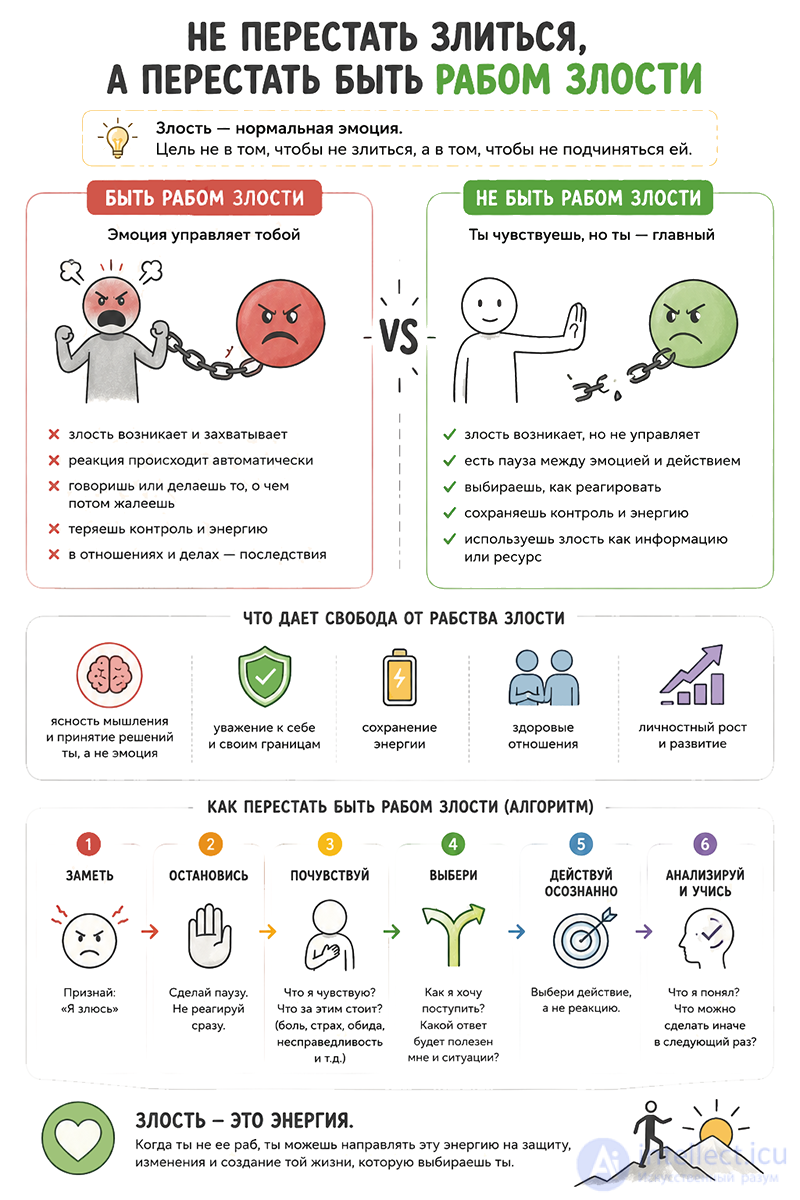
As for "how to suppress the expression of irritation," it is usually more useful not to suppress it completely but to control the way it is expressed.
Several practical techniques:
Turn your reaction into a description of the facts
Instead of:
Better:
Suppressing another person's emotion is usually impossible. You can only help reduce its intensity.
What often helps:
What usually intensifies irritation:
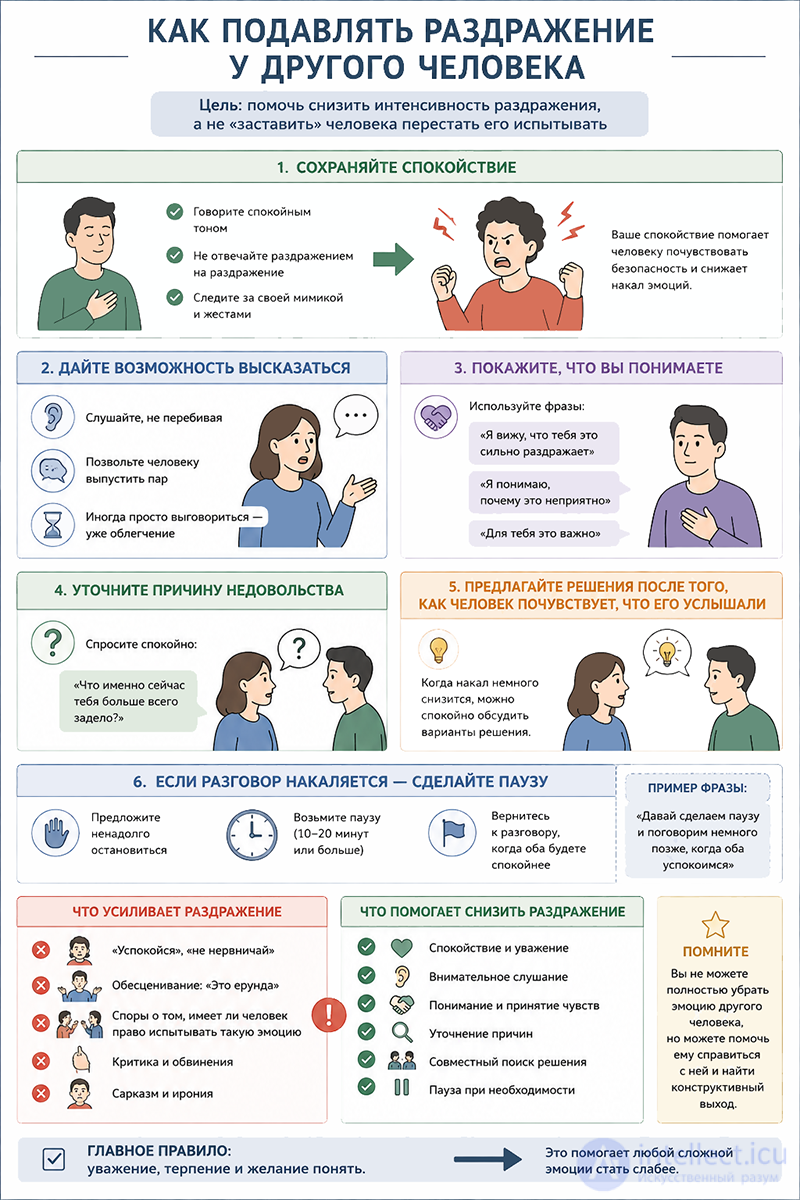
Irritation is a natural emotional reaction of a person to obstacles, discomfort, and unmet needs. In most cases it performs a signaling function, pointing to a problem that requires attention. However, frequent or chronic irritation can negatively affect mental health and relationships with others. Awareness of the causes of irritation and the development of emotional self-regulation skills help a person cope more effectively with life's difficulties and maintain psychological well-being.

Comments