
Lecture
Emotions are a fundamental part of human experience. They color our perception of the world, shape our relationships, and determine our behavior. In recent decades, however, people have increasingly spoken of the phenomenon of emotional anesthesia – a state in which a person loses the ability to fully experience feelings, as if their inner world were "frozen."
Emotional anesthesia is not a medical diagnosis but a psychological phenomenon. It manifests as a reduced or completely absent emotional response to events that usually evoke joy, sadness, fear, or inspiration. A person may be aware of what is happening but feel no emotional response to it.
(an- + Greek aisthesis – sensation, feeling) – a temporary loss of emotions, mental numbness, reduced emotional sensitivity or reactivity. A common symptom of acute stress reaction and post-traumatic stress disorder.
Main signs:
a feeling of inner emptiness;
indifference to joyful or tragic events;
difficulty forming emotional connections;
performing duties mechanically, without involvement.
Emotional anesthesia can be caused by various factors:
Chronic stress — constant tension exhausts emotional resources.
Psychological defense — the psyche "switches off" feelings in order to reduce the pain of trauma or loss.
Burnout — professional or personal, when emotions cease to be accessible.
Social factors — pressure from a society that demands constant productivity and self-control.
On the one hand, emotional anesthesia can temporarily protect a person from severe pain. On the other, its long-term persistence leads to:
loss of motivation;
the breakdown of interpersonal relationships;
a lower quality of life;
a risk of developing depressive states.
Modern culture often encourages "emotional restraint": being rational, not showing weakness, controlling one's feelings. As a result, many people perceive emotional anesthesia as the norm, when in fact it is a signal of an inner crisis.
Awareness: recognizing that one's emotions are dulled.
Psychological help: working with a therapist helps restore contact with one's feelings.
Creativity and art: music, painting, and literature can awaken an emotional response.
Body practices: sports, breathing exercises, and yoga help restore the connection with the body and emotions.
Social connections: spending time with loved ones gradually restores the ability to feel.
Knowledge about emotional anesthesia can be useful in a wide variety of fields where it is important to understand a person's inner state and their capacity for emotional response. Here are the key areas of application:
Diagnosis and assistance: specialists use an understanding of emotional anesthesia to identify hidden depressive states, post-traumatic reactions, or burnout.
Development of therapy methods: techniques for working with emotions, art therapy, and body practices help restore the ability to feel.
Psychiatry: knowledge of the phenomenon is important when working with patients who have experienced trauma, loss, or chronic illness.
Neurology: helps investigate the connection between brain processes and emotional reactivity.
Supporting vulnerable groups: people who have survived violence, war, or disaster often experience emotional anesthesia as a defense mechanism.
Rehabilitation: understanding this state helps in building adaptation programs.
Working with teenagers: teachers and psychologists can recognize signs of emotional anesthesia in students in order to offer support in time.
Burnout prevention: the knowledge is applicable to teachers and students living under constant stress.
HR and corporate culture: understanding emotional anesthesia helps identify employees experiencing burnout and develop support programs.
Leadership: managers can use this knowledge to create a healthy working atmosphere.
Literature, film, theater: the phenomenon of emotional anesthesia is often used as an artistic device to portray a character's inner crisis.
Music and painting: artists can explore the theme of "emotional emptiness" as part of modern experience.
Examples
to not feel the ground under one's feet from happiness.
Having caught up with Vera, he took her by the arm. Despite the wind and the snow, the young people walked slowly… Namilov felt that priceless arm on his own, felt the beating of her heart, while Vera – as I suppose, saw nothing and remembered nothing of what was going on around her (A. Pisemsky, The Rich Fiancé).
Self-understanding: knowledge of the phenomenon helps a person recognize their own state and seek help in time.
Interpersonal relationships: understanding emotional anesthesia makes it possible to be more attentive to loved ones who may be going through an inner crisis.
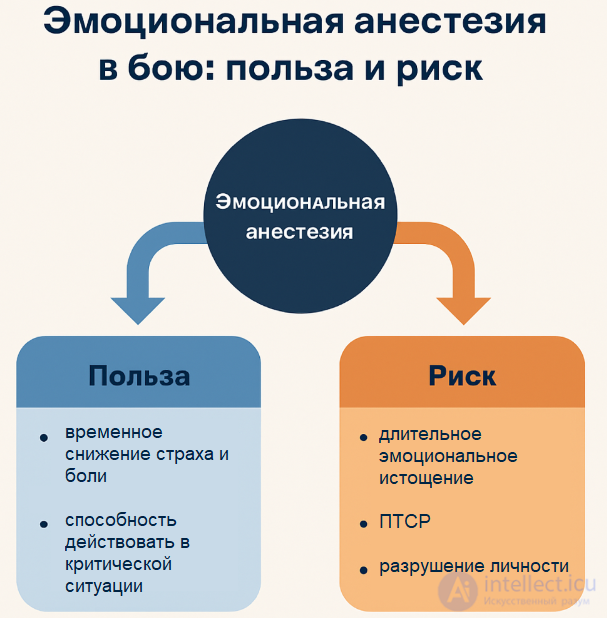
Military psychologists study the phenomenon of emotional anesthesia as a natural defense mechanism that can temporarily reduce the level of fear and pain.
This helps in developing training programs in which soldiers learn to recognize their states and manage them.
After combat, soldiers often develop emotional anesthesia as part of post-traumatic syndrome.
Knowledge of the phenomenon allows specialists to distinguish a temporary defensive reaction from a pathological condition that requires therapy.
In combat conditions, emotional anesthesia can be useful: a soldier acts "on autopilot" without giving in to panic.
However, prolonged persistence of this state reduces the ability to adapt and can lead to emotional burnout.
When treating wounded soldiers, doctors and psychologists take into account that emotional anesthesia can prevent a patient from expressing pain or fear, which complicates diagnosis.
In rehabilitation, it is important to gradually restore the capacity for emotional response.
Commanders should understand that emotional anesthesia in subordinates can manifest as indifference or "coldness," but this is not always a sign of weakness.
Knowledge of the phenomenon helps to assign tasks properly and maintain morale.
In works of fiction about war, emotional anesthesia is often used to portray the "frozen" state of a soldier who has lost the ability to rejoice or to grieve.
This helps society better understand the psychological cost of war.
Emotional anesthesia is not a sentence but a signal that the inner world needs care and attention. In modern society, where stress and pressure have become the norm, it is important to remember: the ability to feel is not a weakness, but a source of strength and humanity.

Comments