
Lecture
Interest is a positively colored emotional process (a feeling, in A. N. Leontiev's classification) associated with the need to learn something new about the object of interest and with heightened attention to it . A facial expression showing strong interest (an emotion) includes a slack jaw, a tongue thrust up and out, and dilated pupils.
Interest is a feeling or emotion that causes attention to focus on an object, event or process . In modern psychology of interest, the term is used as a general concept that can encompass other, more specific psychological terms, such as curiosity and, to a much lesser extent, surprise
What is interesting is that which convincingly presents something unexpected .
Interest is understood as a need-based attitude or motivational state that prompts cognitive activity. Interest is closely tied to the distinctly human level of mastering reality in the form of knowledge and unfolds mainly on the inner plane. At the basis of interest lies a cognitive drive (desire) toward one or another area of reality. Gradually it may grow into a stable personal need for an active, engaged relationship with the subject. Interest is described in terms of absorption in the content, involvement in the task and in the process of activity. Interest may be interpreted as one of the emotions close to surprise and inquisitiveness .
The emotional and volitional sides of interest are distinguished. The emotional side means an intellectual emotion; the volitional side means the effort involved in overcoming intellectual difficulties .
The average person experiences interest more often than any other emotional state. C. E. Izard classes it among the basic human emotions. He also considers it the main motivator of a person at work and the most important element of creative activity .
Golosovker deals in considerable detail with the concept of interest and of the interesting in his Logic of Myth. He names boredom as the antonym of interest and curiosity as a form of interest. At the same time, interest reveals a mystery, for example when people speak of an "interesting condition" meaning pregnancy. Analyzing philosophical works, Golosovker notes that they are rarely interesting, since they do not awaken the imagination. At the same time, the interesting is always ephemeral and temporary, and in the academic environment it carries the sense of the superficial, risky and even scandalous .

Facial expression of interest
The feeling of interest may show itself in one or several of the following facial movements, which are usually brief (up to 4-5 seconds) :
A person may continue to feel interest after it has ceased to show in their facial expression, but a prolonged absence of facial manifestations is regarded as a sign of fading interest .
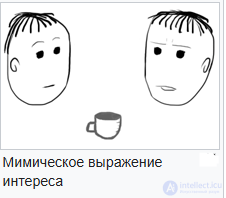
The feeling of interest is usually accompanied by a slowing of the heart rate, but prolonged and intense interest produces the opposite effect .
In the measurement methodology of the social sciences, when the intensity of (sexual) interest needs to be measured, changes in pupil size are proposed as a suitable indicator, despite its weaker but still consistent correlation with other measures, such as self-reported orientation of sexual interest .
An interested person feels interest-excitement. This is a feeling of being captivated, enchanted and curious. An individual experiencing this emotion has a desire to explore, to get involved, to broaden experience by taking in new information, and to approach the object that arouses interest in a new way. With intense interest a person feels inspired and animated. It is precisely this animation that provides the link with cognitive and motor activity. Even with relative immobility a person feels that they are "living and acting" .
Interest plays a key role in various spheres of life, promoting learning, development and the achievement of goals. Here are several practical applications of knowledge about interest:
Education and learning – Teachers use interest to increase student engagement. When learning material arouses curiosity, students remember information better.
Marketing and advertising – Companies seek to attract consumers' attention by creating content that arouses interest and encourages people to explore a product.
Scientific research – Researchers are often driven by interest in new phenomena, which helps to discover new knowledge and technologies.
Psychotherapy – Understanding interest helps therapists identify patients' motives and guide them toward more productive life decisions.
Social interactions – People intuitively use eye contact and dilated pupils to show genuine interest in conversation, which helps build trust.
Interest is a powerful force that influences behavior and decision-making.

Comments