
Lecture
Motivation (from the Latin movēre "to move") — an inducement to action; a psychophysiological process that governs a person's behavior, giving it direction, organization, activity, and stability; a person's ability to actively satisfy their needs.
A motive (Latin moveo "I move") — a material or ideal object representing a terminal (ultimate) value for the subject, which determines the direction of their activity and whose attainment constitutes the meaning of that activity. A motive is revealed to the subject through specific experiences, characterized either by positive emotions (from achieving it) or negative ones (from losing it). Becoming aware of a motive requires inner work. The term "motivation" was first used in an article by A. Schopenhauer.
A motive is one of the key concepts of the psychological theory of activity developed by the leading Soviet psychologists A. N. Leontiev and S. L. Rubinstein. The simplest definition of a motive within this theory is: a motive is the object of a need. A motive is often confused with a need and a goal, but a need is, in essence, a state of the organism in which it objectively requires something, while a goal is the result of conscious goal-setting, the mental image of what is required in that state. For example: thirst is the subject's need, the idea of how the thirst will be quenched is the goal, and the bottle of water the person reaches for is the motive. In this context, "a motive is a resource (water), the striving to obtain or preserve which determines the subject's behavior."
There are various approaches to the concept of "motivation".
For example, according to V. K. Vilyunas, motivation is a cumulative system of processes responsible for inducement and activity. K. K. Platonov, on the other hand, believes that motivation as a psychic phenomenon is the totality of motives
Extrinsic motivation — motivation not related to the content of a particular activity, but determined by circumstances external to the subject.
Intrinsic motivation — motivation related not to external circumstances, but to the content of the activity itself.
Positive and negative motivation. Motivation based on positive stimuli is called positive. Motivation based on negative stimuli is called negative.
Example: the construction "if I tidy up the desk, I will get a candy" or "if I don't misbehave, I will get a candy" is positive motivation. The construction "if I don't tidy up the desk, I will be punished" or "if I misbehave, I will be punished" is negative motivation.
Stable and unstable motivation. Motivation is considered stable when it is based on a person's needs, since it does not require additional reinforcement.
Two main types of motivation are distinguished: "away from" and "toward", or the "carrot and stick method". The following are also distinguished:
"unstable motivation"
Without establishing the motive, the question of how to classify a crime cannot be correctly resolved.
This principle is illustrated in Eldar Ryazanov's films "Beware of the Car" (1966): Detochkin, in "stealing" cars, had no mercenary motives. A similar story is shown in another Eldar Ryazanov film, "The Old Men-Robbers" (1971): the old men, in committing "thefts", had no mercenary motives.
The leading role in the formation of biological motivations is played by the hypothalamic region of the brain, which produces hormones. It is here that the processes transforming a biological (metabolic) need into motivational arousal take place. Based on their influence on other parts of the brain, hypothalamic structures determine the formation of motivation-driven behavior.
Theories of motivation analyze the factors that influence motivation. Their subject matter is largely concentrated on the analysis of needs and their influence on motivation. The study of these needs gave rise to three main directions:
Content theories of motivation study which needs motivate a person toward one activity or another, what their structure is, which needs are primary and which are secondary, and in what order they are satisfied. They study the goals a person strives for. The main theories of this direction are: Maslow's hierarchy of needs theory; Alderfer's theory; McClelland's theory of acquired needs; Herzberg's two-factor theory.
Process theories of motivation focus on explaining the process of choosing behavior capable of leading to desired results. Process theories explain how a person allocates effort to achieve various goals and how they choose a specific type of behavior. The main theories in this direction are considered to be: Vroom's theory, Adams's theory, the Porter-Lawler theory, Locke's theory, and the concept of participative management.
Theories based on a specific picture of the person. Theories based on a specific picture of the employee take as their basis a particular model of the employee, their needs and motives. These theories include: McGregor's theory and Ouchi's theory.
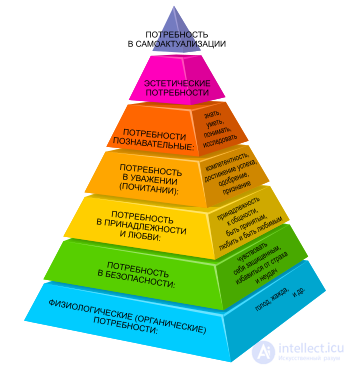
In his work "Motivation and Personality" (1954), Maslow suggested that all human needs are innate, or instinctive, and that they are organized into a hierarchical system of priority or dominance. Other scholars continued this work.
Needs in order of their priority:
Physiological needs
These consist of a person's basic, primary needs, sometimes even unconscious ones. In the works of some contemporary researchers they are sometimes called biological needs.
Need for safety
After the physiological needs are satisfied, their place in the individual's motivational life is taken by needs of another level, which can most generally be grouped into the category of safety (the need for safety; for stability; for dependency; for protection; for freedom from fear, anxiety, and chaos; the need for structure, order, law, and limits; and other needs).
Need for belonging and love
A person craves warm, friendly relationships; he needs a social group that would provide him with such relationships, a family that would accept him as one of its own.
Need for esteem
The needs of this level fall into two classes.
The first includes desires and aspirations associated with the concept of «achievement». A person needs a sense of his own power, adequacy, and competence; he needs a feeling of confidence, independence, and freedom.
In the second class of needs we include the need for reputation or prestige (we define these concepts as the respect of others), the need to gain status, attention, recognition, and fame.
Need for self-actualization
It is clear that a musician must make music, an artist must paint, and a poet must write poetry, if they are to be at peace with themselves. A person must be what he can be. A person feels that he must live up to his own nature. This need can be called the need for self-actualization. Obviously this need is expressed differently in different people. One person wishes to become an ideal parent, another strives to reach athletic heights, a third tries to create or invent. It seems that at this level of motivation it is almost impossible to draw the boundaries of individual differences.
A number of social conditions can be named that are necessary for satisfying basic needs; the improper fulfillment of these conditions can directly hinder the satisfaction of basic needs. These include cognitive and aesthetic needs.
Need for knowledge and understanding
Aesthetic needs
Aesthetic needs are closely intertwined with both conative and cognitive needs, and so a clear differentiation between them is impossible. Such needs include the need for order, for symmetry, for completeness, for finality, for system, for structure.
Needs of one type must be fully satisfied before another, higher-level need emerges and becomes active.
A. Maslow's theory correlates fairly clearly with the theory of the motivational complex, which likewise assumes the existence of five groups of needs. However, these needs are linked to one another by cyclical rather than hierarchical connections, after the fashion of the five-element scheme in Chinese philosophy, requiring priority satisfaction, with the movement of needs proceeding from the bottom upward (T). Alderfer, unlike Maslow, holds that the movement of needs proceeds both from the bottom upward and from the top downward (); he called upward movement through the levels the process of need satisfaction, and downward movement — frustration — the process of failure in the attempt to satisfy a need.
It is well known that a certain degree of motivation is necessary for an activity to take place at all. However, if motivation is too strong, the level of activation and tension increases, and as a result certain disruptions arise in the activity (and in behavior), meaning that the effectiveness of the work deteriorates. In such a case, a high level of motivation gives rise to undesirable emotional reactions (tension, agitation, stress, and so on), which leads to a decline in performance.
It has been established experimentally that there exists a certain optimum (an optimal level) of motivation, at which the activity is carried out best (for a given person, in a specific situation). Any further increase in motivation will not lead to improvement but to a deterioration in the effectiveness of the activity. Thus, a very high level of motivation is not always the best. There is a certain threshold beyond which a further increase in motivation leads to worse results.
This relationship is known as the Yerkes — Dodson law. These researchers, studying the effect of negative motivation on animals, established in 1908 that in order to teach animals to run a maze, a medium intensity of motivation (set by the intensity of electric shocks) was the most optimal.
What, then, must be introduced into the scheme as something inexplicable within the subject in order to facilitate the explanation of individual differences in behavior, their consistency or lack thereof in relation to situations, and their stability over time? For this purpose, all manner of concepts denoting various kinds of dispositions have been drawn upon, for example: character traits, attitudes, beliefs, interests, abilities, temperament characteristics, and much else.
Let us take as an example the specific ability called cognitive structuring [O. Harvey, D. Hunt, H. Schroder, 1961; H. Schroder, M. Driver, S. Stenfert, 1967]. It accounts for individual differences in the ability to process information, namely: 1) the number of dimensions along which information is analyzed (differentiation); 2) the degree of scale gradation for each dimension (discrimination); and 3) the organization and coherence of the resulting multidimensional structure (integration). Thus, people with low cognitive structuring act in a stereotyped manner, are unable to flexibly adjust to new situational demands, tend toward broad generalizations, and often turn out to be dependent on external circumstances, and so on. The introduction of a construct such as cognitive structuring indicates, of course, not only an individual-centered interpretation but also an interactionist one. After all, the actual "ability to process information" that determines behavior is the result of a two-way dependency between the subject's "structuring of the cognitive system" and the momentary "complexity of the surrounding world." "As the situation becomes more complex, people with high cognitive structuring will increase their rate of information processing faster than people with low cognitive structuring. The former will manage to cope with a more complex environment before their ability to process information declines or is exhausted [H. Krohne, 1977].
Attempts of this kind to explain behavior in terms of abilities, attitudes [I. Ajzen, M. Fishbein, 1977], interests, and so forth will not be considered in this book, at least not on their own. Instead, it analyzes a broad class of approaches that have been drawn upon since time immemorial to explain behavior, especially its individual differences, and that are united by a fairly simply justified premise: behavior is guided by expectation, by the evaluation of the anticipated results of one's actions and their more remote consequences. The significance that the subject attaches to these consequences is determined by the value dispositions inherent in them, which are most often referred to by the word "motives."
The concept of «motive» in this case includes such notions as need, urge, drive, inclination, striving, and so on. Despite all the differences in nuance among these terms, they all point to a «dynamic» moment of an action's directedness toward particular target states which, regardless of their specific content, always contain a value component and which the subject strives to attain, whatever varied means and paths may lead to it.
On this understanding, one may assume that a motive is defined by such a target state of the «individual—environment» relationship that is itself (at least at the given moment) more desirable or more satisfying than the present state. From this quite general notion one can derive a number of consequences regarding the use of the concepts «motive» and «motivation» in explaining behavior, or at least single out some of the basic problems of the psychological study of motivation. If motive is understood as a desired target state within the framework of the «individual—environment» relationship, then on this basis the main problems of the psychology of motivation can be outlined.
1. There are as many different motives as there are content-wise equivalent classes of «individual—environment» relationships. These classes can be distinguished on the basis of characteristic target states which people are often observed to strive toward. (Alongside desired target states, motives within certain «individual—environment» relationships can also be defined through states to be avoided.) Here we are dealing with the problem of the substantive classification of motives, of compiling an inventory of them.
2. Motives are formed in the course of individual development as relatively stable evaluative dispositions. It is necessary to determine on the basis of which opportunities and activating environmental influences individual differences in motives arise, and also to clarify the possibilities of changing motives through purposeful intervention. Here we are dealing with the problem of the development and change of motives.
3. People differ in the individual manifestations (character and strength) of particular motives. Different people may have different hierarchies of motives. Here we are faced with the problems of measuring motives.
4. A person's behavior at a given moment in time is not motivated by any or all of his possible motives, but by the one among the highest motives in the hierarchy (i.e., among the strongest) that, under the given conditions, is most closely tied to the prospect of attaining the corresponding target state, or, conversely, whose attainment has been called into question. Such a motive becomes activated, becomes effective. (Other motives, subordinate to it or in conflict with it, may be activated at the same time. But for simplicity we will disregard secondary motives.) Here we encounter the problem of the actualization of a motive, that is, the problem of identifying the situational conditions that lead to such actualization.
5. A motive remains effective, that is, continues to participate in the motivation of behavior, until either the target state of the corresponding «individual—environment» relationship is attained, or the individual approaches it as far as the conditions of the situation allow, or the target state ceases to threateningly recede, or changed situational conditions make another motive more pressing, causing the latter to become activated and dominant. An action, like a motive, is often interrupted before the desired state is reached, or breaks up into parts scattered over time; in the latter case it is usually resumed after some time. Here we encounter the problem of identifying parts of an action within the flow of behavior, that is, the problem of a change of motivation, of the resumption or after-effect of motivation that has already taken place.
6. The instigation to action by a particular motive is designated as motivation. Motivation is conceived as a process of choosing among various possible actions, a process that regulates and directs action toward the attainment of goal states specific to a given motive and that sustains this direction. In short: motivation explains the goal-directedness of action. Here we are dealing with the problem of motivation as the general goal-directedness of activity, and in special cases with the problem of motivational conflict between different goals.
7. Motivation is certainly not a single process running uniformly through a behavioral act from beginning to end. Rather, it is composed of heterogeneous processes that perform a self-regulatory function at particular phases of the behavioral act, above all before and after the action is carried out. Thus, at the outset a process of weighing the possible outcomes of the action and evaluating their consequences operates. Here we encounter the problem of the analytical reconstruction of motivation through hypothetical intervening self-regulatory processes that characterize the individual phases of the course of action.
8. Activity is motivated, i.e., directed toward the attainment of the motive's goal, but it should not be confused with motivation. Activity is composed of separate functional components—perception, thinking, learning, the reproduction of knowledge, speech, or motor activity—and these possess their own stock of capacities accumulated over the course of life (skills, abilities, knowledge), which the psychology of motivation does not concern itself with, taking them as given. It is motivation that determines how and in what direction the various functional capacities will be used. Motivation also explains the choice among various possible actions, among various modes of perception and possible contents of thought; moreover, it explains the intensity and persistence with which the chosen action is carried out and its results achieved. Here we encounter the problem of the diversity of motivation's influences on observable behavior and its outcomes.
These, in brief, are the eight key problems that the psychology of motivation attempts to untangle and with which we shall be concerned further. However differently they may appear, be formulated, or be introduced, and however tangled their history and however strongly the theoretical search for their solution in psychology may diverge, all the efforts in this field of research can be reduced to these eight problems. A few additions and caveats are also necessary.
First. The mode of presentation we have chosen—for example, adopting the «individual—environment» relationship, or the concepts of motive and motivation, as explanatory notions—and even our theoretical conceptions, for instance, concerning the constancy of motives directed toward goal states, their activation by the situation, and their influence on action through a variable, short-term process of motivation, will by no means be unanimously accepted by all motivation researchers. However, the mode of presentation we have chosen and our theoretical conceptions are formulated broadly enough; moreover, the eight main problems are quite clearly separated from one another and can easily be related to other modes of presentation and other theoretical conceptions without losing their specificity. In part, the matter is simply a question of terminology. An analogous explanation can be carried out using other concepts as well. Instead of motives one can speak of needs or attitudes; instead of motivation—of directed drive; and the goal-directedness of behavior can be left, as in the classical theory of learning, to the well-established «stimulus—response» bonds. One can even dispense with the concepts of «motive» and «motivation» altogether and take as a basis, as Kelly does [G. Kelly, 1955, 1958], «systems of personal constructs.» The problems remain essentially the same; only the approaches to their solution change somewhat.
Second. The form of presentation and the theoretical notions used—are no more (but no less) than a way of making sense of the problems that were, and still are, denoted by the naive and scientific explanations of action under the general term «motivation».
They represent something invented; their scientific explanatory value still needs to be established and proven. The eight points listed above, rather, contain what needs to be explained, not what itself claims to explain. The same holds true for all definitions of motivation: they describe problems in need of explanation, but explain nothing themselves. This is clearly seen in the following list of problems:
«...how behavior arises, how it is energetically supplied, maintained, directed, and terminated, and what kind of subjective reactions occur in the organism while all this is taking place» [M. Jones, 1955, P. VII].
As we shall see, the fundamental difficulty is that motive and motivation (or their equivalents) are not directly observable and are therefore inaccessible to direct cognition. As explanatory concepts they are hypothetical constructs. It must be empirically proven that the use of these constructs is fruitful. This requires special methodological premises and experimental designs.
Third. The importance attached to one view or another of the problem has changed noticeably over time. If, for example, at the birth of the psychology of motivation interest was mainly focused on classifying motives, this is now considered largely unproductive, and a careful isolation of the individual motive is deemed sufficient. As applied to specific motives, considerable attention is drawn to the seventh problem—namely, the analysis of the mediating motivational processes of self-regulation.
Fourth. Not only in the range of issues chosen but also in the level and differentiation of theoretical and methodological approaches, the psychology of motivation still presents a rather patchy and heterogeneous picture to this day. Many researchers go no further than a purely descriptive level, afraid to expose theoretical constructs to the risk of colliding with empirical data, so fragmentation of approaches to the psychological study of motivation is, rather, the rule than the exception.
The descriptive, rather than explanatory, use of the concepts of motive and motivation can be demonstrated especially clearly using the sixth problem—the general goal-directedness of behavior. It is easy to show how extracts from descriptions of observed behavioral phenomena are essentially equated with their explanation, which closes the definitions of these concepts into a vicious circle.
If, at the dawn of scientific research, and in everyday speech even today, the concept of motive denoted a conscious impulse to act, a reflection of its intent, professionals later abandoned this understanding. After all, an action turns out to be motivated, in the sense of its goal-directedness, even without being accompanied by any conscious intention on the part of the subject, or even when it is difficult to imagine any intention at all. There must be something that allows a choice to be made among different courses of action, that «triggers» the action, directs, regulates, and carries it through to completion, after which a new sequence of actions begins, in which yet another goal-directedness can again be discerned. This something, called for now simply motivation (not motive),— is a concept used above all to explain the sequence of behavioral acts directed toward a particular goal, which, depending on the given circumstances, can be achieved by quite different means.
The goal-directedness of behavior is especially striking when one and the same person tries to achieve one and the same goal by completely different means. When a direct attempt to reach the goal meets an obstacle, another, sometimes roundabout, path is chosen. Thus, quite different modes of action can reveal one and the same goal-directedness (motivation). Brunswik [E. Brunswik, 1952; 1956] called this equifinality and illustrated it with the so-called lens model (see fig. 1), thereby developing a probabilistic model that made it possible, given observational data on extremely diverse sequences of actions, to determine their goal-directed equifinality.
However, identifying clear goal-directedness with motivation still explains nothing; motivation remains a problem. Nor does anything change if one attempts to account for motivation, i.e., the goal-directed character of observed behavior, by attributing a motive to the subject. Such a derivation of motivation from a particular motive would be useless, a mere semblance of explanation, or, as they say, would suffer from the fallacy of circular reasoning. We give the observed behavior a name and assume that this name captures its innermost essence. In reality, however, we are merely designating certain facts of the observed action, namely the fact of its goal-directedness.
Such pseudo-explanations are encountered everywhere in everyday psychological language. A child plays because he has a «need for play»; people save because they have a «motive of thrift»; someone works even in his free time because he has a high «achievement motivation», and so on. Reasoning of this kind has no scientific value whatsoever; it is simply a play on words, driven by people's tendency to reduce observed phenomena to ultimate causes. However, to conclude from this that we are all possessed by an «explanatory motive» would again be to fall into a vicious circle (see chapter 10 on this).
The scientific approach in the psychology of motivation has for a long time likewise needed to free itself from the vicious circle of pseudo-explanations: goal-directed behavior was declared to be motivated, and motivation was reduced to the underlying motive. One may ask: why, then, are the concepts of «motive» and «motivation» still used today? The reason is that these concepts acquire explanatory value once we begin to treat them as hypothetical constructs and fulfill all the requirements that follow from this.
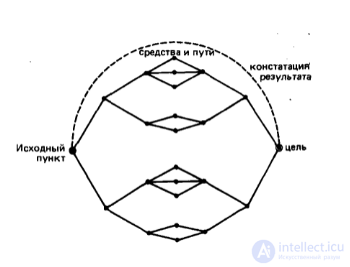
Fig. 1.4 Brunswik's lens model, illustrating the so-called equifinality in which the goal-directedness of behavior finds expression. The quite different paths and means that we observe in the course of carrying out an action can lead to one and the same goal.
In reality, no motives exist at all. This, perhaps puzzling, formulation requires a twofold clarification. First, as already noted, motives are not directly observable and in this sense cannot be represented as facts of reality. Second, they are not facts in the sense of real objects accessible to our direct observation. They are conventional, understanding-facilitating, auxiliary constructs of our thinking, or, in the language of empiricism, hypothetical constructs*. A hypothetical construct is a conventional, in Tolman's terms an «intervening», variable that can be inserted into the explanatory scheme of action between the initial observable circumstances of the situation and the subsequent observable phenomena in behavior itself.
_____________________
* Here we do not follow the distinction between intervening variables and hypothetical constructs introduced by MacCorquodale and Meehl [K. MakCorquodale, P. Meehl, 1948].
A hypothetical construct cannot simply be invented and arbitrarily placed in the world. If we want to use the concept of «motive» as a hypothetical construct, we must first establish under which specific initial conditions the motive is activated, and then determine which of the behavioral effects observed afterward are in fact produced by motives. Thus, in studies of animal learning it proved fruitful to introduce the motivational concept of V «need» as a hypothetical construct. For example, need explains the relationship between the length of time an animal was deprived of food before an experiment and its success in learning. With longer food deprivation, the animals made fewer errors, ran to the feeding place faster, and so on. An example from human psychology can be drawn from studies of the so-called achievement motive. The initial conditions must give the subject opportunities for an activity whose results he could attribute to himself rather than to pure chance, and for which he could assess the degree to which he used his abilities. For the achievement motive to manifest itself, i.e., for performance to be related to a scale of one's own abilities, the tasks must be neither too difficult nor too easy. This conclusion was drawn on the basis of such external manifestations of activity as effort and persistence in obtaining good results.
But for the introduction of a hypothetical construct to be justified, it is necessary, alongside the initial («antecedent») conditions, to also specify the subsequent effects in observable behavior, i.e., to establish what must follow. Thus, to use the achievement-motive example again, it must be established that a person with a pronounced achievement motive should show a preference for an activity (engaging in it longer and more persistently) that is neither too easy nor too difficult and whose outcome depends more on one's own skill than on chance.
From this example one can see that the cognitive value of a hypothetical construct is determined by nothing other than its place. Its intermediate position between the initial conditions of the situation and the individual characteristics of the subject, on the one hand, and the ensuing action, on the other, makes it possible to explain a consistently observed series of indicators. The concept of motive has its own place in the universal network of observed «if..., then...» relations. The hypothetical processes (or their hypothetical results) that account for the complex of «if..., then...» relations we encounter in a specific behavioral situation are usually (as proposed above) called motivation, while the individual characteristics of the hypothetical process are called the motive.
But the concept of motive will be fruitful only if it makes it possible to predict and discover unknown «if..., then...» relations. As a result, a researcher may reveal (and this has already been done) a denser network of «if..., then...» relations, which ultimately forces the originally unified construct of «motive» to be broken down into more specific, mutually related constructs. Such a breakdown makes it possible to better explain the features of the goal-directedness of an individual's actions and to predict them more accurately. Thus, today a number of so-called intervening cognitive processes, which also represent hypothetical constructs, are distinguished from the achievement motive. Since such intervening cognitive processes are personal in character, i.e., provide information about individual differences, they are included as a component part of the concept of motive.
The concepts of "motive" and "motivation," taken as hypothetical constructs, prove the more fruitful the more it becomes possible to identify, in the initial conditions of a situation, features that call for individually differentiated reactions - that is, the more clearly one is able to specify further the intervening motivational variables in order to explain the connection between the conditions of a situation and its appraisal. In other words, it is important to identify more precisely the information-processing mechanisms by which not only objectively different but also objectively identical situations are perceived and structured differently by different people, and are evaluated differently both from the standpoint of possible actions and from the standpoint of the goal.
Accordingly, the psychology of motivation is primarily concerned with diagnostic techniques for identifying individual differences in motives. This brings out personal characteristics as intervening variables and as conditions of goal-directed behavior. Such individual differences, established in advance, are implied whenever contemporary motivation psychology speaks of someone having a strong or weak motive of achievement, power, or affiliation, or of someone's achievement motivation being characterized either by a striving for success or by an avoidance of failure, and so on. Such expressions attempt to give an approximate description of certain stable tendencies (in principle, a tendency toward one-sidedness in information processing) in a given person's behavior. People are not merely playthings in the hands of changing situational conditions; if that were so, the explanatory concept of a motive would be superfluous.
Thus, in contemporary motivation research a motive is taken to mean (within a given substantive class of "individual-environment" relations) simply the differences among such stable individual characteristics. In this case the motive plays the role of an explanatory concept (first perspective). The initial conditions of directed action - namely, the features of the given situation (second perspective) - are regarded as behavior-motivating variables that activate the subject's stable motives. This activation is conceived as a process of two-way interaction between the characteristics of the situation and the subject's motives (third perspective). The result of this interaction is designated as motivation. Motivations in this sense are situationally determined and hence relatively short-lived. It is assumed that they are precisely what triggers a sequence of actions, directs them toward a goal, governs them, and disappears once the goal has been reached.
On this approach, the concept of "motive" appears fairly abstract; its meaning reduces to the unification of connections found between the initial conditions of a situation and the subsequent action. Fixing stable individual characteristics (differences among people) as a motive performs an important explanatory function. If such regularities are specified for some one substantive class of initial-situation conditions that activate one particular motive, then - since the immediate initial conditions are known - it becomes possible to predict with reasonable probability what the subsequent action will be. Or else, by recording the action as it is carried out, one can better understand why it takes precisely that form, rather than merely restating in other words what can already be seen in the observed behavior. To the extent that the definitions of "motive" and "motivation" are not caught in a vicious circle, they are concepts that make it possible to explain and predict behavior.
Let us summarize in conclusion everything said about the concepts of «motivation» and «motive.» The concept of «motivation» is often used in a purely descriptive sense, indicating that behavior displays goal-directedness; motivation thereby merely points to an observed feature of behavior without explaining it. In contemporary psychology, the concept of «motivation» plays the role of a generalized explanation of «if..., then...» type relationships that exist between the initial conditions of a situation and the subsequent action. In a number of theoretical statements, unobservable «intervening processes,» introduced to explain the connection between initial conditions and subsequent effects, are also called motivation. It is assumed here that such processes take place within the subject itself, although it is clear that these are merely conventional explanatory constructs. (This does not mean that cognitive and affective processes that adequately describe experience cannot characterize the forms and kinds of motivation.)
Motivational intervening processes are determined not only by the situation but also by individual characteristics. Since, in a specific situation, goal-directedness, the intensity of the action, and persistence in carrying it out present us with a different picture in different people, this very dissimilarity is reduced to manifestations of unequal motives. A motive is a hypothetical construct used to explain individual differences in activity carried out under identical conditions. The manifestations of a motive in an individual are not revealed in a concrete action; the action itself still requires explanation. A motive has to be identified not in connection with the action but with the aid of specific diagnostic methods. The methodology is constructed so that it can be used to establish relatively stable tendencies in the subject's behavior and in his evaluation of a particular class of equivalent situations (relations of «individual—environment»).
At the next step our reasoning needs to be made more concrete, and after all the theoretical constructions we must move closer to research practice. This can be achieved by linking the eight basic problems of the psychology of motivation to the ideas of hypothetical constructs, which are precisely the explanatory concepts of «motive» and «motivation.» From this follow the experimental designs used to study the problems of the psychology of motivation. There are five such designs in all. If one examines experimental studies of motivation closely, it is not difficult to reduce all of them to one or another of these designs. Of course, experiments differ in such respects as the theoretical formulation of the problem, the specification of independent variables, the choice of dependent variables, the method of their analysis, and many others. However, this does not affect the type of experimental design, which establishes a methodological link with one of the eight basic problems of the psychology of motivation.
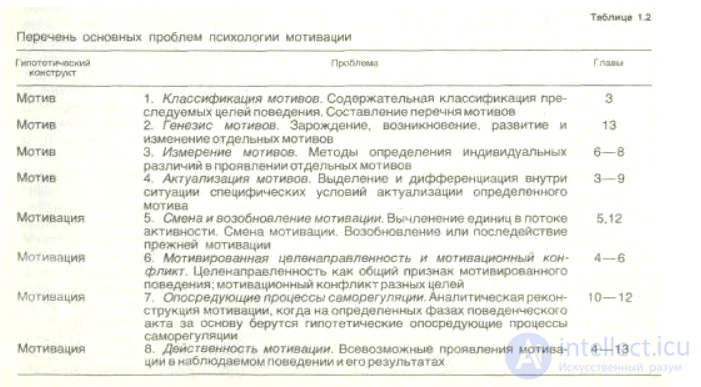
To clarify this in more detail, let us recall the eight basic problems of motivation. They are listed in Table 1.2. Its last column gives the numbers of the chapters of this book in which the results of research on the corresponding problem are presented. As the table shows, the first four problems are linked to the hypothetical construct «motive,» while the last four are linked to the hypothetical construct «motivation.» Most of the research conducted so far has analyzed the fourth and eighth problems, namely the activation of the motive and its effectiveness (as can be seen from the last column of the table, most of the chapters of this book are devoted to these complexes of questions).
It is not surprising that the activation of a motive and the effectiveness of motivation have attracted the greatest interest among researchers. Both of these problems, after all, are connected with the external manifestations of the events that make up an action. In this case the hypothetical constructs "motive" and "motivation" can be tied to the observable initial conditions of the situation (activation of the motive) and to the subsequently observable changes in the action and its results (effectiveness of motivation). For these constructs must be introduced precisely in order to explain the relations between the observed initial state of affairs and the observed consequences.
By means of an experiment it is possible to investigate and clarify the connections between conditions. Conditions that are considered to exert an influence are controlled, i.e., held constant or systematically varied in their effect. Such conditions, planned in advance and controlled and isolated within the experimental design, are the independent variables of the experiment. The influence of the systematically isolated conditions manifests itself in the experiment through certain features or changes in the subject's behavior. These behavioral characteristics are the dependent variables. Here it is worth deepening our earlier methodological discussion of the hypothetical construct and introducing further distinctions. Independent variables (IVs) and dependent variables (DVs) are present in an experiment always at the level of descriptions, not at the level of hypothetical explanations. What is meant is data - either specially arranged IVs or resulting DVs - that can be observed and recorded in the form of so-called protocol statements. This category in principle also includes data from introspection, which cannot be directly accessible to another individual. The question of whether such data can be treated as scientific facts, given their lack of intersubjectivity - that is, the possibility of observation by other persons - belongs to the sphere of metatheoretical problems. Functional relations of the "if..., then..." type between independent and dependent variables, which can be formulated as regularities, likewise belong to the descriptive level.
By contrast, all the hypothetical constructs (HCs) that fill the gap between the IV and the DV belong to that level of explanation which is not accessible to direct observation. The same applies to all models that make it possible to represent and unfold the presumed mediating processes, for example computer modeling. Hypothetical constructs in the psychology of motivation are often not neutral but are loaded with additional meanings that are, to a greater or lesser degree, externally tied to the descriptive level of the data. Take, for example, "hunger" as a hypothetical motivational construct. This term can be understood neutrally, as a specific state of need. But it can also be linked to internal sensations of hunger, or to physiological changes in the organism. In the first case the hypothetical construct in question acquires an additional psychological meaning; in the second, a physiological one.
The constructs themselves are not fixed but variable quantities. As such, they can be divided into dispositional and functional ones. A dispositional variable is relatively constant over time. At the same time it varies among different individuals and does not (or only very rarely) vary within one and the same individual. The hypothetical construct "motive" is a typical dispositional variable. A functional variable is a short-term process or state. Here what matters is not the differences between individuals but those within one and the same individual, since these are especially important for explanation. The hypothetical construct "motivation" is a functional variable.
Hypothetical constructs, as already noted, are not introduced and applied arbitrarily, or else they would hardly be suitable for explanation. They must be linked to data. There are two kinds of links that can arise in an experimental situation: first, between independent variables and hypothetical constructs (IV→HC), and second, between hypothetical constructs and dependent variables (HC→DV). The first link (IV→HC) introduces into the experiment, for the purpose of explaining subsequent behavioral data, the functional variable «motivation». We do not simply give subjects tasks; we make these tasks important to them, engaging their «self». For example, we tell them that these tasks will reveal to what extent they possess certain desired personality traits. Underlying this is the implicit assumption that everyone is roughly equally susceptible to the experimenter's motivating instruction — for instance, ready to make a maximal effort to achieve a result that will raise their self-esteem and the esteem of others. Upon finding, as often happens, that as the motivating force of the instruction increases, a quantitative (though not always qualitative) rise in achievement is also observed, we obtain grounds for postulating the effectiveness of the hypothetical functional variable «motivation». It is true, however, that even with an identical instruction, and even taking differences in ability into account, discrepancies in achievement remain unexplained.
The second link (HC→DV) allows the dispositional variable «motive» to be introduced experimentally and individual differences in motives to be revealed through dependent behavioral outcomes. Here the difficulties are clearly greater. For under such an experimental design one must start from an independent variable that is itself a hypothetical construct, that is, from something not directly observable. This link has long been the Achilles' heel of general-psychological research on motivation. Attempts were made to cope with it by appealing to observable dispositional variables that, in all likelihood, most adequately represented the hypothetical properties of personality — say, the individual strength of a particular motive. For this purpose, all sorts of sources of information were used (the subject's statements, external ratings, indicators of membership in a particular social group, or peculiarities of behavior) that made it possible to group people according to the criterion of presumed motive strength. Without going into a detailed discussion of these indicators (see chapters 6—9), it is easy to see that such an approach not only fails to provide clear differentiation but is also quite speculative. The a priori choice of indicators is likewise questionable.
Satisfactory solutions were long in coming. How can a hypothetical construct, the dispositional variable «motive», be turned into an independent variable and thereby made controllable within an experimental design? This can be done by recording representative behavior that has first been validated in relation to the corresponding motive. We will return to this later.
In presenting experimental designs, we will follow a strategy of gradually increasing complexity and begin with the simplest design, in which the two hypothetical constructs — the dispositional variable (motive) and the functional variable (motivation) — are not separated. This scheme can be represented as follows: IV→ (HC1→HC2) →DV.
Initial conditions for the actualization of a given motive are independent variables (IVs). Behavioral dependent variables (DVs), as directly as possible, are the motivation- and motive-driven reactions. They consist, for example, in the workings of the imagination as it proceeds from situational stimuli. In any case, a solid basis is needed for assuming that differences in motives (and, at the same time, in motivation) are reflected in behavior (see Chapter 6).
Here, however, a problem arises. So far we have distinguished only relations in which, alongside the hypothetical construct, there is also a variable of an empirical nature, i.e., one based on descriptive-level data: either IV→HC, or HC→DV. But in this section we also encounter relations of a third type,
relations between two hypothetical constructs: HC1 →HC2. Exactly how to represent this connection more precisely — additively, multiplicatively, or in some other way — cannot be determined with any certainty from the results of experiments built on this scheme. To do so, one of these constructs — isolating either HC1 (motive) or HC2 (motivation) — would have to be linked to representative data. As we shall see, in fact only one path is possible here.
The first and simplest assumption is to picture the connection between the two hypothetical constructs as linearly increasing. This means that, given the same intensity of stimulation (IV), motivation (HC2) is expressed more strongly the stronger the motive (HC1). In this scheme, what matters is whether changes in the conditions of stimulation correspond to changes in the subject's hypostatized motivation. It also matters whether intra-individual changes in the dependent variables occur when the independent variables change. Let us designate these dependent variables as "behavior representing the motive—motivation." Since the presumed motivational phenomena should manifest themselves as directly as possible, we designate this kind of behavior with the numeral 1, as distinct from all other behavioral variables designated with the numeral 2, whose dependence on motivational phenomena is more indirect. To indicate the hypothetical nature of the intervening variables "motive" and "motivation," they are enclosed in a box in Fig. 1.5.
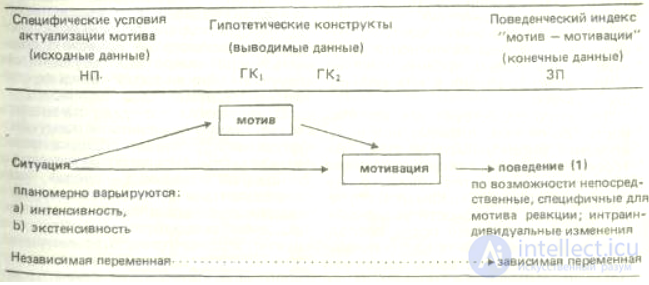
Fig. 1.5. Experimental design of the first type. Initial account of the hypothetical constructs "motive" and "motivation" (without differentiating between them) and resolution of the question of the motivational specificity of direct reactions
As is evident from Fig. 1.5, behavior representing the motive—motivation (behavior 1) is determined both by the situational features of the actualization of a specific motive and by the actual motive itself, and these two dependencies cannot be separated. If we are reasonably convinced that the given situational features correspond to a specific motive, then, as already noted, changing them should produce intra-individual changes in behavior representing the motive—motivation. If this is the case, one may speak of the specificity of representative behavior with respect to the motive. If behavior shows intra-individual differences caused by stimulation, then inter-individual differences should also appear (see the section below on the second-type experimental design). If the specific character of representative behavior for a given motive—motivation is established with any degree of certainty, a clearer account of the motivational specificity of situational features can be obtained, i.e., the corresponding equivalence classes of situations can be delineated, thereby shedding light on questions of the actualization and classification of motives.
There are two possibilities for this. First, the systematic variation of the intensity of a condition considered to actualize a specific motive (experimental scheme Ia). For instance, when studying the food need, the time elapsed since the last meal is increased, and it is checked whether the overall or food-seeking activity of the experimental animals rises accordingly, and in humans — the frequency of food-related images. If, on the other hand, some fear-related motives are being investigated, then (psychologists do this in a fairly varied and inventive way) the temporal or spatial proximity of the event evoking the feeling of fear is varied (for example, the distance from the site of an explosion, the time remaining before an exam, or before a parachute jump) [E. L. Walker, J. W. Atkinson, 1958; R. Fisch, 1970; S. Epstein, 1962; W. Fenz, 1975].
Second, the systematic variation of the content and range of possible situations considered relevant to the actualization of a particular motive (experimental plan Ib). The wider the range of situational features entailing representative behavior, the more justified is the adoption, as a hypothetical construct, of the motivation relevant to that motive, i.e. one that corresponds in content to an equivalent class of "individual—environment" relations. If representative behavior is observed only when the subject is asked to solve a crossword puzzle, but is not observed when solving problems of another type, it is not necessary to postulate the existence of a "crossword-solving motive". It is enough to speak of a specific interest in one thing or lack of interest in another (which, of course, is also a hypothetical construct). To obtain grounds for using the concept of "motive—motivation", it is necessary to identify fundamental (i.e. highly generalized) underlying features that extend to as large a number of concrete situations as possible, however much the latter may differ in their contexts.
In essence, as already noted above, it is important to clarify what a particular content-equivalent class of heterogeneous "individual—environment" relations amounts to, how to identify it and delimit it from other content classes (the first of the eight basic problems). At the same time, it must be borne in mind in advance that the equivalence classes of situations actualizing certain motives may differ in scope for different groups of people. Otherwise we risk falling into the "nomothetic fallacy" pointed out by Bem and Allen [D. Bem, A. Allen, 1974].
Both cases of systematic variation of the conditions for actualizing a specific motive discussed above are designated as the first type of experimental plan. Depending on whether the intensity or the content spectrum (extensiveness) of the situations is varied, two variants are distinguished — Ia and Ib, respectively. The first type of experimental plan, in both of its variants, is suitable for analyzing the first and fourth of the basic problems of the psychology of motivation, i.e. questions of the classification and actualization of motives. Both variants lead to an explanation of behavior in which situational factors figure first and foremost.
The plan described, however, harbors the possibility of a different scheme, one that makes it possible to reveal individual differences in representative behavior. Behavior representing a motive—motivation turns into behavior representing a motive when only inter-individual differences manifest themselves in it. We can measure motives, i.e. separate GC₁ from GC₂ (the second type of experimental plan). Indeed, if systematic variation of the situation reveals the essential conditions for the actualization of a particular motive (plan Ib), then, with the features of the situation kept constant and standard, individual differences in representative behavior can be regarded as indicators of the individual manifestation of the dispositional variable "motive". As can be seen from Fig. 1.5, the observed behavior representing motive—motivation naturally reflects situationally actualized motivation. But since the situation remains constant for all subjects within a given equivalence class, differences in hypostatized motivation must, in essence, reduce to individual differences in the hypostatized motive.
The second design concerns the third of the fundamental problems in the psychology of motivation — the measurement of motives. It, too, has two variants. In variant IIa, differences in the intensity of individual motive expression are established. Studies have shown that this purpose is best served not by situational stimulation that is too strong or too weak, but by stimulation of medium intensity. If the stimulation is too weak, behavior unrelated to the given motive may easily arise, or a conflict with opposing behavioral tendencies may occur. If the stimulation is too strong, situational influences on the aroused motivation will easily override the influence of the motive, and individual differences in it will be leveled out.
In variant IIb, differences in the extensiveness of individual motive expression are established. Extensiveness refers to the breadth of the range of content-specific situations to which, in a given individual, reactions are tied only to the given motive. Inquiring into such extensiveness is much like asking within what limits the content of tasks (aside from solving crossword puzzles) can be varied while a person still responds to them as an achievement situation. However, studies of this kind are not common in the psychology of motivation, so that in this case, as Bem and Allen put it, it is easy to fall into the "nomothetic fallacy." The
продолжение следует...
Часть 1 Motive and Motivation, Situation and Action, Lines of Motivation Research
Часть 2 - Motive and Motivation, Situation and Action, Lines of Motivation

Comments