
Lecture
The innovative potential of an organization is the degree of its readiness to carry out the tasks that ensure the achievement of a set innovation goal, i.e. readiness to implement an innovation project or a program of innovative transformations and the introduction of innovations.
Innovative potential, thus, is determined by the totality of its possibilities for obtaining results in economic activity. Innovative potential can be increased or decreased in the course of an organization's functioning. Therefore, before choosing a strategy for innovative change, a mandatory assessment of innovative potential is needed. If it is insufficient, the innovation process should not be started without first reaching the necessary level of innovative potential, since innovation is defined as the commercialization of new combinations based on the use of new materials, the introduction of new processes, the opening of new markets, the development of new sources of supply of raw materials or semi-finished products, and the introduction of new organizational forms. And therefore the above-mentioned assessment of innovative potential must be carried out with respect to one, or simultaneously several, of these named new combinations.
Economics borrowed the concept of «potential» from physics, where it denotes the amount of energy that a system has accumulated and that it is capable of realizing in practical activity. «Innovative potential» is the means, reserves, and sources that are available and can be used to achieve a particular goal.
The innovative potential of an organization develops as a result of changes in its internal environment. Realization of innovative potential is possible only through the elements of the organization's internal environment that form its system. The main elements of such a system that carry out innovative activity are labor, the means of labor, and the objects of labor. Each element has its own structure of potential (for example, labor potential has its own components).
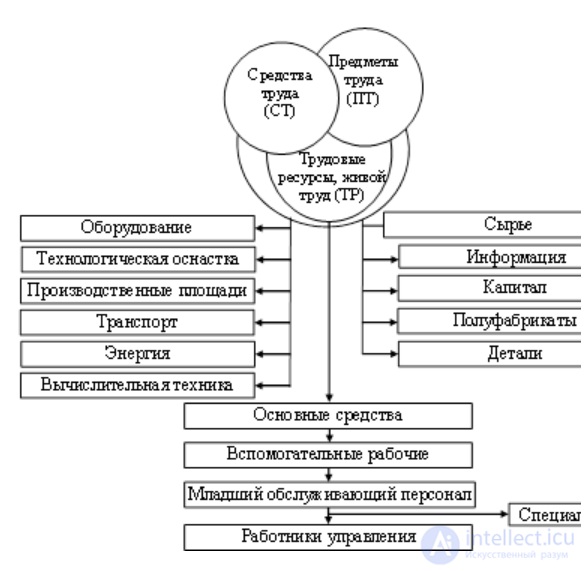
The internal environment of the organization
The internal environment of an organization can also be represented as a production-and-economic system consisting of interrelated elements grouped into the following blocks:
A person's labor potential
| Parameter | Content of the parameter |
| Health | A number of parameters meeting special medical and socio-economic requirements. The World Health Organization defines health as a state of complete physical and social well-being, and well-being as a dynamic state of mind, a psychological harmony between abilities and expectations, demands and opportunities, that the surrounding environment presents and provides |
| Morality | A special form of the relationship between the individual and society, expressed in ideals of good and evil, duty, justice, and society's approval and judgment, etc. In economic relations, contradictions arise between morality and profitability (efficiency), between business ethics and economic goals, between morality and social relations (forms of ownership, methods of economic regulation), and between national morals (love of nature, respect for elders) and economic actions |
| Creative potential | The ratio of the share of persons engaged in mental labor to the share of those engaged in physical labor. Under present-day conditions the share of mental labor is steadily increasing (for example, in the USA about 70% of the working-age population is engaged in precisely this kind of labor) |
| Education | The process and result of acquiring systematized knowledge, skills, and abilities are among the most important factors in raising the efficiency of labor and national wealth, and a core component of human capital |
| Professionalism | An employee's level of qualification is a component of the quality of the workforce. Scientific and technological progress dictates the need for a rising level of employee qualification |

Comments