
Lecture
Management pyramid — a diagram illustrating the hierarchy of subordination relationships within organizations.
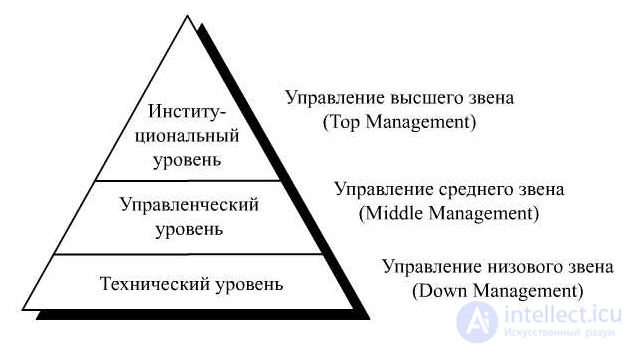
Organizations large enough to draw a clear line between managers and non-managers usually have a substantial amount of managerial work that itself must be divided. One form of dividing managerial labor is horizontal: specific managers are placed at the head of separate departments (for example, the heads of the finance department, the production department, and the marketing department). Just as with the horizontal division of labor for carrying out production work, vertically divided managerial work must be coordinated so that the organization can succeed in its activities. Some managers must spend time coordinating the work of other managers, who in turn also coordinate the work of managers, until, finally, we come down to the level of a manager who coordinates the work of non-managerial personnel — the people who physically produce the goods or provide the services. This vertical unfolding of the division of labor ultimately produces levels of management.
Regardless of how many levels of management exist, managers are traditionally divided into three categories. The sociologist Talcott Parsons examines these three categories in terms of the function performed by the manager within the organization. According to Parsons's definition, at the technical level the main concern is with the day-to-day operations and actions necessary to ensure efficient work without disruptions in the production of goods or the provision of services. Those at the managerial level are mainly engaged in managing and coordinating within the organization, reconciling the diverse forms of activity and effort of the organization's various departments. Managers at the institutional level are mainly concerned with developing long-term (strategic) plans, formulating goals, adapting the organization to various kinds of change, and managing relations between the organization and its external environment, as well as the society in which the organization exists and operates. A more commonly used way of describing levels of management consists in distinguishing the following categories of managers (executives):
Figure 2.1 illustrates the correspondence between these levels and Parsons's concept of levels of management.
Junior managers, also called first-line (lower-level) managers or operating managers — are the organizational level located directly above workers and other non-managerial employees. Junior managers (or supervisors) are mainly responsible for monitoring the execution of production tasks, in order to continuously provide first-hand information on whether these tasks are being carried out correctly. Managers at this level are often responsible for the direct use of the resources allocated to them, such as raw materials and equipment. Typical job titles at this level include foreman, shift supervisor, sergeant, department head, head nurse, and chair of a management department at a business school. The majority of managers overall are first-line managers. Most people begin their managerial career at this level.
Studies show that the work of a first-line manager is intense and filled with a wide variety of activities. It is characterized by frequent interruptions and transitions from one task to another. The tasks themselves are potentially brief: one study found that the average time a foreman spent completing a single task was 48 seconds. The time period for implementing decisions made by a foreman is likewise short. They are almost always carried out in less than two weeks. It has been found that foremen spend about half of their working time in communication. They communicate a great deal with their subordinates, somewhat less with other foremen, and very little with their own superiors.
The work of junior managers is coordinated and controlled by middle managers. Over recent decades, middle management has grown considerably, both in numbers and in importance. In a large organization there may be so many middle managers that it becomes necessary to divide this group further. When such a division occurs, two levels are formed, the first of which is called the upper level of middle management, and the second—the lower level. In this way, four basic levels of management are formed: top, upper-middle, lower-middle, and first-line. Typical positions for middle managers include: department head (in business), dean (in a college), regional or national sales manager, and branch director. Army officers from lieutenant to colonel, and clergy holding the rank of bishop, are considered middle managers within their organizations. A middle manager often heads a large division or department within an organization. The nature of their work is determined more by the content of the division's work than by that of the organization as a whole. For example, the activity of a production manager at an industrial firm mainly involves coordinating and managing the work of first-line managers, analyzing productivity data, and interacting with engineers on new product development. The head of the external relations department at the same firm spends most of their time preparing documents, reading, holding conversations and discussions, and attending various committee meetings. For the most part, however, middle managers serve as a buffer between top-level and first-line managers. They prepare information for decisions made by top managers and pass those decisions on, usually after transforming them into a technologically convenient form, such as specifications and specific assignments, to first-line managers. Although variations exist, most of a middle manager's communication takes the form of conversations with other middle- and first-line managers. One study on the work of middle managers at a manufacturing enterprise found that they spend about 89% of their time in verbal interaction.
Middle managers as a social group were especially strongly affected by various economic and technological changes in production during the 1980s. Personal computers eliminated some of their functions and altered others, giving top managers the ability to obtain information directly at their own desks straight from the source, instead of having it filtered at the level of middle managers. The wave of corporate mergers and the general pressure to improve efficiency also caused radical reductions in the number of middle managers in many organizations.
Top-level managers are responsible for making the most strategically important decisions for the organization as a whole or for its principal part. If a firm's top management decides to switch the corporation over to producing goods that are unable to compete, middle and lower-level managers can do little to prevent a major failure. Strong top-level managers leave their personal imprint on the entire character of the company. That is why successful top-level managers in large organizations are valued very highly, and their labor is very well compensated.
However, the work of a top-level manager is associated with an intense pace and an enormous volume of work, which is largely explained by the fact that a top-level manager's job has no clear-cut completion point. Unlike a sales agent, who has to make a certain number of phone calls, or a production worker, who has to meet an output quota, an enterprise as a whole has no such moment, apart from a complete shutdown of the enterprise, at which the work can be considered fully finished. That is why a top-level manager can never be certain that they have successfully completed their work. Since the organization continues to operate and the external environment continues to change, there is always a risk of failure.
That was how things used to be. But as business became automated, things became more interesting. A top-level manager can now more often limit themselves to overseeing the controlling and strategic level, since management itself is a middle-level matter. And why waste time on that when this time could instead be spent diversifying and either building a new stage of growth or building one's own second company?..
The highest organizational level — top-level management — is far smaller than the others. Even in the largest organizations, there are only a few top-level managers. Typical positions of top-level managers in business are chairman of the board, president, corporate vice-president, and corporate treasurer. In the army they can be likened to generals, among government officials to ministers, and at a university to rectors.
Thus, an essential feature of the modern structure of large firms' management apparatus consists in separating the strategic and coordinating tasks of management from operational activity: the top level of management is oriented primarily toward developing strategic directions and development goals, coordinating activity on a global scale, and making the most important production and business decisions; the middle level is meant to ensure the effectiveness of the firm's functioning and development by coordinating the activity of all divisions; the lower level is focused on the operational resolution of organizational tasks within individual structural units, whose main task is to fulfill established targets for output and profit. The operational level of management develops and implements the means and methods for achieving the set goals independently, but only within the relationships and interdependencies established within the firm and regulated by top management.
Note. The comparison of managers at various levels of management with military personnel, members of the clergy, government officials, university staff, and so on is a matter of convention, since the army, the state, the education system, and so forth are not commercial structures.

Comments