
Lecture
Hydraulics is divided into two branches: hydrostatics and hydrodynamics.
Hydrostatics — is a branch of continuum physics that studies the equilibrium of fluids (in particular, in a gravitational field).
Hydrostatics is the theory of the behavior of fluids at rest.
When studying hydrostatics, it is possible to draw certain analogies with the theory of elasticity, which studies the equilibrium of solid bodies; however, unlike a solid body, a fluid offers no resistance to shear stresses. This is precisely why anisotropy of stresses cannot exist in a fluid. Consequently, instead of a multicomponent tensor (as for a solid body), the stress in a fluid is described by a single quantity — pressure. From this follows Pascal's law: pressure exerted on a fluid is transmitted by the fluid equally in all directions.
Hydrodynamics is a much broader branch and will be covered in
subsequent lectures. This lecture will cover hydrostatics.
Hydrostatics is the branch of hydraulics that
studies the laws of fluid equilibrium and their practical
application.
Pascal's law: pressure in a fluid is transmitted equally in all directions.
Archimedes' law: any body submerged in a fluid experiences a buoyant force.
Pressure increases with depth: p=ρgh
Some principles of hydrostatics were known, in an empirical and intuitive sense, since antiquity to the builders of boats, cisterns, aqueducts, and fountains. Archimedes is credited with discovering Archimedes' principle, which relates the buoyant force acting on an object submerged in a fluid to the weight of the fluid displaced by the object. The Roman engineer Vitruvius warned readers that lead pipes could burst under hydrostatic pressure.
The concept of pressure and the way it is transmitted by fluids was formulated by the French mathematician and philosopher Blaise Pascal in 1647.
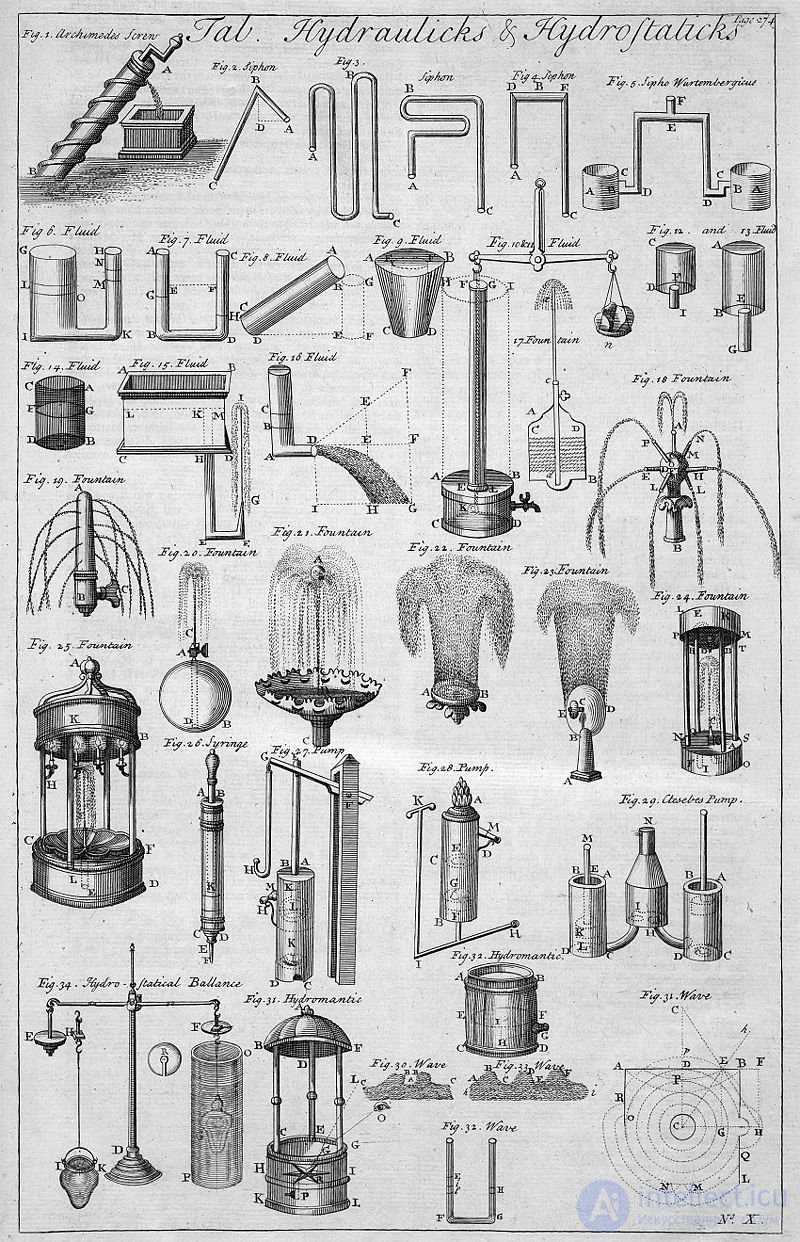
A table of hydraulics and hydrostatics from the «Encyclopédie» of 1728
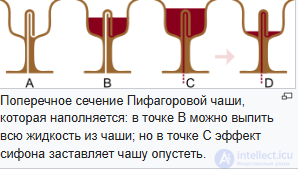
The «fair cup» or Pythagorean cup, which dates back to approximately the 6th century BC, is a hydraulic device whose invention is attributed to the Greek mathematician and geometer Pythagoras. It was used as a teaching aid.
The cup consists of a line carved inside the cup and a small vertical tube in the center of the cup that leads to the bottom. The height of this tube is the same as the line carved inside the cup. The cup can be filled up to the line without any liquid entering the tube at the center of the cup. However, once the amount of liquid exceeds this fill line, the liquid spills into the tube at the center of the cup. Due to the resistance the molecules exert on one another, the cup empties completely.
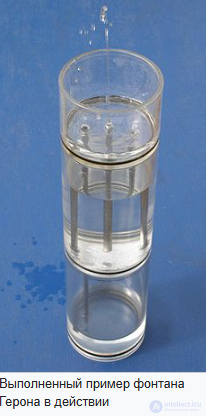
Heron's fountain — is a device invented by Heron of Alexandria that produces a jet of liquid fed by a reservoir of liquid. The fountain is constructed so that the height of the jet exceeds the height of the liquid in the reservoir, apparently in violation of the principles of hydrostatic pressure. The device consisted of an outlet and two containers positioned one above the other. The intermediate vessel, which was sealed, was filled with liquid, along with several cannulas (small tubes for transferring liquid between vessels) connecting the various vessels. Air trapped inside the vessels forces a jet of water out of the nozzle, emptying all the water from the intermediate reservoir.
Pascal contributed to the development of both hydrostatics and hydrodynamics. Pascal's law is a fundamental principle of fluid mechanics, which states that any pressure applied to the surface of a fluid is transmitted uniformly throughout the fluid in all directions such that the initial pressure differentials remain unchanged.
In a fluid at rest, there is always a pressure force present, which
is called hydrostatic pressure. The fluid exerts a force
on the bottom and walls of the vessel. Fluid particles located in
the upper layers of a body of water experience smaller compressive forces than particles
of fluid located near the bottom.
Consider a reservoir with flat vertical walls,
filled with liquid (Fig. 2.1, a). A force P acts on the bottom of the reservoir,
equal to the weight of the poured liquid G = γV, i.e., P = G.
If we divide this force P by the bottom area Sabcd, we obtain
the average hydrostatic pressure acting on the bottom of the reservoir
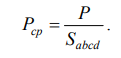 (2.1)
(2.1)
Hydrostatic pressure has certain properties.
Property 1. At any point in a fluid, hydrostatic pressure
is perpendicular to the plane tangent to the selected volume and
acts inward into the fluid volume under consideration.
To prove this statement, let us return to Fig. 2.1, a.
Let us select an area Sside on the side wall of the reservoir (shown hatched).
Hydrostatic pressure acts on this area as a
distributed force, which can be replaced by a single resultant,
which we denote as P. Suppose that the resultant of the
hydrostatic pressure P, acting on this area, is applied
at point A and directed toward it at an angle α (in
Fig. 2.1 it is shown as a dashed segment with an arrow). Then the reaction force R of the wall on the
fluid will have the same magnitude but the opposite
direction (solid segment with an arrow). This vector R can
be resolved into two component vectors: the normal Rn
(perpendicular to the hatched area) and the tangential Rτ along the
wall.
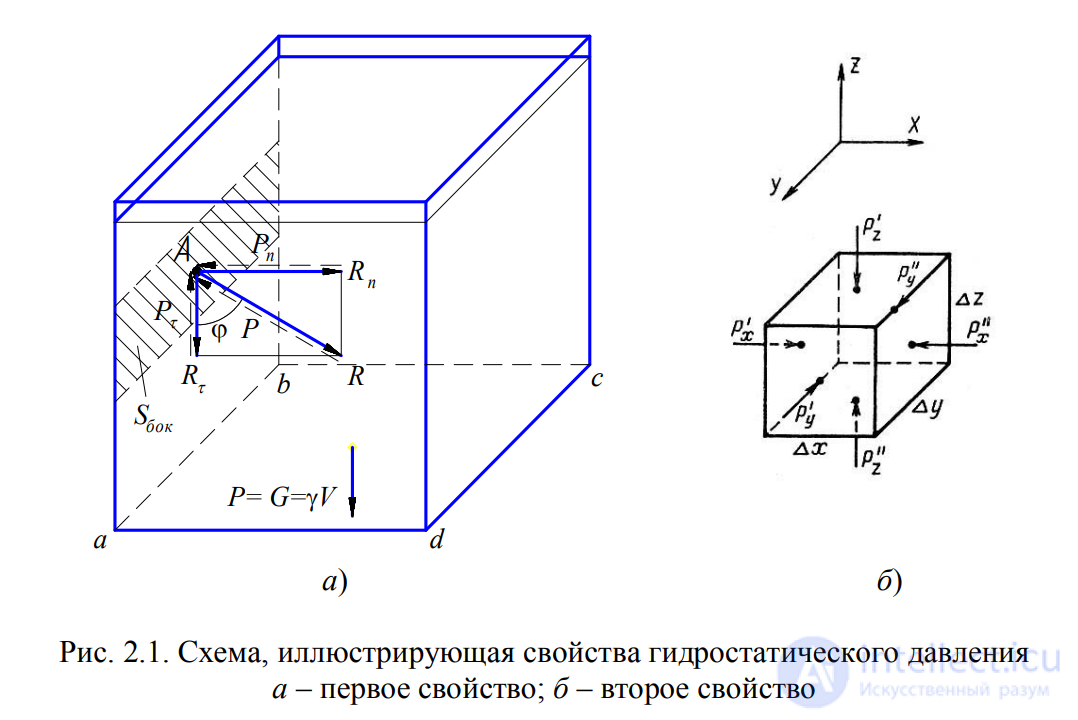
Fig. 2.1. Diagram illustrating the properties of hydrostatic pressure
a – first property; b – second property
The normal pressure force Rn induces compressive stresses
in the fluid. The fluid easily withstands these stresses. The force Rτ,
acting on the fluid along the wall, would have to induce
shear stresses in the fluid along the wall, causing the particles to
move downward. However, since the fluid in the reservoir is in a
state of rest, the component Rτ is absent. From this we can draw
the conclusion of the first property of hydrostatic pressure.
Property 2. Hydrostatic pressure is the same in all
directions.
In a fluid filling some reservoir, let us select an
elementary1
cube with very small sides Δx, Δy, Δz (Fig. 2.1, b). On
each of the side faces, a hydrostatic pressure force will act,
equal to the product of the corresponding pressure Px, Py, Pz and the
elementary areas. Let us denote the pressure vectors acting in the
positive direction (according to the specified coordinates) as Px, Py, Pz, and the pressure vectors acting in the opposite direction1
The term «elementary» means a very small value, which tends to approach zero.
In this case, this is the linear dimension of the sides of the cube.
correspondingly as 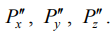 Since the cube is in equilibrium,
we can write the equalities
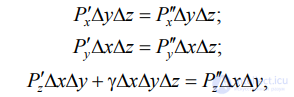
where γ - is the specific weight of the fluid;
 – is the volume of the cube.
Reducing the resulting equalities, we find that

The term of the third equation Δz, being infinitesimally small compared to
Pz
and Pz
, can be neglected, and then finally

Because the cube does not deform (does not stretch
along any one of the axes), it must be assumed that the pressures along the various axes
are equal, i.e.,
 . (2.2)
This proves the second property of hydrostatic pressure.
Property 3. Hydrostatic pressure at a point depends on its
coordinates in space.
This statement requires no special proof, since
it is clear that as the depth of a point increases, the pressure at it will
increase, and as the depth decreases, it will decrease. The third
property of hydrostatic pressure can be written as
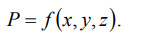
Let us consider the common case of fluid equilibrium, when
only one body force acts on it – the force of gravity, and derive
an equation that allows us to find the hydrostatic pressure at any
point of the fluid volume under consideration. This equation is called
the basic equation of hydrostatics.
Let a fluid be contained in a vessel (Fig. 2.2), and let a pressure P0 act on its free
surface. Let us find the hydrostatic pressure P
at an arbitrarily chosen point M, located at depth h. Around
point M, let us select an elementary horizontal area dS and construct on
it a vertical cylindrical volume of fluid of height h.
Let us consider the equilibrium condition of this volume of fluid,
isolated from the total mass of fluid. The pressure of the fluid on the lower
base of the cylinder is now external and directed along the normal
into the volume, i.e., upward.
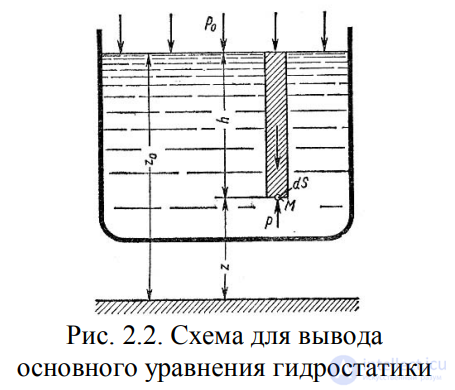
Fig. 2.2. Diagram for deriving the basic equation of hydrostatics
Let us write the sum of the forces
acting on the volume under consideration, projected onto
the vertical axis:
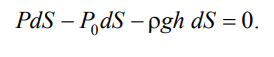
The last term of the equation
represents the weight of the fluid
contained in the vertical cylinder under consideration
with volume
h dS. The pressure forces on the side
surface of the cylinder do not enter into the equation, since they are perpendicular to
this surface and their projections onto the vertical axis equal zero.
Reducing the expression by dS and regrouping the terms, we find
 . (2.3)
The resulting equation is called the basic equation of
hydrostatics. It can be used to calculate the pressure at any point
in a fluid at rest. As can be seen from the equation, this pressure
consists of two quantities: the pressure P0 on the external surface of the
fluid, and the pressure due to the weight of the overlying layers
of fluid.
From the basic equation of hydrostatics it can be seen that whatever point in
the volume of the entire vessel we choose, the pressure applied to the external
surface P0 will always act on it. In other words,
the pressure applied to the external surface of the fluid is transmitted to all
points of this fluid, in all directions, equally. This statement is
known as Pascal's law.
A surface at every point of which the pressure is equal
is called a level surface (discussed in detail in Section 2.6). Under
normal conditions,
level surfaces are
horizontal planes.
Let us have a reservoir with an inclined right-hand wall,
filled with a fluid of specific weight γ. The width of the wall in
the direction perpendicular to the plane of the drawing (away from the reader) equals b
(Fig. 2.3). The wall is conventionally shown unfolded relative to the axis AB and
is hatched in the figure. Let us construct a graph of the change in excess
hydrostatic pressure on the wall AB.
Since the excess hydrostatic pressure varies according to the
linear law P=γgh, then to construct the graph, called the pressure
diagram, it is sufficient to find the pressure at two points, for example A and B.
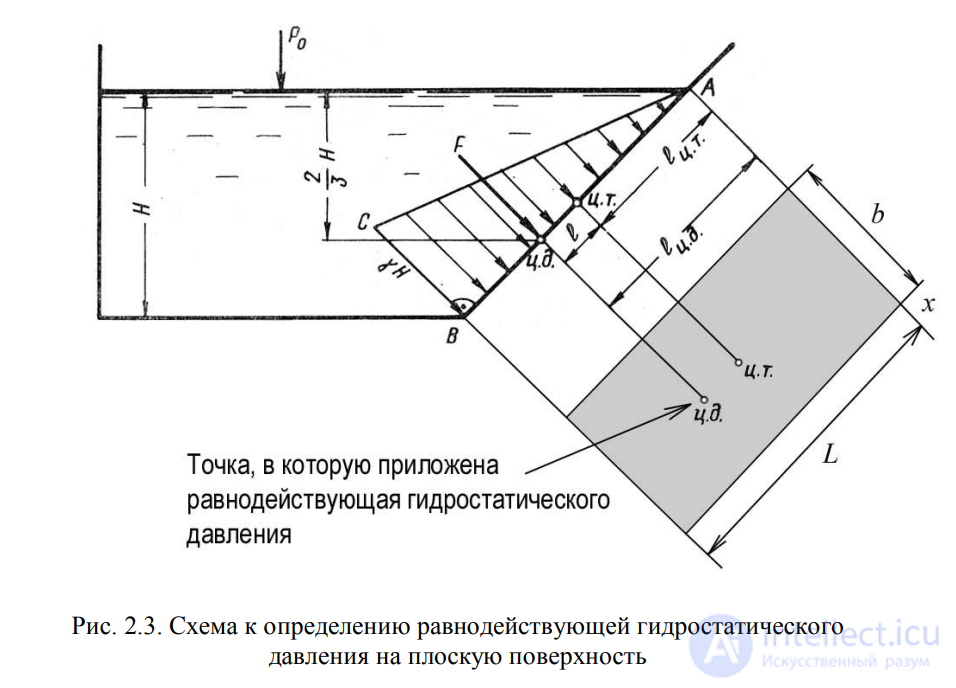
Fig. 2.3. Diagram for determining the resultant of hydrostatic
pressure on a flat surface
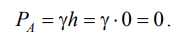
The excess hydrostatic pressure at point A will be equal to
.
Correspondingly, the pressure at point B:

where H – is the depth of the fluid in the reservoir.
According to the first property of hydrostatic pressure, it is always
directed along the normal to the enclosing surface. Consequently,
the hydrostatic pressure at point B, whose magnitude equals γH, must
be directed perpendicular to the wall AB. Connecting point A with the end of
segment γH, we obtain the triangular pressure distribution diagram ABC with
a right angle at point B. The average pressure value will equal
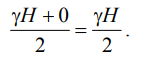 . (2.4)
If the area of the inclined wall is S=bL, then the resultant of the
hydrostatic pressure equals
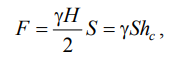 , (2.5)
where hc = H/2 – is the depth of submersion of the center of gravity of the flat surface
below the fluid level.
However, the point of application of the resultant hydrostatic
pressure, the center of pressure, does not always coincide with the center of gravity of the flat
surface. This point is located at a distance Δl from the center of gravity and
equals the ratio of the moment of inertia of the area about the central
axis to the static moment of the same area.
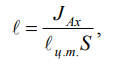 , (2.6)
where J Ax – is the moment of inertia of the area S about the central axis
parallel to Ax.
In the particular case where the wall has the shape of a rectangle
with dimensions bL, and one of its sides lies on the free surface at
atmospheric pressure, the center of pressure is located at a distance b/3
from the lower side.
Let a fluid fill a reservoir whose right-hand wall
is a cylindrical curved surface ABC
(Fig. 2.4), extending toward the reader over a width b.
Let us erect a perpendicular AO from point A to the free surface
of the fluid. The volume of fluid in the section AOCB is in equilibrium. This
means that the forces acting on the surface of the selected volume V, and
the weight forces, are mutually balanced.
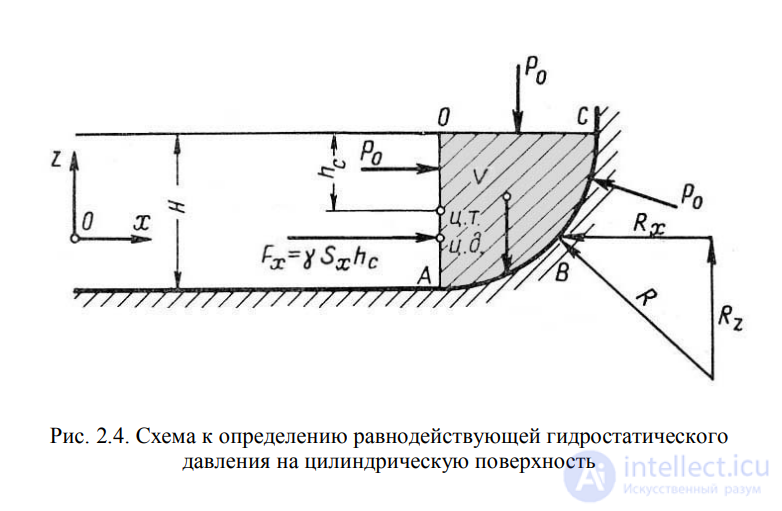
Fig. 2.4. Diagram for determining the resultant of hydrostatic
pressure on a cylindrical surface
Let us imagine that the selected volume V is a solid
body of the same specific weight as the fluid (this volume in Fig. 2.4
is hatched). The left surface of this volume (in the drawing, the vertical
wall AO) has an area Sx = bH, which is the projection of the
curved surface ABC onto the plane yOz.
From equation (2.5), the hydrostatic pressure force on area Sx
equals Fx = γSx hc.
On the right side, the section experiences the reaction R of the
cylindrical surface. Let the point of application and direction
of this reaction be as shown in Fig. 2.4. Let us resolve the reaction R
into two components Rx and Rz
.
Of the acting surface forces, only the
pressure on the free surface P0 remains to be accounted for. If the reservoir is open,
then naturally the pressure P0 is the same on all sides and therefore
mutually balances out.
The section ABCO is acted upon by its own weight force G = γV,
directed downward.
Let us project all forces onto the axis Ox:
 . (2.7)
Now let us project all forces onto the axis Oz:
 . (2.8)
The component of the hydrostatic pressure force along the axis Oy
becomes zero, meaning Ry = Fy = 0.
Thus, the reaction of the cylindrical surface, in the general
case, equals

,
and since the reaction of the cylindrical surface equals
the resultant of the hydrostatic pressure R=F, we conclude that
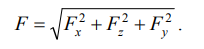 . (2.9)
A body submerged (wholly or partially) in a fluid
experiences from the fluid a total pressure directed
from below upward, equal to the weight of the fluid in the volume of the submerged part of the body.
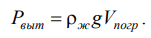 . (2.10)
For a homogeneous body floating on the surface, the relation
holds
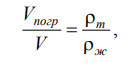
where: V – is the volume of the floating body;
ρt – is the density of the body.
The existing theory of floating bodies is quite extensive, so
we shall limit ourselves to considering only the hydraulic essence of this
theory.
The ability of a floating body, displaced from its equilibrium
state, to return again to that state is called
stability. The weight of the fluid taken up in the volume of the submerged part of the vessel
is called the displacement, and the point of application of the resultant
pressure (i.e., the center of pressure) – the center of buoyancy. In the
normal position of the vessel, the center of gravity C and the center of buoyancy d
lie on the same vertical line O–O, which represents the axis
of symmetry of the vessel and is called the floating axis (Fig. 2.5).
Suppose that under the influence of external forces the vessel tilts through a certain
angle θ, so that part of the vessel KLM emerges from the fluid, while the part KLM′, on the contrary,
becomes submerged in it. This results in a new position of the center of
buoyancy d′. Let us apply a lifting force R at point d′ and extend its line of
action until it intersects the axis of symmetry O–O.
The resulting point m is called the metacenter, and the segment mC = h
is called the metacentric height. We consider h to be positive
if point m lies above point C, and negative otherwise.
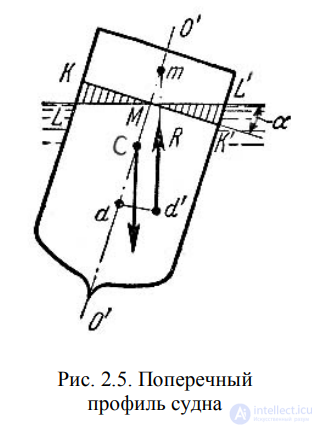
Fig. 2.5. Cross-sectional profile of a vessel
Now let us consider the conditions for
equilibrium of the vessel:
1) if h > 0, then the vessel
returns to its original
position;
2) if h = 0, then this is the case of
neutral equilibrium;
3) if h < 0, then this is the case of
unstable equilibrium, in
which the capsizing of the vessel
continues further.
Consequently, the lower
the center of gravity is positioned, and the
greater the metacentric height,
the greater the stability
of the vessel will be.
As already noted above, a surface at every point of which
the pressure is equal is called a level surface or a surface
of equal pressure. Under non-uniform or curvilinear motion, in addition to
the force of gravity, inertial forces also act on fluid particles,
and if they are constant over time, the fluid assumes a new
equilibrium position. Such an equilibrium of the fluid is called
relative rest.
Let us consider two examples of such relative rest.
In the first example, let us determine the level surfaces in the fluid
contained in a tank, while the tank moves along a
horizontal path with constant acceleration a (Fig. 2.6).
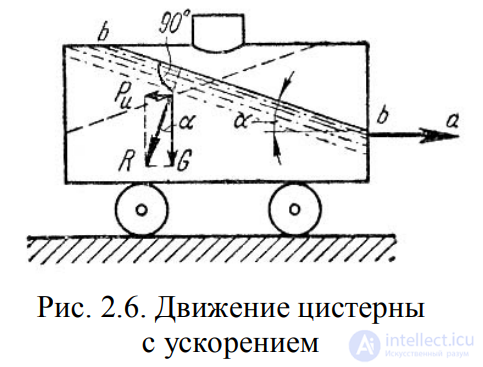
Fig. 2.6. Motion of a tank with acceleration
On each particle of fluid
of mass m, in this case, there must be
applied its weight G = mg and the inertial
force Pi, equal in magnitude to ma.
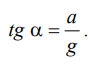
The resultant of these forces

is directed to the vertical at an angle α,
the tangent of which equals
Since the free surface, being a surface of equal pressure,
must be normal to the stated resultant, it, in this
case, will represent no longer a horizontal plane but an inclined one,
forming an angle α with the horizon. Given that the magnitude of this angle
depends only on the accelerations, we conclude that the position of the
free surface will not depend on the type of fluid contained in the tank. Any other
level surface in the fluid will also be
a plane inclined to the horizon at angle α. If the motion of the
tank were not uniformly accelerated but uniformly decelerated, the direction of the
acceleration would reverse, and the inclination of the free surface
would tilt to the opposite side (see Fig. 2.6, dashed line).
As a second example, let us consider a case of relative rest of a fluid, frequently encountered in
practice, in rotating vessels
(for example, in separators and centrifuges used for separating
liquids). In this case (Fig. 2.7), on any particle of fluid, during its
relative equilibrium, body forces act: the force of gravity
G = mg and the centrifugal force Pi = mω²r, wh
ere r – is the distance of the particle from the axis
of rotation, and ω - is the angular velocity of rotation of the vessel. The surface of the fluid
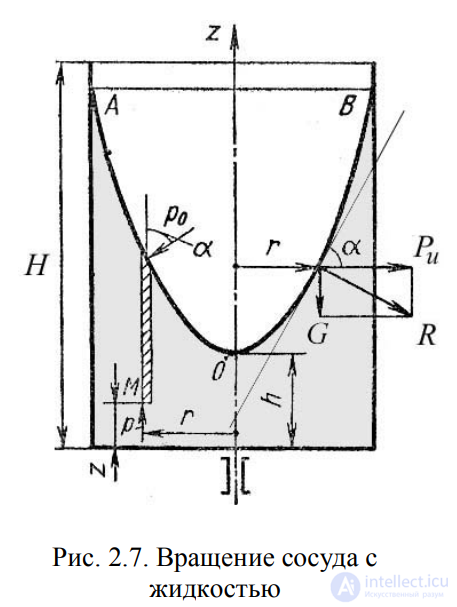
Fig. 2.7. Rotation of a vessel with fluid
must also be normal at
every point to the resultant
of these forces R and represents
a paraboloid of revolution.
From the diagram we find
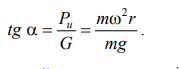
On the other hand:
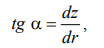
where z – is the coordinate of the point
under consideration. Thus, we obtain:

,
from which
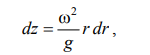
or, after integration,
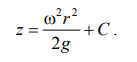
.
At the point where the curve AOB intersects the axis of rotation, r = 0, z = h = C,
therefore, finally, we have
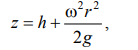 , (2.11)
i.e., the curve AOB is a parabola, and the free surface of the fluid
is a paraboloid. Other level surfaces have the same shape.
To determine the law governing the change of pressure in a rotating
fluid as a function of radius and height, let us select a vertical
cylindrical volume of fluid with base in the form of an elementary
horizontal area dS (point M) at an arbitrary radius r and
height z, and write the condition of its equilibrium in the vertical direction.
Taking equation (2.11) into account, we have
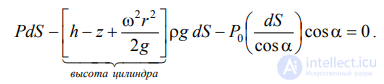
.
After simplification we obtain
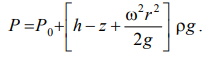 . (2.12)
This means that the pressure increases in proportion to the radius r and
decreases in proportion to the height z
Design of reservoirs and dams.
Hydraulic lifts.
Calculation of pressure on underwater structures.
Navigation (vessels and submarines sailing).

Comments